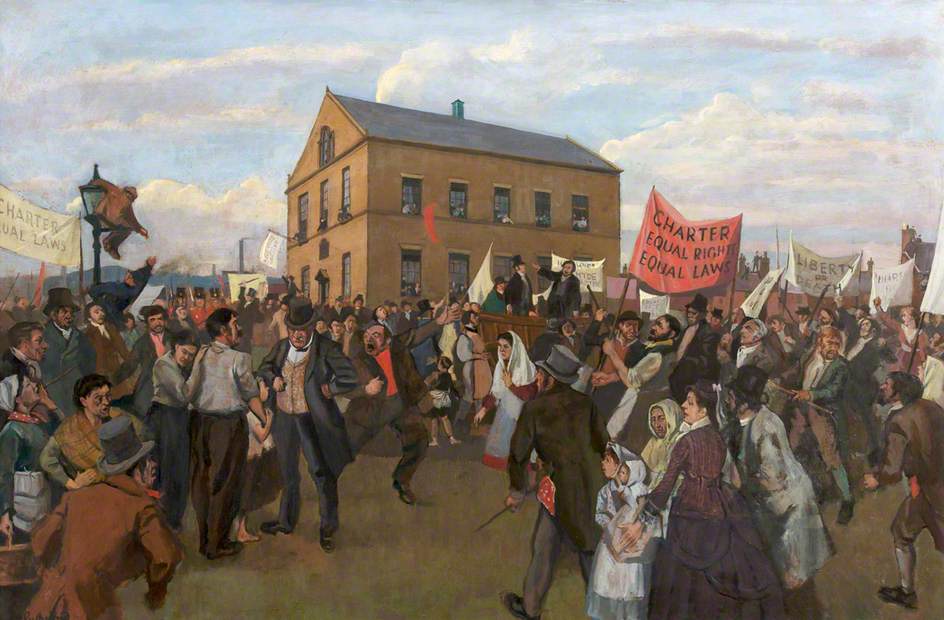
Written by the leading Chartist Ernest Jones while in prison after his 1848 conviction for ‘sedition,’ this was a one of a number of Jones’ poems that remained popular in the English-speaking workers’ movement for generations after his 1868 death.
‘Song of the Wage Slave’ (1849) by Ernest Jones from Socialism in Verse. Appeal Socialist Classics No. 12. Girard, Kansas. 1916.
The land it is the landlord’s,
The trader’s is the sea,
The ore the usurer’s coffer fills—
But what remains for me?
The engine whirls for master’s craft;
The steel shines to defend,
With labor’s arms, what labor raised,
For labor’s foe to spend.
The camp, the pulpit, and the law
For rich men’s sons are free;
Theirs, theirs the learning, art, and arms—
But what remains for me?
The coming hope, the future day,
When wrong to right shall bow,
And hearts that have the courage, man,
To make that future now.
I pay for all their learning,
I toil for all their ease;
They render back, in coin for coin,
Want, ignorance, disease:
Toil, toil and then a cheerless home,
Where hungry passions cross;
Eternal gain to them that give
To me eternal loss!
The hour of leisured happiness
The rich alone may see;
The playful child, the smiling wife—
But what remains for me?
They render back, those rich men,
A pauper’s niggard fee,
Mayhap a prison-then a grave,
And think they’re quits with me;
But not a fond wife’s heart that breaks,
A poor man’s child that dies,
We score not on our hollow cheeks
And in our sunken eyes;
We read it there, where’er we meet,
And as the sum we see,
Each asks, “The rich have got the earth,
And what remains for me?”
We bear the wrong in silence,
We store it in our brain;
They think us dull, they think us dead,
But we shall rise again:
A trumpet through the lands will ring;
A heaving through the mass;
A trampling through their palaces
Until they break like glass;
We’ll cease to weep by cherished graves,
From lonely homes we’ll flee;
And still, as rolls our million march,
Its watchword brave shall be—
The coming hope, the future day,
When wrong to right shall bow,
And hearts that have the courage, man,
To make that future NOW.
The Appeal to Reason was among the most important and widely read left papers in the United States. With a weekly run of over 550,000 copies by 1910, it remains the largest socialist paper in US history. Founded by utopian socialist and Ruskin Colony leader Julius Wayland it was published privately in Girard, Kansas from 1895 until 1922. The paper came from the Midwestern populist tradition to become the leading national voice in support of the Socialist Party of America in 1901. A ‘popular’ paper, the Appeal was Eugene Debs main literary outlet and saw writings by Upton Sinclair, Jack London, Mary “Mother” Jones, Helen Keller and many others.
PDF of pamphlet: https://books.google.com/books/download/Appeal_Socialist_Classics.pdf?id=Sl1ZAAAAYAAJ&output=pdf
 Revolution's Newsstand