‘The Cocoanut in the Philippines’ by Marion Wright from International Socialist Review. Vol. 15 No. 10. April, 1915.
THE poor of the human race—and they are many, indeed—would indeed be left to the yellow fangs of famine if the palm tree should become extinct. There are hundreds of varieties of palms, and all of them are useful in a way that may be utilized by the poor. We may class dates and pineapples as luxuries coming from the palm tree, but the cocoanut is a dire necessity —it is the staff of life to millions. Medical men will tell you that if the druggist were to banish from his shelves all the medicines derived from coal tar and opium the corner drug store would be practically empty except for the “side issues” carried to be sold. Similarly, if the cocoanut and its products were banished from the Philippines, the home of the native would be stripped clean. He would have no root over his head; no mat under his feet; no cup for his drink—in fact, no drink—and his bill of fare would be restricted to rice and fish. The cocoanut is the most valuable tree in the world, supporting as it does many millions of human beings in all tropical countries besides the uses to which its products are put by the people of civilized countries. Every child has seen pictures of the royal cocoanut palm and has wondered at the big brown nuts piled up at the
corner grocery, but how many, even among the grownups, know anything worth while about the nut—where and how it grows, and the manifold uses to which the tree and its products may be adapted for the well being of mankind? One of the greatest cocoanut countries in the world belongs to the United States, the Philippines.
Already the American capitalist is grabbing up the rich lands adapted to the growth of the nut and pushing the native with his few trees into the background. Before many years—just as the rich sugar lands were taken from the Hawaiians—no Filipino of the working class will own a tree, but he will tend the trees of the capitalist and receive enough fruit for his labor to enable him to exist.
Cocoanut trees begin to bear from seven to ten years after planting and continue to bear indefinitely. Groves known to be more than one hundred and fifty years old are still producing. Thus the expense to the exploiter of these lands is in maintaining the grove for seven years and then the profits begin to roll in and the profits never cease during his lifetime or that of his grandchildren.
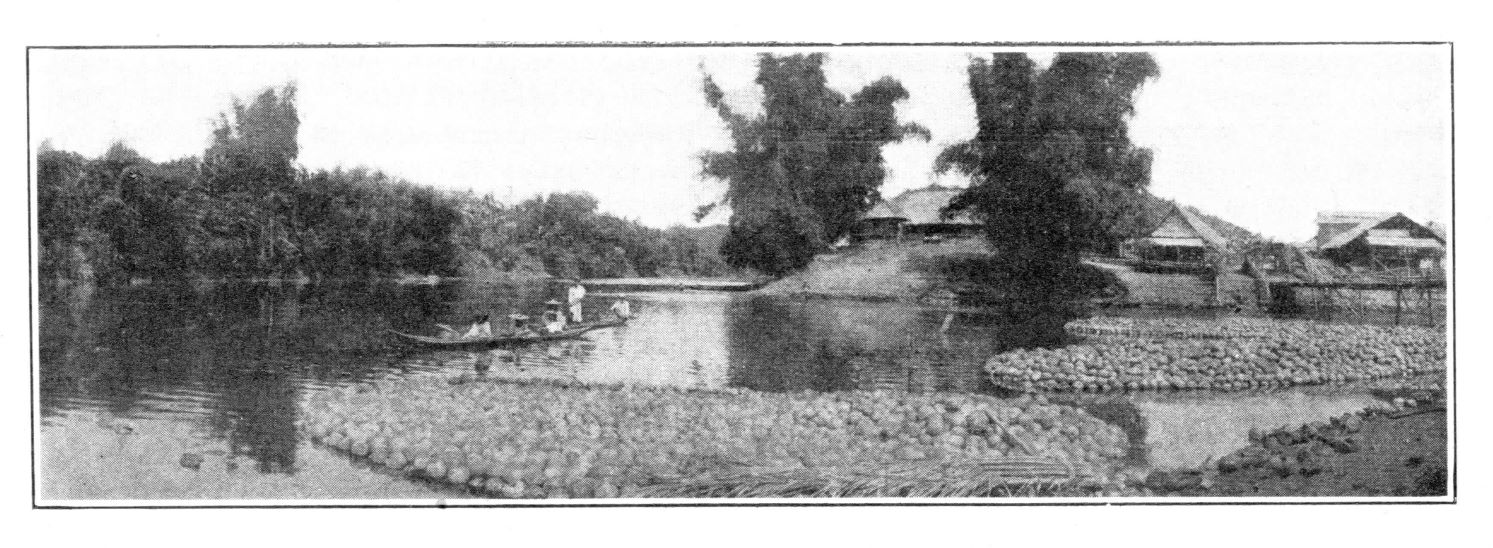
There is no harvest season in the tropics. The trees bear all the time and the nuts are gathered every three or four months. Nimble naked men scamper up he long trunks with knives in their teeth and cut the nuts from the tree. The nuts are sent to market by sled, cart or packhorse, and sometimes are made into big rafts along a river and floated down to the sea.
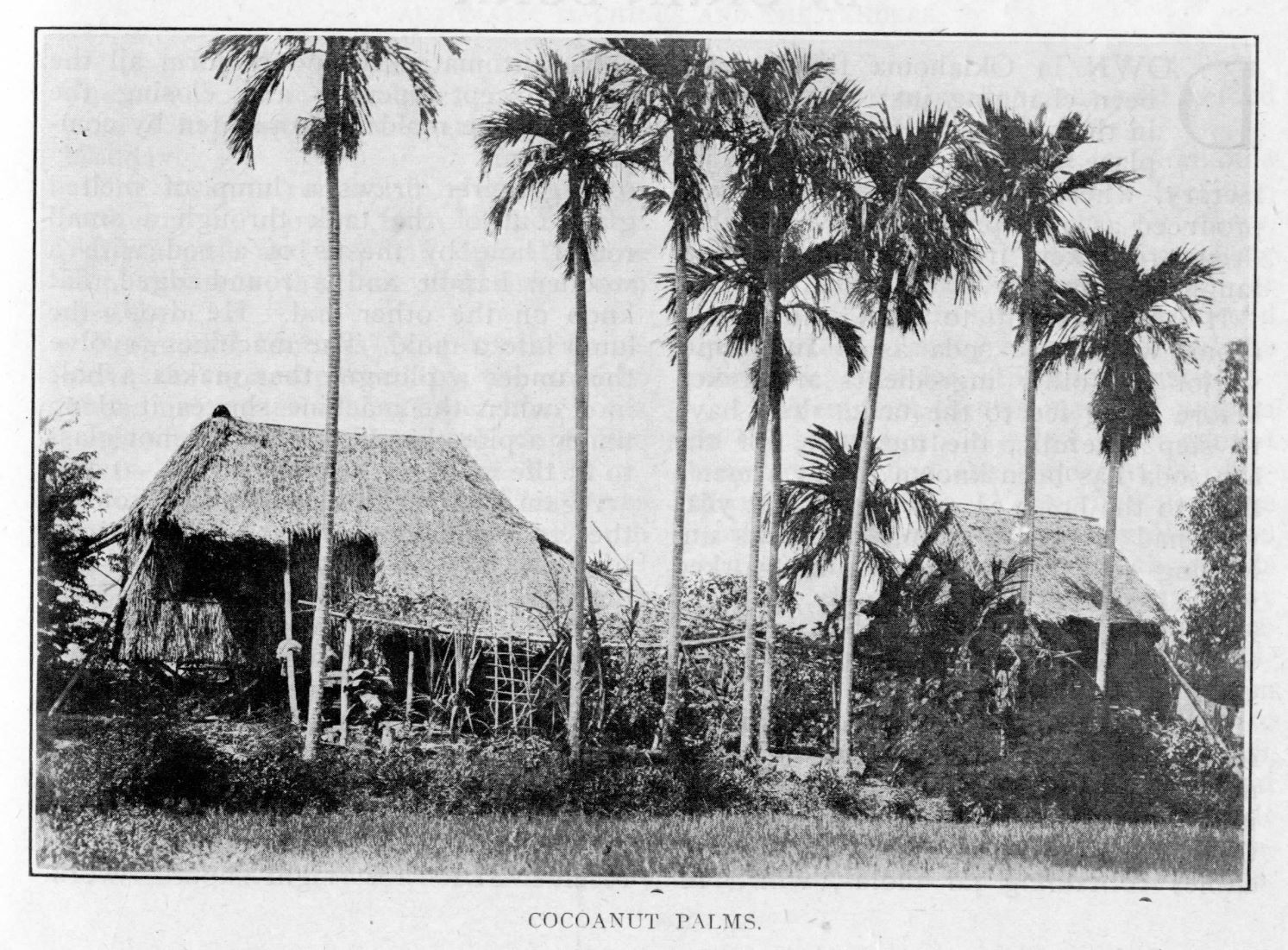
To begin at the top of the tree, the native uses the leaves to roof his hut and obtains fibre from the stems to make hats, baskets, brooms and mats. When the tree begins to flower he taps the blossoms and obtains a sap called tuba from which he distils cocoa wine and another intoxicating drink. This gathering of the sap destroys the nut, but as there have been plenty of trees the native finds enough for both his drink and his food.
From the matured nut the Filipino drinks the rich milk and eats the soft white meat, both excellent articles of food. And let it be recorded here that a cocoanut just off the tree is vastly different in quality from the dried specimen you pay a dime for at home. The milk of the fresh nut is thicker and sweeter and the meat is much thicker and softer and more palatable than that obtained from the nut after it has been shipped across the sea and stored for months in warehouses. From the coir, a tough fibrous jacket two or three inches thick which covers the nut, matting and cordage is made. And the shell is made into cups, ladles, bowls, spoons and useful articles of every description.
The white man gets far more out of the cocoanut than does the native. He converts the milk into fine vinegar; produces excellent charcoal by burning the shell; manufactures brushes, brooms, caulking and cordage from the fiber, and makes his big profit from the copra, or dried meat.
In the manufacture of copra the nuts are husked and cut in halves and dried in the sun until the meat can be easily removed. This dried meat is then sacked like potatoes and sent to market. It gives off a very offensive, oily odor, and anyone familiar with the San Francisco water front knows the smell of a copra ship. The copra is sent chiefly to France and San Francisco. The French city of Marseilles has many factories for extracting the oil from the copra and refining it into various bases to be used in making fine soaps, face creams and proprietary articles. A great deal of the oil is shipped to Denmark, where it is converted into cocoa-butter, used extensively for medicinal purposes and also as a food. Husking cocoanuts is an art. It has been said that a white man would starve to death in a cocoanut grove for the reason that he would be unable to get the husk off the nut. It would certainly take many hours’ patient work with a strong pocket knife to overcome the tough fibers. In fact, they are hard to cut even with a heavy knife. The native cuts down a green sapling about as big as one’s wrist with his bolo or head knife, drives a piece about three feet long into the ground with a club, leaving a foot exposed. He sharpens this end with his knife and, swinging the nut above his head, brings it down hard on the pointed stake. This rips a seam in the husk and he inserts the stick again and works it around until the fiber is torn so that the nut drops out. He can then hold the nut in one hand and with one sweep of his big knife take the top off neatly without spilling the milk.
If the wonderfully rich resources of the Philippines could be socialized and its wealth of fine hard-woods, hemp, tobacco and cocoanuts utilized for all the people, each and every one of its inhabitants would be what is known in this country as “well off.” Only Socialism will prevent the Filipino going the way of his Hawaiian cousin, robbed of his land and his right to make a living except on the hard terms of his plutocratic masters.
The International Socialist Review (ISR) was published monthly in Chicago from 1900 until 1918 by Charles H. Kerr and critically loyal to the Socialist Party of America. It is one of the essential publications in U.S. left history. During the editorship of A.M. Simons it was largely theoretical and moderate. In 1908, Charles H. Kerr took over as editor with strong influence from Mary E Marcy. The magazine became the foremost proponent of the SP’s left wing growing to tens of thousands of subscribers. It remained revolutionary in outlook and anti-militarist during World War One. It liberally used photographs and images, with news, theory, arts and organizing in its pages. It articles, reports and essays are an invaluable record of the U.S. class struggle and the development of Marxism in the decades before the Soviet experience. It was closed down in government repression in 1918.
PDF of full issue: https://www.marxists.org/history/usa/pubs/isr/v15n10-apr-1915-ISR-riaz-ocr.pdf
 Revolution's Newsstand