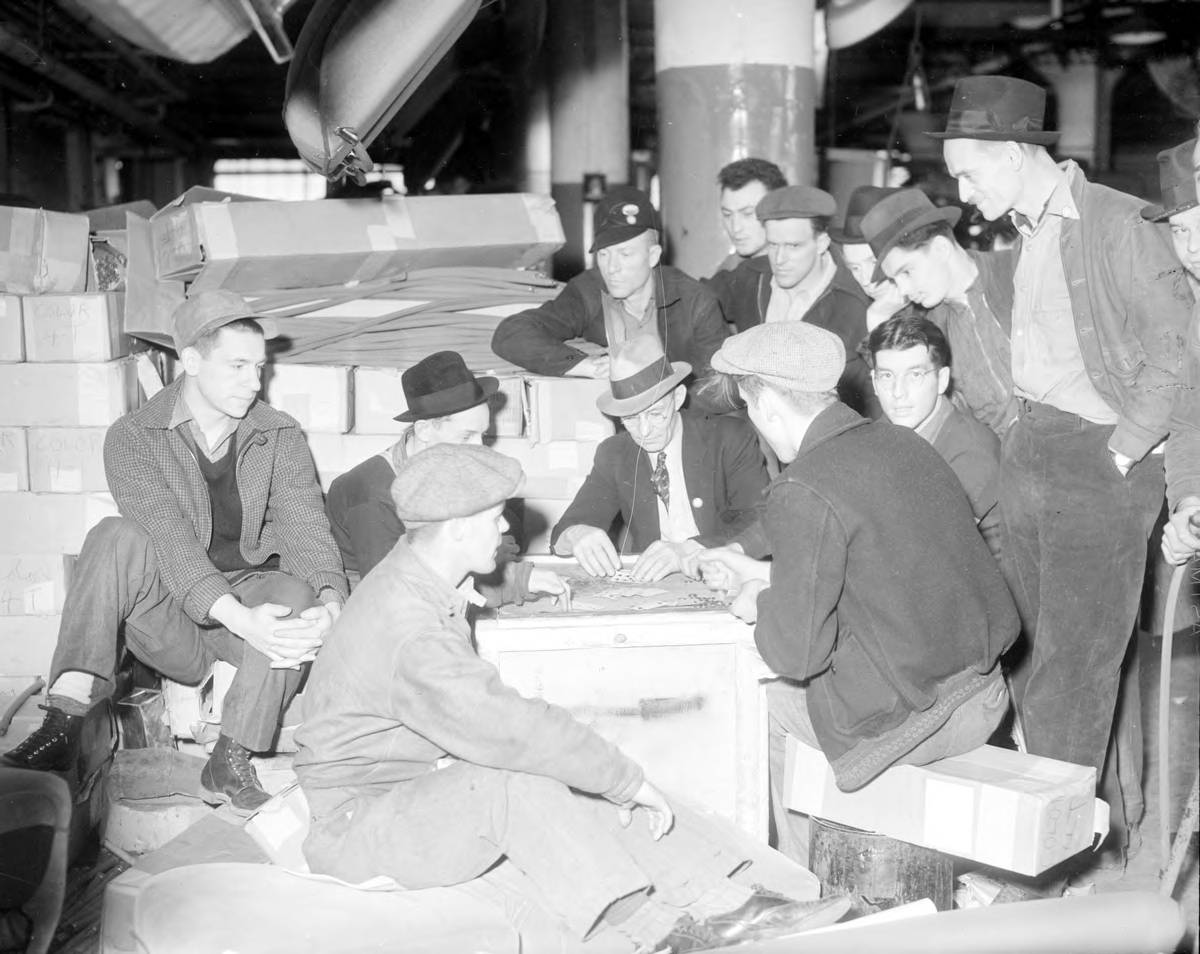
Hy Fish visits one of the occupied plants during the Flint Sit-Down strikes that brought the union to auto.
‘A Day with the Striking Auto Workers in Fisher Body Plant No. 1’ by Hy Fish from Socialist Call. Vol. 2 No. 100. February 13, 1937.
Although I had a pass duly signed by Robert Travis and Roy Reuther, I was thoroughly “frisked” by the two strikers standing guard inside the entrance window of Fisher No. 1 in Flint. And with an “O.K., brother” I was given the freedom of the plant.
Crossing assembly line tracks I came into a dim part of the plant where some of the strikers were luxuriously sleeping on over- stuffed auto seats. It was explained that they were off duty.
“They don’t sleep much around here–not more than usual, anyway,” my guide told me. “Every guy is assigned to some duty. We take turns in the kitchen, on the clean-up squad, doing guard duty and the other things that have to be done around here.”
The condition of the plant bears eloquent testimony that this work is well organized and that the men are doing their duty. The auto bodies left on the assembly belt are protected by covers. Everything else is neatly stacked away in boxes or in corners.
A Socialist “Sheriff”
A strong discipline exists in the plant. A “police force” keeps order. Phil Wise Sr., veteran Socialist, is the “sheriff.”
If anyone shirks his duty or breaks one of the rules, he is jerked before a kangaroo court. If found guilty he is sentenced to do extra work. Wise presides.
“Phil is fair,” my guide said. “If he was the judge in the Circuit Court, GM wouldn’t find it so easy to get an injunction.”
In several places a group of ten to twelve men were seated under lights making souvenirs out of leather.
In the basement the lights are brighter. The ping pong tables provided by General Motors, which the men never had much time to use, are now in constant use. Several card games were going on. A number of the men were reading.
There is a certain peaceful atmosphere around the plant–a feeling of the correctness and the justice of their demands. The men KNOW they are going to win. Not one to whom I spoke gave any sign of weakness.
They know they have the upper-hand as long as they remain in the plant. And they intend to stay in the plant until they are satisfied with the settlement and an agreement has been signed. They are ready for ready for any surprise move on the part of the vigilantes or the GM police or the national guard. Every entrance is carefully guarded and barricaded.
The men aren’t allowing themselves to get soft. Every day they go through strenuous exercises. Each man knows exactly what he has to do if any attack is made on them.
They’ve been in since December 30, and I’m convinced that they are willing to stay in until next December 30 if their demands are not granted.
Socialist Call began as a weekly newspaper in New York in early 1935 by supporters of the Socialist Party’s Militant Faction Samuel DeWitt, Herbert Zam, Max Delson, Amicus Most, and Haim Kantorovitch, with others to rival the Old Guard’s ‘New Leader’. The Call Education Institute was also inaugurated as a rival to the right’s Rand School. In 1937, the Call as the Militant voice would fall victim to Party turmoil, becoming a paper of the Socialist Party leading bodies as it moved to Chicago in 1938, to Milwaukee in 1939, where it was renamed “The Call” and back to New York in 1940 where it eventually resumed the “Socialist Call” name and was published until 1954.
PDF of full issue: https://www.marxists.org/history/usa/pubs/socialist-call/call%202-100.pdf
 Revolution's Newsstand