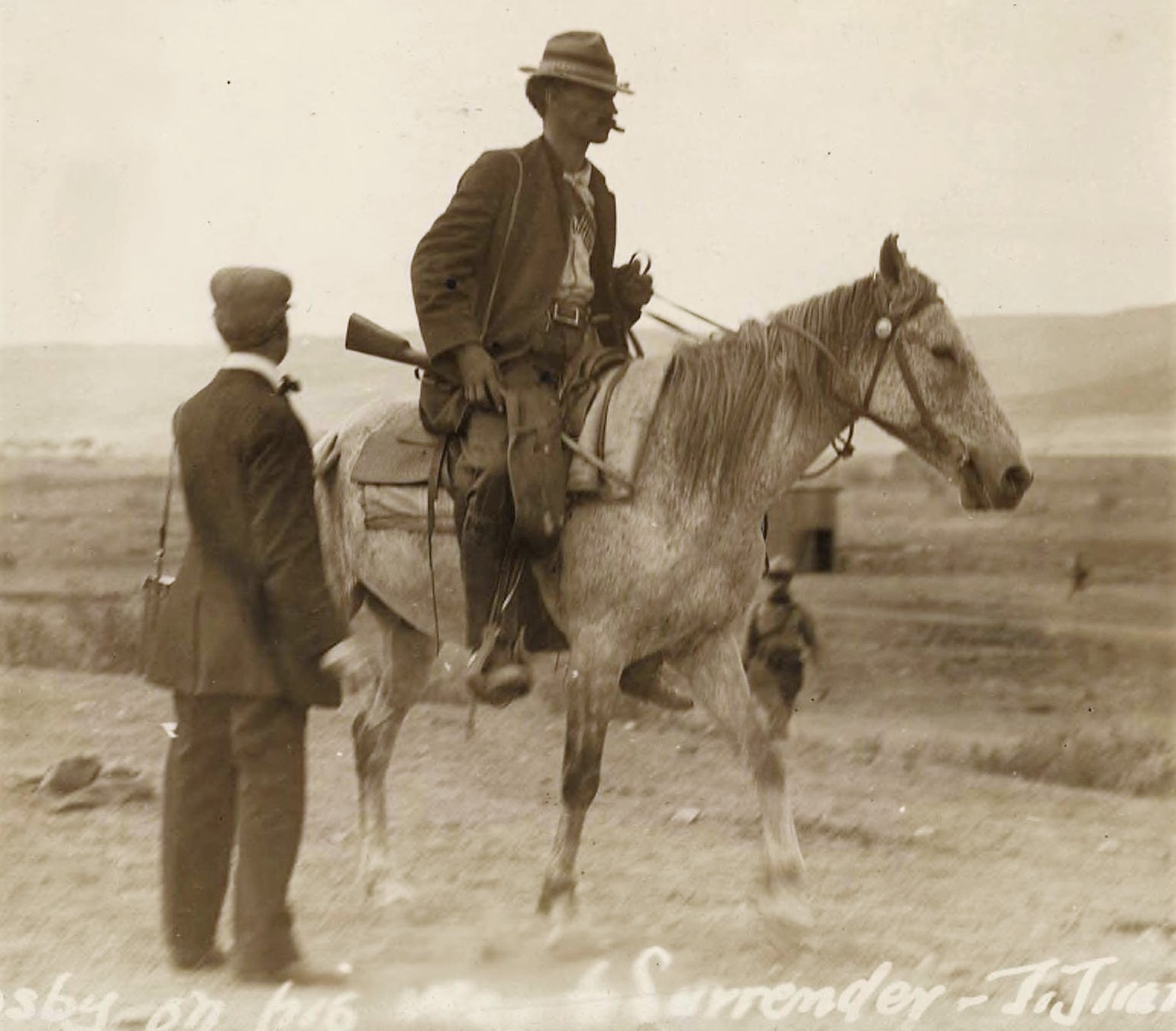
A fascinating inside account of the I.W.W. volunteers fighting during the Magonista rebellion in Baja, Mexico of 1911, and of violent divisions among the combatants.
‘Rebels in Mexico Defeated, Not Conquered’ from Industrial Worker. Vol. 3 No. 15. July 6, 1911.
The Liberal campaign in Lower California was practically ended with the defeat of the hundred men under General Jack Mosby at Tijuana, Mexico, on June 22nd, although there is yet two bands of armed rebel Mexicans, one near Santa Rosalia, in the southern end of the peninsula and another of about twenty-five men in the mountains between Tijuana and Mexicali in the north.
The defeat of Mosby was the culmination of a hard and discouraging campaign lasting over six months and which begun with the taking of Mexicali the first of the year. The Lower California campaign is now recognized by all as a mistake as there is nothing but desert waste and barren hills for hundreds of miles and no army can keep in good condition and continuously remain in that territory without importing provisions, etc. This the rebels did not have the money to do and they were forced to live as best they could at the expense of the ranchers, always making it a point to go after the big ranches first. The campaign in Lower California should never have been started. The man who inaugurated it was Leyva, who immediately sold out to the Mexican government and when Fellow Worker Wm. Stanley tried to counteract this he was put out of the camp at Mexicali. Later he went back and organized an independent division and when Colonel Mayol, came as he said, “to clean out the rebels” Stanley with eighty-five men, of whom only sixty-five were in action, met Mayol and put him to rout. Mayol had nearly five hundred men to Stanley’s sixty-five and was beside armed with machine guns and Mauser rifles as against Stanley’s old carbine and Springfield rifles. Stanley did not wait for Mayol to attack Mexicali but went out to meet him, the battle lasting all day. The rebels advancing for two miles over the fields in the face of a continuous rain of lead from machine guns and rifles and without the loss of a man until late in the afternoon, when Stanley was killed and his Mexican Lieutenant wounded.

Stanley would have captured Mayol’s machine guns and many men if he had had a few reinforcements, but all this time traitor Leyva, was reposing in the trenches at Mexicali, waiting for Stanley and his men to be slaughtered. As it was Mayol was put in hasty retreat, and he did not stop retreating until he was many miles from Mexicali, where he remained for several months and then sneaked back to Ensenada with many of his command deserted. Stanley saved Mexicali. He was a member of the Industrial Workers of the World and was a former United States soldier and a red revolutionist through and through. Stanley was the best man the liberals ever had in Lower California, without exception, and had he lived the campaign would have taken on a far different aspect than it did.
After Stanley’s death his men were commanded by a man named Pryce, who proved himself to be a scoundrel and grafter. They were called the Second Division of the Liberal Army of Lower California, while the men at Mexicali were the First division.
The Second division prepared to move on Tijuana, a small town just south of San Diego, Cal. and in the meantime the command of Simon Berthold came up from below Ensenada to Tecate. Berthold had been killed at Alamo and the men were commanded by Jack Mosby, a fearless red, who like Stanley was a former military man. He was a member of the Socialist party of Oakland, Cal.
Mosby waited at Tecate–which is on the boundary line about thirty miles east of Tijuana-until Leyva came up with reinforcements, but on his arrival Leyva refused to aid in the attack on Tijuana. (It was afterward found out that Leyva was receiving money from the Mexican government at that time.) Mosby had about forty men and would have attacked Tijuana then, but had been wounded in the attack on Tecate and was taken into the United States where he remained until June 1.
Mosby’s men waited at Tecate until Pryce came up with the Second division from Mexicali and the two forces consolidated and captured Tijuana, Mexico, on May 9, where they remained inactive until after June 1.
Pryce made various excuses for his remaining there, but all the time he was receiving money which totaled several thousand dollars, but he did not purchase any supplies or other necessities with this and he made no move to defend the town or to advance on Ensenada.

During this time a dirty capitalist politician named Dick Ferris began to send a lot of cut throats to join Pryce’s Liberals in an effort to get control of the outfit and start a filibustering expedition for the purpose of capturing Lower California and annexing it to the United States. The Liberals did their best to weed out these Ferris men, but they created a lot of trouble and got possession of all the offices and when an I.W.W. man attempted to open his mouth he was put across the line. This went on for nearly three weeks and Pryce seemed to be in favor of it until one day he skipped out taking an unknown amount of funds with him. This seemed an opportune time for the Ferris outfit to get control, so they tried to put their man Schmidt in command and Ferris was so sure of having captured the outfit that he sent down a new flag for “the republic of Lower California” and he also brought some ammunition down in his automobile. However he had not reckoned with his host, for the I.W.W. men and the Socialists and anarchists would not stand for a deal like that and Ferris was told he would be shot if he showed his face in Tijuana again and his flag was burned and Captain Mosby, who had just recovered from his wounds, was placed in command. After this the Ferris outfit seeing that they were goners, stole all the good horses and all the good guns and went to the United States, where some of them are now in jail charged with smuggling and here’s hoping they get sixty years for it. Dick Ferris was arrested, but being a capitalist, nothing will be done to him.
Immediately after being placed in command Mosby made preparations to reorganize the army and to advance upon Ensenada, although it was realized that the opportune time for that move had passed, owing to Pryce’s incompetence and crookedness.
When at last preparations had been completed to advance from Tijuana the federals had over a thousand men in Ensenada with heavy artillery, while the rebels had only one hundred men and no artillery. Mosby gave up hope of capturing Ensenada at that time and started for Mexicali to reinforce the garrison there and to fortify the town and wait for more men and artillery before attacking Ensenada. But in the meantime the ranchers near Mexicali had raised a large sum of money and induced the few insurgents who were there to leave, and that town was occupied by federal soldiers. This caused Mosby to give up his plan of attacking Mexicali and he retired to Tijuana to await more men and artillery, and in the meantime Governor Vega, with nearly one thousand men advanced upon Tijuana. They were well equipped and had six field pieces and two machine guns.

Mosby, realizing the futility of attacking such a force was for laying down arms and crossing into the United States as refugees, but the men wanted to fight, so leaving about twenty men to guard the boundary line, the Liberals advanced five miles into the hills near Tijuana Hot Springs and gave battle to the federals. The fight lasted over three hours and Mosby seeing that he was being flanked and cut off ordered a retreat, his men taking possession of a railway train and going back to Tijuana, turned over their arms to the American troops and surrendered to the American authorities as refugees. This course was absolutely necessary, for if they had been captured by Madero’s troops they would all have been tortured and then butchered in cold blood. As it was, several wounded rebels who were left behind were tortured. One had his eyes gouged out and was left on the field all night: they shot him in the morning. Another had his shin bones scraped and was likewise left on the field all night to be shot in the morning. We do not know how many more of our Fellow Workers were treated like wise. “Take no prisoners” was the order issued by Governor Vega and this is the result.
It will probably never be known how many of our comrades perished, but we estimate about ten, and of the federals about fifty.
Madero’s commander, Vega, refused to let the American Red Cross nurses on the battlefield to care for the wounded. He told the Red Cross nurses and doctors that “his men would take care of the wounded rebels.” We know how he “took care” of them.
The rebels who surrendered were held at Fort Rosecrans for three days and then released with the exception of thirteen who were deserters from the army and navy and Mosby and Laflin, whom the Madero government is trying to extradite to torture and murder in Mexico. Boys, will we stand for it? I’ll leave it to your actions. Will you act?
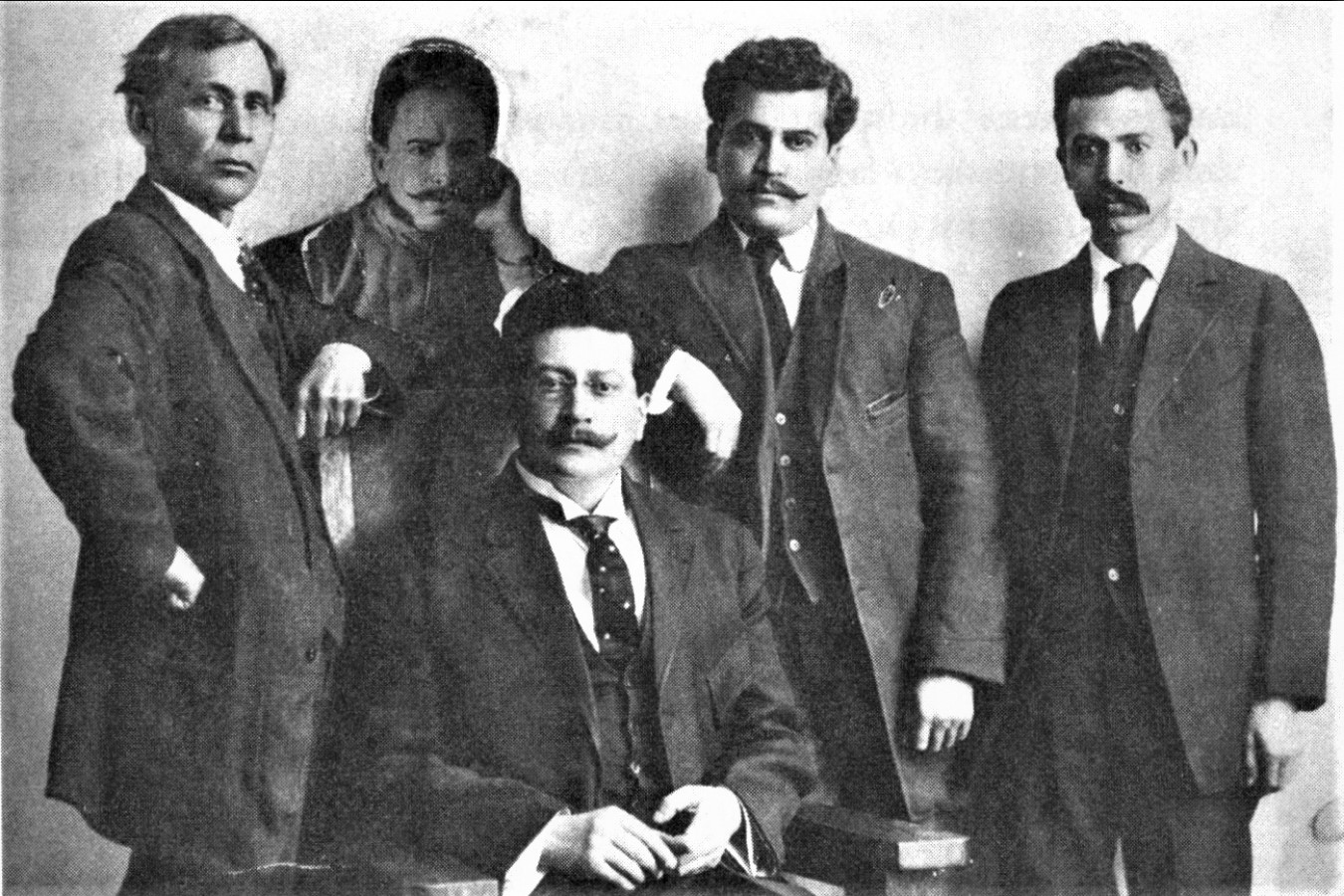
About the same time the battle took place the Liberal Junta in Los Angeles were arrested They have already served three years in our vile American prisons and we must not let them serve any more years.
Subscribe for “Regeneracion” (address 519 1/2 East Fourth street. Los Angeles) and learn the facts of the case.
Remember although the little campaign in Lower California has been smashed the Mexican people are not through revolting. Madero did not start the revolution NOR WILL. HE END IT. Yours in the eternal revolution.
CHILI-CON-CARNE.
The Industrial Union Bulletin, and the Industrial Worker were newspapers published by the Industrial Workers of the World (IWW) from 1907 until 1913. First printed in Joliet, Illinois, IUB incorporated The Voice of Labor, the newspaper of the American Labor Union which had joined the IWW, and another IWW affiliate, International Metal Worker.The Trautmann-DeLeon faction issued its weekly from March 1907. Soon after, De Leon would be expelled and Trautmann would continue IUB until March 1909. It was edited by A. S. Edwards. 1909, production moved to Spokane, Washington and became The Industrial Worker, “the voice of revolutionary industrial unionism.”
PDF of full issue: https://www.marxists.org/history/usa/pubs/industrialworker/iw/v3n15-w119-jul-06-1911-IW.pdf
 Revolution's Newsstand