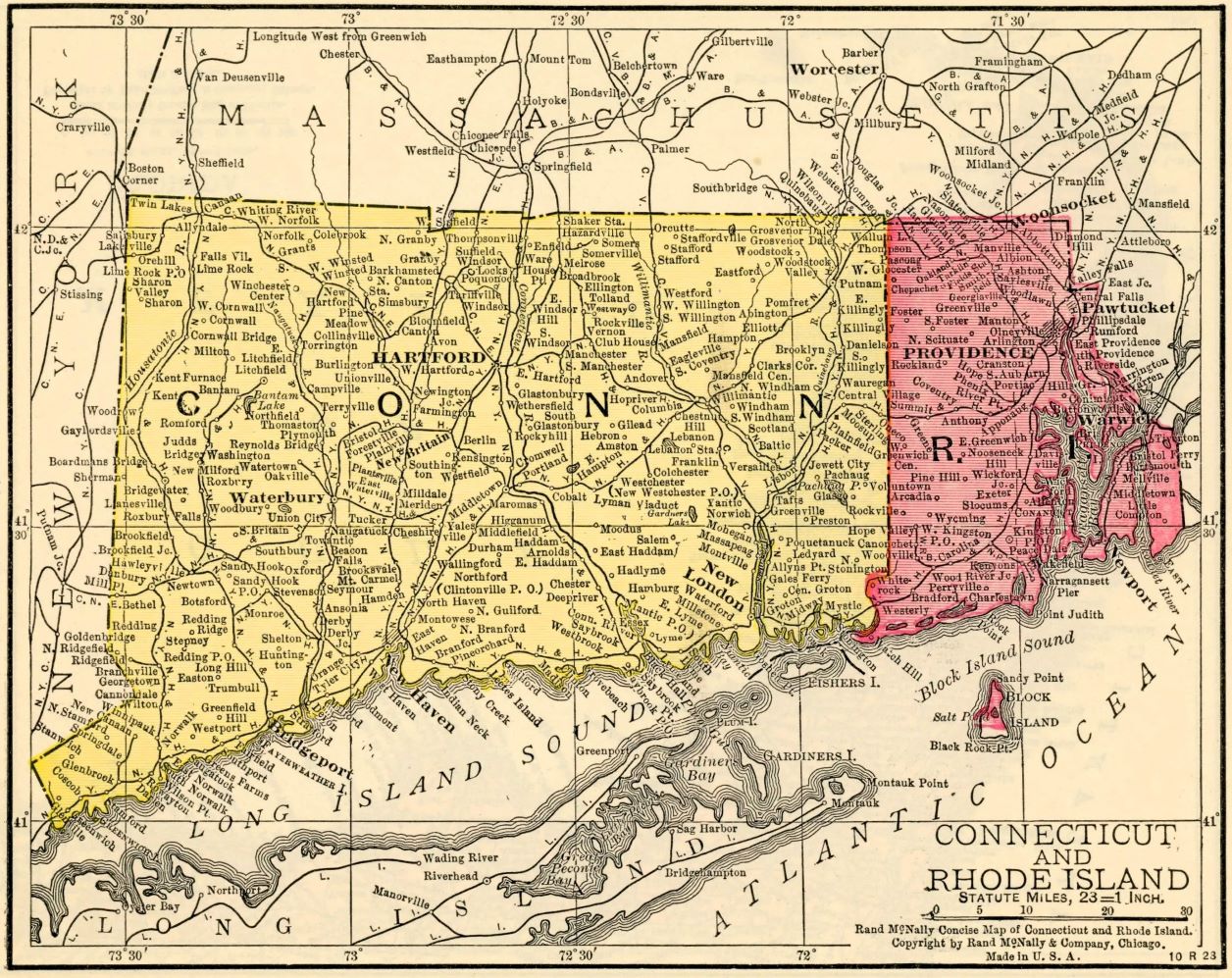
A look at the state of Socialism at the turn of the last century in Connecticut and Rhode Island from S.L.P. organizer B.F. Keinard. The S.L.P. had recently won council seats in New Have and New Britain, Connecticut and been involved in a strike at Slattersville, Rhode Island.
‘The S.L.P. in Connecticut and Rhode Island’ by B.F. Keinard from The People. Vol. 9 No. 11. June 11, 1899.
Organizer B.F. Keinard’s Bird’s-Eye View and Valuable Details.
A few words on the movement in Connecticut and Rhode Island may not be amiss to the comrades elsewhere who will be encouraged to hear of the great progress made here and be confirmed in rigid adherence to the straight tactics of the S.L.P., which are proving every day more and more successful as they are here put into practice.
These two States are, taken as a whole, the best advanced in clearness of ideas, absence of freaks and in aggressiveness of any States I have seen. As to freaks, I can remember seeing only a poor, lone. “Tepsie,” and, Lord, wasn’t it “woozy!” It looked and acted like one of those funny, fuzzy. startled things that one sometimes chased in oft a prairie in front of a big fire. I think I also saw somewhere a demoralized Single Taxer, showing up in the increasing blaze of Socialism like a sleepy cockroach crawling blinded by the sun out of an abandoned snake-hole.
CONNECTICUT.
Some of our comrades will remember how eagerly the working class of Connecticut listened to Socialism in 1896, when they seemed to eat it. Well, that appetite gets more voracious every day. Everywhere there seems to be a waking up, which has been sill further stimulated by the glorious victory in New Britain and the big vote in New Haven.
The comrades elsewhere can get a pointer or two from New Britain. In this place they have knocked the intestines out of the Democratic party and brought blood out of the Reps also, the S.L.P. delegation in the city legislature being equal to the Democratic (which includes hold-overs), and a Rep Ward barely escaping going under. The least part of their success was due to speakers. It was due to their good organization, good attendance at business meetings and general “hustling.” They got their literature into the hands of every workingman, they made a house to house canvass and pulled the voters out and so laid the matter on the conscience of a workingman that he had to vote the ticket to feel like a decent man. Another thing: they get all the funds coming to them. They do not rely merely on their own members for contributions. They go to everyone who at all sympathizes and more than one dollar was contributed, and not unwillingly either, by people who are not members of the Party. “Go there, and do likewise.”.
I saw our five comrades installed in office and they drew the class line in a competent and dignified manner the very first night, in spite of the “jollys” and bilious blandishments of the united Dems and Reps. We had here once again illustrated the oneness of the two old parties. The night preceding the meeting of the new Councilmen and Aldermen, the Reps and Dems met in JOINT caucus and fixed up a JOINT slate of officers and committees for the ensuing year. The next night we had the inspiring spectacle of Democrats (good Bryanites “workingmen’s friends”) lining up solidly with the Republicans in choosing a Republican labor skinner as President of the Council, and in seconding and supporting absolutely without dissent every motion introduced by said labor skinner. Important offices, like City Attorney, Corporation Counsel, etc., of immense danger to the workers if controlled by capitalists but of immense service to workingmen if controlled by their own class, were put by united Dem and Rep votes into labor skinning hands. The test was again shown strikingly on the matter of the Street Committee, where the Socialist plank of 8 hours a day, $2 a day and more men employed (and therefore more taxes for property holders), frightened not only the Reps but also the “workingmen’s friends,” and as a “consequence the Socialists were barred clear off said Committee and all their efforts to get on were immediately blocked by one absolutely unanimous Rep-Dem vote.
In other words, there were only two parties present, the Republican, or capitalist, party, and the Socialist Labor, or working class Party. What was formerly a concealed fact now took visible shape.
This thing alone is going to make much trouble for the “workingmen’s friends,” and there were a lot of horny-handed sons of toil sitting in the gallery that night and who will be there every meeting night watching THEIR business that help make that trouble.
As a result of our comrades’ intelligent working class stand upon the unemployed plank, and the self-evident impossibility of tampering with them, the capitalists are making an attempt to have the New Britain charter so amended that street improvements are subject to the decision of the property holders themselves. The working class may not be able “to get anything through legislation,” but your capitalist, I observe, isn’t taking any chances about it.
The election of our comrades has had very stimulating effect upon the increase of membership. Comrade Ruther, of Holyoke, tells me of the same result of his election there. That the workers are ripe for Socialism everywhere and need only to have it made incarnate in competent S.L.P. officials to get their support. In Hartford Comrade Patrick and I spoke to what I believe was the first outdoor meeting held there. 500 or 600 listened with great interest and half a dozen applications for membership were received.
In New London, where our Section is only a few months old and where we have practically never had any but private agitation before. 1,000 people attended the meeting and heard Socialism expounded.
The capitalist press throughout the whole State is getting alarmed about the New Britain and New Haven victories and we therefore see expressions like the following from the Waterbury “Herald”: “To be sure, there are sufficient of Republicans and Democrats, who, while they fight among themselves, are one in steadfast allegiance to the old Stars and Stripes in the Common Council to restrain the impetuosity of the Socialists. But what of the time to come when there will not be? That time will come, if the Socialist movement grows in the next ten years as it has in the last four as surely as come death and taxes.” And don’t forget one point. my friend, STRAIGHT INTOLERANT S.L.P. tactics did it.
RHODE ISLAND.
“Little Rhody,” “little, but mighty” for Socialism, is THE State. Here our energetic comrades have demonstrated the immense practical and immediate value of the S.T. & L.A. Many towns new contain textile Alliances, some places having a membership of as high as 800. The effect of Socialist leadership has been shown in the winning of concessions and in the orderly and dignified conduct of the strikers. Even where the strikers have gone back and may not get concessions, yet they do so in an organized and orderly body with an enthusiastic determination to continue and perfect their Alliances. At one place, River Point, where during the strike, 250 some had joined the Alliance and had gone back to work without gaining anything, a meeting called four or five days after going back was attended by over 100 who showed a remarkable enthusiasm in deciding to continue and perfect their Alliance.
The success of the Alliance is all the more remarkable when we consider that some of those people have never been on strike before and are composed of many different nationalities. At Natrick, for example, seven or eight different nationalities belong to the Alliance, making to some extent interpreters necessary. In spite of all these and other difficulties, which the mill owners’ gang were prompt to take advantage of, the Alliance held the workers together and took them back in a dignified and organized body more than ever convinced and determined to strike the capitalist at the ballot box.
Of the first strike at Slattersville, where the weavers obtained concessions, such discipline and self-control were shown in the face of threats to evict the strikers from their tenements, the shutting off of credit at the company store, etc., that even intense capitalist papers like the Providence “Journal” were obliged to confess that never before had they seen so orderly a strike. Said a Woonsocket evening paper: “The strike was free from violence and bitterness. The weavers are to be complimented on their manly and dignified bearing during its progress. Not only have they refrained from making a display of force, but they have refused to resort to any under-handedness to gain what they were fighting for. Their actions were all in the open and were above reproach.”
As a further evidence of these men’s self-control we have, after their deciding to go back with an increase of 6 and 10 per cent. their voting to stay out one day longer to give themselves a chance to listen to a Socialist agitator. A week after that their Alliance, composed of 60 some members bore fruit in a Section of 26 members. Let stuffed prophets, “dopes” and fossils take note.
The second Slatersville strike is on; this one, even more so than the first, is indeed a cheering spectacle of class-conscious Labor standing up against the capitalist class.
Thus in many of these places Socialism is coming to be a household word. Many of these valleys will soon be entirely Socialist, one town already giving over 100 votes out of a total of 200 and something. The Alliance now contains far more textile workers than all the pure and simple organizations in Rhode Island combined and will soon have all the textile workers within its folds.
That in many places the Alliance is the only means to spread Socialism and that no Alliance, no Socialism, is demonstrated by our opposite experience in those places captured by the fakirs. In the town of Warren, R.I., where the fakirs forestalled us, and have poisoned the minds of the operatives against us, we get a very poor hearing, hold smaller meetings than before the strike and can show only 7 votes for the S.L.P. These are the same kind of workers as in Natick, etc., where we are organized so successfully. Such is the result of the Judas work of the pure and simple labor fakir.
That the real union-wreckers are every pure-and-simplers appeared again during these strikes when they came on the scene and did their best to prevent the Alliance from organizing in fields where we had preceded them and where no organization at all existed. However, they got short shrift. National Secretary Donohue, of the Textile Workers’ Federation being sent home by the audience like a whipped cur.
The recent textile workers’ strikes of Rhode Island have brought to light the facts that where pure-and-simplers would have gained nothing, the Alliance did gain advances; where pure-and-simplers would have had the unsuccessful workers go back as a demoralized mob, the Alliance takes them back better organized and more enthusiastic than ever: and where fakirism leaves them at best the disheartening prospect of the same bitter interminable story steadily growing worse, the Alliance gives them the hope and determination soon to render strikes forever unnecessary by destroying the system that breeds them and setting up in its stead the Cooperative Commonwealth.
Our whole Rhode Island movement is spreading so rapidly that the day is not far distant when the entire State (no bigger than some counties elsewhere), composed of an overwhelming working class population centered in a few cities and towns, will send its whole delegation to Congress. Representatives and Senators, with the Red Flag in their hands.
New York Labor News Company was the publishing house of the Socialist Labor Party and their paper The People. The People was the official paper of the Socialist Labor Party of America (SLP), established in New York City in 1891 as a weekly. The New York SLP, and The People, were dominated Daniel De Leon and his supporters, the dominant ideological leader of the SLP from the 1890s until the time of his death. The People became a daily in 1900. It’s first editor was the French socialist Lucien Sanial who was quickly replaced by De Leon who held the position until his death in 1914. Morris Hillquit and Henry Slobodin, future leaders of the Socialist Party of America were writers before their split from the SLP in 1899. For a while there were two SLPs and two Peoples, requiring a legal case to determine ownership. Eventual the anti-De Leonist produced what would become the New York Call and became the Social Democratic, later Socialist, Party. The De Leonist The People continued publishing until 2008.
PDF of full issue: https://www.marxists.org/history/usa/pubs/the-people-slp/990611-thepeople-v09n11.pdf
 Revolution's Newsstand