
When the February Revolution broke out Bukharin was living in New York City and collaborating in editing the newspaper Novy Mir with Trotsky and Kollontai at its St. Marks Place offices. Bukharin returned in early April to play his leading role in the Revolution, the Party, and the International. Near the height of his authority ten years later, he made this typically wide-ranging and multi-faceted speech analyzing those events at the 10th Anniversary Celebration Meeting in the Great Theatre of Moscow.
‘The Tenth Anniversary of the February Revolution’ Speech by Nikolai Bukharin from International Press Correspondence. Vol. 7 Nos. 21 & 22. March 27 & 32, 1927.
1. On the bloc of the “Die-hards” with the Tsarist diplomat–On General Hoffmann and the flourishing hopes of monarchism–On Fascist Italy and Cyrill the autocrat, and why it is of advantage for the working population of the Soviet Union to remember the old regime.
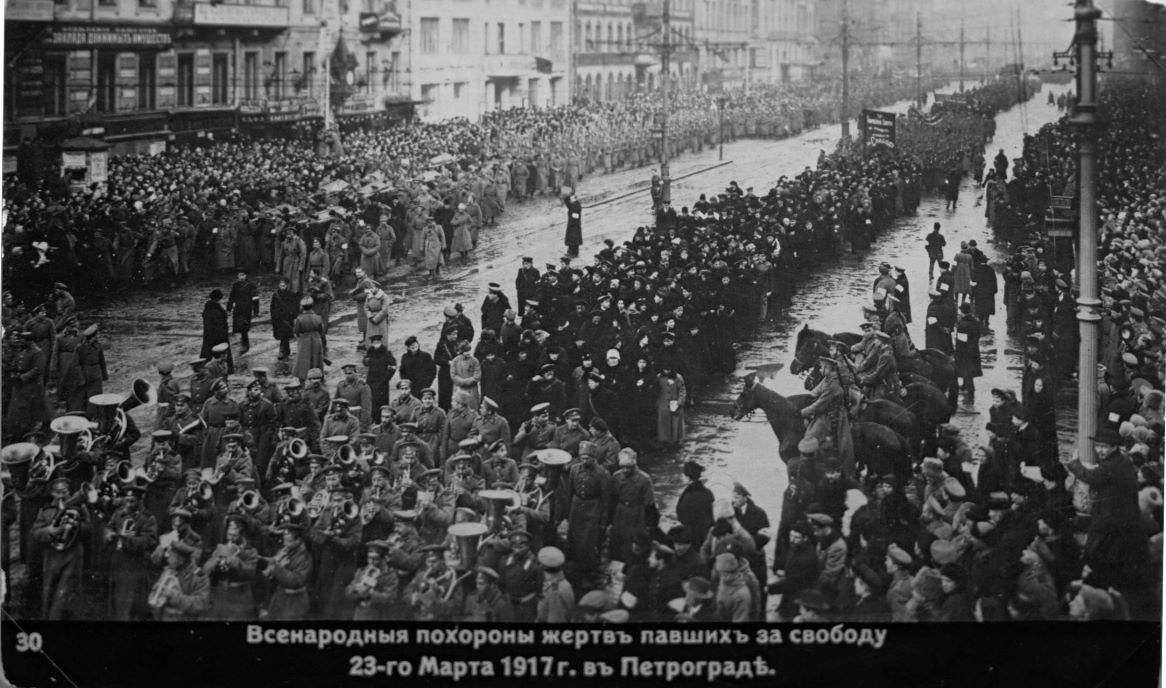
Comrades, To-day we are assembled to celebrate the memory of our glorious victory in February 1917. But the festival of to-day is not an ordinary anniversary, like many other days in our calendar. Ten complete years have elapsed since the tempest of popular indignation swept away the two-headed bird of prey, that symbol of Imperial Russian despotism.
Naturally it might be asked, is it not out of place for us, the champions of the proletarian revolution, to celebrate the February revolution, which, in doing away with Tsarism, brought the bourgeoisie to power? Such a question might be asked us. But we have every right to reply that the February revolution is nevertheless our revolution. For it can be rightly said that the October revolution was the great successor of that of February.
There is another question which might be asked. We might be asked what sense there is in our reminding ourselves of Tsarist despotism, that curse of our land, now that the bones of the last monarch have long been rotting in the damp ground, now that there is no longer any remembrance of the old regime in our country, which is harrowed by the deep-reaching tractor of the revolution? The answer to this question is simple enough. These remembrances weld us together again and again when we recall the heroic days of our common history. That is the idea of such remembrances.

They possess a special significance, however, on this tenth anniversary of our first great decisive victory. Now more than ever it is expedient that we call to mind the old régime and all its “splendours” and our own long and terrible fight against it.
We know full well our present international position. Every press telegram brings us fresh news of the so-called “crusade” which is being prepared against us by the international bourgeoisie, led by that of Great Britain. We have naturally every reason to affirm that the bourgeois system of society will not succeed to attack us in any very near future. But, comrades, this is no reason for us to close our eyes to those truly, frantic preparations being made against us by the ruling classes of the capitalist countries, with the Conservatives of the decaying but yet very strong and powerful British Empire at their head.
For this very reason it is of use to recall what has long been buried underground and overgrown by the grass.
For do we not know very well that at the present moment the official British diplomats are in immediate relations with the representatives of the old Tsarist diplomatic corps? Do we not know that at this very moment the British monarchist “die-hards” are organising a united front against us? Are we not the witnesses of a sharp turn in the international policy of Fascist Italy, which is under the impress of a pronounced form of “Caesarism”, a fundamentally monarchist principle. Had we not the “pleasure” a few days ago to read the highly significant lines characterising the mentality of General Hoffmann, one of the heroes of the imperialist war and the Peace of Brest-Litovsk, who pointed out that the struggle between so-called “civilisation” and the Soviet Union could only be decided by “force of arms”? Have we not quite recently heard the crowing of Gallic cocks in the French press?
And can we finally not see clearly enough how, under the beneficial “golden rain” of foreign capitalist aid, our emigrants are beginning to revive? Such semi-corpses, such dried up mummies, as Grand duke Nikolay Nikolayevitch (“Longshanks’) or such types as the “Despot of all the Russians”, Cyrill Vladimirovitch, of whom it was once said that the only reason he did not drown at the time of the Japanese war was that “fat always floats on the surface”. (Applause, laughter.) Have we not already the official admission of people belonging to the ruling upper class in Great Britain, that they are in connection with Sablin, a Tsarist diplomat? It was only recently that we read the “reports” of this Tsarist boaster in our own press columns, documents which were not denied for the simple reason that they cannot be denied, since they differ from the so-called “Zinoviev letter” by being absolutely true.
Just now, when the monarchist cliques are playing the first fiddle in the international interventionist concert against us, our peasants and our workers must more than ever bear in mind what the order of society overthrown ten years ago really represented.
2. On the superstition of the English lords, the execution of the English king, and the abolition of the monarchy in England; on its restoration and on many other interesting facts, such as the “Zinoviev letter”, the concealment, of Parliamentary documents and the incorrect methods of the historical calculation of certain statesmen.
The deep-lying reasons of the hatred of the bourgeoisie against the rising Soviet republics are well known to all. Equally well known are the special reasons in connection with the growth of the revolutionary movement in the colonies and raising with particular emphasis the question of Great Britain’s relations to the Soviet Union. Psychologically speaking, we can well understand why the Conservatives “see red” in their fit of rage. But, to put it mildly, we cannot altogether comprehend those Utopian expectations which are entertained by certain “die-hards”, hopes of the “overthrow of the Soviet power”. In the nature of things, these people cannot be designated anything else than phantastic optimists. For a cool and critical estimation of the proportion of forces now developing in international politics can hardly be encouraging to our adversaries or drive them on to any specially zealous attempts of a military nature. Perhaps, however, they are allowing themselves to be duped or encouraged in this connection by some additional motives. Who can tell?
It may be that some importance still attaches to the fact that the family of the King of England was closely related to the house of Romanov, and that the unceremonious treatment of the Romanovs is resented quite particularly by the adherents of the monarchist principle in Great Britain. In this connection, however, we must call to mind that at one time the British Ambassador himself, Sir George Buchanan, aided and abetted the overthrow of Nicholas Romanov.
Possibly certain wrongly understood lessons of British history have also contributed to this incomprehensible attitude. In bourgeois circles such phenomena are not infrequent. When they have exhausted their capacity of properly estimating the situation, an ungovernable inclination arises to replace this proper estimation by various forms of “telling fortunes from a teacup”. The result is a curious form of mysticism, a belief in signs, a belief in “numbers”. Thus it was repeatedly asserted that the number “nine” was a sacramental number and that our dictatorship would be bound to end in the ninth year of its existence. But “ten”, too, is a remarkable number, especially as regards English history, since in the first bourgeois revolution, the English revolution, the revolutionary power lasted for ten years. And perhaps the fact that the new regime in England was put down in its tenth year may have awakened superstitious hopes in the English minds of a similar termination in our case. The devil take it all, we ought to follow the example set by the “civilised countries” (Laughter, applause).
What is it that actually happened in England? We must call the facts to mind, if we are to comprehend the total lack of all reason in this superstition of the British aristocracy. I believe no one will consider it an “intervention” or an “interference in the internal affairs of a foreign Power”, if we venture to recall some facts from English history (laughter, applause), seeing that the facts in question have attained a venerable age and we can hardly be supposed to have employed our “Soviet agents” in the seventeenth century, however much we might have endeavoured to do so. (Laughter.)

This is what occurred on January 27th, 1649. The House of Lords, which had been appointed by the House of Commons, that is to say by the actual English Parliament, passed the following sentence on the King of England:
“As a tyrant, a traitor, a murderer, and an enemy to the State, Charles Stuart is to be subjected to capital punishment by having his head struck off.”
On January 30th, this sentence was carried out. At the same time a declaration was passed by the House of Commons to the effect that any one proclaiming the son of the English king or any British subject King of England, should be accused of high treason. On February 7th, the monarchy was abolished by a declaration which argued as follows:
“Experience has proved and the House declares that the office of king in this country is superfluous, obnoxious, and dangerous to the freedom, security, and wellbeing of the people. It is therefore forthwith abolished.” (Applause.)
This happened, as already stated, in 1649. But in 1660, i.e. ten years later (and this is obviously what promotes the “hopes” of the Conservative “young bloods” and comforts the old “die-hards”) there follows the restoration of the Stuarts by the return of King Charles II., son of the executed monarch, Charles I. In this connection the Parliament, which was naturally quite differently made up, resolved that “on the strength of the old and fundamental laws of the realm, the Government consists and must consist of the King, the Lords, and the Commons.”
The adherents of the new king and of the Parliament naturally hanged a considerable number of those who had followed their convictions in adhering to what the old Parliament had resolved. Even the remains of the deceased Cromwell, the revolutionary dictator, in whose lifetime the head of Charles I. had been severed from his body, were hanged so as to bring the people “better to their senses” and to provide a diversion for the aristocratic rogues.
Thus the circle once more closed; the sands ran out, and again the English king was placed on his throne and the monarchy was reestablished, after having been designated in 1649 as obnoxious and dangerous to the welfare of the people. It is of interest to note one characteristic “detail”. The Parliamentary resolutions against the Monarchy were torn out of the Parliamentary archives by the adherents of the monarchic system. If the “die-hards” of the present day make an existing fact out of the non-existent “Zinoviev letter”, their illustrious ancestors made a thing which actually existed non-existent. The forging of history is therefore a matter of sound tradition, and the faking of the “Zinoviev letter” is based according to all rules on a precedent. Be this as it may, the fact remains that ten years after the execution of one monarch another monarch appeared on the scene.
Obviously this example from English history is constantly before the eyes of the present British rulers. In its entirety it is of course not very “suitable” for the British monarchists, who are constantly appealing to examples from their own history. For no one has yet succeeded in proving that it is the Parliament of 1660 and not that of 1649 that must be taken as pattern. (Laughter.) Yet in 1649, it was also Englishmen who were acting, and surely England could not change its character as a “civilising factor” in so short a period as ten years. We have a great opinion of this country, as we have of every civilised country, and without the least shame for our proletarian consciousness we can regard it in certain periods of its history as the pattern of a revolutionary country, in contradistinction to that British fraud and hypocrisy of the present day, which in the eyes of a man like General Hoffmann represents “great civilisation”.
We can assure our opponents most sincerely that “fortune-telling from a teacup” and veneration for sacramental numbers (yes, we must tell this to our opponents “with our whole heart”) will not bring them any good. When people start discovering various superstitious signs, it is the first indication that all is not right with them. But, united as we are with them by our common human descent (since both the British lords and we are mortal, walk on two legs, and eat with our mouths) (Laughter), we will for the sake of humanity advise them not to permit their policy to be determined by considerations worthy of superstitious old women. This cannot contribute to their welfare, as has been conclusively shown and proved by the historical experience of Russian Tsarism.
An “analysis” of this kind, which rests solely on analogies, generally contains the one principal fault that its believers do not take into consideration the far-reaching changes in the entire situation. Therefore the conviction which results in their minds is somewhat as follows: If there are ten years of revolutionary power, that is the limit of all recorded historical terms, and it therefore follows that it cannot possibly be exceeded. If even England, which is the best organised of all countries and must therefore naturally also have had a revolution of greater durability than any other land, if even England showed the complete impossibility of revolutionary power, if even England confirmed the “historical law” that “there can be no revolution without a succeeding reaction”, if even in England the period of “revolutionary madness” did not exceed the iron limits of a single decade, the Soviets must “inevitably” fall. Nietzsche, however, asserts that “you must push a falling man”.

In all such “hopes” there is a “small” error, which consists in the total lack of comprehension for the fact that the times have changed, that the international situation and the relations of the main combatants are altogether different, that it is nonsense to think of a present, or future, nay of the very simplest repetition of the past without taking into consideration the concrete peculiarities of our epoch. The execution of a monarch had a precedent both in English and in French history. But even the October revolution had practically no precedent (we say “practically” in view of the Paris Commune); the Soviet Power had no precedent whatever, still less so the ten years’ duration of a proletarian dictatorship.
The entire historic position of the present times is altogether different in its fundamentals from that of former times. Hence our conviction of the solidity of our achievements. At the same time, if the classes who have outlived their time mobilise even the Tsarist and grand-ducal scum against us, if they get into “contact” with the clowns of the Tsarist diplomatic corps, if they attempt to put figures into motion which are so characteristic of the times of Tsarist rule, we must by no means remain idle and it is all the more appropriate that we call to mind what the Romanov monarchy meant for us, a monarchy against which a whole series of generations fought, and in fighting for the fall of which the best forces of our land were sacrificed.
3. On the nature of the Russian autocracy, the real estate of the large landed proprietors, the poverty of the peasants, the taxes and other blessings which Tsarism provided for the peasants.
The autocratic monarchy in our country was, even more than the autocratic monarchies in other countries, an embodiment of the rule of the large landed proprietors. The large landowners in general and the landowners in the times of serfdom in particular were certainly the most blood-thirsty and oppressive of classes. It was only at the end of their historical existence, that is to say when their rule was drawing to a close, that the bourgeoisie of the Fascist type, that last embodiment of the dictatorship of the capitalists, could vie with them in this respect. “Our” large landed proprietors maintained their power for a particularly long time. In no single country of Europe did the dictatorship of the big landowners last so long as in Russia. And therefore it is no wonder that especially in the last decades of the past century and at the commencement of the present century, Tsarist Russia was often called a “Prison of the People”, the “International Gendarme”, or an “Asiatic Despotism”. For in Europe this order of things, a regime of this kind, had long become a thing of the past, swept away by the march of historical events.
Among us Marxists there are even now differences of opinion as to what the Tsarist autocracy actually represented during the last years of its rule. To this question we feel bound to give a thoroughly exact reply. Down to the last days of its existence, the Tsarist autocracy did not cease to be the regime of the big serf-holding landlords. It is erroneous to imagine that after the revolution of the year 1905 the Tsarist autocracy underwent any radical change in its class nature. It was and remained a regime of big landlords. Our country was an extensive, tremendous, and enormously oppressive mechanism of a Government of large landowners. True, after the revolution of 1905, the Tsarist autocracy, as Lenin put it, “took little steps in the direction of a bourgeois monarchy”. But these steps were very “little”. The basis of power, to nine tenths of its extent, consisted of the large landowners and not of the bourgeois class; it was wild and had all the characteristic of feudal serfdom, but not of capitalism. All the more acute, the more crass, and the more pronounced was the difference between the autocratic regime and the total development of the country. Tsarism was a dictatorship of serf-holding landed interests, a fact which our peasants in particular should always bear in mind.
The social basis, the social foundation of the regime of large landowners was the large landed property itself. A well known and highly popular publication is the calculation set up by Lenin giving a very striking survey of the landed property conditions in Russia. In fifty Gouvernements of Russia in Europe, 10 million peasant farms covered together about 73 million desyatins, while almost just as much ground, viz. 63 million desyatins, was in the hands of 28,000 large landed proprietors. 10 million farms on the one hand, and only 28 thousand estates on the other the latter in the hands of “noble and dirty landlords”, as Lenin called them, here, by chance, employing an “English” analogy most happily. Of the above landed proprietors, 669 possessed practically 30,000 desyatins each. Of the 62 million desyatins, meanwhile, which belonged to the said 28,000 landlords, 44.5 millions were in the hands of the “noble aristocracy”.
These few figures show us in the most striking manner the class character of the economic basis of the Tsarist autocracy. “The ground in the hands of the big landowners”, that was the basis of the Tsarist regime, and this our peasants must bear in mind when the monarchists of all the world advocate intervention against the Soviet Union and prepare a “crusade”, allegedly in defence of civilsation. The Romanovs are the personal, or rather the family embodiment of the regime of landlords, of whom they themselves were the very greatest.
But the fact that the overwhelming bulk of the soil was in the hands of the aristocrats, furnishes a supplementary feature of the large landowner society in our country down to the October revolution. Here it was not only a question of an insignificant number of landlords possessing a vast quantity of ground. It was also a question of this ground not being cultivated on a basis of progressive agriculture, leased not on a capitalist basis but against exorbitant payment from the “landless” and half destitute peasantry, who could not earn their livelihood without land. There were therefore quite mediaeval forms of exploitation, a policy of squeezing the peasantry by the lack of land and the so-called starvation lease system. While down to the year 1861, the illustrious bureaucrats and the serf-holding simpletons were wont to exchange their serf-girls for bottles of wine, and their young male serfs for young greyhounds, the big landowners began after 1861 (when the peasants were at the same time released from serfdom and deprived of their right to land) to throttle them by means of starvation leases and high taxation.

This “machinery” worked till the overthrow of the landlord regime. And this is what our peasants must remember, although ten years have passed since the time when Russian autocracy was finally buried. The whole huge pyramid of counts, illustrious princes, barons, and countesses, this entire title-decked bureaucracy who squeezed the peasants dry, all these representatives of the landlord class, constituted nothing but an enormous parasite on the body of the nation. And if at present P. N. Milyoukov magnanimously invents a “special” theory, according to which the population of Russia lives “at the expense of the State”, this is but an example of the stupidity which occupies the thoughts of people who have been wholly and completely “shelved” by the real population of Russia on account of their utter incapability.
4. On the rapacious policy of the despotic regime, on wars, on the fostering of popular ignorance, and on the hatred of culture, or an explanation why certain British statesmen love Tsarist lackeys.
We have already pointed out that the Tsarist despotism had become involved in a violent opposition to the entire development of our country. We must dwell at greater length with this aspect of the question. Not infrequently we are asked, “But how can that be; Russia surely developed very rapidly in the few years preceding the war”. True, but so far a it developed at all, it developed against the will of the Tsarist regime. The main cause of rapidity of capitalistic development as really existed, was the vigorous influx of foreign capital seeking investment. On the other hand, the peasantry, almost destitute and devoid of land, impoverished by exorbitant taxation and rents (which latter rose at a catastrophic rate), represented no sufficiently absorbing market. Enormous regions, especially in what we may call our “central zone”, were in decay.
Partly with a view to making up for this lack of adequate markets and sufficient taxable objects, the arbitrary Government was obliged to plunge into adventures abroad and to continue plundering more and more territories. This is the reason why the arbitrary regime displayed so aggressive and rapacious a character in foreign politics. Although from the standpoint of power this was neither a dictatorship of financial capitalism nor one of the bourgeoisie, but rather a dictatorship of the large serf-holding landed proprietors, these landed proprietors pursued an aggressive foreign policy, not only because they were compelled to listen to the demands of the bourgeoisie, nor yet merely because such a policy was dictated to them by the allied bourgeois countries, but also out of compliance with their own interests as large landed proprietors, interests which they were wont to designate as “genuine Russian”.
The home policy of this regime was therefore closely bound up with its foreign policy. But the wars placed tremendous burdens on the country and radically undermined the entire bureaucratic Tsarist machinery, which they utterly disintegrated and demoralised. Nor is it by any means a matter of mere chance that the Tsarist autocracy should have experienced a “dress rehearsal” of its final overthrow, the first powerful blow dealt it following after an “unsuccessful” war. Following on the cruel reverses of the Russo-Japanese war, there came the year 1905, with the barricades at Pressnaya, the working class quarter of Moscow, and the powerful agrarian movement among the Russian peasantry. Arbitrary rule collapsed under the blows of the revolution, which was in closest connection with the military collapse of the Empire in the course of the great war. If the year 1905 was the “dress rehearsal” of the overthrow of arbitrary rule in Russia, the year 1917 was its grave.
The tremendous apparatus of Tsarist exploitation could not be maintained for any length of time, save by being based on an equally stupendous ignorance on the part of the peasantry. The “relative stabilisation” of the Tsarist regime rested to a very great degree on this ignorance, a fact which explains the extraordinarily furious hatred of the arbitrary regime against all and every innovation, even in the way of bourgeois culture, and the specially furious hatred felt towards every individual or small group among the people who ever succeeded in raising themselves to a higher rung of the ladder of culture. A Russian Minister of the Tsarist regime is well known to have remarked that a “cook’s son” had no business to come to the University. But even against the simple bourgeois culture, the arbitrary Tsarist regime sometimes showed a truly bestial hatred. In this connection great interest attaches to an example which, it is true, refers to the time of Tsar Nicholas I., or as he was called, Nicholas Palkin (derived from the word “palka”, meaning a stick or cane).
When Pushkin, a man whose importance in Russian literature is well known to everyone, died and was about to be buried, the censors prohibited the publication of any material about him. I may quote a short dialogue which took place in this connection at the time, and which has since been published in a highly interesting booklet on Pushkin by the well known writer Veressayev. When A.A. Krayevsky caused a short notice on the poet’s death to be published, he was immediately summoned to “render account” therefor to the Curator of the Educational District, Prince Doundoukov-Korsakov, who was at the same time the chairman of the Committee of Censors.

This “Prince Doundouk”, whom Pushkin had made notorious, now reproached Krayevsky as follows for his “crime”:
“I must inform you, he said, that Minister Uvarov is highly displeased with you. Why this notice in regard to Pushkin? How do you come to put a black border round the obituary notice of a man who had neither official rank nor any position in the State service? This is really going too far. What are these expressions you employ? “The sun of poetry’. Pray tell me, why so much honour? ‘Pushkin in the midst of his great work’. What sort of work was it? The Minister himself asked whether Pushkin was the leader of an army, a warrior, a minister, a statesman?! And when all is said and done, he died without even attaining the age of 40. Writing verses constitutes no great work, as the Minister himself remarked. I have been instructed to reprimand you severely and to remind you that, as an official in the Ministry of Public Education, you should particularly refrain from all such publications.” (Quoted from “Krassnaya Novy”, vol. 3, p. 157.)
Is there not palpably presented here that stupid, narrow regime of Nicholas Palkin, which recognised nothing but Governors? (Applause.)
5. On the evidence of Souvorin senior, on the Grand Dukes and the administrative methods of the autocracy, on the “benefits” conferred by the autocracy on the peasants, workers, and national minorities.
It is obvious that, in view of the extremely narrow circle which provided the State administrators during the Tsarist regime and which refused to admit any individuals from without, it cannot be said that intelligence of any higher order flourished among the administrators of the Tsarist Empire. Even from the standpoint of the interests of the big landowners, it cannot be maintained that the representatives of the Imperial bureaucracy were distinguished for special “nimbleness of thought”.
This has been pointed out, inter alia, by some of those who were not prepared to spend their whole lives in licking the boots of the “autocrats”. It is generally known, that a certain Souvorin was at one time editor of the “Novoye Vremya” (New Age) a publication which was in connection with the secret police and had the character of a semi-official paper. In the latest period of the history of “public opinion” in Russia, this same Souvorin attained a great reputation; indeed, the expression “children of Souvorin” is very widely used in place of a certain Russian term. (Laughter.)
Souvorin, who produced such “children” and who played a relatively important role in Russian culture, wrote for his own amusement a diary, which has now been published. And it is a matter of some interest to see what he wrote “for his pleasure” about those circles, which in his “Novoye Vremya” he served, not for pleasure but for hard cash. The difference is tremendous. On page 229 of his “diary”, e.g., he writes in regard to the Grand Dukes. i.e. about the very highest circle of those in power under the landowner regime, as follows:
“I have heard that Kuropatkin has been transferred to the Caucasus and that he can no longer agree with the Grand Dukes at Warsaw. A great pest, such Grand Dukes. Only rogues can get on well with them, for to such they are a good source of income.”
On the same page, Souvorin remarks:
“Plyushtchik-Plishtchevski relates that on his recommendation Grand Duke Sergius Alexandrovitch received a bribe of two millions for the further grant of the spirit monopoly at Moscow, that Witte undoubtedly possessed reliable evidence of the fact, and that the Tsar knew of it. Sergius Alexandrovitch came here a few days ago for a space of five hours all told. In one way or another, the Grand Dukes at all times accepted bribes and endeavoured to enrich themselves in every way.” (Diary of A. Souvorin, Frenkel edition.)
All this was said by a witness who certainly knew what he was talking about, for he had insight into the most intimate secrets of the old regime, into what might be called the “holy of holies”. It is also of interest that this apostle of Russian autocracy who offered incense to it at all street corners and praised it to the skies (Souvorin’s son is still present at all the parades of Wrangel’s men and is an enthusiast for the by-gone “golden times” of Russian autocracy), it is interesting, I say, to notice how Souvorin wrote for his own “amusement” in regard to the state of affairs among the autocrats. I may quote another short passage from his diary. This is the manner in which he speaks of the order prevailing under autocracy.
Absolutism is far better than parliamentarism, for in the latter case it is human beings that rule, while in the former it is God. An invisible God, who is, however, tangible enough. Nobody sees him, but all have heavy hearts and every one can be besmirched in any case and beyond all measure. The Tsar learns of God alone and consults with none but God. But since God is invisible, he takes counsel of all men whom he encounters, with his wife, with his mother, with his stomach, with his entire nature, and all this he looks upon as the counsel of God. The counsels of the Ministers, however, are yet superior to those of God, for they take care of themselves, they take care of the Tsar and of the dynasty. There can be nothing better than absolutism, for it breeds a whole hive of superfluous and altogether useless people, who find some job for themselves. These are people of the privileged classes, and the main part of their privileges consists in the fact that, though they have nothing in their heads they are the heads of the people.” (Laughter, applause.)

It is altogether obvious that the cruel process of exploitation of the broadest classes of the population, the working class and the peasantry, had to be protected by a gigantic political apparatus. And if the so-called Russian intellectuals (men of letters, professors, i.e. persons wearing pinze-nez), were allowed occasionally to squeak out something in a terribly thin treble, no “weakness” at all was shown in dealing with the “dregs” of the population, the “cooks’ sons”, the workers and peasants; as a matter of fact, the working class and the peasantry were practically “outside the law” and a pack of rural police chiefs, district prefects, rural commissaries, rural police sergeants, gendarmes, secret police agents, regional inspectors, district police superintendents, and local police superintendents could act at their own sweet will.
When the working class first appeared on the political stage in Russia and began to create its own organisations, it was in a state of illegality and was forced to be illegal under the political order which dominated the whole country. It had not even the right to possess the most innocent of organisations. All activity on the part of the workers was persecuted; not even benefit funds might be founded. All cultural associations were quickly suppressed. There was no question at all of organisations among the peasantry.
Throughout the country, the Tsarist autocracy trampled the population under foot. While cold steel and fetters were employed against the working class, the most active class, with heads full of revolutionary ideas; and while the peasantry was suppressed just as severely from the political as from the economic point of view, the cold steel was also directed with all vigour against the numerous national minorities inhabiting the country. Any so-called “border district” and any group of the so-called “racial foreigners” (which charming term served in the literature of Russian autocracy as the official expression even in the broadest circles) in short all such as had not the “honour” of belonging to the ruling nation of Russian traders and Russian autocrats, were made to feel the full rigour of the laws of a regime which was specially directed against them. Such was the nature of this truly diabolical machinery of the Tsarist autocratic rule.
6. On the “love” of the people for the big landowners, on the subject of Pougatcheff’s mutiny, on the revolutionary movement, on the kindly feelings of the nobles towards the people, on the year 1905, on the diary of Count Witte, on the brute proletariat, on Shoulgin’s machine-guns, on Tchernov’s mob-rule, and on the subject of some tasks of ours arising from the foregoing.
In the course of the 300-years history of the house of Romanov, the people repeatedly rose and turned in its masses against that diabolical machine.
The last movement against the system of serfdom, a far-reaching and deeply-rooted movement of the masses, was the mutiny of Pougatcheff, designated by the ruling classes as “senseless and merciless”. It is only now that the historians of our Soviet Union have opened the dusty coffer with its archives which refer to this great peasant movement against the big landowners. And only now have we learnt how powerful this movement was, how well organised it was, and how it reflected the burning hatred of the peasant against the serf-holding landlord. We have now a whole collection of appeals which were drawn up in the camp of the insurgents participating in the “Pongatcheff mutiny”.
The proclamations of Pougatcheff and his closest collaborators are a true reflection of life under the stress of a rough and merciless struggle. If the landlords called the rebels “malefactors” and “thieves” and described them as “convicts”, the waves of the popular fury and hatred were directed against the entire regime of landlords, and against the whole system of serfdom. Pougatcheff called himself a “peasant Tsar’ under the assumed name of “Peter Fedorovitch”, with a view to exploiting certain monarchist prejudices of the peasantry. His orders, however, express clearly enough against what class enemy the weapons of the fight must be directed.
As an example of these manifestos, I may quote the following passage:
“But if any of you refuse to pay heed to the moderation I have shown, as the nobles and the landlords refuse to do, he will lose his life, i.e. suffer death, as a criminal against the law and against the public peace, as a malefactor and an opponent of the imperial will; his house and all his possessions meanwhile will be confiscated.” Another passage, culled from an order dated July 1774, runs as follows:
“The former nobles in their domains and entailed estates are to be looked upon as opponents of our power and as inciters against the realm and ravagers of the peasants, and as such they must be seized and hanged.”. These examples clearly show that this last of the risings of the masses of Russia against the system of serfdom was fully conscious of its class aims; it speaks straight out regarding the rule of serf-holding landlords and calls for an unrelenting fight against this class that ruled Russia at the time.

Naturally this rising ended in the same way as previous attempts had ended. The best generals and best commanders of the Empress Catherine II were summoned by that “virtuous”, “humane”, and philosophising lady to aid the throne. The movement was destroyed; it was suppressed by merciless terrorism; an enormous number of people were executed; Pougatcheff was taken prisoner. It was a particularly “humane” act on the part of the Empress, who had a reputation for reading French philosophy and of being very “humane” and “liberal”, that she should have given the order that Poutgatcheff be locked in a cage, taken to the so-called “swamp-ground”, and there quartered. The hangman, who was instructed to kill the prisoner gradually by first amputating his arms and legs and then beheading him, could not bring himself to do so and preferred to put this peasant leader out of his misery at once.
This was the end of the movement. In the course of the further history of the Tsarist autocracy, we find a number of other attempts at the overthrow of the regime, both timid attempts in this direction on the part of the bourgeoisie (e.g. the movement of the Dekabrists, the centenary of which we recently celebrated and which has been much spoken and written of late) and the heroic fight of the rebellious peasants in the time immediately preceding the “emancipation” of the serfs in the year 1861; finally also the fight put up by the revolutionary parties, those first nuclei of the organised struggle against the Tsarist autocracy, and the first actions of the proletariat.
Finally we come to the year 1905, which determined fundamentally that proportion of the social forces within the country which crystallised in the year 1917. The most far-seeing among those in the camp hostile to us foresaw this proportion in its entirety.
One of the very few far-sighted men at the disposal of Tsarism, was the well-known Count Witte. He, too, left a diary, which has now been published. From this diary of Witte’s, which contains a great amount of extremely interesting material, I shall here quote a passage which describes the impression of this certainly far from dull observer in regard to the distribution of the social forces in the course of the revolution of 1905 and the “sentiments” he had in this connection. This is what he wrote in regard to the situation which had developed in 1905!
“The nobility has come to recognise that it will have to divide the cake with the bourgeoisie; to this idea it has become reconciled. But neither the nobility nor the bourgeoisie have so far given a thought to the class-conscious proletariat. In the meantime, the latter, to the surprise of these short-sighted politicians, suddenly appeared on the scene in September, 1905, with all its elementary force, a force which is based on numbers, but also on the low level of culture, and perhaps more than all on the fact that the class in question has nothing to lose. Hardly had it approached the cake (here Witte forgets to mention that the cake by rights, belongs to the people, describing it rather as a foreign object)” (Laughter), than it began to roar like a beast which holds back at nothing in order to devour all that is not of the same origin as itself. When the nobility and the bourgeoisie caught sight of this animal, they began to retire, that is to say, the rich began to get together.”
This is by no means badly expressed: “When the nobility and the bourgeoisie caught sight of this animal, they began to retire, that is to say, the rich began to get together. These are remarkable words. Here the writer analyses quite correctly the proportion of the social forces and that of the classes, such as resulted during the revolution of 1905. The bourgeoisie complains against the Tsarist autocracy, but they have caught sight of the “beast” in the shape of the proletariat, and that has frightened it more than autocracy, and therefore they have begun to form a closer alliance with the big landowners, which means that they have become counter-revolutionary. This was indeed the fact, and the entire subsequent history of the revolution confirmed it.
The sober, I might almost say, Bolshevist, analysis of Count Witte was naturally accompanied by bitter animosity against the proletariat, which he, of course, also designated as an “animal”, and as one “of poor culture” into the bargain. It is no wonder that Witte should have been fully and wholly in favour of treating this animal to a heavy dose of machine-gun lead, confirming, as he did, the sole and unrestricted right to the “cake” on the part of the big landowner animals, those true champions of culture and civilisation, so delicately characterised for hundreds of years by the nagaika and the knout.
In the revolution of 1917, this ranging of forces, and the general tendency of the class groupings found a yet more sharp expression. And why? Because during the time which had passed since the first revolution of the year 1905, our “poorly cultured animal”, our class, the proletariat, had managed to rise, began to roar somewhat louder than in 1905 and had probably also become rather better cultured. On the basis of the economic growth it had grown in numbers, had profited by the lessons contained in its own history, had succeeded in forming a good organisation of its own, had learnt to manoeuvre in face of the other classes, and had attracted the many millions of peasant farmers, who had started to cry not only “Down with the war!” but also “Give us the land of the big landlords!” It was not only the peasant mutineers of Pougatcheff that now came forward under a new name, but also the proletarian “animal”, which raised itself to its full height and marched with gigantic strides at the head of the entire movement.
It is therefore quite natural that the process of the bourgeois rally should have ensued most rapidly. This rally comprised not only the actual bourgeoisie, but also the petty bourgeois parties, all the Zeretellis, Tchernovs, Dans, etc. who were also extremely terrified at the sight of the “animal”. It is hardly surprising that Victor Tchernov, one of the most eminent ideologists of the S.R. Party, should have called our October revolution undemocratic and non-proletarian. He managed to find a name for it in the Greek dictionary, “ochlocracy”, or mob-rule. It is not difficult to comprehend that Tchernov’s “mob” is related to the “animal” of Count Witte. But whether the expression chosen to designate us was mob or animal, need not matter a rap to us. (Applause).
It is of historical importance that the said “animal” and its “bestial” “mob-rule” party, should have proved prudent and far-seeing than the bourgeoisie and the compromising slyboots of all forms and shades. But that they called our class “mob” and “animal” must not be forgotten, least of all by our peasants, for the united front from Tchernov to the Nikolay Nikolayevitch is by no means a matter of chance. It is the united front of all that furious hatred, which grows more and more difficult to restrain the more hopeless the position of the opponents of the proletarian dictatorship becomes.
A classical and in its way magnificent example of this unrestrained hatred on the part of the nobles against the workers and peasants is to be found in the works of M. Shoulgin, a “humane” and “cultured” champion of civilisation of the big landlords.
Shoulgin writes of the people in its entirety, not of any particular “bolsheviki” and not even about the proletarian “animal”, but of our people as a whole. This is how he describes the February revolution:
“From the first moment of this “deluge” (if the February revolution is a deluge, it certainly has swept away many people) (Laughter, applause), my soul was filled with horror, which has not quitted it since then, throughout the whole duration of the “great” Russian revolution.
“The endless and inexhaustible current of human events again and again showed fresh faces in the Duma; but, however many there were it was always one and the same face, either blackguardly and bestially dull or blackguardly and diabolically malicious. (“The February Revolution”. Recollections. State Printing Works, p. 89).
And then again:
“Lord, that was awful! So abominable that I ground my teeth and felt within me nothing but a single, helpless, and yet increasingly fierce longing. Machine-guns!
“Machine-guns it was that I longed for. For I felt that nothing but the language of machine-guns is comprehensible to the street mob, and that only bullets could drive back into its den the abominable animal which had been let loose on the world.
“And this animal, alas! It was no less than His Majesty the Russian people!” (Ditto).
Such were the sentiments which animated “them”. Thus Shoulgin speaks not only of the “animal” but also of the machine-guns which are to be used against it. This should likewise and in any case be remembered by our peasants, not to mention our workers. This is what the nobility thinks of our entire working masses of the population. And that is the unabashed tone in which the nobles will once more begin to speak to us should the hand of the people fail and should “they” once more seize the people by the throat. In another passage later on Shoulgin writes:
“I remember the sentiment of the nearness of death and the readiness for death which I felt all that day and during the following few days.
“Was I to die? Be it so.
“Only not to have to see the repulsive faces of the blackguardly mob, not to hear the impudent speeches and the howls of these miserable curs.
“Oh, for the machine-guns. Would I had machine-guns.” (Ditto, p. 91.)
This language is almost artistic. It is curious and in its way almost beautiful. There is a certain amount of pleasure to be derived from reading something like that. Here we see what are the motive forces which drive our opponents. We know that the General Hoffmanns of all countries, those civilised opponents of ours, may sometimes speak to us in very courteous language. But we also know that behind this language is hidden their real Shoulgin vocabulary. And now that we see how the malicious glances of the imperialists are once more directed towards our country, we must say to ourselves “We shall certainly be on our guard”. And if we know now that our opponents have not yet sufficient forces to oppose us speedily, if we know that we must be exceedingly calm and reserved, we are yet bound to look forward and be able to distinguish between the diplomatic phrases and the “Shoulgin” feelings which reveal our class-opponents as they really are. On the tenth anniversary of our February victory, at the celebration of that February which was but a forerunner of October, our class, the vanguard class, the great working class, our proletariat, grabs the hand of the peasantry and raises aloft its red flag, higher and yet higher. Still more brightly gleams our Soviet star over all the world, and more closely and quickly shall we establish our Socialist fatherland, which we have conquered at the price of our blood. We are building up our Union of Soviet Republics, not as a prison, but as a great fraternity of all peoples (for there are more than 100 nationalities in our Soviet Union); we are building it up not as a realm for obnoxious capitalist exploitation but as a great, powerful granite pillar of future Socialism; we are not building it up as an international police-office, but we are welding the great organisatory forces for the historical battles of the future, for the decisive victory of the international working class. It is for this victory that we live and for this victory we shall fulfil all that has been entrusted to us by the history of our class in its responsible historic position. (Vociferous applause. Singing of the “International”.)
International Press Correspondence, widely known as”Inprecor” was published by the Executive Committee of the Communist International (ECCI) regularly in German and English, occasionally in many other languages, beginning in 1921 and lasting in English until 1938. Inprecor’s role was to supply translated articles to the English-speaking press of the International from the Comintern’s different sections, as well as news and statements from the ECCI. Many ‘Daily Worker’ and ‘Communist’ articles originated in Inprecorr, and it also published articles by American comrades for use in other countries. It was published at least weekly, and often thrice weekly. The ECCI also published the glossy magazine ‘Communist International’ edited by Zinoviev and Karl Radek from 1919 until 1926 monthly in German, French, Russian, and English. Unlike, Inprecor, CI contained long-form articles by the leading figures of the International as well as proceedings, statements, and notices of the Comintern. No complete run of Communist International is available in English. Both were largely published outside of Soviet territory, with Communist International printed in London, to facilitate distribution and both were major contributors to the Communist press in the U.S. Communist International and Inprecor are an invaluable English-language source on the history of the Communist International and its sections.
PDF of issue 1: https://www.marxists.org/history/international/comintern/inprecor/1927/v07n21-mar-27-1927-inprecor-op.pdf
PDF of issue 2: https://www.marxists.org/history/international/comintern/inprecor/1927/v07n22-mar-31-1927-inprecor-op.pdf
 Revolution's Newsstand