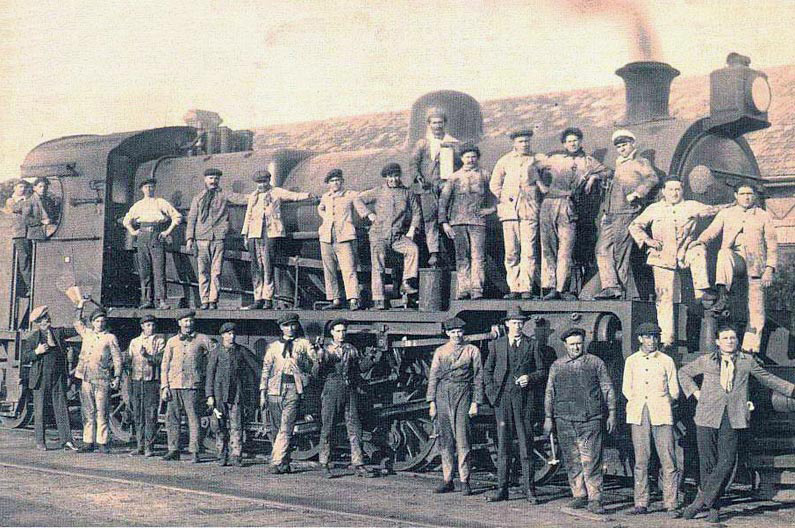
A valuable report on the 1921 founding and early strikes of the Confederacion de Sociedades Ferrocarrileros de la Republica Mexicana.
‘Militant Mexican Railroad Workers’ by F. W. Leighton and Carl Brannin from Labor Herald. Vol. 2 No. 2. April, 1923.
ON August 1, 1922, the workers of Mexico staged a remarkable demonstration of international solidarity. On every railway division of the country the workers ceased from labor for four hours as a mark of sympathy for their American brothers engaged in a life-and-death struggle with the railroad barons. Passenger trains were exempt from the strike order, but in many cases even these were stopped by their crews at the appointed hour. Every other class of railroad labor was called upon to stop for four hours and the order was completely obeyed. Probably few American workers knew of this great manifestation. Its significance is great.
Establishing the Mexican Unions
Two years ago such a demonstration as this would have been impossible. At that time the railroad workers were divided into sixteen or more unions, with little common understanding and no unity of action. This is not surprising in a country where the anarchistic philosophy, characteristic of Spanish countries, is predominant in labor circles. But new influences are at work, as demonstrated when the condition of disorganized weakness gives way within a short period to a condition of organized power. The movement for unity began early in 1921, when a convention of all railroad organizations was called in Mexico City.
Clear headed militants in the divided unions had become convinced of the necessity for uniting their forces. But they had many difficulties to overcome. Among the unions present was one of long standing, comprising some of the conductors, brakemen, engineers and firemen. This union was extremely reactionary in its officialdom, and was under the domination of the railroad management. In the convention it was discovered that an attempt was being made to give control of the newly formed federation to these reactionaries, with a program dictated by them. In the struggle that followed the progressives won out. A pact of confederation was adopted which bound the unions together in a strongly centralized organization, known as the Confederacion de Sociedades Ferrocarrileros de la Republica Mexicana, with a radical program which included the general strike. The railroad management refused to recognize it, and a struggle ensued which tested out the new organization.
In February, 1921, a general strike was called. The objects were to obtain recognition of the union and the removal of the Director General. With the exception of the “yellow” union previously mentioned, every worker on the National Railways walked out. A bitter struggle was on. The Government, with the aid of scabs and soldiers, was able to operate a few passenger trains, but in the main the tie-up was complete. Every effort was made to drive the workers back. Troops were sent to various points, and strikers were shot down. The workers generally kept their heads, refusing violence, and concentrated upon making the strike effective, in which they were successful.
The strike lasted until March 19, and ended with something of a compromise. The management agreed to pay full wages to all strikers for time lost, and to re-employ all at their old jobs as quickly as possible. Full seniority rights were restored, except that members of the “yellow” transportation union were allowed precedence over strikers, an injustice which since has been partially corrected. The Government saved its face by refusing immediate recognition, but giving an unwritten promise that the Confederation would be recognized. The objectionable Director General was soon sent away on a mission to the United States. Substantial concessions had been won. Soon after the point of recognition was gained, strikers were reinstated, scabs were eliminated, the membership of the “yellow” union largely won over, and the Confederation has thoroughly established itself.
An Industrial Union
The solidarity of the 45,000 members of the Confederation, covering all the railway lines of Mexico, seems now to be impregnable. The small elements of disunity are rapidly disappearing. This is best shown in the recent action which restored full seniority rights to the striking engineers and firemen as of the date of the strike. In a letter to the scab union announcing this action, President Obregon urged it to unite with the other railway workers in the Confederation. The Confederation controls the situation.
This new power in the hands of the railroad workers arises from their solid organization. They have what amounts to a departmentalized industrial union. The old craft unions retain their machinery of organization, formulate their demands, and even carry on negotiations. But every point must first be passed on to the central organization for approval, which controls all strike action and agreements. They have concentrated great power in the central organization
The leading body is composed of two general committees of 28 members each, two delegates from each of the 14 unions in the Confederation. One is the Executive Committee, with headquarters in Mexico City; the other is the Legislative Committee, which meets from time to time at Aguas Calientes, a large division point 300 miles north of the capital. The delegates are elected by their separate organizations and serve until recalled. These Committees meet twice a month, or oftener if necessary. The Legislative Committee studies all proposed changes in the laws of the Confederation and passes them on to the Executive Committee for final action. The latter body passes upon all contracts and agreements of all the component unions. Any component union with an unadjusted grievance submits it to the Executive Committee. In this manner the full power of the entire Confederation is thrown behind all issues on which a struggle threatens.
The centralization of strike power, as contained in the rules of the Confederation, was complete, strikes of individual unions being strictly prohibited. In spite of this provision, there have been a few short local strikes to ad- just local grievances, the results of which have been satisfactory. There is now a sentiment for an amendment to the rules permitting short, quick walkouts to adjust local matters, always with the approval of the Executive Committee.
Accomplishments of the Union
Shortly before Christmas the Telegraphers finished their convention and signed up the most favorable contract of any railroad union. It provided that every employe in their jurisdiction, which includes station agents, train dispatchers, traveling auditors, telegraph operators, and linemen, must be members of their society. In other words, they have the closed shop. The agreement provides for full seniority, compensation for sickness and injury, and for a system of old-age pensions provided by the railroads. Eight hours constitutes a day’s work, seven hours for night work. Time and one-half is paid for overtime, as in all the railroad contracts The telegraphers contract is being taken as a model by the other unions in the Confederation.
The eight shop organizations, Boilermakers, Machinists, Painters, Molders, Patternmakers, Carpenters and Car Repairers, Sheet Metal Workers, and Blacksmiths, are now meeting in joint convention. All these unions have their separate functional machinery, but they draw up and sign a single contract with the management under the Confederation. The agreement provides for the particular needs of each craft. They have also secured the closed shop. They are now asking for wage increases of about 50%, which will bring the rate for first class workers to $1.54 per hour (Mexican). Proposals are now being made to equalize the wages in all shop crafts. Strenuous efforts are being made to immediately bring a standard wage according to United States scales, to make possible a freer interchange of workers between the two countries, and a better understanding between them. Arrangements are already in effect for interchange of membership with the International Association of Machinists of the United States.
Development of Policies
Speaking in terms of Mexican radicalism, one could hardly say that the railway men are “reds.” Yet the most conservative of their leaders would seem a flaming Bolshevik as compared to Jewell, Stone, or Lee. They speak easily of “revolution” and “direct action,” but on the whole their actions are conservative, with a readiness to change and adjust themselves quite absent from our conservatives in the States. Mexican railroad union leaders are not corrupted by high salaries; the president of the Telegraphers, for example, receives around 500 pesos ($250, U.S.) per month, less than many members of the union receive from the railroads.
With growing power, the railroaders are now looking at questions of management. Replacing the irresponsibility of the days of starvation wages, has come a new idea; already the shop unions, in demanding wage increases amounting to 20 million pesos per year, have accompanied their demands with recommendations for economy and efficiency in management which, according to carefully worked out plans, will save the railroad administration 80 millions per year. The Mexican railroad workers are rapidly preparing to administer the railroads themselves.
The Confederation has no affiliation with the Mexican Federation of Labor, the orthodox labor body, or with the General Federation of Workers, the Syndicalist group. It distrusts the leaders of the Mexican Federation of Labor as being too closely allied with the present Government–a number of them hold good jobs under the Obregon regime. Yet there is a recognition of the importance of closer relations between the workers of Mexico and of other lands. An agreement is in effect with the port workers at Vera Cruz not to handle freight when a strike is involving that port. It seems to be the spirit of the leaders of the Confederation, and is certainly so of the rank and file, to extend this principle to other industries and to amend their contracts accordingly.
In their relations to the workers of other countries, the Mexican railroad workers have a keen sense of solidarity. They follow the movement in other countries closely. A plan of affiliation with the railroad workers of Argentine and Brazil is being studied. Recently the newly elected president of the Confederation said: “In the final analysis the railway workers of Mexico can progress no faster than our brothers in the United States.” A demonstration of this thought, and of the closeness with which they watch our movement, was given by the greetings sent to the Amalgamation Conference of the U.S. railroad workers in Chicago in December, and also by the congratulations sent by the Maintenance of Way Convention to its sister organization in the U.S., upon the defeat of Grable and the election of progressives on a platform of amalgamation.
An example of the spirit of these workers is found in the case of Ricardo Flores Magon, idealist, radical, and martyr. When the politicians would have made capital out of his death in Leavenworth prison and would have brought his body to Mexico at Government expense, the railway men raised a fund, sent a representative to Los Angeles and secured the remains for burial by the workers, whom Magon loved and for whom he fought. A special train manned by men who donated their services, brought the body from Juarez to Mexico City. Stops were made at all important points and demonstrations held. At the capital the remains lay in state at the railwaymen’s headquarters for the passing tribute of thousands. When the body was interred a tremendous demonstration was held in which all elements of labor participated. It was a fine exhibition of working-class sympathy and appreciation and much credit is due the railroad men for taking the lead. It was an outward symbol of the spirit which has made the Mexican railroaders an integral part of the vanguard of the American labor movement.
The Labor Herald was the monthly publication of the Trade Union Educational League (TUEL), in immensely important link between the IWW of the 1910s and the CIO of the 1930s. It was begun by veteran labor organizer and Communist leader William Z. Foster in 1920 as an attempt to unite militants within various unions while continuing the industrial unionism tradition of the IWW, though it was opposed to “dual unionism” and favored the formation of a Labor Party. Although it would become financially supported by the Communist International and Communist Party of America, it remained autonomous, was a network and not a membership organization, and included many radicals outside the Communist Party. In 1924 Labor Herald was folded into Workers Monthly, an explicitly Party organ and in 1927 ‘Labor Unity’ became the organ of a now CP dominated TUEL. In 1929 and the turn towards Red Unions in the Third Period, TUEL was wound up and replaced by the Trade Union Unity League, a section of the Red International of Labor Unions (Profitern) and continued to publish Labor Unity until 1935. Labor Herald remains an important labor-orientated journal by revolutionaries in US left history and would be referenced by activists, along with TUEL, along after it’s heyday.
PDF of full issue: https://www.marxists.org/history/usa/pubs/laborherald/v2n02-apr-1923.pdf
 Revolution's Newsstand