The wobbly agitator, and founding Communist, Harrison George was one of hundreds of political prisoners in Leavenworth Federal Penitentiary for labor organizing and opposition to the First World War. Spending more time than most others locked-up, he wrote a number of articles on prison life on his release, perhaps to work through the experience. Here are a series of moments and emotions born of Leavenworth, ten acres of hell, powerfully described.
‘Ten Acres of Hell’ by Harrison George from The Liberator. Vol. 6 No. 8. August, 1923.
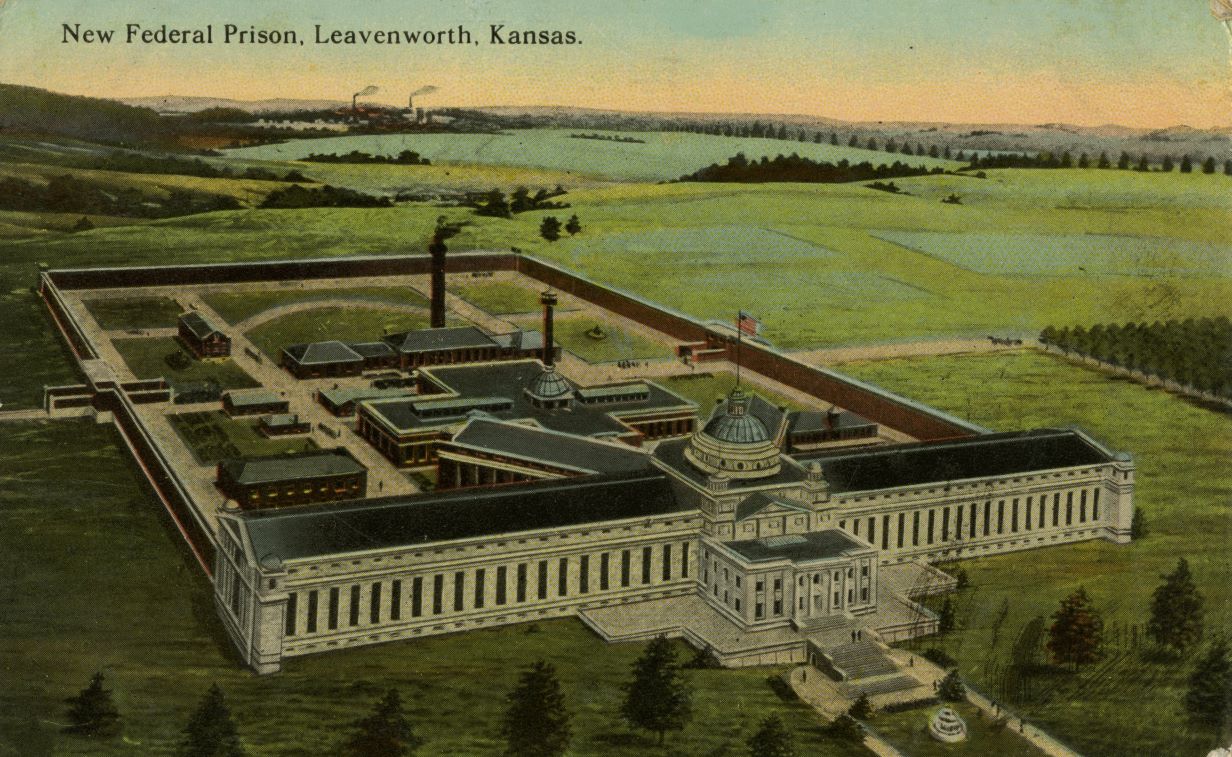
A THIRTY foot wall crowns a long, smooth hill a mile from the drowsing town of Leavenworth, Kansas, in the countryside where John Brown’s men argued abolition with rifle and dirk. A south front, with a facade of white stone that looms, glistening and majestic, against sunny skies. Gravel driveways to the entrance. To right and left, wide lawns and sumptuous residences for the warden and his deputy. Black soldiers, now convicts, who resisted lynching in Texas, scrub and flunkey here. Before the double-barred “main gate” a tower rises from the lawn. Above, a tobacco-chewing Cerberus paces with rifle and pistol belt, challenging all comers. Trusty prisoners with “outside passes,” wearing yellow stars, lounge about. Guards, hard-faced men in cheap blue uniforms, twirl clubs and loll at the steps. They are paid seventy dollars a month by a prodigal government and-they belong to the A.F. of L.
Occasionally, across the peaceful stretch of lawn, come “fresh fish”–new prisoners, manacled and watched by a dutiful agent of the law. Dutiful but often drunk. Some new men wear clothes that are good but in disarray. Others, often many in a group, netted out of lousy jails where they starve and wait their fate, lack coats, sometimes shoes, always baths–and the posture of freedom. Wan-faced, wide-eyed, they glance about covertly, speaking no word in the presence of the monster which is about to swallow them. Sharp commands. Pale apprehension seizes them as the outer gate swings inward, a name is checked off, a soul expires and a body becomes a number…
They must not look backward now; they must not glance a farewell to the reposeful wooded hills and the green slope of lawn, where, on Sunday evenings, come the lovers of the village with their gay and laughing girls, to listen to the prison band…
INSIDE. Ten acres of hell surrounded by a thirty foot wall. Birds fly over it. Happy birds that feed on horse dung and can fly across the wall. Prisoners envy them…
From the air the sparrow sees brick streets separating brick buildings within the inclosure, mostly massed against the south wall. There are the cell houses, the cages full of men-two or three thousand men in cages. The shops lie scattered, the kilns of the brick-yard belch smoke and sulphur fumes at one corner and, in the center, the power house lifts its smoke-stack a hundred feet above the pavement. Here is the siren which blows, bellowingly and screechingly, warning farmers of the country that a convict has escaped, telling them to seize their shot-guns and join the man-hunt for lust of blood and twenty-five dollars “dead or alive.” The happy birds that feed on horse dung and know nothing of rules, pause, terrified at this weird, metallic screaming. Then they flutter across the wall… Prisoners are sent, when “escape” blows, to their cells… The guards join the man-hunt…
INSIDE the cell-houses. NSIDE the cell-houses. Huge shells of buildings erected around and over-but without touching at top or sides- the “cell-block”; a rectangular pile of steel and stone, twenty odd feet wide, a long block long and five crouching storeys high. Between it and the cell-house wall, all around and above, is twenty feet of space. The cell-block is the kernel in the shell of the cell-house. There are four cell-houses. Not one cell opens a window to the day; each is windowless; each but a hole dug into the rock of the cell-block, little box-like holes, nine feet deep in the rock from each side of it, seven feet high and just four feet six inches from wall to wall. The front, open upon brass railed runways around the whole block of stone, is all of steel bars three inches apart. Five layers of cells, one over the other, with an approaching stair at one end of the block.
You enter a cell through a door of bars in the front wall of bars. A sense of utter powerlessness overcomes you as the guard turns the key. From the half light of the front you look into the gloom at the back. Faintly discerned objects outline themselves. Between the cell wall at one side and the double decked bunk-occupying most of the cell–at the other, there is scarcely walking room. At the inner end a small wash-bowl with a spigot of cold water. This is a face bowl, bath-tub and laundry for you. Beside it the toilet bowl. “Hmm…not so bad.” Wait!…
Night comes. The cell-house fills at five o’clock, with grey-clad, silent men, marching in rows, stolid and resigned, to their cells. Continuous crashing of steel on steel as doors are shut and locked. Guards shod with “sneak shoes” pass your cell with suspicious glances, counting you. You must stand. You are a number. You are a cadaver. You are reckoned up as so many cadavers. If no cadaver is missing you may sit on a canvas stool after “count.” Guards pass the cell silently, looking in. You are watched. Always you feel, always you will feel through the years to come, that you are watched. Asleep or awake, in mute anguish or silent merriment, hostile eyes will be upon you…

By a weak electric light that burns overhead you may read, but as you read the guard pauses in front of your cell and you look up, apprehensively; you lose your page and the power to immerse yourself. You may write, but the guard pauses, gazing critically, a symbol of constraint. Censorious eyes will read every word you write to your wife, to your sweetheart, to your friends. Vulgar men, prisoners chosen for servility, will laugh at your most sacred emotions. They will read each message from your loved one before you do…Dare you complain in a letter of the slightest detail of prison, dare you assert with but the usual boldness of the citizen the criticisms of government heard in the street, and your letter will be turned over to the warden, your number called next day, your cadaver hailed before authority, despotic, ignorant, vindictive, phobiac; and you will be sent to “the hole” on bread and water and a bed on the floor–a wooden plank. Your “writing privilege” will be cut off, your loved ones will wonder, worry and become frantic. You will vision it, and you will come to know the cynic truth in the saying of prisoners that your friends forget you at once, that a sweetheart lasts six months–sometimes, a wife remembers her wifehood but a year, and only a mother never forgets…Yes, you may read and you may write in Leavenworth!…
The Liberator was published monthly from 1918, first established by Max Eastman and his sister Crystal Eastman continuing The Masses, was shut down by the US Government during World War One. Like The Masses, The Liberator contained some of the best radical journalism of its, or any, day. It combined political coverage with the arts, culture, and a commitment to revolutionary politics. Increasingly, The Liberator oriented to the Communist movement and by late 1922 was a de facto publication of the Party. In 1924, The Liberator merged with Labor Herald and Soviet Russia Pictorial into Workers Monthly. An essential magazine of the US left.
PDF of full issue: https://www.marxists.org/history/usa/culture/pubs/liberator/1923/08/v6n08-w64-aug-1923-liberator.pdf
 Revolution's Newsstand