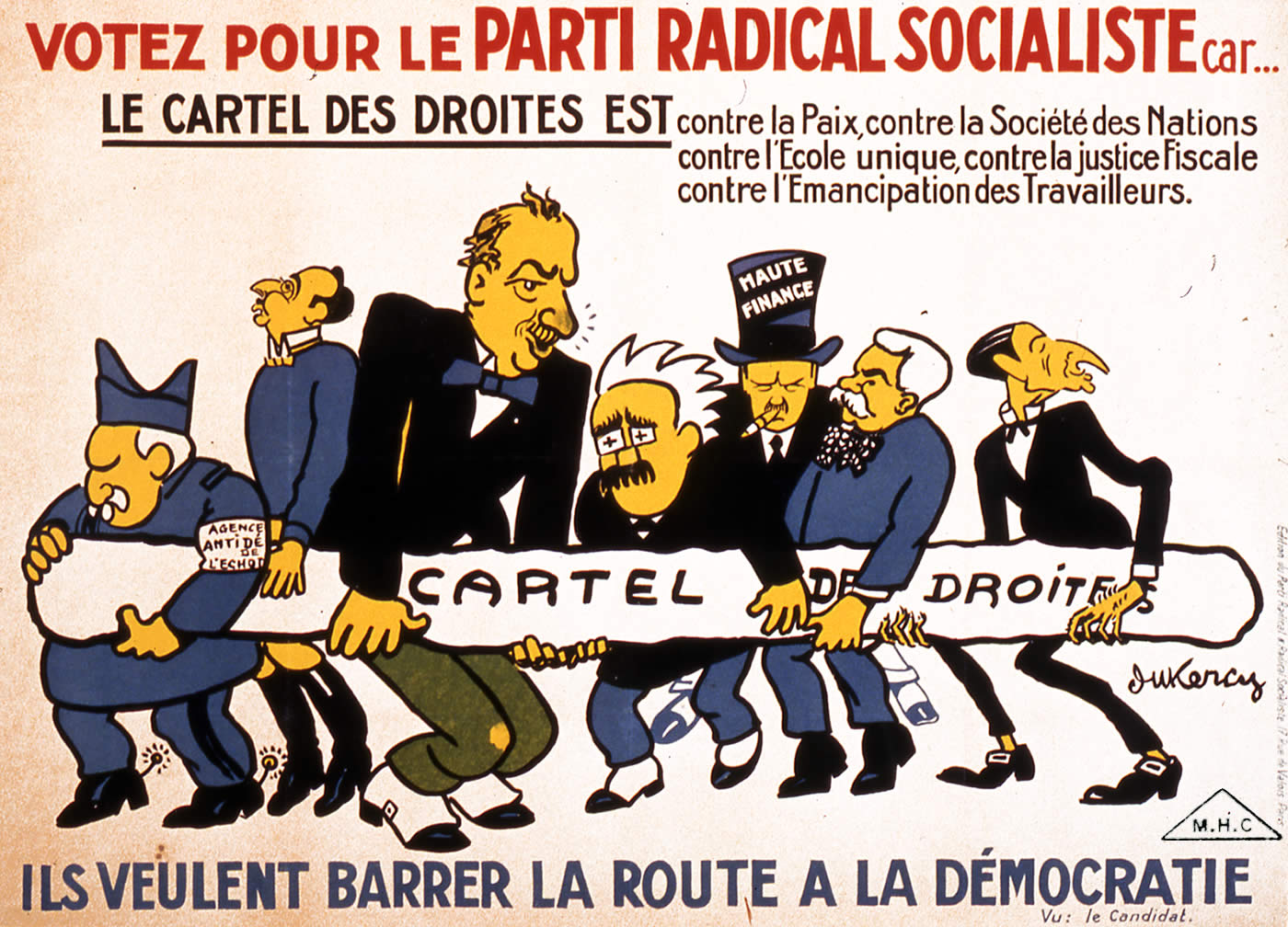
Veteran revolutionary Charles Rappoport writes in the run-up to the 1924 French legislative elections which saw the victory of the Cartel of the Left alliance of the Socialist Party and Radicals. The French Communist Party received nearly 1 million votes, or 10%.
‘The Electoral Struggle in France’ by Charles Rappoport from International Press Correspondence. Vol. 4 No. 24. April 10, 1924.
The Mustering of the Parties.
André Tardieu: “Liar! Miserable wretch!” Franklin-Bouillon: “You should be the last one to talk!” Electoral Meeting at Sèvres.
This is only a beginning. The electoral exchange of compliments is to be continued in the same tone between the hostile brethren of the bourgeois block, who, at bottom, have the same ideas, the same hate of revolution and of Communism, but who possess divergent electoral appetites and interests.
For the Communist Party the task is not only to take note of these blows and to derive profit from them. It must, in the first place, unmask all the bourgeois parties and their conceptions, setting out with full details a faithful record of their stupidities and of their crimes.
First let us cast a general glance over the political chessboard and the large parties engaged in the fight. For the moment we will pass over the parties “standing outside” and all kinds of malcontents of the latest fashion, seeking for social position and parliamentary seats.
There then remain three large parties, representing three large social classes, striving with their utmost means to attain power.
1. The Party of the Bloc National representing a nondescript coalition of capitalist greed and interests.
2. The democratic party (Radical-Socialists) represents the middle and petty bourgeoisie (non-socialist peasants, small annuitants, small shop-keepers, all kinds of brokers, and those members of the liberal professions who have not abandoned themselves to the reaction). This middle and petty bourgeoisie is menaced with irreparable ruin. And during critical moments flies to the opposition in the full hope of reestablishing itself with the aid of parliamentary power and of credits.
3. The Party of the Working and Peasant Class. While waiting for the full development of class consciousness, we are unfortunately obliged to consider as one of the parties of the working class, the socialist “Party” (S.F.I.O.) which still has in its ranks misled proletarians, credulous peasants and exasperated petty bourgeois. To-morrow, it will confound itself with the Radical-Socialist Party, which is neither radical nor socialist. The day after to-morrow, all the elements of the left will assume the socialist label, omitting the prefix “radical” which, since it extends from Perchot to the editors of the “Lanterne” and of the “Rappel”, has lost all serious significance. At such time, the socialist party, section of the “International of the Royal Ministers”, as stated by the citizen Barthelemy Mayeras, one of the distinguished members of this same quasi-International, will lay all its cards on the table, will throw off its mask and proclaim itself a party of the counter-revolutionary order.
The situation will become clear and definite. The workers and peasants class will be represented solely by the Communist Party, Section of the Communist International.
The three parties (Bloc National, Radical Party, Socialist Party), whatever they may be saying and doing, have common features, common interests and even a common mentality.
First of all, they have a common foe: the Revolution, and its Party: Communism. Beginning with M. Poincaré, including M. Herriot, right up to Blum-Paul Faure, they have a horror of the revolution, not of the word, but of the thing itself. For these three parties, the revolution is an accomplished fact, or, according to the classic formula of reformism, is accomplishing itself every day, by means of reforms. For these three parties the question is how to seize power by means of the parliamentary, of the legal method.
The socialist party having once attained power in France, will repeat the same acts, the same gestures, as were performed by its “brother parties” of Germany with Ebert-Noske-Scheidemann, of Sweden with Branting, of Belgium with Vandervelde, of England with Ramsay Mac Donald. This is not a hypothesis, a supposition, a polemical slogan. These are facts which strike the eye. The Hamburg Socialists have been governing, are governing and will be governing the capitalist Society on behalf of and for the profit of the capitalist Order.
The bourgeoisie, particularly the stupid, ignorant and terrified French bourgeoisie, will need a bit of time before it can grasp the fact that it is to its interest to clear out the Bloc National which is ruining and rendering ridiculous the capitalist regime in itself, and that the radical party in itself is without backbone. As instinct of self-preservation opens the eyes of the blindest, so even that great baby, the French bourgeoisie, will realize in time, that its best game-keeper is the party which calls itself socialist, which at one time played the poacher role in the struggle between the propertied and non-propertied classes.
There is still another fact welding together these three parties and making of them a block of capitalist conservation, in spite of temporary divisions. This is the so-called national interest, the so-called national defense. Anyone listening to Paul Boncour or Varenne when speaking on vital questions would think he was hearing an oration by M. Poincaré. One must not give heed to Blum, or to Longuet, because these citizens, being the mouth-pieces of another phraseology, will speak of other things, while voting in war-time for war credits.
Organized Communism must therefore fight to the bitter end against these three parties of different origin, but of identical counter-revolutionary import. This is not altered by the fact that each of these three parties has its own particular character, its political apparatus, its own methods.
We must thoroughly understand their real nature in order the better to fight against them.
International Press Correspondence, widely known as”Inprecor” was published by the Executive Committee of the Communist International (ECCI) regularly in German and English, occasionally in many other languages, beginning in 1921 and lasting in English until 1938. Inprecor’s role was to supply translated articles to the English-speaking press of the International from the Comintern’s different sections, as well as news and statements from the ECCI. Many ‘Daily Worker’ and ‘Communist’ articles originated in Inprecorr, and it also published articles by American comrades for use in other countries. It was published at least weekly, and often thrice weekly.
PDF of full issue: https://www.marxists.org/history/international/comintern/inprecor/1924/v04n24-apr-10-1924-inprecor.pdf
 Revolution's Newsstand