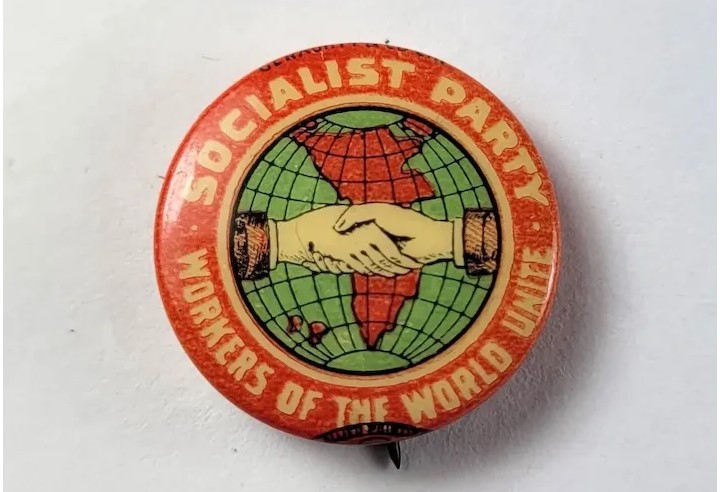
Future Communist J.O. Bentall was major figure in the Socialist Party of the Upper Midwest, and in 1910 was Illinois Socialist Party State Secretary. Overshadowed by Chicago, downstate Illinois has a tremendous history of class battles and radical activity. Bentall describes Party organization in the state, which in 1910 had just over 4000 members. By the time of the 1912 elections it had nearly 7000.
‘Illinois Works for Socialism’ by J.O. Bentall from the Chicago Daily Socialist. Vol. 4 No. 159. April 30, 1910.
Fight Being Made for Organization and Education of Workers
Socialism in Illinois is getting into good shape. For two years we have laid especial stress on organization and education and results are most gratifying.
The State Committee clings to a definite plan and the wisdom of this is apparent in every development of the movement.
Work of Organizers
1. We are employing first-class organizers who go from plans to place encouraging and reorganizing locals and placing before them the most vital elements of our method as well as breaking into new and unorganized territory wherever possible.
This is a work that has a two-fold effect:
(a) It helps the organizations to keep alive and improve.
(b) It adds new blood continuously to the constituency,
2. We are laying special stress on the distribution of literature. Only a comparatively people can be kept on the road for poking purposes, but hundreds and thousands of comrades can become effective educators by placing good reading material in the homes of the workers.
Have Definite Plan
In order to make this as systematic as possible we have formulated a definite organization plan. An outline of this diagram and samples of the card system was published in the Chicago Daily Socialist on April 15.
The fundamental idea in the plan is to locate a comrade in a specific territory and make him responsible for everything that is to be done within the prescribed limits.
This comrade is in charge of the distribution of literature, securing of members for the party, collecting dues, advertising meetings, selling tickets for lectures, taking subscriptions for pa- pers, collecting data with regard to the voters, bringing Issues before the people during campaigns, getting Socialist voters to the polls on election day, securing a correct count of the ballots,-In short, to manage his territory from the simplest form of propaganda to the keenest form of political action.
Card System Used
A complete card system is worked up which is simple and easily handled. An outfit or cabinet is furnished to the locals at cost. This plan has been adopted in a number of states already and results are better even than was anticipated.
“The Next Step”
Our regular literature consists of a monthly publication called “The Next Step” issued by the State Committee. Plain and easily read articles, as well as state news, make up each number. Our last issue was 90,000 copies.
A considerable quantity of this went into states outside of Illinois. This paper is sent out at 10 cents a year to individual subscribers, 15 cents in Chicago. In bundles it is 10 cents a hundred, $1 a thousand.
3. In addition to the organizers and the continuous distribution, we get good lecturers into the state for services of a special nature. We feel that one good, large and successful meeting is worth a dozen small failures. We, therefore, arrange to have these lectures as a feature in the local that arranges for them.
Ticket Selling Plan
We have adopted a plan of selling tickets which has proven especially helpful. There are four advantages connected with this method, as follows:

(a) You get a chance to talk to the people in your effort to sell a ticket. This means a great deal more, frequently, than a whole lecture.
(b) You get the money, so that whether the night is good or bad, you have covered the cost of the meeting. We frequently fall down on finances when the weather is against us.
(c) We get the crowd. A person who has paid 10 cents will generally make it a point to come to the meeting. He feels that he wants his money’s worth, and is not going to let a few drops of rain or a little wind scare him away.
(d) People who have paid for a lecture generally expect something worth the while. They also come with a mind more ready to receive than they would without having put anything into the affair. The meeting is part of their own and they are more largely influenced by the lecture. The speaker is also spurred on to do his level best when he has before him a good crowd and one that expects full returns.
Of course, there are poor people who want to go to a lecture occasionally but cannot afford a dime. There is nothing, however, to hinder the local to give such a one a complimentary ticket. A ticket meeting always raises the standard and gets better results.
Enlist Them All
You can also enlist all the comrades in selling tickets, which adds to the advertising value of the effort. It means that all this work has to be done in advance. Never depend on people coming to the window to buy tickets. Sell them a week or two ahead of time. One hundred tickets sold in this way generally clears all expenses. If rightly handled, a local in a good-sized town can easily sell from four to five hundred tickets, and you see how that mounts up.
These meetings do that which literature cannot do. They provide an opportunity for great masses of people to come together and get the inspiration of the human voice as well as the spirit that pervades gatherings of this kind.
Milwaukee Enthusiasm
The Milwaukee victory threw the entire state, as well as the whole nation, into a condition of enthusiasm. We were very fortunate in having laid a very solid foundation so that we could meet the exigency in the new awakening. We have the literature ready and our organizations are in shape and our working force on the ground to take hold of the increased interest.
We have had on an average of four organizers in the field since the first of January, 1909. Comrade F. T. Maxwell has not missed a single day since that time and has done a most valuable work. He has spoken every day and Sundays two and three times, which is a record-breaker in the work.
Work of Organizers
Miss Anna Swanson has also spent four months continuously and her work has been commended very highly wherever she has been.
Ralph Korngold has given three months to Illinois and his efforts have been exceedingly welcome.
F. G. Strickland has been engaged for several trips through the state with the specific object of delivering lectures to well organised locals for the purpose of bringing the greatest possible enthusiasm into the city where he enters. His meetings have been big and his lectures eagerly received.
National organizers have also done considerable work within our borders. Our membership has steadily increased and the working capacity of the organizations have multiplied manifold.
Spring Election Results
During the spring elections we were successful in a number of places where the Socialist ticket landed its candidates. Ledford elected a mayor, Shelbyville an alderman, Litchfield a street commissioner, Herrin two school directors and in Rockford a park commissioner.
In a great number of places we came so close to the capitalist tickets that only a few votes were lacking to carry our candidates into office. In a great majority of cases the vote has more than doubled and in no part of the state has there been a decrease.
We are rapidly gaining a foothold among the unions and are utilizing organized labor in every possible manner. We are taking an active part in every strike and showing the union man that the Socialist Party is here to be used as an instrument to rid him and all other workers of the shackles forged by capitalism.
The outlook in Illinois is exceedingly bright. We stand face to face with the period in the movement that will place the Socialists in control of the political field and thus secure for the workers their complete emancipation.
The Chicago Socialist, sometimes daily sometimes weekly, was published from 1902 until 1912 as the paper of the Chicago Socialist Party. The roots of the paper lie with Workers Call, published from 1899 as a Socialist Labor Party publication, becoming a voice of the Springfield Social Democratic Party after splitting with De Leon in July, 1901. It became the Chicago Socialist Party paper with the SDP’s adherence and changed its name to the Chicago Socialist in March, 1902. In 1906 it became a daily and published until 1912 by Local Cook County of the Socialist Party and was edited by A.M. Simons if the International Socialist Review. A cornucopia of historical information on the Chicago workers movements lies within its pages.
PDF of full issue: https://www.marxists.org/history/usa/pubs/chicago-daily-socialist/1910/100430-chicagodailysocialist-v04n159.pdf
 Revolution's Newsstand