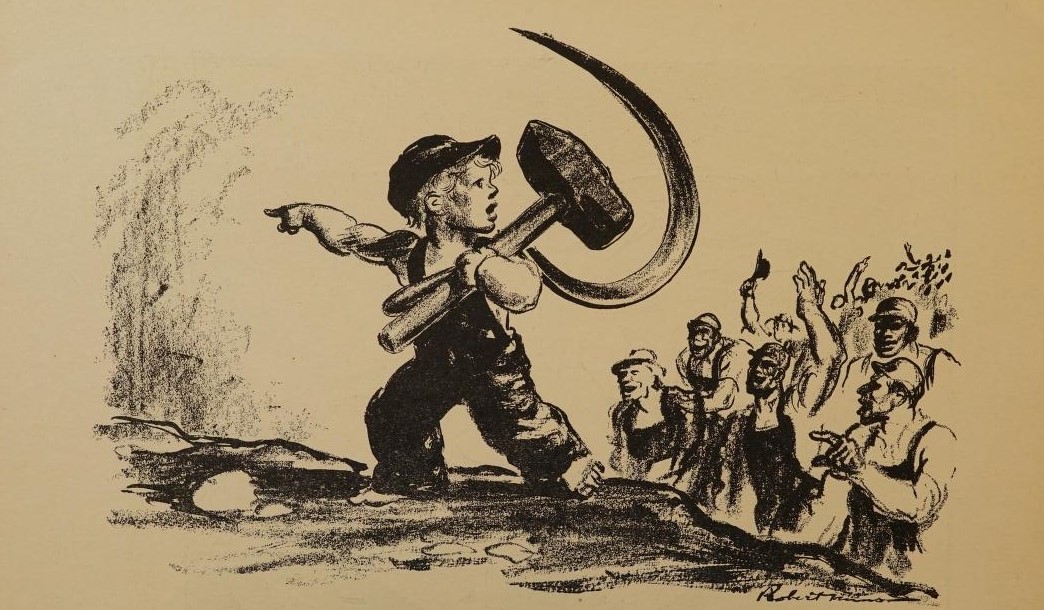
A leader with William Z. Foster and James P. Cannon of one of the two main factions in the early Communist Party, Dunne lays out their perspective for work in the unions, and the broader orientation to the working class through the shop floor rather than through party political campaigns.
‘Communists in the Labor Unions’ by William F. Dunne from The Worker. Vol. 5 No. 234. August 5, 1922.
There are certain individuals who, because of a disposition for study and leisure to indulge it, have acquired more than the average knowledge concerning the history of social development, the struggles of the exploited masses, and the revolutionary nature of the conflict that rages in society.
Equipped with this knowledge, they feel that they hold the key to all the problems that bedevil the workers and they are very impatient with the mob which continues to butt its head against a stone wall and apparently refuse to see that most of its efforts are wasted.
It is because of the impatience of the so-called intellectual with the workers, his contempt for what he terms the petty nature of the endless struggle for more bread and butter, that until recently almost all revolutionary political movements were of a sectarian character. The truth was in the possession of a few, they had the word and the light and they would not risk contamination; their trust was too sacred for that.
When the Russian Revolution upset all the established theories of revolutionary tactics and demonstrated that just as important as unsullied intellectual purity was the participation in the everyday struggles of the working masses as the most active and skillful section of the organized workers, a striking change took place in all revolutionary movements.
The New Humility.
Intellectuals began to manifest a humility that was in striking contrast to their former lofty disdain for those who had not received the revelations and consequently could not quote verbatim from the revolutionary classics; in the unions now the theoreticians meet the workers to whom they formerly talked from outside and they appear to think that in so doing they are carrying out both the letter and the spirit of the slogan “Go to the Masses.”
The great mass of mankind, however, does not learn by listening to and analyzing speeches, no matter how many truths they may embody, nor by reading literature, no matter how ably written and how timely.
The mass of workers especially learns from experience, by the constant impact of the thousands of bitter facts connected with their daily tasks of earning a precarious livelihood. Those who aspire to leadership in the class struggle will find that the workers will judge them by their deeds rather than by their words. If they can frame policies that meet the immediate needs of the workers in the organizations of the workers, they will automatically acquire — indeed, it will be thrust upon them — leadership and the responsibility that goes with leadership.
Theory Not Enough.
Being theoretically sound, it should be easy for Communists to convince the workers of their right to responsibility. They know and understand the real basis of the conflict; understanding the mechanism of the social system they can predict, in a large measure, the outcome of the various struggles in which the workers are forced to engage from time to time. They cannot, however, depend upon their theoretical soundness alone to win the workers because few workers have the time and many have not the mental capacity to make decisions by pure reasoning. To those who fight and get results will leadership go and to no others.
Good union men who are Communists will have little difficulty in extending the influence of the party because the American worker, in forming an opinion of movements, attaches much importance to the individuals who represent them. A Communist who can give cards and spades to Marx and beat him hands down, but who makes grave mistakes in the union can do the party more harm at the present stage of its development than all the attacks of the reactionaries.
Learn from the Enemy.
Just as the employers marshal their best tacticians for the war upon the workers in the industries, so must the Communists train their fighters for the work on the industrial field. Into the party must be brought the best brains and courage of the labor movement; the party workers who have special ability for industrial work must be trained to skill and efficiency. Theory and practice must be combined to build a machine that can withstand all the attacks from the actual enemies of the labor movement and those whose lack of understanding lends aid and assistance to the enemy. The workers must be made to see that Communists do not seek strategic positions merely because they desire to hold and wield power, but because they can serve the interests of the working class better than those who see in the labor movement only an opportunity for personal advancement.
Work All the Time.

There is no magic in the word Communism that will cause the workers to rally to its standard. The service that the Communists render to the labor movement will be the yardstick by which the workers will measure the value of the Communist Party, and it is that alone that will determine its influence in the class struggle in the United States.
Communists have a year-round task; they do not come out only at election time and appeal to the workers for votes, but their work must be more intensive every day than were the election campaigns of the Socialist Party in the old days.
It is for this reason that the activities of the Communists assume more importance from the standpoint of the individual member than those of other organizations calling themselves revolutionary. It is upon the activity of the membership and the value of its activities to the labor movement that the party is judged. Inactivity is inexcusable and is worse than making mistakes; we can learn from our mistakes, but from inactivity we cannot even learn. The criticism of our opponents, their pleasure at our mistakes, must be taken as incidents in the struggle.
Different Types of Workers.
All Communists are not good theoreticians nor are all good practical workers; success cannot come if positions of responsibility are filled in haphazard fashion. There are some gifted comrades who combine these qualities, but they are few and far between and the supply will always be small. Just now it is more than ever important that workers should be assigned tasks for which they are fitted, but to do this is particularly difficult when theorists want to be down in the daily struggles and practical workers want to write theses.
The mistakes made so far have largely been due to the selection of workers who were inexperienced in the particular field to which they were assigned; the many spheres of party activity require large numbers of specialists that cannot always be secured and makeshift selections have to be made. Time is the remedy for this condition, which could only occur in a party that is trying to do something.
Conclusions.
All this is by way of saying that Communists must take the labor movement for what it is and not for what it should be or what they would like it to be; intellectual egotism is out of place in the labor movement, and in all probability our past mistakes will do much to make us realize that in the unions there is no protecting halo around the head of Communists which makes them immune from the penalty of mistakes.
In the unions a Communist is only a union man, and the unions will be communist in sympathy only insofar as communist policy, as carried out by the workers of their unions, fits in with the needs of the organized masses.
The Daily Worker began in 1924 and was published in New York City by the Communist Party US and its predecessor organizations. Among the most long-lasting and important left publications in US history, it had a circulation of 35,000 at its peak. The Daily Worker came from The Ohio Socialist, published by the Left Wing-dominated Socialist Party of Ohio in Cleveland from 1917 to November 1919, when it became became The Toiler, paper of the Communist Labor Party. In December 1921 the above-ground Workers Party of America merged the Toiler with the paper Workers Council to found The Worker, which became The Daily Worker beginning January 13, 1924.
PDF of full issue: unavailable.
 Revolution's Newsstand