
The sparsely populated, Finnish speaking Karelian Workers Commune was established in 1920 (or 1918 depending) and existed until 1923. Leading Finnish-American Communist and pioneering cooperativist George Halonen acted as U.S. emissary for the Commune. Hanolen would be expelled from the C.P. as a ‘rightist’ in 1929, largely over differences of the relationship of the Party to the co-operatives.
‘The Karelian Workers’ Commune: The Beginning of a Red Scandinavia’ by George Halonen from The Toiler. No. 167. April 16, 1921.
Soviet Karelia, or the Karelian Workers’ Commune, is a red neighbour to White Finland and White Scandinavia. Diplomatically it may be called a Red “buffer state,” a bulwark of Soviet Russia against the Northern White world.
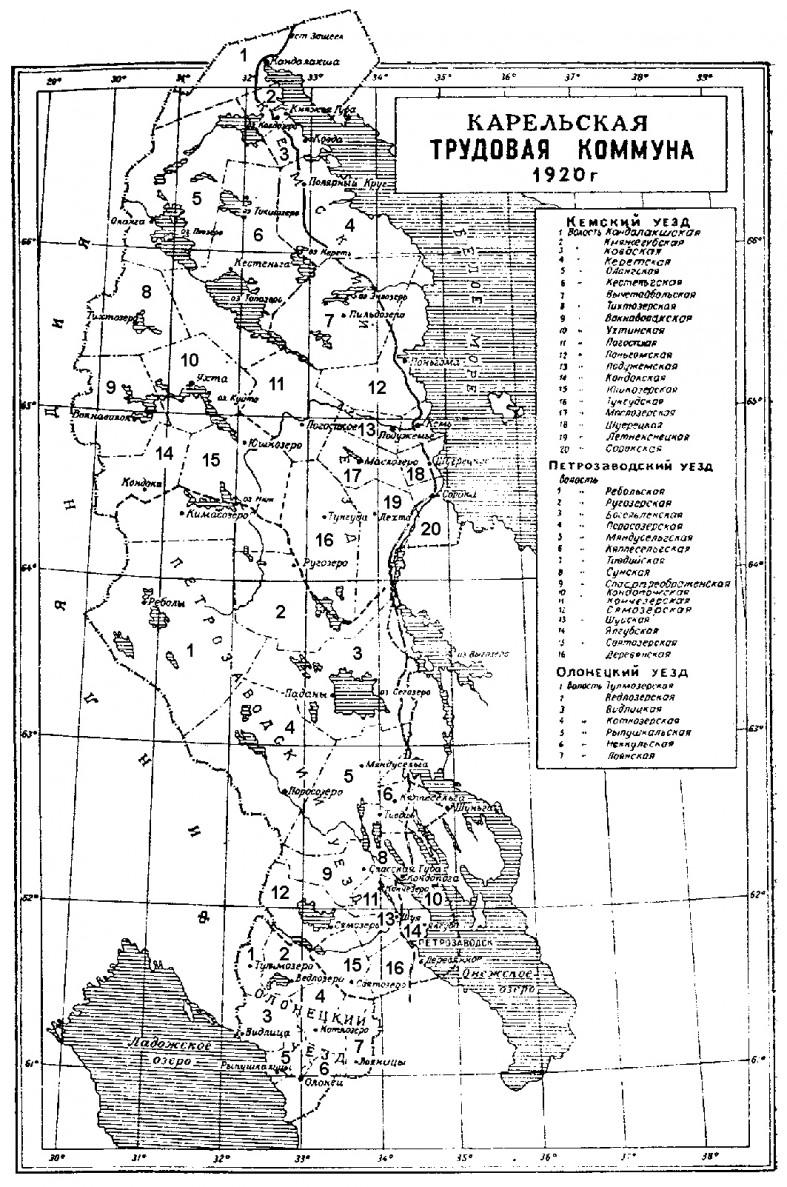
The Karelian Workers’ Commune was officially formed June 7, 1920, by a degree of the Soviet government of Russia. The Commune extends from the River Svir, in the south, across Lake Onega to the White Sea and around Kola peninsula to the Finish frontier, and again southward for a thousand miles along white Finland. This equal to area about two-thirds of Finland, contains but a small population, about 300,000. The politically and economically important Murmansk railway runs entirely through this district.
This Commune was established because revolution and only revolution will realize the self-determination of small nationalities. When the imperialistic states speak about the self-determination of small nationalities, they “realize” it by submitting them to the imperialist yoke. Under the guise of self-determination, the natural riches and the peoples of the small nations are exploited and oppressed.
White Finland, in its imperialistic dream about “Great Finland,” also spoke about the “self-determination” of Karelia. The Karelians happen to be kinsmen to the Finns. Their language is very much like Finnish. This was enough for the Finnish imperialism to speak about “self-determination” of Karelia.
Economic Base of Finn Regard.
In reality the kinship of the Finns and Karelians was not the cause of the Finnish “love” of Karelians. The Finnish bourgeoisie, now playing with imperialism, knew something about the great natural riches. of Karelia. There are great areas of forests. The total forest area is about 100,000,000 hectares, or one and one-half times that of Norway! The timber is worth hundreds of millions of dollars! So, it pays to speak about the “self-determination” of Karelia in order to gain possession of this great wealth.
Karelia is also rich in minerals. Even coal veins have been discovered. Also zinc, copper etc. Iron ore is in abundance. These possibilities have been but little investigated. A single lake, Vikujavri, showed by investigation to contain about 11,000,000 tons of bog iron ore!
The lakes and rivers are supplied with fish in great abundance. Water power can be obtained from many great water falls; all of which means that once developed, Karelia will be one of the most important industrial countries of Northern Europe.
The Finnish capitalists wanted the “self-determination” of Karelia and of course, themselves as “guardians”, in order to exploit and rob these natural riches.
After the Russian workers’ revolution, the Finish Whites concentrated a part of their mercenary troops in Karelia. The Allies also sent armies. The purpose was to form Karelia as a white basis against Red Russia. Karelians were oppressed and forced to join the anti-bolshevist armies, but many Karelians fled either to deep forests or when possible, joined the Red Army. The White Finns began their “self-determination” with plundering, robbing and murder.
The White rule, however, was put to an end by the heroic fighting of the Red army. And in the spring of 1920 the remnants of the Finnish Whites were driven from Karelia.
But in Finland as well as in other foreign countries the capitalists interested in the natural riches of Karelia, continued to speak about the “self-determination” of Karelia.
Their propaganda, however, was cut short by revolutionary Russia, which did not speak loudly about. self-determination for Karelia, but actually realized it.
Soviet Russia Decrees Self-government.
The Russian Soviet government published, June, 7, 1920, a degree concerning Karelian self-government. And August 4, the All-Russian Central Executive Committee and Soviet government officially designated the plan of frontiers of this new sister-republic of Soviet Russia. Wide self-governing powers were given to the Karelian toilers in their own national and economical questions.
This “Declaration of Independence” of the Karelian Workers’ Commune by the All-Russian Central Executive Committee and Soviet government, says in part as follows:
“Being in close touch with the workers of all nationalities residing in Soviet Russia, the working people of Karelia are now entering a new phase of their history. The future of the Karelian toilers rests in their own hands. On the basis of the self-determination of nations before them lies the unlimited possibilities of national development. The powerful union of the working peoples federated in Soviet Russia, will defend the rights of Karelian toilers, their national self-determination and their freedom from the yoke of all exploiters and oppressors. After fighting many hundreds of years against a barren nature for their existence, the Karelian toilers are now entering from oppression and exploitation onto the road of the family of different nationalities freed from all oppression and exploitation…
“Hand in hand with the toiling forces of the Soviet Republic, helping its heroic Red Army and allied with the splendid sons of kindred Finland, the Finnish red communist forces, the toiling people of Karelia are freed from the violence of the white armies and from the yoke of robbers and exploiters. The toilers of Karelia, as well as the other peoples of the Soviet Republic, have, in the form of the soviets of workers and peasants, at last received the means of the social freedom and peaceful cultural and national development. The supreme authority in Karelia will hereafter reside in the hands of the Congress of Karelian Soviets, but temporarily the affairs will be directed by the Karelian Revolutionary Committee. The Karelian Workers’ Commune, in accordance with the decision of the first All-Karelian Conference, will be in close touch with the Russian toiling people and as a whole with the Soviet Republic of Russia. Although being a part of the Republic, differing from its other parts through the national and economical conditions, it will receive its own able self-governing bodies with a wide liberty of action…
The Soviet government of Russia greets with deep joy the newborn Karelian Workers’ Commune, which joins the family of workers’ Soviet Republics, and it has full confidence that the Karelian Commune will grow and bloom as the advance guard of the working class in the far away North western part of the Federative Soviet Republic. The Russian Soviet government gives to the Karelian Commune its promise, that it will give all help and defend it in its work, seeing in this an important step in the great construction work of the World Soviet system.”
And so side by side the new Karelia, the Karelian Workers’ Commune, is arising from the runs of the capitalist system, erecting the workers own structure of society, Communism.
The Toiler was a significant regional, later national, newspaper of the early Communist movement published weekly between 1919 and 1921. It grew out of the Socialist Party’s ‘The Ohio Socialist’, leading paper of the Party’s left wing and northern Ohio’s militant IWW base and became the national voice of the forces that would become The Communist Labor Party. The Toiler was first published in Cleveland, Ohio, its volume number continuing on from The Ohio Socialist, in the fall of 1919 as the paper of the Communist Labor Party of Ohio. The Toiler moved to New York City in early 1920 and with its union focus served as the labor paper of the CLP and the legal Workers Party of America. Editors included Elmer Allison and James P Cannon. The original English language and/or US publication of key texts of the international revolutionary movement are prominent features of the Toiler. In January 1922, The Toiler merged with The Workers Council to form The Worker, becoming the Communist Party’s main paper continuing as The Daily Worker in January, 1924.
PDF of full issue: https://www.marxists.org/history/usa/pubs/thetoiler/n167-apr-16-1921-Toiler-rsz-chronAM.pdf
 Revolution's Newsstand