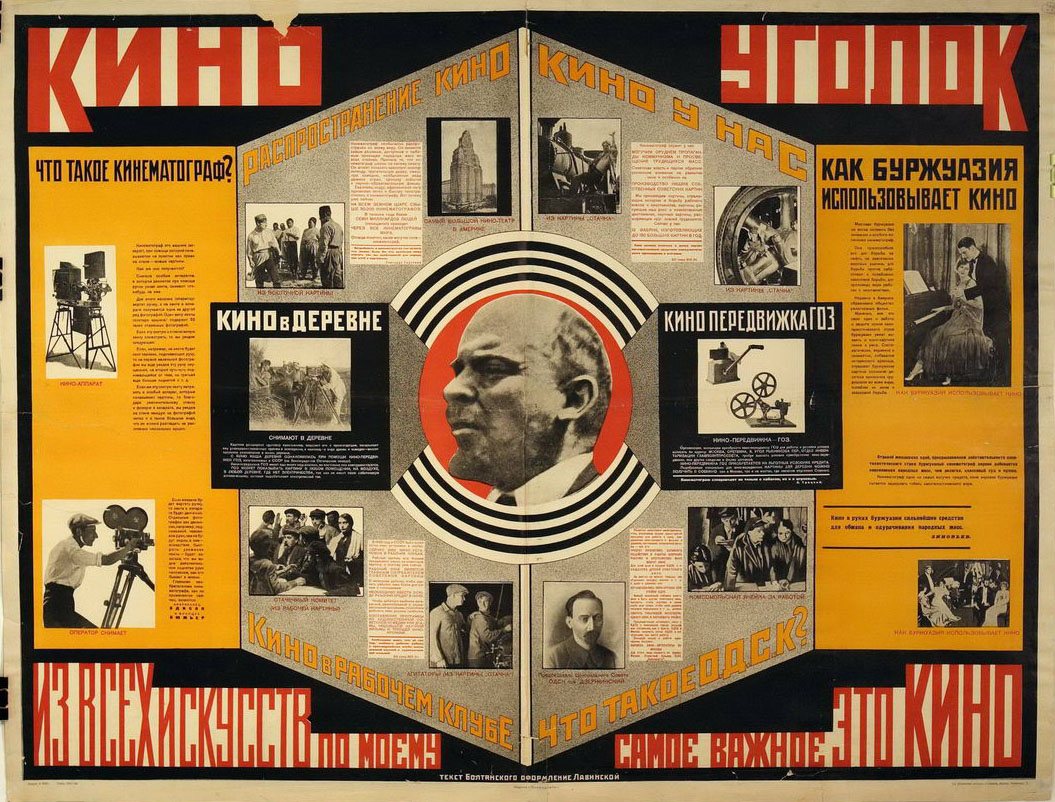
‘Capture the Film! Hints on the Use of Proletarian Film Propaganda’ by Willi Muenzenberg from The Daily Worker. Vol. 2 No. 166. July 24, 1925.
FERDINAND LASSALLE characterized the press as a new major power. The same can be said of the film, which, in some countries, has already achieved a greater significance than the press Itself. The total attendance in the movie theaters of England, France and the United States is perhaps even today greater than the total number of newspaper readers in those countries.
Even if the press were granted the greater numerical dissemination, let it not be forgotten that the film, thru the medium of the visual picture, influences its patrons far more strongly and emphatically than does the printed word its readers. He then develops the thought of the importance of technical progress in the film world finally convincing the last opponent of its value and permanence.
We must develop the tremendous cultural possibilities of the motion picture in a revolutionary sense the film must truthfully reflect social conditions instead of the lies and fables with which the bourgeois kind befuddles the workers, etc.
AS in many other instances, the working class organizations were the most timid and most tardy in the effort to put this new medium to their use. The time is not so far past when social-democratic leaders, in common with bourgeois ideologists, in all seriousness proposed to boycott the films because of their competition with the theater, their flattening of public taste and destruction of literary standards. Only after the war were timid attempts made to put the film into the service of working class propaganda. In various countries workers’ organizations arranged “Better Movie Nights” in which, besides the showing of educational and cultural films, criticism of current entertainment films was given. In 1922 in Germany the A.D.G.B. (All German Federation of Trade Unions) tried, thru the establishment of a “Peoples Movie,” to produce and exhibit socialistic working class pictures. The attempt was unsuccessful, but it was later repeated by the A.G.D.B. in the production and distribution of the film “The Smithy,” which, however, also failed of mass Influence. In the main the labor organizations and even the Communist Parties and groups have left this most effective means of propaganda and agitation unopposedly in the hands of their enemy.
The bourgeoisie, and especially the extreme nationalists and militarists very early recognized the significance of the film as a propaganda weapon, and constantly and most extensively put it to their service. Particularly far-reaching exploitation of the film took place during the world war, particularly by England and France which spent tremendous sums on film propaganda against the Central Powers in allied and neutral countries. Germany tried in vain to beat the opponent at this game, and even created a special film center for the purpose of pushing nationalist films to fan the war spirit. These films received little distribution outside of Germany and Austria. But it is beyond argument that the war and incitive films contributed very heavily to the creation of the chauvinist insanity in the war, and the post-period showed continued use of the films for the purpose.
WHILE in England and France a whole row of pictures proclaimed the military victory, the German producers were more concerned with awakening a faith in the possibility of a rebirth of the “good old times” of Germany’s “greatness.” A typical example of this series is the picture “Frederick, The Great,” which was mightily effective along this very line in petit-bourgeois and “spiessbiirgerlichen” circles.
In considering the development of the German film industry it is interesting to note the reflection of the current political tendencies. During the mounting wave of the monarchist movement which culminated openly in the election of Hlndenberg there was decided increase in the production and release of monarchist and militarist films.
The pictures, “The King’s Grenadier,’’ “Ash Wednesday,” “Reveille,” “The Tragedy of Major Redl,” etc., are typical examples of this tendency, and it would be very interesting to establish statistically in how many theaters, during the few weeks before the presidential by-elections these and similar films were shown to the public.
HOW far film is exploited for definite political ends Is shown in the large number of prejudice building films directed by European and American producers against Soviet Russia. For example the film “Death Struggle” (Todesreigen) produced in Berlin, which for months in practically all German cities conjured up on the screen the most unconscionable concoction of invention and fantasy of terror and horror on the part of the Soviet government against the Russian workers and peasants. In several industrial centers the workers became so enraged at this calumny that, as in Leipsig, they smashed up the projectors and burned the films. The attitude of these workers is entirely understandable, but it recalls its precedent in the early days of capitalism when the workers, feeling their livelihood threatened by the new machines smashed the new tools and set a red cock on the roof of the manufacturer. Only later did the proletarians learn that it does no good to destroy machines, but that what concerns us in the conquest of those machines and their application in a manner useful to the workers. Understandable tho the action of the Leipsig workers, it shows no workable remedy with which to meet the evil. Not the destruction of tools and technical equipment, but their conquest and their turning to the use of the labor movement, for the idea-world of Communism. One of the most pressing tasks confronting Communist parties on the field of agitation and propaganda is the conquest of this supremely important propaganda weapon until now the monopoly of the ruling class, we must wrest it from them and turn it against them.
The Daily Worker began in 1924 and was published in New York City by the Communist Party US and its predecessor organizations. Among the most long-lasting and important left publications in US history, it had a circulation of 35,000 at its peak. The Daily Worker came from The Ohio Socialist, published by the Left Wing-dominated Socialist Party of Ohio in Cleveland from 1917 to November 1919, when it became became The Toiler, paper of the Communist Labor Party. In December 1921 the above-ground Workers Party of America merged the Toiler with the paper Workers Council to found The Worker, which became The Daily Worker beginning January 13, 1924. National and City (New York and environs) editions exist.
PDF of full issue: https://www.marxists.org/history/usa/pubs/dailyworker/1925/1925-ny/v02b-n166-NY-jul-24-1925-DW-LOC.pdf
 Revolution's Newsstand