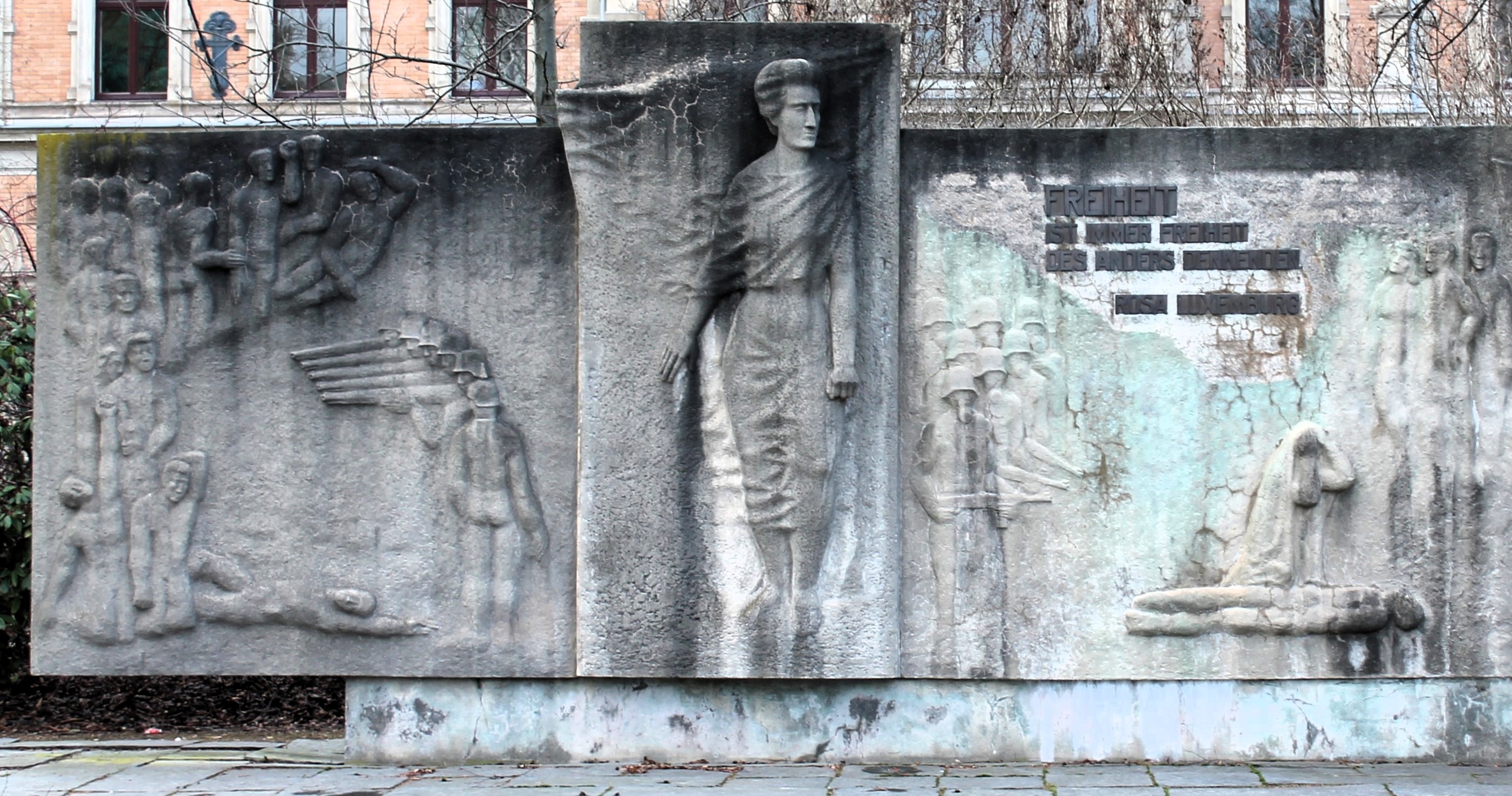
In August, 1904 a somewhat giddy Rosa Luxemburg began serving her first time in jail, Zwickau Prison, sentenced to two months for ‘offending the sovereign.’ In this letter to Karl and Luise Kautsky the names of Plekhanov, Singer, Bebel, Troelstra, Kurt Eisner, and George Gradnauer are mentioned as is the work of the International.
‘From Zwickau Prison’ (1904) by Rosa Luxemburg from Letters to Karl and Luise Kautsky, 1896 to 1918. Edited by Luise Kautsy, Translated by Louis Lochner. Robert M. McBride and Company, New York. 1925.
Undated. According to content Zwickau 1904. Dear Carolus:
Thanks for the information. I, too, had not expected much from the Press Committee.1 I shall now refrain for the present from publishing the article, for I can well understand that a press discussion can’t be conducted adequately from the prison cell. There is one thing, though, that I want to urge most earnestly upon you: write a few words to Plechanow2 (his address, if necessary, is to be found in my home), in order to inform him as to the fate of the article; he is waiting for its publication. Will you do that? Thank you in advance! Reassure him that later, when I am free again, we shall certainly find an opportunity to raise the whole question and to say the right thing in our press. (Tell him, too, that the executive committee of the party is on our side.)
So you now have other fights to fight! I am quite happy about this, for it shows that these dear people felt our victory in Amsterdam quite severely. As far as I can judge the situation, they intend to have their revenge at Bremen—and that is a broth that we shall salt good and hard for them! That’s why I am vexed at your envying me the cell. I don’t doubt but that you will hit Kurt3 George4 & Co. quite thoroughly on their so-called heads. But you must do it with spirit and joy and not as though it were a bothersome intermezzo, for the public always senses the spirit of the combatants, and the joy of battle gives resonance to a controversy and ensures moral superiority. To be sure, you are now quite alone, as I observe; August5 will surely remain in the vineyard of the Lord till Point 18, and Arthur dear and Pauly6 dear are “elegiac,” as you put it. Would that thunder and lightning struck them seven fathoms deep into the ground, if they can still be “elegiac” after such a congress!!—between two battles, when one is happy to be alive! Carl, this present “brawl” is certainly not a forced skirmish, fought out in the grey atmosphere of listlessness, such as you have been compelled to fight many a time in recent years! The interest of the masses is astir again; I feel it even here, penetrating through the prison walls. And don’t forget that the Internationale is now looking with bated breath upon us—I should rather say, upon you, for the starting point of the whole controversy is Amsterdam. I am writing you all this not to stir you up to rebellion—I am not so devoid of good taste as all that, but rather to make you happy at the controversy, or at least to transmit my joy to you, for here in No. 7 I can’t do much with that commodity.
Do you know, I have thought a great deal about Amsterdam, about the general position of the international movement and the prospects of our Marxism in the Internationale. There is so much to say to you about it, but that must wait. The moral of the whole story for me is this: there is an immense amount of work to do and especially an immense amount to study—I mean the movement in the different countries. I have a feeling that we (the Germans) will gain a supremacy and influence even by the mere knowledge of the movement in the other countries; and on the other hand I feel that we shall strengthen our position (in the narrower sense) within the German movement by our very approach to the Internationale. In a word, I am happy to be alive.
Please send me your articles, but in the form of clippings. I am sure that Clara is not “elegiac” but appreciates her contact with you and me. Both of you will have hot days ahead in Bremen. Do arrive at an understanding with her in time; one can depend on her. I should so much like to have a letter from her. Apropos of the 4th Volume,7 when will it appear? You see, I should like to write a review of it; a number of thoughts about this material are crowding into my head.
And now to you, dearest Louise, or rather, now only to you, for this whole letter is for you too. Oftentimes you understand my mood better and more quickly (if there is anything to “understand”). There was so much I wanted to write, and yet I must be so brief! Well then, only this much, that your letters put me in the sunniest frame of mind. Thank you a thousand times for every word. You are giving me such a vivid picture of your surroundings! Send the heartiest letters from me to Holland. Write often, but only when you like to—don’t force yourself to. I kiss you all and the boys. Greetings to Granny.
Your Rosa.
Louise dear, write to Troelstra and tell him that I shall embrace the first opportunity to visit Frau Sjoukje8 when we get there. You may send a photograph perfectly safely. Write me two words immediately from Bremen9 as to what the situation there is.
NOTES.
1. Of the “Vorwarts.” L.K.
2. One of the founders of the Russian Social-Democratic party. Transl.
3. Kurt Eisner, later premier of the short-lived Bavarian Soviet Republic. L.K.
4. George Gradnauer, Saxon socialist leader. L.K.
5. August Bebel. L.K.
6. Arthur Stadthagen and Paul Singer. L.K.
7. Kautsky was at that time preparing the fourth volume of Marx’s “Capital.” L.K.
8. Troelstra’s first wife. L.K.
9. Socialist party convention at Bremen, Sept. 18-24, 1904. L.K.
Letters to Karl and Luise Kautsky from 1896 to 1918 by Rosa Luxemburg. Edited by Luise Kautsy, Translated by Louis Lochner. Robert M. McBride and Company, New York. 1925.
Contents: Introduction by Luise Kautsky, Beginnings, 1896-1899, Incipient Friendship1900-1904, From the Imprisonment at Zwickau to the First Russian Revolution, The First Russian Revolution 1905-06, Up to the World War 1907-1914, Letters from Prison During the War 1915-1918, Postscript by Luise Kautsky, Appendix: Biography of Karl Kautsky. 238 pages.
PDF of original book: https://archive.org/download/lettersofrosalux0000unse/lettersofrosalux0000unse.pdf
 Revolution's Newsstand