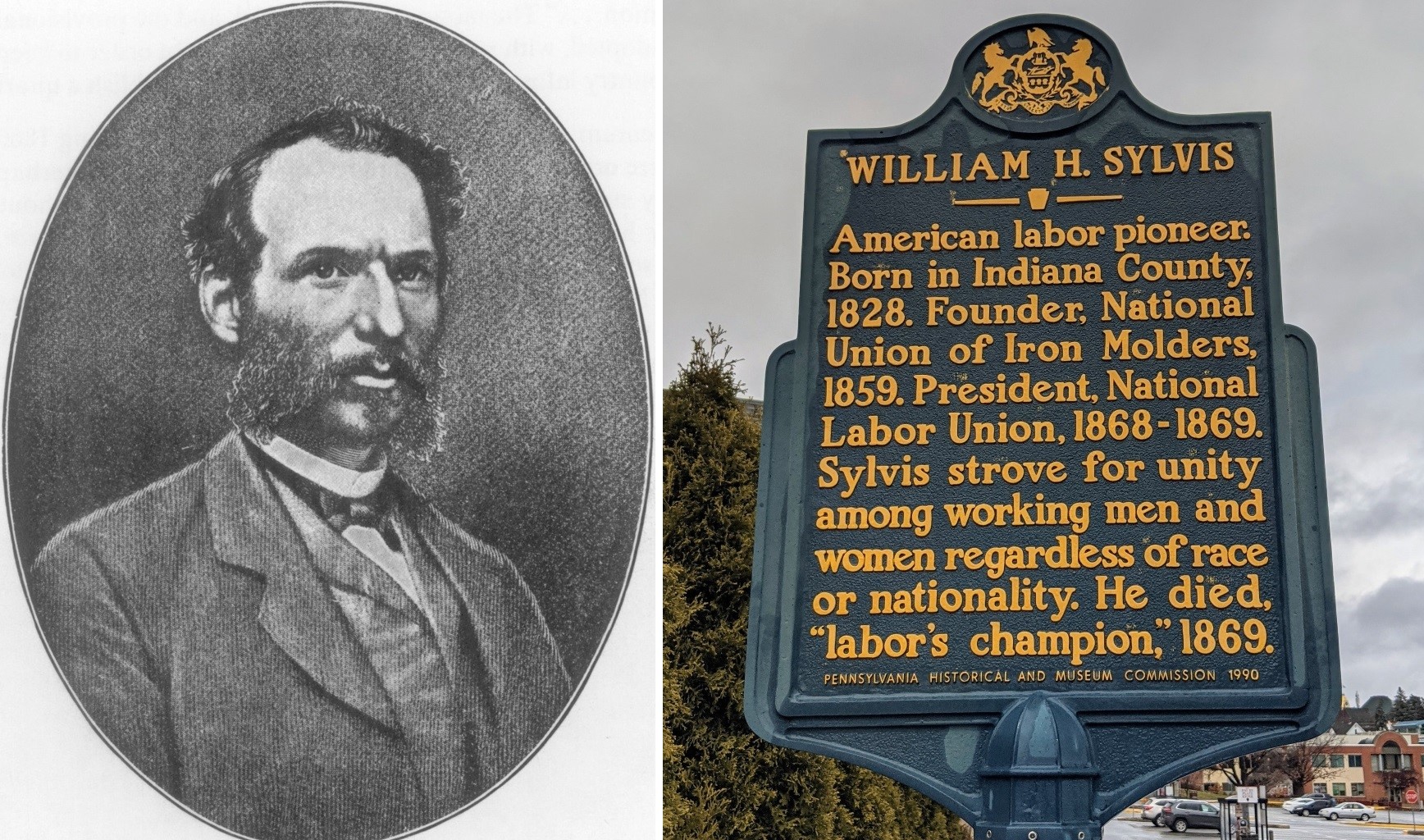
Overflowing tears at the funeral of the first great national U.S. labor leader, and a link to the First International, the iron molder and founder of the National Labor Union William H. Sylvis.
‘Sylvis!’ from The Workingman’s Advocate (Chicago). Vol. 6 No. 3. August 14, 1869.
THE NATIONAL CALAMITY. HIS LAST HOURS, ETC.
In the following article it is simply our intention to refer to the scenes attending the last hours of our dear departed friend, as the next issue of the ADVOCATE will contain a carefully prepared biographical sketch. We shall, therefore, confine our present remarks to an account of
HIS LAST SICKNESS.
On Thursday morning, July 22d, he came to the office as usual, and commenced the preparation of his address to the National Labor Congress, which be intended should be a full resume of the moment since his accession to the presidency, but shortly after felt so unwell that he was compelled to leave for home. At 5 o’clock his family physician was summoned, who pronounced his ailing to be a severe attack of inflammation of the bowels, but expressed the belief that the disease would speedily succumb to the remedies prescribed. His hopes or predictions were unrealized, as a restless night was spent, the disease increasing hourly in intensity. On Friday was cheered by the arrival of his friend, Richard Trevelleck, who, up to the hour his death, continued his constant attendant and ministered to his necessities. On Saturday he seemed considerably revived, so much so indeed as to make buoyant the spirit of his anxious friend, and encourage the hope that the crisis had been passed. These hopes were of short duration, for on Sunday morning it was deemed expedient to summon additional aid. Consequently consultation was held, and the terrible truth was made known that his sickness was unto death, of which fact he already seemed to be aware.
On Monday morning at 9 o’clock a great change for the worst had taken place, the disease having continued to baffle all aid and the skill of his physicians. At midnight his spiritual adviser, the Rev. Mr. Kemp, pastor of the Fitzwater street Methodist Episcopal Mission Church, was summoned, and at his request engaged is prayer. In reply to the inquiry if he had any fears in view of his approaching dissolution and if his mind was at place, he calmly replied, “If it pleases God to take me, I have no fears of death; I believe I am grounded in the true faith; Christ has pardoned my sins.” At 2 o’clock, when asked by his wife how he felt, he said, “Go to bed, birdie, and lay down, you will make yourself sick by waiting so much.” At twenty minutes past three, he again asked Mr. Kemp to supplicate a throne of grace, and while so engaged a heavenly light seemed to overspread his countenance. Fervently clasping his hands, he exclaimed, “Glory to God; glory to God; I am going home to Christ; I know my sins are all forgiven.” These were his last words, though he was conscious to the moment of his departure. He continued growing fainter and weaker until twenty five minutes to six o’clock, when his peaceful spirit burst its tenement of clay and took its flight to its eternal home. And so passed from earth to heaven, one of the best, the purest and the grandest men which the 19th century has produced–Wm. H. Sylvis. Peace to his ashes! A nation mourns. He died as he lived, in the full enjoyment and triumph, of Christian’s faith!
THE FUNERAL
took place on Friday morning, July 30th, and was largely attended by the representatives of labor from the various parts of the country. The Iron Moulders Unions of Philadelphia, under the command of their presiding officers, turned out en masse, and presented a very creditable appearance. At nine o’clock, the remains were placed in the hearse, and the procession wended its way to the church in the following order:

At the arrival at the church an able and eloquent sermon was preached by his pastor from the text-
“My ways are not as your ways nor my thoughts as your thoughts, lor as the heavens are high above the earth, so are my ways love your ways, my thoughts above your thoughts.”
After briefly referring to the inscrutable dispensation which had called his hearers together and the almost irreparable loss, which the toiling millions of the country had suffered by the death of their leader in the very zenith of his fame, and when his hopes seemed about to be realized, the speaker dwelt at length on the christian virtues of the deceased, and the sterling qualities which peculiarly distinguished him alike in his public and private life. His eulogium, so earnest, so unaffected and so truthful, touched a sympathetic chord in the hearts of all present, as was evinced by the outburst of genuine sorrow which was heard on every hand. Scarcely a dry eye was to be seen; rough, strong men wept, as perhaps they had never wept before, and bowed their heads in humble submission to the infinite decree of Him
Who moves in a mysterious way, His wonders to perform.
At the conclusion of the pastor’s remarks the coffin lid was removed to enable all present to take a last, lingering look at their beloved friend, during which many a kiss and tear were planted on the marble brow. The cortege then took up its solemn march to the beautiful cemetery of Laurel Hill, situated on the banks of the Schuylkill, where now slumbers the mortal remains–of a great and a good man, a worthy citizen, a loving husband, and a kind and indulgent parent.
The Chicago Workingman’s Advocate in 1864 by the Chicago Typographical Union during a strike against the Chicago Times. An essential publication in the history of the U.S. workers’ movement, the Advocate though editor Andrew Cameron became the voice National Labor Union after the Civil War. It’s pages were often the first place the work of Marx, Engels, and the International were printed in English in the U.S. It lasted through 1874 with the demise of the N.L.U.
Access to PDF of issue: https://chroniclingamerica.loc.gov/lccn/sn89077510/1869-08-14/ed-1/seq-2/
 Revolution's Newsstand