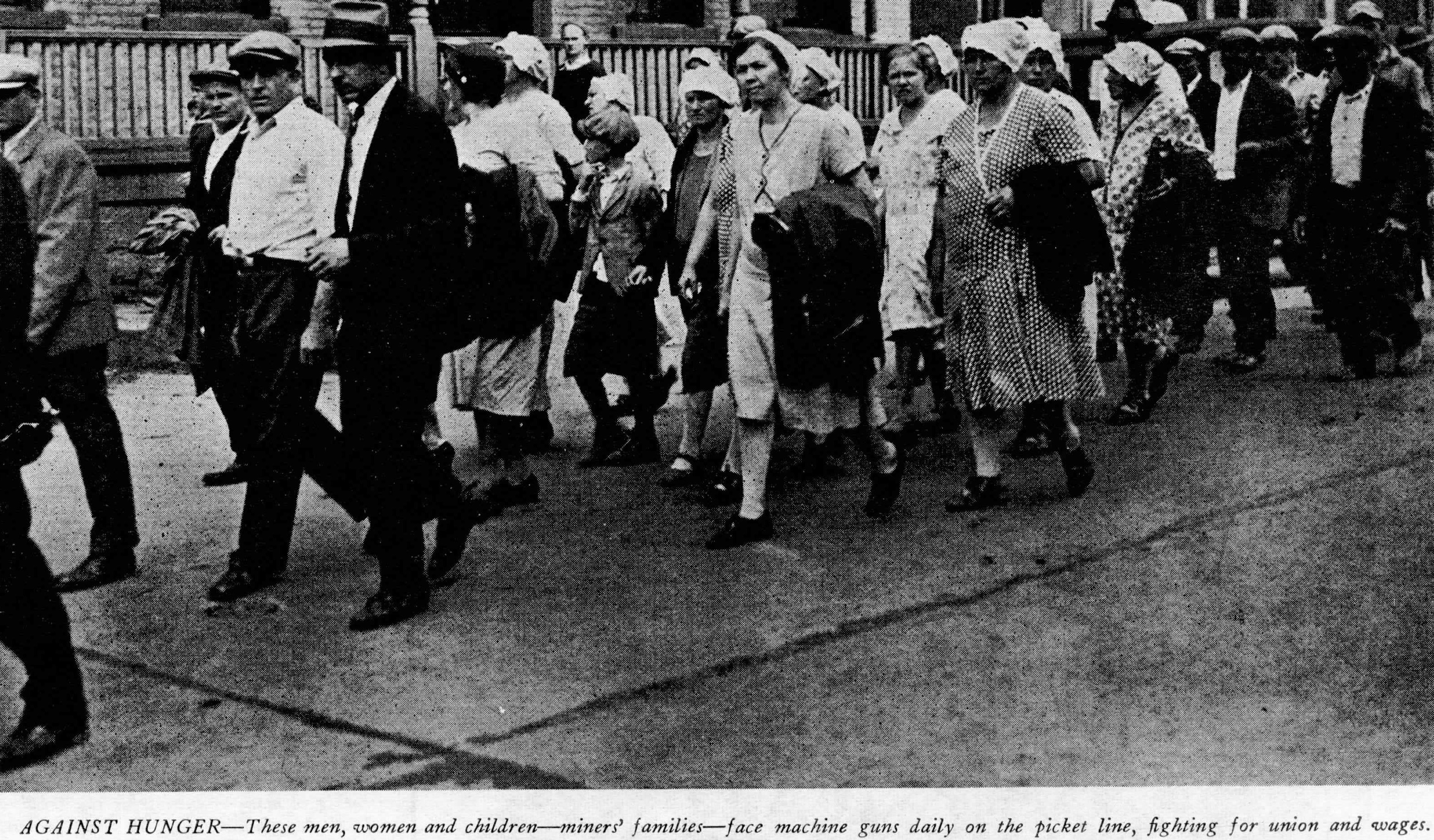
With the recruitment of over 1000 new members in the Communist Party’s Pittsburgh District (5) during the 1931 miners’ strikes, a new cadre training school was opened.
‘Training New Recruits in the Pittsburgh District’ by Gertrude Haessler from the Daily Worker. Vol. 8 No. 248. October 15, 1931.
THE influx of over a thousand new members into the Party in District Five, as a result of the mine struggle, raises the question of developing new forces for local leadership. Can we solve this question of local leadership–the question of section and unit functionaries–by depending on the “importation” of outside forces? Certainly not. Our outlook must be toward the development of the tremendous latent forces which have been tested in the struggle and shown abilities for leadership.
The dependence solely on outside forces is one evidence of the lack of faith in the masses which the Thirteenth Plenum of the Party so sharply denounced.
District Five, confronted with the problem of providing leadership for building the Party from the new material, has established a one-month full-time training school as one of the means of solving this problem. Although at the time of writing this article, the school had been in process only ten days, it was already apparent that functionaries of a very responsible level were in the process of development there.
Composition of the Student Body
In many ways this training school is unique in the history of the Party. The composition of the student body alone gives it an outstanding character. Of the 27 students, 21 are American-born, and of the remaining six, three are citizens.
Eight, or nearly one-third of the students are Negroes. Fifteen of the students are under 25 years of age, and 20 of them are under thirty. The proportion of women is not good–only two women in the school.
Twenty of the students are miners, five are steel workers, one laborer, one seaman, and two (the women) with no particular trade. All but three are members of the T.U.U.L. unions.
The length of time that the students have been in the Party or League (four of the students are Y.C.L. members), is also exceptional. Twenty of them have been in the Party less than six months, four of them from six months to one year, two from one to two years, and one for nine years. The majority of the students came into the Party or League in the course of this summer’s struggle in the mine fields.
Three basic courses are being given–Party Organization, Fundamentals of Communism, and the Trade Union Course. Besides this there is a special short courses on Negro Problems, and certain periods set aside for talks on special subjects.
Study Groups–Method of Teaching
The students are divided into five study groups of about five in each group. These study groups are of the utmost importance as they give the students an opportunity to continue the study of the subject just discussed in a more informal manner, and to digest it thoroughly. It also accustoms the students to methods of self-study and stimulates their initiative. For nearly two hours after each class, the groups read aloud from the assignment made, and discuss the subject, exchanging experiences from their own lives to illustrate the points made. Should any question come up in the groups which the students are unable to solve, or a disagreement arises, the comrade in charge of the school, who is always present, is called in to settle the difficulty. This comrade also goes from group to group, stimulating discussion, guiding the study, and at the same time, getting personally acquainted with all the students individually.
The method of teaching which all the instructors use is the question and discussion method, linking up the lesson as closely as possible with the lives and struggles of the students themselves, and drawing them into taking part in the class. The method of giving a lengthy lecture and having a formal discussion afterward is absolutely out of the question. We can best make the students understand trade union strategy, the role of the Party, and the capitalist system of exploitation, if we base their study on their own experiences, and if we can make the students contribute as much to the class as the teacher does. Thus the two-hour class is a general discussion of a concrete nature, guided by the instructor to cover certain subjects and to avoid an abstract handling of the subject-matter.
The Students Run The School
Another important factor in the school is the system of self-government by the students. A students council of seven is the guiding body, and submits its recommendations to the general assembly of all the students, which is held twice a week. Here also the method of teaching, the subject-matter of the courses, and other questions of an academic nature are also discussed. A number of student committees take care of the student needs. The students run the school themselves. This has had a very healthy effect on the school. It stimulated in the students a spirit of self-discipline and responsibility toward the school. It eliminated the need of discipline from above.
Reading And Literature
The lack of simple elementary literature on any of the three subjects given is a tremendous handicap. The literature available is too difficult for elementary study.
In connection with giving assignments for practical activity, we must remember that the students come for a limited period of time. Therefore, it should be an iron-bound rule that assignments should be given only from the point of view of the education the student gets. The tendency of using the students as pinch-hitters in emergencies in the District work, must be rigidly curbed.
The students must be systematically stimulated to read. Therefore provision must be made at home and in the school curriculum, for opportunity for individual reading. We must be careful not to overtax the students. They must be in a position to digest what they study and what they are taught.
Written assignments are important because they train the students to express their thoughts in an organized manner, and develops habits and methods of self-study.
Selection of Students Decisive
One of the important lessons, however, to be drawn from this school, is on the method of choosing the students. Due to circumstances prevailing in the District at the time the school was organized, the preparations were insufficient and the method of choosing the students was far from satisfactory. The day before school opened, the students were still being selected. The candidates should be chosen from among the most active and promising workers in the field. In some cases the section organizers nominated those he could “spare” better than others. Since the success of the school depends to a great degree on the composition of the students, every care must be taken in the selection of the students.
The reaction of the students toward the school is splendid. They are, with very few exceptions, eager to learn, and take the school very seriously. They try hard, and are intensely interested in the subjects taught.
In spite of the defective preparations for the school, and in spite of the shortcomings still existing, as pointed out above, the high hopes placed in the school are being justified. The Pittsburgh School is just one more proof of the fact that the continual clamoring by the Districts for outside forces will not solve the problem, and that the only solution is the training and development of forces right at home.
The Daily Worker began in 1924 and was published in New York City by the Communist Party US and its predecessor organizations. Among the most long-lasting and important left publications in US history, it had a circulation of 35,000 at its peak. The Daily Worker came from The Ohio Socialist, published by the Left Wing-dominated Socialist Party of Ohio in Cleveland from 1917 to November 1919, when it became became The Toiler, paper of the Communist Labor Party. In December 1921 the above-ground Workers Party of America merged the Toiler with the paper Workers Council to found The Worker, which became The Daily Worker beginning January 13, 1924. National and City (New York and environs) editions exist.
PDF of original issue: https://www.marxists.org/history/usa/pubs/dailyworker/1931/v08-n248-NY-oct-15-1931-DW-LOC.pdf
 Revolution's Newsstand