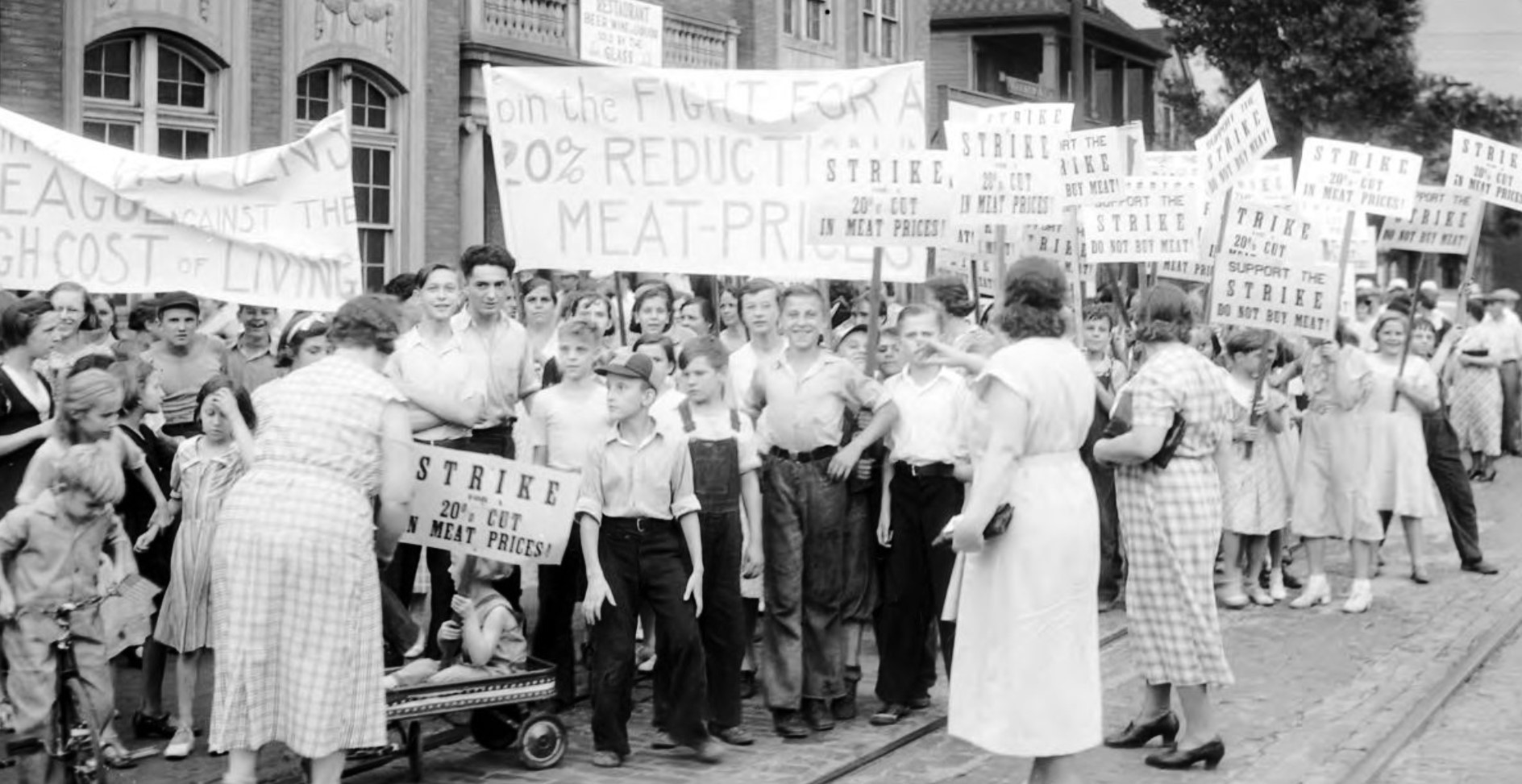
The inside story of the Hamtramck, Michigan ‘meat strike’ lead by Mary Zuk and largely involving Polish women as they fought high grocery prices during the Great Depression.
‘The Detroit Meat Strike’ by P.M. from Working Woman. Vol. 6 No. 9. November, 1935.
THE Detroit and Wayne County meat strike has become known to all housewives and working women all over the country because of the militant activities of the meat strikers. The name of Mary Zuk is known in every household as the “mother” of the Detroit Meat Strike.
How did our strike start? This question has been asked of the Central Action Committee from women eager to begin the fight against the high cost of living. We started our strike by getting a few women in Hamtramck, a Polish neighborhood to call a mass meeting. To this mass meeting came over 500 women who heard the story of the fight against high meat prices in other cities like New York and Los Angeles. They showed by their enthusiasm that they wanted action. At this meeting action committee was enlarged to 25 which in turn was divided into a publicity committee and so on. The next meeting was held in a public school to which nearly 2,000 people came and voted for the strike.
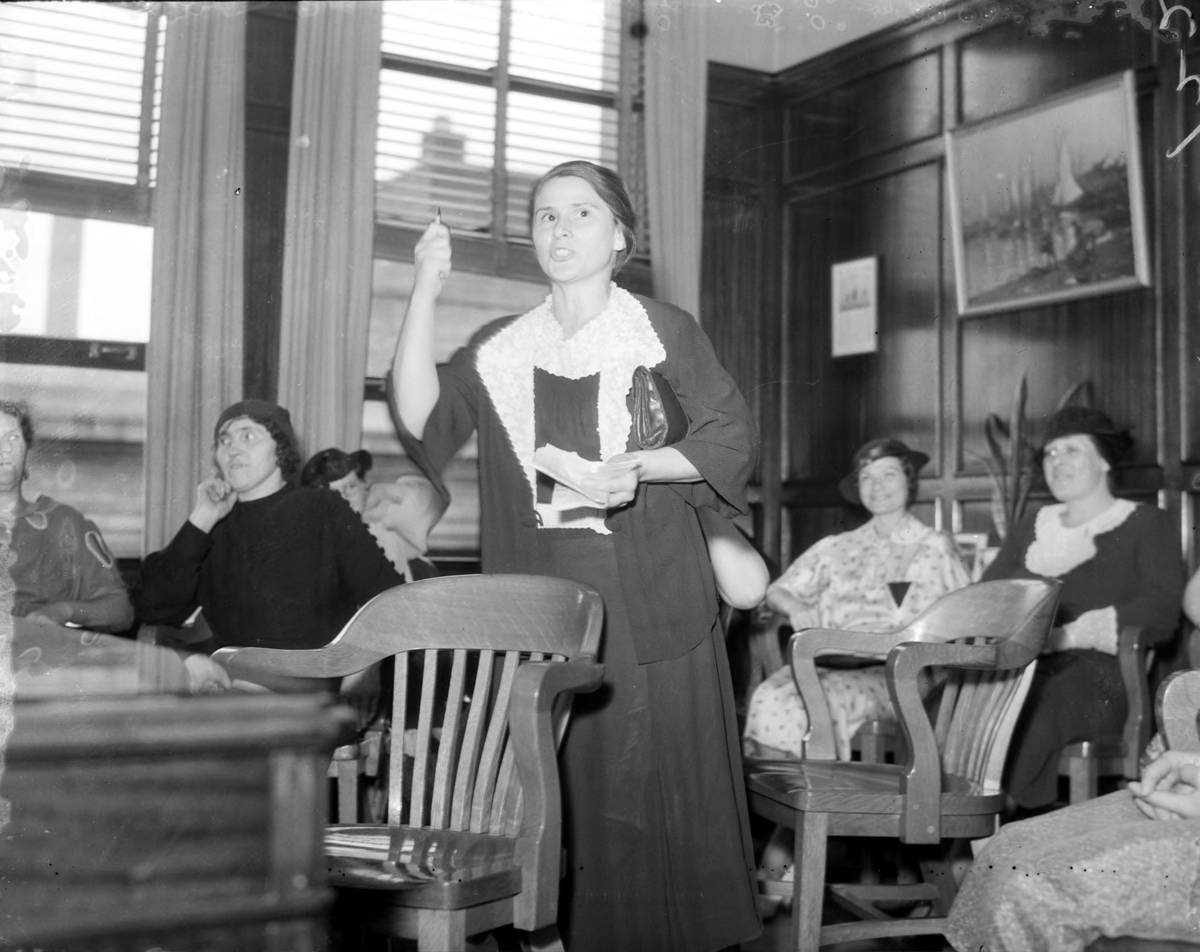
Mary Zuk, a miner’s daughter, who had worked in factories since she was 12 years old and who was for many years an auto worker and now a mother of two children, was elected chairman of the Action Committee, which at this meeting was enlarged to 65 members. The butchers were informed that the strike was being held and were told to close their stores.
To the meeting next morning there came over 125 pickets, who carried signs demanding a 20 per cent reduction in meat prices. The women stationed themselves at each store inspecting bags to see that there was no meat in them.
Store after store was closed and that night practically all stores were closed, the strikers telling butchers to organize with us against the millionaire meat packers who had made millions while we couldn’t even buy hamburger “Capusta and cartofle” (cabbage and potatoes) was the cry–but no meat.
The newspapers had big accounts of the strike in the local papers, with pictures of Mary Zuk and the strike committee. As a result of the militant Hamtramck women starting the strike, groups of women got together in all neighborhoods, meeting in schools and churches, and the following week a general strike was called. A delegation of over three hundred women went to the packers here in trucks and cars, picketing the packing houses, all together shouting while the committee was inside. “We want a twenty per cent reduction in meat.”
There were radio announcements of open air meetings, tireless picketing, parades. Delegations to the City Council demanding that they take a stand the order of the day. Pickets were arrested but hundreds of women stormed the police stations and demanded and got the release of their prisoners. The strike received the endorsement of many labor organizations, including the Detroit and Wayne County Federation of Labor.
Finally we started an organization, the Women’s League Against the High Cost of Living whose aims are to: (1) Reduce the prices of meat, milk, bread and other necessities of life; (2) To reduce cost of gas and electricity; (3) To reduce rents and to better housing conditions. (4) To abolish the sales tax; (5) To cooperate with trade unions, working people’s organizations and farmers to maintain and raise the standard of living. A drive was made for members and an office was opened.
Conferences were held and it was decided to send delegations to Washington and Chicago. The delegates were elected at a mass open meeting at which there were over 7,000 people present who gave their pennies, nickels and dimes to cover the expense of the delegates. What happened in Washington became news for the entire country which was waiting to hear what Wallace, “the man who killed all the little pigs,” would say. We all know how he ran away from the delegation. Mass meetings greeted their return. The “Red Scare” was raised but we fought it because from the fight against the high cost of the very beginning we had said that living involved everyone, regardless of their nationality, race, color or political beliefs. Everyone eats meat and pays too much for it–the fight against the high cost of meat is everybody’s fight.

At a conference held recently it was decided to end the strike. We determined to build a strong Women’s League to fight against the high cost of living. Out of the meat strike have sprung many women who have become mass leaders. Our courageous fighting women, dauntless, have blazed a trail for the women of all nationalities to follow.
Many Polish women were involved in the meat strike as well as women of every nationality, Negro and white who fought against high meat prices. Our Action Committee sent greetings to Chicago, Shenandoah and Cleveland congratulating them on their fight.
The Working Woman, ‘A Paper for Working Women, Farm Women, and Working-Class Housewives,’ was first published monthly by the Communist Party USA Central Committee Women’s Department from 1929 to 1935, continuing until 1937. It was the first official English-language paper of a Socialist or Communist Party specifically for women (there had been many independent such papers). At first a newspaper and very much an exponent of ‘Third Period’ politics, it played particular attention to Black women, long invisible in the left press. In addition, the magazine covered home-life, women’s health and women’s history, trade union and unemployment struggles, Party activities, as well poems and short stories. The newspaper became a magazine in 1933, and in late 1935 it was folded into The Woman Today which sought to compete with bourgeois women’s magazines in the Popular Front era. The Woman today published until 1937. During its run editors included Isobel Walker Soule, Elinor Curtis, and Margaret Cowl among others.
PDF of full issue: https://www.marxists.org/history/usa/pubs/wt/v6n09-nov-1935-WW-R7524-R2.pdf
 Revolution's Newsstand