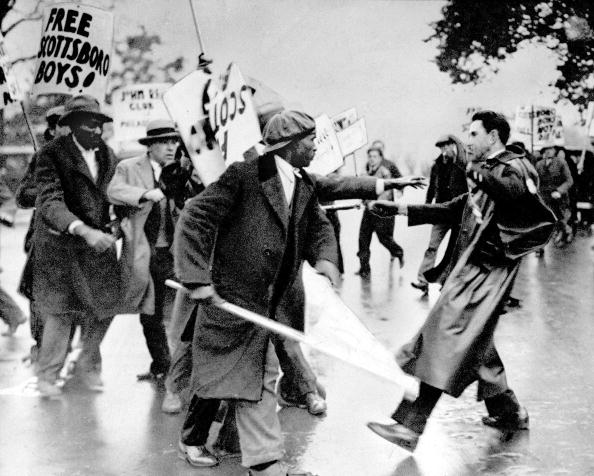
An inter-racial picket in Washington D.C. of Black and white workers fighting with police over a racist Supreme Court decision was an astounding sight in 1932.
‘We Picket the Supreme Court’ by Joseph North from Labor Defender. Vol. 9 No. 1. January, 1933.
A brigade of police hid in the basement of the United States Capitol directly beneath the chambers of the United States Supreme Court. Tear gas bombs hung on their belts: revolvers in their holsters. Outside police sentries picketed all entrances to the Capitol. Motorcycle police stationed at the crossroads within a half mile radius of Capitol Hill. A No Man’s Land had been marked off before the United States Supreme Court. The boundary line: cordon of gun-bearing police.
Why all these precautions? Was the Capitol Building in danger of siege? In peril of capture by the enemy hosts?
No: a picket demonstration of 125 workers was scheduled. For a week in advance the leaders of the picketers had sought a permit. Moth-eaten officeholder that he is, Captain Stephan J. Gnash ran to confer with the higher authorities in the White House. Thumbs down on the idea: their decision. Keep them away from the Supreme Court if it takes guns.
“You will not picket. We will not permit it even if we must use force,” Captain Gnash told the committee of the picketers, which included as spokesmen Frank Spector, assistant national secretary of the ILD, Carl Murphy, Jr., Washington representative of the Baltimore Afro American. On the committee were delegates of working class and sympathetic organizations.
Spector warned Gnash that the workers would picket despite all police prohibitions. “We are determined to demonstrate our solidarity with the enslaved Negro masses of the United States: the life of the Scottsboro boys is our concern–and no injunctions by the police to the contrary, will halt us. The responsibility for violence will be directly upon the shoulders of the police,” he said.
Now why this ultra-fear on the part of the authorities against a picket line before the Supreme Court? The dignity of the Supreme Court was assailed. And Captain Gnash ran to its defense. He was revealed in the Baltimore News the day of the conference with the picketers’ delegations as an “advocate of bullets to drive the bonus marcher ruffians from the Capitol grounds” several months ago.
The sacred cow of capitalism–the Supreme Court–is “endangered.” This court, the “court of last illusions,” was created, as Alexander Hamilton said, to divert “the anger of the rabble into a peaceful channel” and dissipate their possible militant action. The value of the Supreme Court as safety valve is well understood by the authorities in power. And they are frightened for its aura of impartiality built up so carefully by the apologists of the ruling-class is dimming. In an unguarded moment Governor Roosevelt, rendered wild by the scent of the presidential chair, declared, “that after March 4, 1929, the Republican party was in complete control of all branches of the government and I may add, for full measure, to make it complete, the United States Supreme Court. Roosevelt, of course, was yearning for the day when this “august, impartial body” would be under the control of the Democratic wing of capitalism.
The Hoover Business Men’s League, of Baltimore, immediately beat an alarm, rushing out thousands of letters stating, “no greater harm can be done our national institutions or to the cause of justice than to attempt to drag the United States Supreme Court into the arena of party politics.”
Thus you can see the fear and trembling with which the class of the rulers viewed any attempt to undrape the Supreme Court to divest it of its sanctified robes of impartiality.
This was the background of the picketing demonstration at the Supreme Court.
On a rainy morning, Monday, November 7th, the trucks loaded with Negro and white workers trundled into Washington. Elaborate strategy by the Capitol authorities was evident on every street-corner. Motorcycle police nervously peered at all out-of-town cars. On the Plaza every car without a District of Columbia license was halted. Awaiting the picketers were 500 Metropolitan police, plainclothesmen in overalls with blackjacks in their pockets, and Capitol policemen. In the Capitol basement the detachment of policemen fingering shotguns waited.
At 11:30, while 1,500 Negro and white sympathizers stood in the rain awaiting the picketers, the trucks drew up. They were filled like the Trojan horse with silent men. Surprising the authorities in a courageous sally, they alighted on the avenue at Constitution and Dela ware. They formed immediately into ranks of Negro and white. Side by side black and white worker marched directly into the gauntlet of terror. They marched onto the Plaza bearing a forest of placards calling for the freedom of the Scottsboro boys, the Logan Circle boys, Orphan Jones. They shouted “Death to the lynchers.” The hundreds of police were petrified for a moment. Then they galvanized into action. They swarmed from all parts of the Capitol grounds toward the picketers. One policeman assaulted a placard bearer. When the cop drew his black-jack the picketers repulsed him and proceeded. This Capitol policeman, George Walker, angered into frenzy, whipped out his revolver. He was about to fire into the demonstrators when some workers, two Negroes and a white, prevented him.
Police Inspector Headley thereupon attempted to halt the demonstrators. They proceeded. He gave the signal. The police attacked fiercely, maddened by the solidarity of Negro and white. The overwhelming forces of police tore down the placards. But the picketers continued their cries, “Free the Scottsboro boys”; “They Shall Not Burn”; “Free Tom Mooney.”
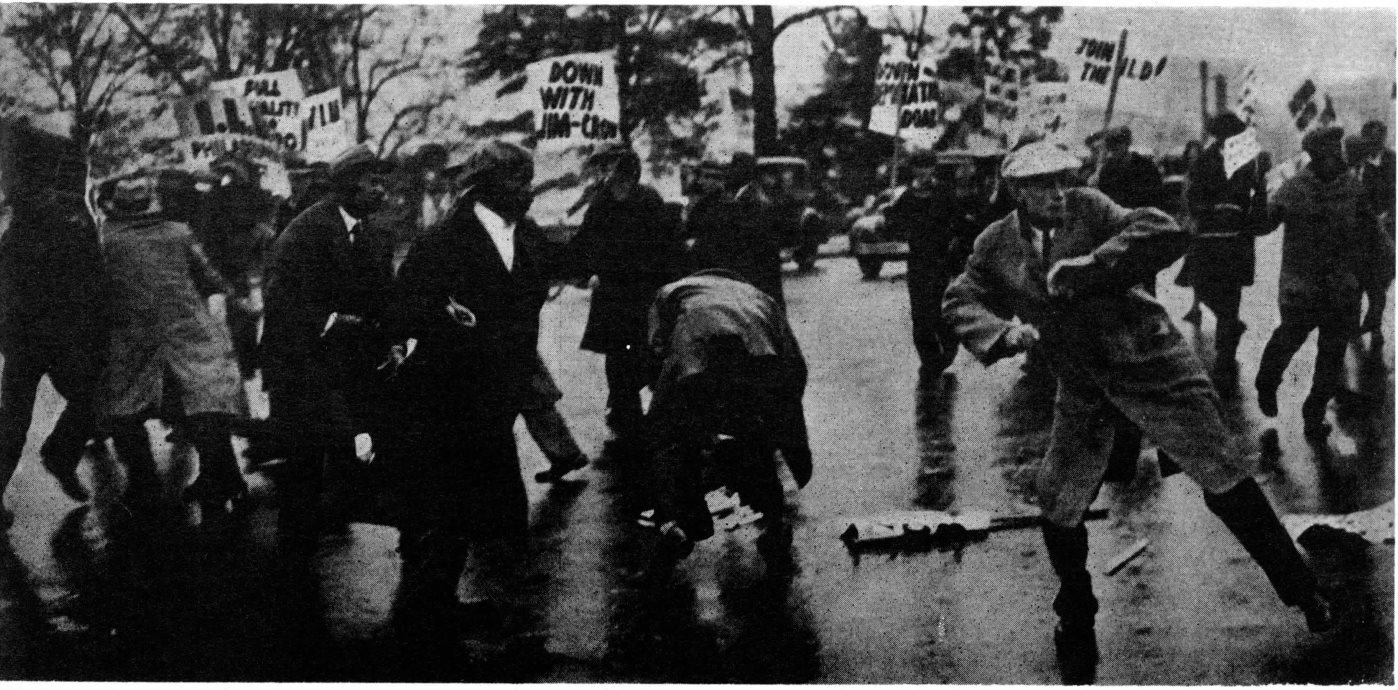
Workers continued to moil about in the Plaza shouting their slogans into the very chambers of the Supreme Court. The police scurried like the Capitol squirrels in all directions. They bear clubs in hand. They discharged tear gas guns into the ranks of the crowd.
Rarely before was there such a stirring example of solidarity of Negro and white. Side by side they had marched into the teeth of capitalist terror. Side by side they resisted the attempts of police to smash their demonstration. Negro and white, they thundered their call for the freedom of the Scottsboro boys, against Negro persecution and legal lynching. And many millions of Negro and white workers in America and over the world heard them.
Labor Defender was published monthly from 1926 until 1937 by the International Labor Defense (ILD), a Workers Party of America, and later Communist Party-led, non-partisan defense organization founded by James Cannon and William Haywood while in Moscow, 1925 to support prisoners of the class war, victims of racism and imperialism, and the struggle against fascism. It included, poetry, letters from prisoners, and was heavily illustrated with photos, images, and cartoons. Labor Defender was the central organ of the Scottsboro and Sacco and Vanzetti defense campaigns. Not only were these among the most successful campaigns by Communists, they were among the most important of the period and the urgency and activity is duly reflected in its pages. Editors included T. J. O’ Flaherty, Max Shactman, Karl Reeve, J. Louis Engdahl, William L. Patterson, Sasha Small, and Sender Garlin.
PDF of full issue: https://www.marxists.org/history/usa/pubs/labordefender/1933/v09n01-jan-1933-lab-def.pdf
 Revolution's Newsstand