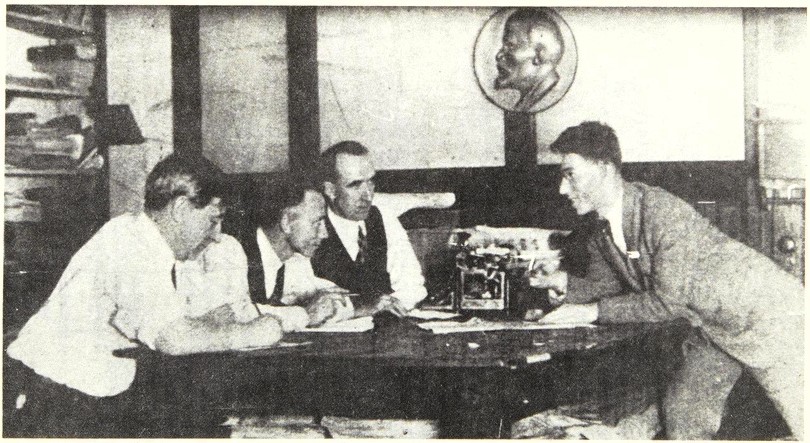
‘Third Convention of the Canadian Workers Party’ By Maurice Spector from International Press Correspondence. Vol. 4 No. 31. May 29, 1924.
If it translates its resolutions into realities, the third convention of the Canadian Workers Party will have been one of the most important gatherings in its history. Not only were the guiding policies of the past two years re-affirmed (the campaigns for the Labour Party, for industrial amalgamation and more recently for Canadian trade union autonomy) it was also decided to break new ground by changing our name to that of Communist Party and extending the front of its activity by a campaign to transform the labour party movement into a movement for a Farmer-Labour Party.
Owing to the considerable emigration of Canadian workers to the United States, the Party has had to register a slight decrease in its membership. But there has been no decrease of its influence. This is evidenced no less by our role in the workers’ struggle as in Nova Scotia and in the Left Wing at the Trades Congress than by our record in the Labour Party. We have sufficiently familiarized our labour movement with communist policies and established ourselves to take the name of Communist Party openly.
The United Front, in spite of the mistakes made in its application by so many sections of the International, still remains our guiding policy. As Secretary Jack Macdonald noted in his report, “there is always the danger in our united front policy of forgetting that our chief task is the building up of a fighting Communist Party”. Here and there reformists have raised their heads who would like to apply to the Canadian Labour Party the notorious precedent set by the British and Australian Labour Parties of excluding the Communists. We will also have to combat more vigorously the attempt of the reformists to undermine the federative basis of the Labour Party by their tactic of fostering individual membership branches.
The chief feature of the report on the political situation was the question of our relation to the farmers. The farmers movement is experiencing an economic and political crisis of such magnitude that the convention considered it impossible for the Party to postpone the adoption of a positive agrarian policy any longer.
The farmer has become the slave of the banks, mortgage houses, insurance companies, implement manufacturers and other Big Business Interests. The average loss per farm in Alberta had been $15, and this during 1923 when the crops had been heavier than ever before. The Progressive Party has functioned chiefly as a wing of the Liberal Party and the resulting disappointment of the farmers is seen in the decline of both membership and interest in the formers organizations, in the defeat of the Ontario Farmer Government and the dissatisfaction with the Alberta Farmer Government. The convention decided to make one of the chief political tasks of the Party the campaign to develop the Labour Party into a Farmer-Labour Party.
In connection with both the political and industrial reports, as well as the communication of the Communist International, the convention discussed the implications of the Nova Scotia struggle. The strike had been epoch-making for Canadian Labour on account of its open political character. It was evidence of the immaturity of the Party however, that there was lack of close co-operation between the districts and the Party centre during the struggle and its political issues had not been sufficiently developed throughout the country. The need for Dominion trade union autonomy to free the hands of Canadian Labour for its political struggles was unanimously recognized.
International Press Correspondence, widely known as”Inprecor” was published by the Executive Committee of the Communist International (ECCI) regularly in German and English, occasionally in many other languages, beginning in 1921 and lasting in English until 1938. Inprecor’s role was to supply translated articles to the English-speaking press of the International from the Comintern’s different sections, as well as news and statements from the ECCI. Many ‘Daily Worker’ and ‘Communist’ articles originated in Inprecor, and it also published articles by American comrades for use in other countries. It was published at least weekly, and often thrice weekly
PDF of full issue: https://www.marxists.org/history/international/comintern/inprecor/1924/v04n31-may-29-1924-inprecor.pdf
 Revolution's Newsstand