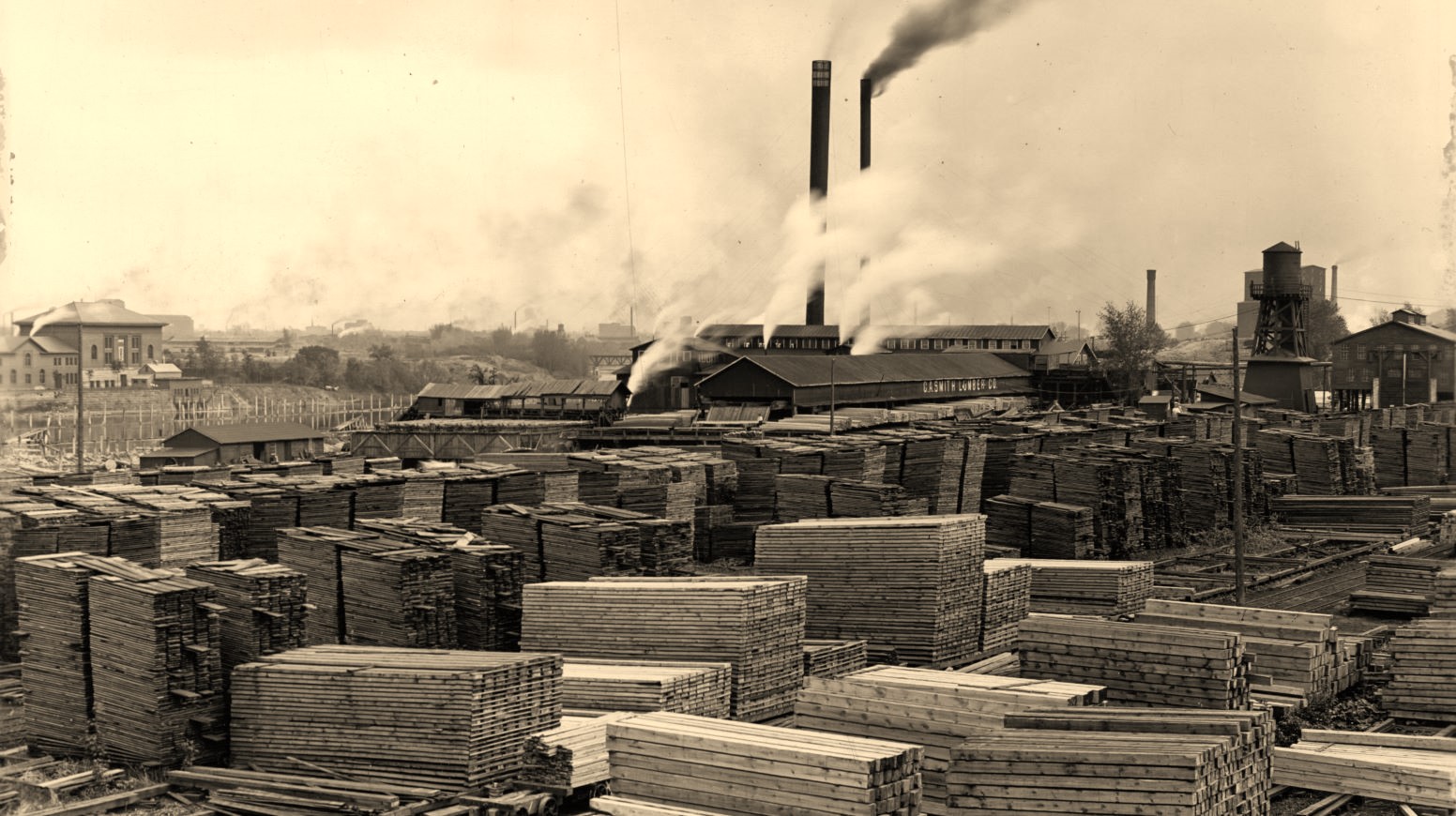
‘A pen picture of one of Minneapolis’ leading industries by a wage worker.’
‘Saw Milling’ by a Minneapolis Wage Worker from The Weekly People. Vol. 13 No. 3. April 18, 1903.
Monopolization of the Forests by Fraudulent Means–Increased Capacity of Mills Due to Labor Saving Inventions–The Daily Exploitation of the Mil Hands and Their Efforts Toward Emancipation Well Set Forth.
The most extensive branch of the lumber industry in Minneapolis is the saw milling industry. A number of large mills are located a few miles up the river from the Falls of St. Anthony. Several of the larger mills employ from 700 to 800 men and occupy a territory along the river front varying from fifty to 100 acres each. Some of these mills have daily capacity of about 500,000 feet of lumber. The C.A. Smith Lumber Company cuts in the neighborhood of 108,000,000 feet of lumber in a season. The output of this one mill is nearly equal to the entire capacity of the Minneapolis mills in 1870, it being then 118,230,133 feet. The output of these mills in 1899 was 504,373,000 feet. It is estimated that Minnesota has timber enough to supply the mills for twenty years at the present rate of output. These great forests are monopolized by few capitalists whose original accumulation began with the appropriation of timber claims by fraudulent means.
These lumber steals in the early days were the foundations for the fortunes that have been accumulated by the present “brawny and benevolent” captains of this industry.
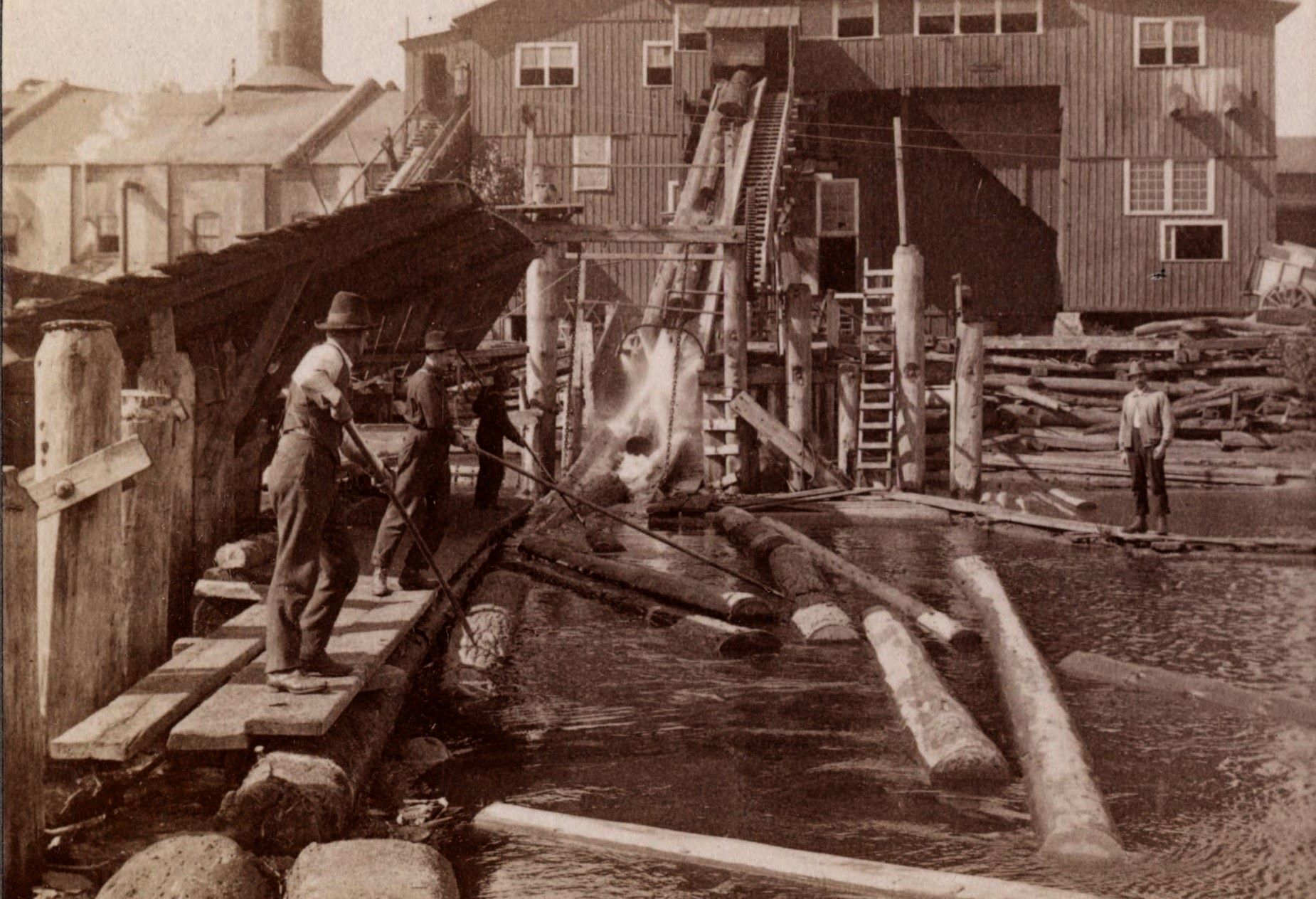
The increased capacity of the saw ills is a result of many inventions by which much time and labor is saved in manufacture and handling. Steam drive rollers, endless chains, log turners, steam cranes for lifting logs and lumber, automatic sorters, gang edgers and trimmers, steam cylinders for driving log carriages and a multitude of similar devices send a log through the mill and leaves it sorted into a dozen kinds of lumber in less time than one of the old mills took to cut the first slab from the log. There are also great improvements in the saws. The circular saw is a time-saver, but it wastes much lumber, as it cuts a curve one-quarter of an inch wide. The gang saw is also a valuable time-saver, but it wastes lumber, as the sawyer has but little choice as to what he can make of the log.
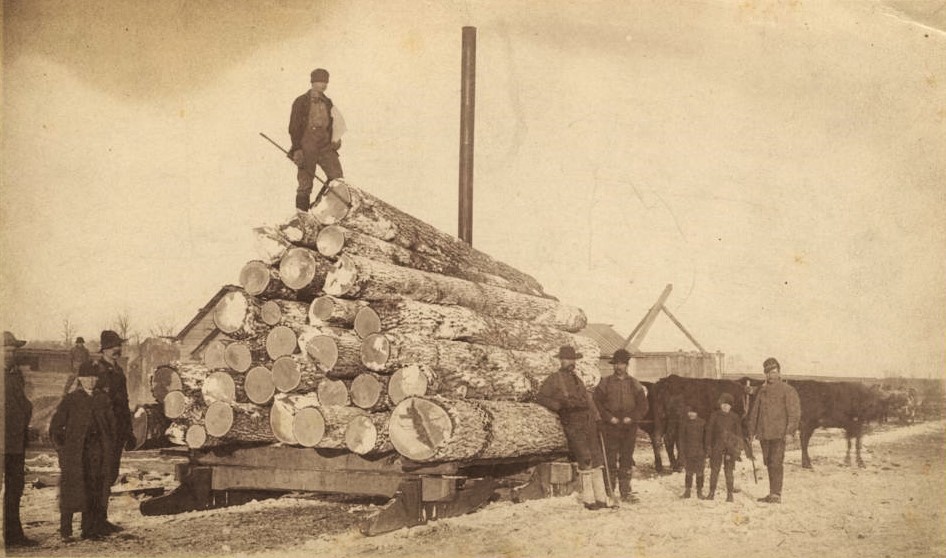
Up to six logs can be sent through the gang at once. It is constructed of twenty to forty saws set an inch apart and the lumber all comes out an inch thick. The band saw, on the other hand, is great lumber-saving invention, as it cuts a curve only one-eighth of an inch. It is made similar to a leather belt, toothed on one edge, running over two wheels. It cuts continually downward through the log. This band saw, however, is already getting out of date, as some mills have lately put in one with two cutting edges, so that a board can be cut from the log coming and going. So it has come to pass that one large mill to-day outdoes in capacity 200 such mills as first stood at the Falls of St. Anthony.
Not only have new inventions done away with much waste of lumber, but millwood, bark, sawdust, etc., formerly given away or allowed to drift down the river have now a regular market price, which the coal famine this year has sent a-soaring.
It is interesting to note the changes in one industry which the development of another and totally different one may bring about. The development of railroads in the Northwest worked and then was sent south, mostly to St. Louis, by the river route. Extension sluices were made extending from the mills located on the St. Anthony to some distance below the falls, where the lumber was made into large rafts usually containing 1,000,000 feet. Some twenty-five to thirty men had to follow the raft and it took twenty-five to thirty days to make the trip from Minneapolis to St. Louis. It cost $3 per thousand feet to raft lumber to St. Louis and often a load of other merchandise was carried on the top. To-day lumber rafting exists no more, the railroads being able to transport the lumber much cheaper than it can be done by the river route.
We said in the beginning that these lumber magnates had derived their original accumulation by defrauding the government of millions of feet of standing timber. But as every Socialist knows, it is only the “original accumulation” the very humble beginning that can accrue by such means. To be able to continually live in idleness and luxury and at the same time have the “humble beginning” increase towards millions there must be practised a more systematized, more refined and altogether legalized robbery, namely the daily exploitation of thousands of wage slaves. This is the mint where the millions are coined. The unpaid labor of the hard-driven wage slaves is the source from which the capitalist derives his wealth; it is the fountain that never runs dry, the life-giving, joy-giving Bramah.
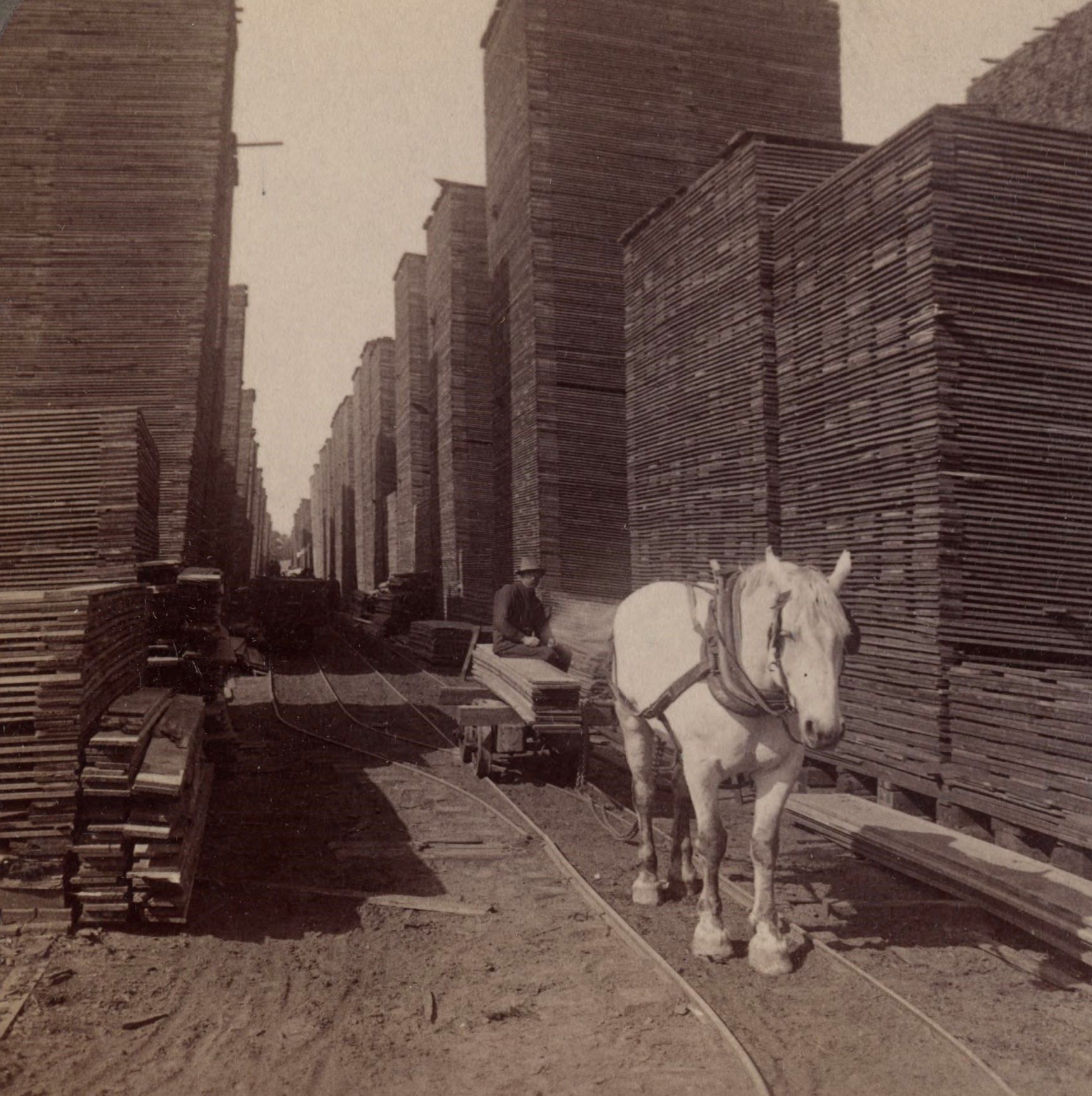
The Minneapolis saw mills employ from 5,000 to 6,000 men during the lumbering season. In no industry in the State is the exploitation of labor brought down to so fine a point as in this. The average wages are very low. Some of the experienced sawyers, of course, receive good wages, but the mass of machine tenders, lumber pilers, loaders, etc. work that needs no skill are poorly paid and hard driven. During the busy season the unskilled laborers may at times get as high as $2 a day for eleven hours, with any amount of overtime forced upon them. This winter loaders, etc., have worked for $1.28 for nine hours.
The work in the saw mills is about the most dangerous in this section of the country. In the mills there is great danger from flying slabs, etc., and, of course, the usual one of unprotected machinery. In the yards there are also frequent accidents. During one season there were about eighty men injured and three killed in C.A. Smith’s mill alone, and it was then the men dignified the establishment by the significant name of “slaughter house.” This benevolent man–and he is a “truly good man”–is reported to have offered a boy sixteen years old the magnificent sum of $100 for a leg that had been crushed, and had to be amputated. Now, however, he is not under pains of doing even this, because he has his men insured wholesale in an insurance company. It goes without saying that the men have to pay that themselves, so much being held out of each man’s wages every month for the purpose.
The petty bosses are among the most severe and brutal of the slave-driving ilk. Here is an example of their standard of humanity or rather brutality. One of the men got sick last winter and had to stay at home for some days. He got well and worked for two days, when his whole family-font persons-were taken ill, and as his labor power was much cheaper than a nurse’s, he had to stay at home again. When he returned the boss “read the riot act” and declared that such work would not do, either he had to work or not work, and there the matter ended. The workman said that his family had been in bed and he had no other choice but to stay home. The brute said, “Well, they ought to stay in bed right along.” The wonder is that something serious did not happen in the lumber yard that morning.
But the S.L.P.’s teachings have also penetrated this field, and may of the hard-driven wage slaves of the lumber industry are being aroused by the spirit of the revolution. He who doubts that the downtrodden wage slaves will finally arise to the dignity of manhood, learn the science of Socialism, and emancipate themselves from wage slavery may be taught a moral upon entering one little home far up above the saw mills, and down by the river front. As one enters the plain but neat proletarian sitting room, the first thing to draw one’s attention is the picture of Karl Marx with his massive head and profound eyes, seemingly much flattered by his surroundings. And well might he be so, for among the little stock of books there is represented those of the greatest philosopher and teacher of our days. Besides is not the proletarian philosopher there present for the sole purpose of saying to the hard-driven workers of North Minneapolis who enter there, “He who desires to be free himself must strike the blow!”
When a wage worker, driven by the lash of wage slavery for eleven hours a day can spend his “leisure” time with Marx, Darwin and the Socialist Labor Party press, who dares say that the wage workers will not eventually raise themselves out of the mire into which centuries of oppression has forced them?
Minneapolis Wage Worker.
New York Labor News Publishing belonged to the Socialist Labor Party and produced books, pamphlets and The People. The People was the official paper of the Socialist Labor Party of America (SLP), established in New York City in 1891 as a weekly. The New York SLP, and The People, were dominated Daniel DeLeon and his supporters, the dominant ideological leader of the SLP from the 1890s until the time of his death. The People became a daily in 1900. It’s first editor was the French socialist Lucien Sanial who was quickly replaced by DeLeon who held the position until his death in 1914. After De Leon’s death the editor of The People became Edmund Seidel, who favored unity with the Socialist Party. He was replaced in 1918 by Olive M. Johnson, who held the post until 1938.
PDF of full issue: https://www.marxists.org/history/usa/pubs/the-people-slp/030418-weeklypeople-v13n03.pdf
 Revolution's Newsstand