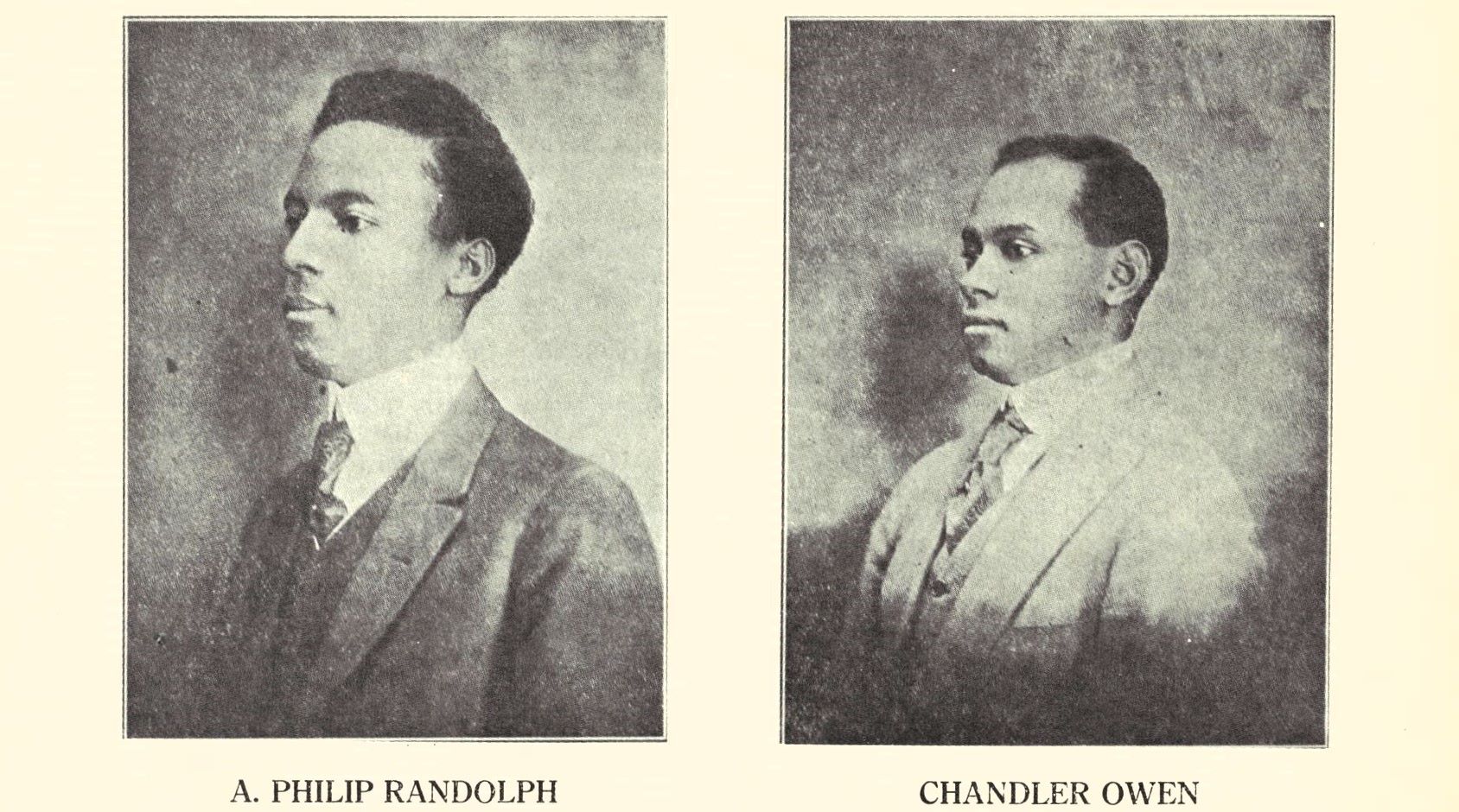
For the first time in its history, the Socialist Party ran a slate of Black candidates in New York State’s November, 1920 elections. Five Black Socialists ran, including The Messengers’ co-editors A. Philip Randolph and Chandler Owen, who wrote this appeal to vote Socialist. Also put forward were Grace Campbell, “the first colored woman to be named for a public office on a regular party ticket in the United States of America,” and trade unionists W.B. Williams and Frank Porec.
‘Should Negroes Be Socialists?’ by A. Philip Randolph and Chandler Owen from The Messenger. Vol. 2 No. 9. October, 1920.
Negro Elective Representation
FOR a long time, the Negro has been begging the Republican Party to give him an opportunity to elect a Representative to Congress, but the Republican Party refused him. In 1917, in the Special Election, John A. Bolles, Candidate for Congress from the 21st Congressional District on the Republican Party’s ticket in New York City, went into the courts, and had the petition of Rev. Ransom (a Negro) thrown out and, prevented him from running in the Republican primaries. So Ransom ran independently. This same man, Bolles, a white, reactionary, Republican politician was the opponent of George Frazier Miller, a Negro Socialist candidate for Congress. And the old, wicked and corrupt Republican Party machine supported him.
NOW, WHICH WILL YOU HAVE?
The Socialist Party is the only party which has given the Negro an opportunity to elect one of its race, A. Philip Randolph, co-Editor of the MESSENGER, for the fourth highest office in the great Empire State of the country, New York-as State Comptroller. Of course, the Negro hating, Negro baiting Democratic Party would not think of putting a Negro on its ticket.
Now, who stands for Negro Elective representation or the principle of self-determination, the Republican, Democratic or Socialist Party?
Mr. Negro Voter, you are the judge and you have the facts. Which party are you conscientiously obligated to support?
When Two Negroes Are Running in the Same District
The question has arisen, time and again, as to what Negro voters should do where two Negroes are running for the same office, in the same District. Obviously this is a case where the choice is not to be made as between two races, but a choice which is to be made as between two parties. For the reason that when two parties nominate men of the same race for the same public office, the men, in question, can only benefit their constituents in proportion as the principles of their parties stand for the class to which their constituents belong. To illustrate: If the Republican Party which is supported by the real estate interests, nominates a Negro for the Assembly from a District in which Negroes are largely of the tenant class, who desire low rents, and the best services obtainable, and this Negro is elected to office, and a measure in Legislature intended to abolish the law of dispossess is raised, the Negro legislator, in question, undoubtedly would oppose this measure. Now, Why? The reason is simply this: A man will not oppose his benefactor. Since the Republican Party is controlled by the Real Estate Interests, and the Real Estate Interests benefit from the “law of dispossess.” which gives them the power to eject tenants when they fail to pay their rents promptly, this Negro, who is a nominee on the Republican ticket, could not and would not oppose the “law of dispossess” of which his benefactor–the Republican Party–is the beneficiary. Now today, the Democratic and Republican Parties are both the servants of the property-owning class. They obey the dictates of this powerful combination of real estate interests, consequently they cannot, and dare not, attempt to protect the tenants, the class which their masters rob through high rents. Besides a member of a party cannot successfully op- pose the policies of his party. The party machine always rules, and when the machine and a member of the machine come in conflict, the machine crushes him. This was amply demonstrated by Roosevelt’s failure to buck the Republican machine. He organized a Bull Moose Party; it had more “bull,” however, than the principles of progress. And the people saw that the “Bull” was ahead of the Progress, so they refused to follow the “Bull”; hence the Moose died. Ex-Governor Sulzer of New York, who was impeached for going counter to Tammany Hall, is another instance in proof of the impotency and futility of a member of a party opposing the machine tactics and policies, and at the same time remaining within the party. Consequently, Mr. Negro Voter, your task is one of selecting the party which will represent both your interest as a race and your interests as a working-man.
Just a word now as to your race’s interest. You desire to abolish lynching. You desire to have the right to vote. The Republican and Democratic Parties have refused to give you the slightest consideration, by way of remedying these evils, notwithstanding the facts that they both have had the power and the opportunity, by virtue of their control of the Presidency, Congress and the Supreme Court, to recommend and to enforce a Federal Law against lynching, and to secure the enforcement of and the democratic administration of the Fourteenth Amendment to the Constitution, thereby giving the Negro the right to vote.
What about the Socialist Party? We speak of parties because you can get nothing except through parties since voters constitute parties, and parties control the government, and the Government enacts laws which affect both your interests as a race and your interests as a working man. Now, the Socialist Party is the only party, which in its National Platform, has recommended a Federal Law against lynching and demanded the enforcement of the Fourteenth Amendment to the Constitution.
Besides, what is vitally material and important to you, Mr. Negro Voter, is, that the Socialist Party is the champion of the working class, and 99 9/10 per cent of your race belong to that class. The Socialist Party stands for the principle that the worker is entitled to the full product of his toil. It also stands for the reduction of the high cost of living. It would put milk within the reach of the babies of the poor; it would reduce high rents from which Negroes particularly suffer. It can reduce high rents because it receives its funds from the rent-payers, who are interested in paying less rent. It can reduce the high cost of living because it receives its funds from the working class consumers, who are interested in getting better food and paying less for it. It can increase wages and reduce the hours of toil because it receives its funds from those who suffer from over-work and underpay. Consequently, Mr. Negro Voter, the Socialist Party is your party, because you are the victim of every injustice which it opposes, and will ere long abolish. The Republican and Democratic Parties can do you no good, because they serve the very interests who rob you through high rents, the high cost of living, by working you long hours and by paying you low wages. Thus, Mr. Negro Voter, in a district where two black men are running for the same office on different tickets, it is for you to select the party which stands for removing the injustices from which you suffer, the party which can render you some substantial social benefit. Now, for example, let us say, there are two districts in which such a case obtained. In the 1st Assembly District,
A, a Negro, is the opponent of B, a Negro. A is a nominee on the Socialist Party’s ticket. B is a nominee on the Republican Party’s ticket. As to the qualifications and character of the men in question, let us grant that both are qualified. However, permit us to inform you that that is not chiefly material. Because even if a Negro with splendid parts, courage and character was the nominee on the Republican ticket, the fact that he is the creature and tool of the machine, and the fact that the machine serves interests which are against the interests of the constituents whom the Negro, in question, is presumed to represent, are sufficient reasons why he will be absolutely powerless to use his office in the interest of the Negro. Therefore, you see, the question is not one of whether a man is good or bad, but one of whether the party he represents stands for principles in the interests of the constituents which he is supposed to serve. For instance, a good man can do no more with a gun than a bad man. A good man can do no more with a threshing machine than a bad man. The instrument will operate according to its construction. The chief question is: “Who controls the instrument?” Because, he who has control over the instrument will determine the use to which the instrument is put, and the use to which the instrument is put determines whether it is good or bad, in other words, its social value. To illustrate: The same wind which wrecks the ship upon a rock, may waft it safely into harbor, hearing cargoes to satisfy human wants and to alleviate human suffering. Now, then, the point is this: that the enemies of the working class control the Democratic and Republican Parties, and consequently, you cannot expect anything from them; but the Socialist Party is controlled by the working class, the class to which you belong, and consequently, it is from this party alone that you can expect a square deal. So that in the election, you have only one duty to perform, and that is: to vote for yourself, by voting the straight Socialist Ticket.
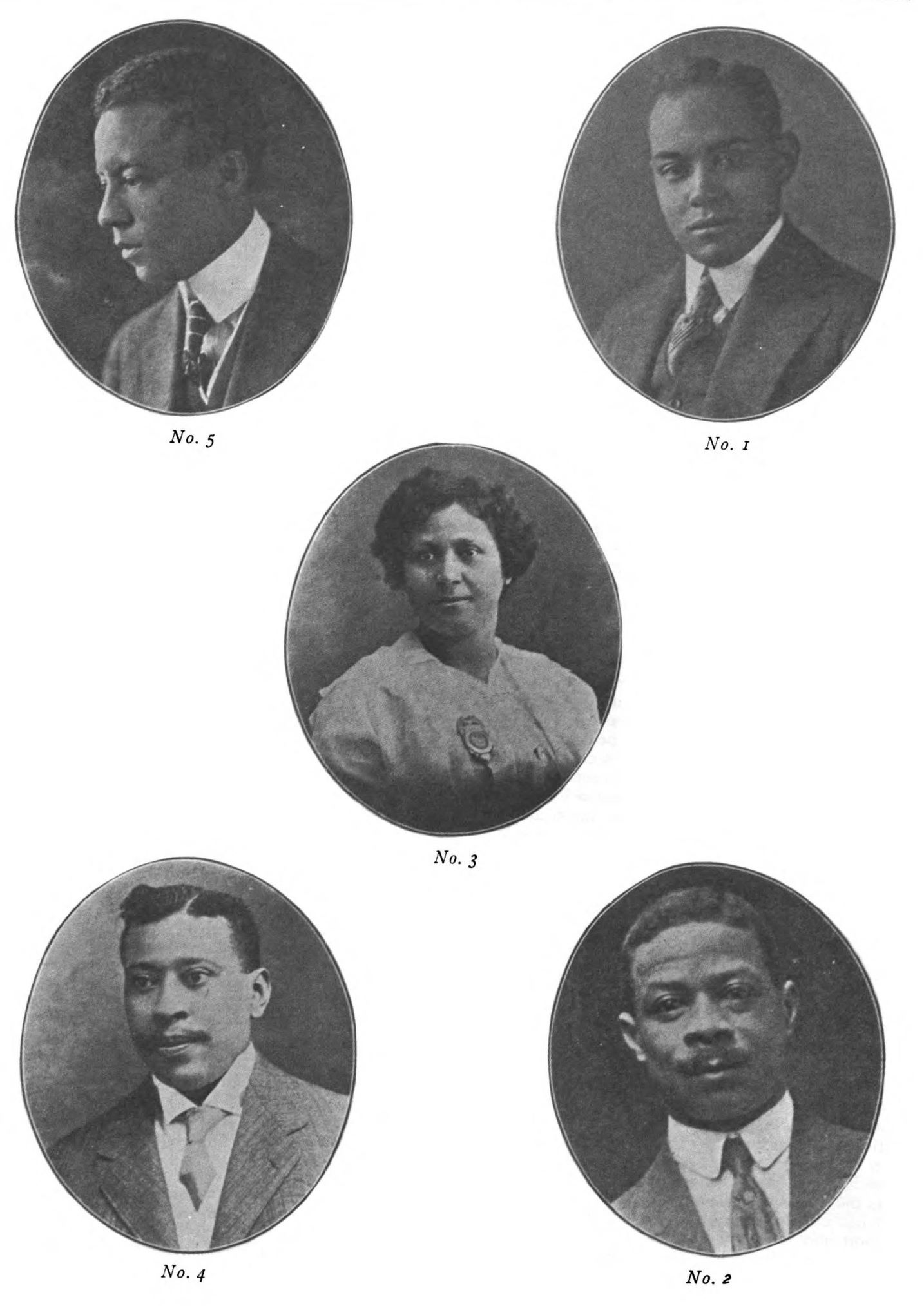
1. Chandler Owen, Candidate for Assembly from the 21st Assembly district is co-editor of the MESSENGER magazine, President of the National Association for the Promotion of Labor Unionism among Negroes, and one of the founders of the Friends of Negro Freedom.
2. W. B. Williams is candidate for Assembly from the 5th Assembly district. He is the only Negro in the Socialist Branch which nominated him. He is also a prominent member of the Scenic Artists’ Union.
3. Miss Grace Campbell is candidate for Assembly from the 19th Assembly district. She is the first colored woman to be named for a public office on a regular party ticket in the United States of America. She is well known for her pioneer social service work for colored girls.
4. Frank Porec is candidate for State Senator from the 18th Senatorial district. He is the first Negro to be named for this office in New York on a party ticket. He is also prominent in labor union circles.
5. A. Philip Randolph is a candidate for Comptroller for the State of New York. He is the first Negro to be nominated for the fourth highest office on a state ticket of a regular party since Reconstruction Days. He is co-editor of the MESSENGER magazine. Secretary-Treasurer of the National Association for the Promotion of Labor Unionism among Negroes, and one of the founders of the Friends of Negro Freedom.
The Messenger was founded and published in New York City by A. Phillip Randolph and Chandler Owen in 1917 after they both joined the Socialist Party of America. The Messenger opposed World War I, conscription and supported the Bolshevik Revolution, though it remained loyal to the Socialist Party when the left split in 1919. It sought to promote a labor-orientated Black leadership, “New Crowd Negroes,” as explicitly opposed to the positions of both WEB DuBois and Booker T Washington at the time. Both Owen and Randolph were arrested under the Espionage Act in an attempt to disrupt The Messenger. Eventually, The Messenger became less political and more trade union focused. After the departure of and Owen, the focus again shifted to arts and culture. The Messenger ceased publishing in 1928. Its early issues contain invaluable articles on the early Black left.
PDF of full issue: https://www.marxists.org/history/usa/pubs/messenger/v2nRN-10-nov-1920-Messenger.pdf
 Revolution's Newsstand