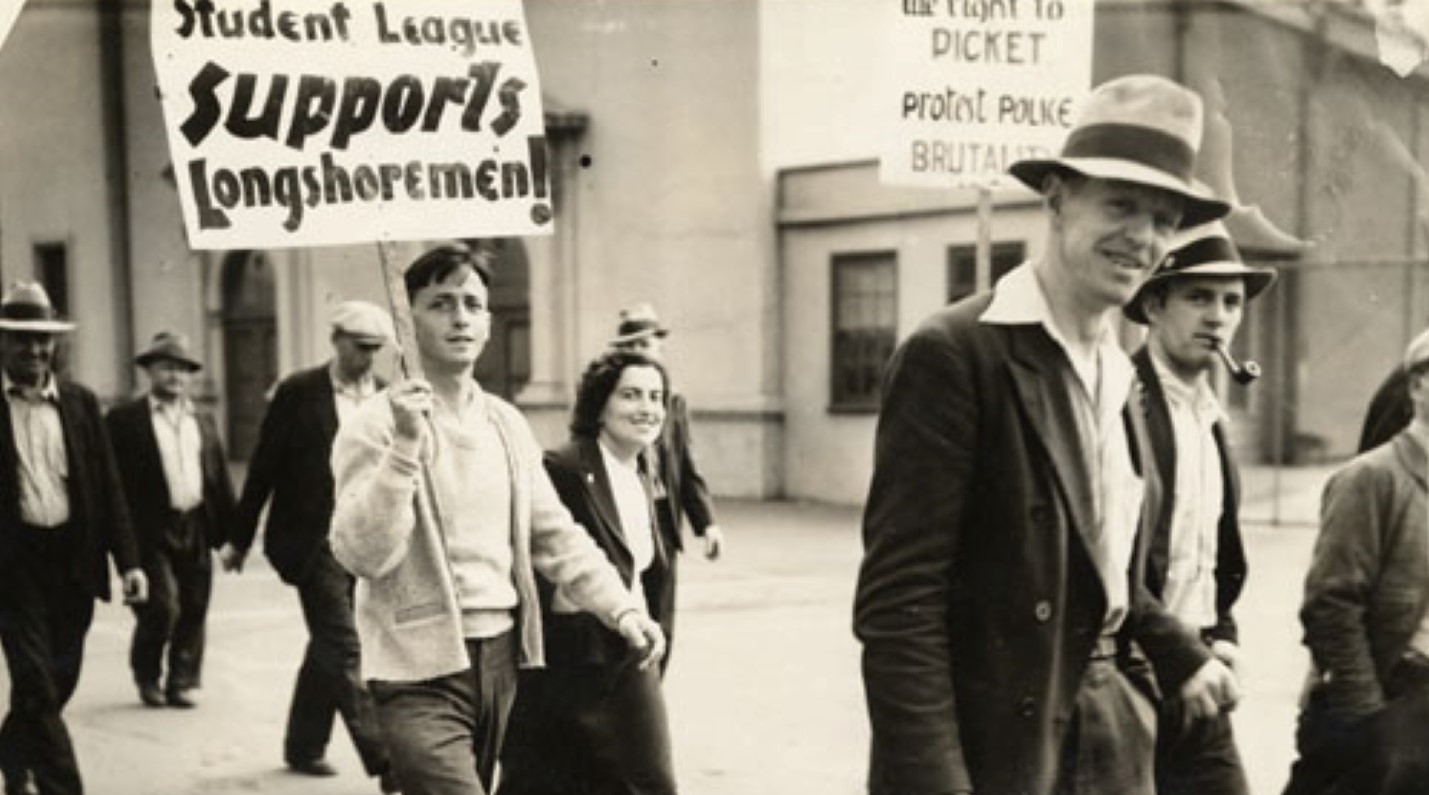
Ninety years ago this week, the San Francisco General Strike. Irish Hamilton wrote in real time of those events for the New Masses.
‘The General Strike’ by Iris Hamilton from New Masses. Vol. 12 No. 4. July 24, 1934.
SAN FRANCISCO. LIKE a besieging army, pickets were stationed on all roads leading into San Francisco and East Bay Cities. Not a truck can pass on El Camino Real, Skyline Boulevard, or the Bay Shore Highway without the pickets’ permission.
The tables are turned with a vengeance. Only yesterday, the Battle of Rincon Hill, last of five Bloody Days (every day of the week but two has been christened “Bloody” in the last two months–days on which police fired their pistols and threw their tear-gas bombs and wielded their skull-cracking night- sticks): only yesterday the Governor of California could order two thousand boys just out of high school to shoot and kill seasoned work-hardened men without whose labor these kids would have whined and starved. (Which of them could carry three hundred-pound loads like a longshoreman, work thirty hours at a stretch? The National Guardlets complained of the cold and discomfort and lack of movies and “fun” after three days.)
Only yesterday Mayor Rossi could sermonize on “law and order,” “fairness to the public,” “protection for citizens” and open the American Legion anti-Communist drive among fanfare of trumpets, mouthing his inanities in the open while secretly assisting the Industrial Association in its attempts to break the strike. Today the Governor is “appealing through the press to representatives of the striking workers to make ample provision for necessary food and medical supplies into San Francisco and the Bay region.” The City Board of Health is asking the Unions for gasoline permits; milk and bakery wagon-companies are asking the Unions for permits to make deliveries.
You can goad men till they enjoy the unchristian virtue of revenge, enjoy it even with a reverend archbishop sitting on a Mediation Board set up by a Christian President….
But that’s not it. Labor in the West has temporarily won; it is thrilling with excitement, spirit and courage. Labor has stuck together up and down this Coast, stuck, steadfast and rocklike as its own Sierras. Fifteen unions are out in sympathy with the striking longshoremen; the strongest, most important and best-organized unions on the Pacific. The Battle of Rincon Hill, in which Mayor Rossi’s police shot and wounded more than a hundred unarmed workers and bystanders (unarmed except for the industrial debris, rocks and bottles and screws, they could pick up) took place on July 5. On July 8 the teamsters met and determined by a vote of 1,220 to 271 to come out three days later if the strike were still unsettled.
On July 10 they came out on a practically unanimous strike vote of 2,000. They are delighted. Their district president, Michael Casey, tried his best to stop them, with warnings, threats and pleas even declaring that the strike was “illegal.” When they overrode him and called their strike, he said: “It will take a few days to establish picketing lines.” But the truckmen, out at midnight, had by dawn their pickets, hundreds strong, on every highroad into and out of San Francisco, and by morning enough trucks lay on their sides, and enough peaches, apricots, pears and cabbages were sprawling over the sidewalks to decide the warehouses and grocery stores not to try to transport anything.
“Too bad,” said Mayor Rossi, shaking his head, as he drove by Dreamland Auditorium and heard the news, “Ts-ts ts too bad!” “We’re out! We’re out!” shouted 2,000 teamsters, as they streamed from the Auditorium amid thunderous cheers and were greeted by an answering thunder from the overjoyed marine strikers and stevedores who had stood waiting on the sidewalk for two hours and a half. A. F. of L. leaders, Kidwell, Vandeleur, Casey had said in that meeting: “Stand by President Roosevelt and his mediators…” “Consider the gravity of rejecting the request…” “It may mean martial law…” “You will lose the $10 strike benefits because sympathy strikes are forbidden…” The teamsters scoffed. They roared for Bridges. “Bridges, Bridges! Get Bridges in!”

Harry Bridges, leader of the Joint Marine Strike Committee and the Longshoremen’s Strike Committee came, surrounded by his strong bodyguard of stevedores. A lusty shout went up.
“The entire labor movement faces collapse if the maritime strikers are defeated,” he said. “If you strike, you will double the power of the strikers.” Unity, solidarity, determination…That is what Bridges harps on, what he and all the other trusted strike leaders have repeated over and over, since May 9, and what is bringing the employers, police, press and mediators, Federal and State and City Governments to their knees. “Stick together and you can’t lose.”
On Monday, July 9, two months after the strike broke out, San Francisco union labor buried two comrades who gave their lives for union labor–for the rank-and-file: Howard Sperry, World War veteran, I.L.A. member, an unemployed fry-cook, and Nicholas Bordoise, seaman, member of the Tom Mooney Branch of the I.L.D. and of the Communist Party. It was a moving mass funeral. The capitalist papers fell over themselves in their descriptive accounts by picked reporters; pages of color-stories; banner headlines. For not only did fifteen thousand men follow the flower-laden coffins, in a procession stretching a mile, but tens of thousands more watched from the streets, heads bared as the slow dirges beat on the sunny air. Workers from shop and mill, truck and ferryboat, street-car and taxi, fell into line in that march; men left their offices and joined that march; relief projects were deserted, buildings, elevators, kitchens, delivery wagons, laundries and factories; as workers joined in that procession, one immense solid phalanx, to bury their dead.
One had seen it somewhere before, this silent, endless march, workers knit by something no outsider could understand; sailors, stevedores, firemen, cooks, oilers, engineers, mates, pilots; with the flowers, with the music, in the sunshine, in silence: moved by one great emotion: one had seen it before–where was it?–Ah, Potemkin! The film Potemkin! That march by the bier of the sailor slain on the Battle Cruiser Potemkin, Odessa, in 1905–because he wouldn’t eat any more of their tainted food!
“In fact, I can state before the Board,” said Harry Jackson, National Organizer of the Marine Workers’ Industrial Union, at the Roosevelt Board open hearings: “I can state before the Board that one-third of the seamen who are forced to go to the Marine Hospital for treatment go there because of the rotten food served aboard American ships.”
But there’s another similarity with that movie of an historical event: and it makes one say, with Vandeleur, one of the sell-out A. F. of L. leaders in San Francisco, “Do you fellows have to see a haystack in the air before you can see which way the straws are blowing?” It is this. Remember that cross bobbing up and down, after the revolt has broken out, that is flashed now at the top of the stairs, now on the lower deck, now in the mouth of the cannon, now in the men’s bunks, as the sailors take over the ship?–the great decorated fluted Greek Orthodox Cross? A symbol. Remember?
The Chairman of the Roosevelt Mediation Board is His Grace the Right Reverend Archbishop Edward J. Hanna.

“You can’t describe San Francisco ‘quite like it,” as the little girl said. The taxis are out–2,500 of them. The hotel bus men are on strike. (The Knights Templars, with their black and yellow banners and their intricate crisscross marchings, who were holding a national conclave in San Francisco, “hurriedly left.” One hotel, used to forty arrivals a day, had four. The cleaners are out; the dyers are out, the butchers, boilermakers, welders, marine cooks, stewards, firemen, oilers, water-tenders, wipers, scalers, engineers, masters, mates and pilots–oh yes, and 12,000 longshoremen–out on the Pacific Coast.
“It’s unique,” cries the capitalist press, “it’s like no other general strike situation ever seen. Why, it is almost entirely a sympathetic strike!” “It’s illegal!” wails Michael Casey. “It’s against our constitution,” moans Edward Vandeleur. “The N.R.A. can’t help them!” shouts General Johnson. “Not till there’s a shipping code.” “The closed shop is illegal–it’s against Section 7A”-headshakes the Employers’ Association….”Ts-ts-ts-ts-breaking laws passed by the impartial federal government!” Oh yeah? say the strikers. And what about those hundreds of pickets you illegally imprisoned and illegally beat up? What about the workers you have jailed illegally for striking, for selling literature, for showing movies, for distributing leaflets, for vagrancy, for protests, for “being a Communist,” as one of your own judges flatly put it, breaking the bounds of legal fiction for a passionate truthful moment? What about the strikers you had illegally shot and no policeman has been even brought to trial for it?
It is not difficult to read, between the lines, the employers’ intention in this historic class battle. There is little doubt left now that this was a concerted, arranged, coastwise (and nation-wide) attack on organized labor. Employers have been laying for some time, on this coast, for a show-down. “It’s got to come sooner or later,” they kept saying. It came. The employers have thrown their all into this battle–their money, guns, vomit gas, mediators, press, their lies, appeals to patriotism, religion, impartiality, “law and order”, their A. F. of L. officials. And yet all they have accomplished, with each successive move, is to turn more sympathy toward the strikers. San Francisco labor is solid for the strike. Every Los Angeles union has voted money and moral support for the general strike when called. Seattle, Portland, Washington, San Pedro are solid for the strike. Today even the barber in the corner shop, the waitress, the manicurist, the hotel employee–people who spend their lives serving the bourgeoisie personally–hope the strikers will win.
The Mediators have played the sorriest role: they have exposed themselves in all the nakedness of the partisanship of the national government. “Roosevelt Board Battles to Avert General Walk-Out” cried Hearst’s Examiner on July 11. But they haven’t battled for peace or for workers; they have battled for and one thing-to break the strike (at $20 a day). The open hearings were calculated-consciously or unconsciously–to create delay, while trucks carried cargo from the water front to warehouses under police and National Guard protection. (Though the Industrial Association, with all its police and troops and murders and hypocritical page-ads in newspapers, has accomplished as much as one little boy might have accomplished; it has moved cargo only from the dock to warehouses. It has to stop that now, because the warehouses are overflowing; and there are no trucks in the city of San Francisco that will move one skein of silk or one pineapple out of a warehouse…
The Board’s open hearings occupied three days. Before they began, Archbishop Hanna asked the men to return to work pending arbitration. The men refused. Appeals were made daily to the strikers and not-yet striking workers for patience, for care for the interests of the public, for trust in President Roosevelt, “who is your friend.” Appeals to workers to trust their (yes, their) Mayor, their Governor (yes, their) whose publicity woman their says: “We can always count on insults to reds to be good publicity”, for return to work pending arbitration. Even when the employers said they would arbitrate and the newspapers spilled it over the front pages, there was a joker in it; they still wouldn’t meet the chosen representatives of the strikers. They still would arbitrate collectively only if they were satisfied with the strikers’ representatives; there was no provision for arbitration if collective bargaining should fail. The hearings before the Board were characterized by clearly stated, terse, vivid pictures by strike leaders of conditions on boats and on the docks, of conditions of work and hiring, underpay and overtime, blacklisting and human degradation that shocked even the sunny California bourgeoisie out of its somnolent paradise. The speaker for the employers, Thomas G. Plant, Manager of the Waterfront Employers’ Union, bald-headed and sonorous-voiced, read from a prepared statement for over an hour: and all he had to say was what they had said before, except that he added a gratuitous insult: The men have had the closed shop since 1921, he said, meaning. the notorious Blue Book company union.

During the three days of the hearing, full-page ads appeared in every San Francisco newspaper morning and evening, telling in bold black print, the employers’ falsehoods.
The Mediators knew the teamsters were going to walk out Wednesday night “unless the strike was settled.” In that time they sat and asked, impotently, “What is a scaler?” “What is a fink, this word fink, Mr. Bridges?” “Why are the insurance rates for longshoremen as high as for aviators?” They let the employers collect funds; move heaven and earth to sway public opinion; they let them lie about wages and conditions, the closed shop, legality. They pleaded for arbitration. The Mayor of Portland let his Chief of Police shoot four strikers, one of whom is still in a critical condition, and when even his City Council protested and asked removal of the official, and the longshoremen came and waved the wounded men’s bloody shirts in his face, he requested them not to use profanity.
“If your police can use bullets, I should think the longshoremen would be allowed to use profanity,” mildly suggested a City Commissioner. And now even Governor Julius Meier, of Oregon, has wired Senator McNary at Washington: “I urge that the Mediation Board either act… promptly…or be succeeded by another.” The Senator was unable to see Miss Perkins, but her Department said the Board was directly responsible to the President. And the President is on the high seas preparing his tackle for fishing off the Cocos Islands.
Archbishop Hanna, just before the teamsters struck, walked up and down the platform, so the radio announced, in great perturbation, praying for the teamsters and counting his beads. Last night, with the General Strike two days off, “as father of the poor and the afflicted” he stated in a nation-wide radio address of great solemnity, “that in the new Law all Men were Brothers in Christ,” and that “a settlement can be arrived at only by arbitration.”
But there is a graver menace to the General Strike labor’s worst enemy, the employers’ most powerful ally: the reactionary A.F. of L. leaders. Their part has also been nakedly exposed in this strike. The rank and file have pushed through, fought through, sacrificed through, to the brink of victory; will these compromising “leaders” snatch the workers’ gains from them now, at the eleventh hour, when labor has the support of every class-conscious workingman, of every sympathizer, every imaginative and generous person in the United States?
In the days after the police shot workers and the troops came out, labor gathered together and answered with a great cry: “General Strike!” A meeting of the San Francisco Labor Council, July 6, to act on the general strike resolution, adopted a substitute resolution–setting up a strike strategy Committee of Seven. The workers were misled at this point, for on this committee were appointed the seven biggest anti-strike, anti-rank-and-file,

anti-democratic, of the well-paid A.F. of L. officials. And they have acted true to pattern. They have delayed the general strike vote, and delayed it again, meanwhile using every thinkable means of splitting the ranks. Up to the moment of the general strike vote, they had failed to even dent the unity of the workers.
The rank and file is wonderful, heartening. They have acted in such a way on the Pacific Coast in this strike as to ensure that there are some things which will not be done to Labor again. For forty years the employers said, “There’s nothing to arbitrate.” Now the longshoremen say it. “There’s nothing to arbitrate in the closed shop. Because, you see, we don’t mean a half-closed, or a three-quarters closed, or a seven-eighths closed shop; we don’t want a crack in the door left open; we mean a closed shop.”
They are learning not to be fooled by lost leaders. (Perhaps not fast enough. That is the great fear. Perhaps not fast enough.) “Those fake leaders haven’t five percent of the support they think they have,” said one rank-and-filer. Many of the rank-and-file, grown wise, have been enlightened by the perception of their own power. They said they could do it, and it’s true: they can! Labor can beat the Company union. Workers can beat Fascism-if-if-they’ll stick by their uncorruptible, uncompromising, red leaders.
For that reason it is that against the leaders who stick by the men, every calumny has been spread; they are dope-peddlers, they are hooligans, criminals, British agents, un-American, aliens, kidnapers, vagrants, REDS! REDS!! Thieves, dynamiters (all one of course)…Reds! The rank-and-file shout for Reds they want more of them…”Give us more Reds!” they cry-and they need more of them.
Capitalists, more and more, are forging the weapons of their own destruction. They have a way of proving whether you’re a Red or not.
If you have discipline, order, poise, intelligence, patience, foresight, loyalty—if you stand devotedly, unflinchingly, uncompromisingly by your men–by the rank-and-file–then you are a red. The flattery of it! The compliment of it! In every kindergarten of the U.S.A., in every Boy Scout troop, in every nursery and schoolroom, the patriotic teachers are seeking to inculcate just those virtues into children which San Francisco capitalists and their tools attribute to communists, radicals, Reds. (Before labor’s onslaught even the American Legion has retreated in dismay. It had to publish an apology for a labor-baiting advertisement in a capitalist newspaper, when it realized it was antagonizing even its own potential recruits.)
The line-up has been clear in this strike. The employers, organized and united, the Government, Arbitration, the Press, Church, police, troops, guns, A. F. of L. officials on one side-and organized labor, solid, conscious, determined, on the other.
Let’s dial in on one last radio news–instalment:
The tomato crop of Contra Costa County, ripening a month ahead of schedule, is threatened with ruin because there are no trucks to deliver them.
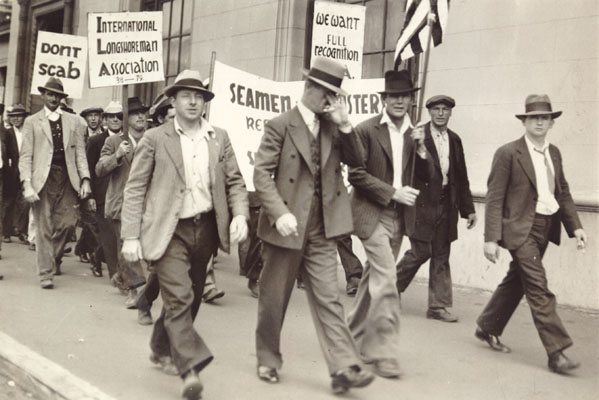
A month ago one hundred and fifty militant fruit pickers, organizing in the Cannery and Agricultural Workers’ Industrial Union, were run out of Contra Costa County by police for striking against a wage of twenty cents an hour, and locked up for three weeks.
Oh, Archbishop Hanna’s heavenly Boss! You couldn’t by any chance be laughing, could you?
(This article was written and dispatched while the unions were voting on the general strike, and before the final decision was known. THE EDITORS.)
The New Masses was the continuation of Workers Monthly which began publishing in 1924 as a merger of the ‘Liberator’, the Trade Union Educational League magazine ‘Labor Herald’, and Friends of Soviet Russia’s monthly ‘Soviet Russia Pictorial’ as an explicitly Communist Party publication, but drawing in a wide range of contributors and sympathizers. In 1927 Workers Monthly ceased and The New Masses began. A major left cultural magazine of the late 1920s and early 1940s, the early editors of The New Masses included Hugo Gellert, John F. Sloan, Max Eastman, Mike Gold, and Joseph Freeman. Writers included William Carlos Williams, Theodore Dreiser, John Dos Passos, Upton Sinclair, Richard Wright, Ralph Ellison, Dorothy Parker, Dorothy Day, John Breecher, Langston Hughes, Eugene O’Neill, Rex Stout and Ernest Hemingway. Artists included Hugo Gellert, Stuart Davis, Boardman Robinson, Wanda Gag, William Gropper and Otto Soglow. Over time, the New Masses became narrower politically and the articles more commentary than comment. However, particularly in it first years, New Masses was the epitome of the era’s finest revolutionary cultural and artistic traditions.
PDF of full issue: https://www.marxists.org/history/usa/pubs/new-masses/1934/v12n04-jul-24-1934-NM.pdf
 Revolution's Newsstand