Robert Wood, the Southern District Secretary I.L.D., describes the ‘difficulty’ of work in the South and his own kidnapping by the Klan.
‘The International Labor Defense in Dixie’ by Robert Wood from Labor Defender. Vol. 11 No. 6. June, 1935.
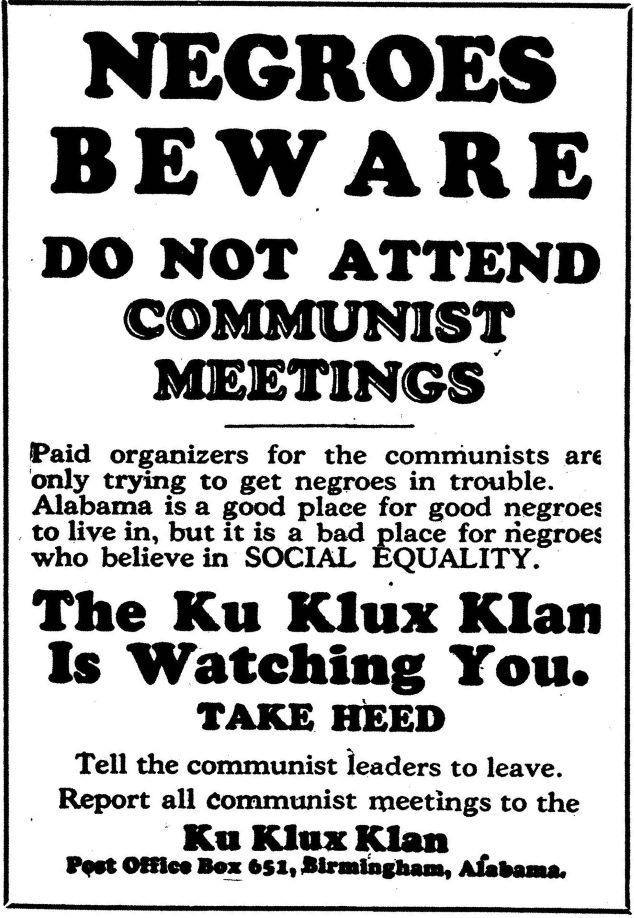
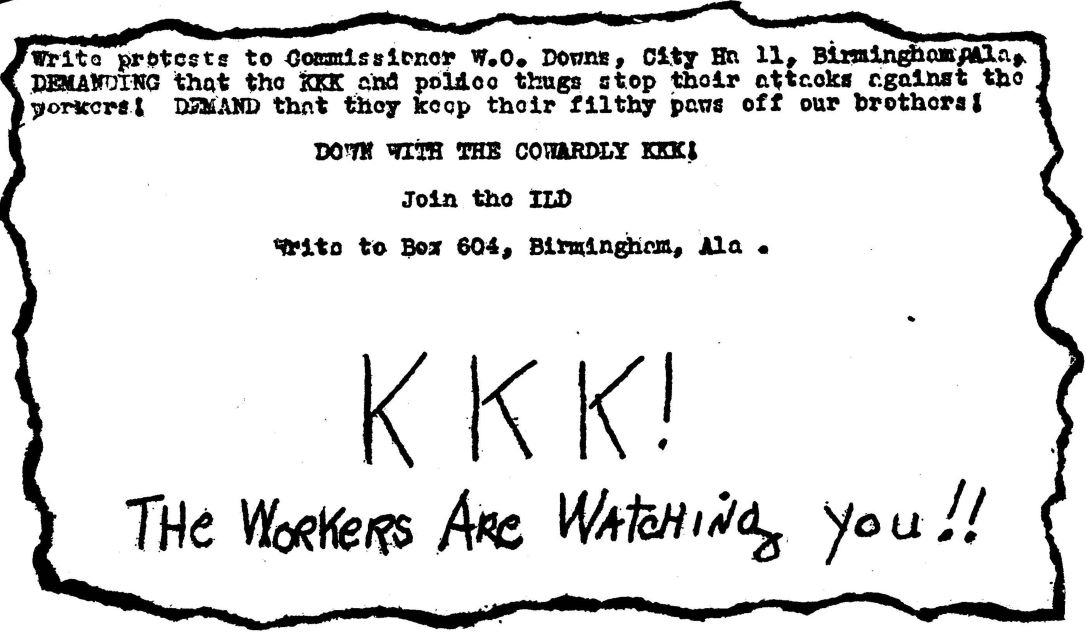
May First, in the city of Birmingham, was the scene of more than the usual vicious terror–which by no means prevented the workers from the workers from gathering to hold “flying” meetings in open parks throughout the city. Dozens of homes were raided, several Negro workers were badly beaten by the police, and men jailed. Thugs operating hand in hand with the police, performed the heavier tasks of taking workers “for rides.” The writer was kidnapped on May Day by four well-dressed thugs, carried twenty miles into the country, beaten, threatened with death and thrown into the creek. Pointing to the railroad tracks, the thugs told him to “get out of Birmingham, you Goddamn N***r Lover and tell all your people back north the same goes for them!”
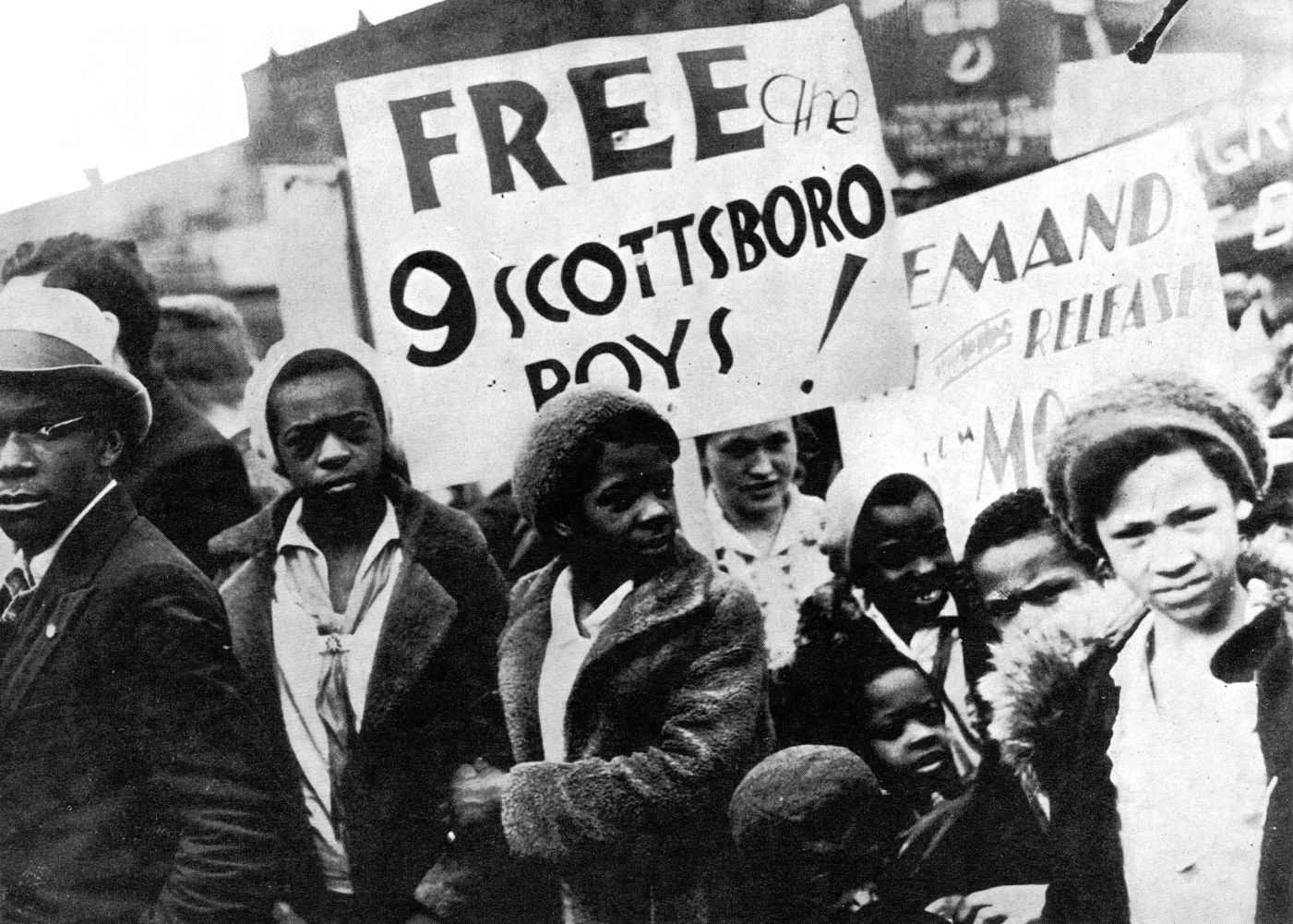
But May Day meetings were held throughout our district and the struggle around Scottsboro formed the central point of every gathering. One young worker, recently recruited into the I.L.D., in speaking of the Scottsboro decision, said: “This makes us be a people now.”
The recent Scottsboro victory has had a wide effect upon the workers in the South. The four-year mass struggle has resulted in arousing thousands of workers throughout our district. This is evident in many ways. Many questions are asked not only as to the decision itself, but as to its political significance. Will it mean the right to vote? The right to sit on juries? The right to hold public office? In addition, the masses of workers are willing to support, are, in fact, determined to press the issue and enforce their right to serve on juries.
As the best indication of the growing alertness of Southern workers, their tremendous advance in the courage and militancy we can point to the example of the delegation of Birmingham Negro women who went to a circuit clerk and demanded that he put their names on the jury rolls!
The terror, now widening to include among its victims many of the white workers, still is most vicious when directed against the Negro workers. Three Negro workers were slain during the past few months. One was shot in the back when police invaded his home to investigate a quarrel between him and his wife. Another was slain for “being sassy.” The third open murder occurred when policeman Duke shot Isaac Mitchell, a Negro restaurant worker, “as a joke.” Duke was recently acquitted of charges growing out of the slaying, because he was in “a nervous condition.”
To meet this terror an All-Southern Conference for Civil and Trade Union Rights is being held in Chattanooga, Tenn., on May 26. Our district took the initiative in calling this conference. It has the support of many leading Socialists throughout the South, in addition to the Southern Tenant Farmers’ Union, the Share Croppers Union, Commonwealth Labor College, College, Highlander Folk School, Younger Churchmen of the South, the American Workers Union of Kentucky, United Farmers’ League locals, the Executive Secretary of the Urban League in Atlanta, Ga., and many A. F. of L. trade-unionists.
In the present laundry strike in Birmingham, we are making systematic efforts to recruit many of the striking workers. Back copies of the LABOR DEFENDER were distributed among the strikers. Several leaflets were issued by the I.L.D. directly to the laundry strikers and were distributed by the thousands in the laundry territory. Leaflets were also distributed to the coal miners and other industrial workers. We expect the first industrial branch in this district to be set up among the laundry workers, to be followed by other industrial branches, in coal, ore and steel.
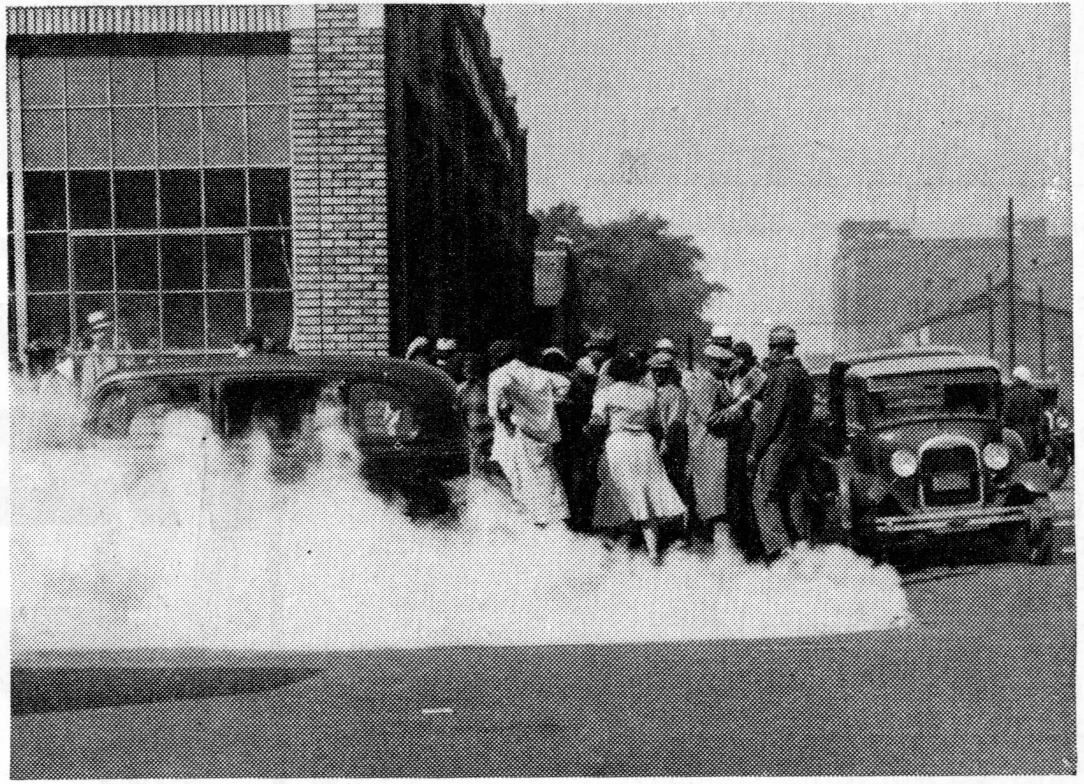
Our district has made very slow progress among the white workers. Our approach has not been direct enough in pointing out to the white workers that the Scottsboro case is intimately tied up with their own problems. We have not made sufficiently clear the lessons of police terror that are directed not only against the Negro workers, but also against the white workers. In recent leaflets dealing with the Herndon case, the police terror directed against the laundry strikers, and with the recent police murder of several Negro workers, we have explained and stressed the white workers’ need for our organization.
Our continued growth, despite the severity of police terror in many sections, is an indication of the increases in the number and strength of local leading forces. We are determined to make our district a real mass district, rooted in the industries and share-cropper country and uniting Negro and white.
Labor Defender was published monthly from 1926 until 1937 by the International Labor Defense (ILD), a Workers Party of America, and later Communist Party-led, non-partisan defense organization founded by James Cannon and William Haywood while in Moscow, 1925 to support prisoners of the class war, victims of racism and imperialism, and the struggle against fascism. It included, poetry, letters from prisoners, and was heavily illustrated with photos, images, and cartoons. Labor Defender was the central organ of the Scottsboro and Sacco and Vanzetti defense campaigns. Not only were these among the most successful campaigns by Communists, they were among the most important of the period and the urgency and activity is duly reflected in its pages. Editors included T. J. O’ Flaherty, Max Shactman, Karl Reeve, J. Louis Engdahl, William L. Patterson, Sasha Small, and Sender Garlin.
PDF of full issue: https://www.marxists.org/history/usa/pubs/labordefender/1935/v11n06-jun-1935-orig-LD.pdf
 Revolution's Newsstand