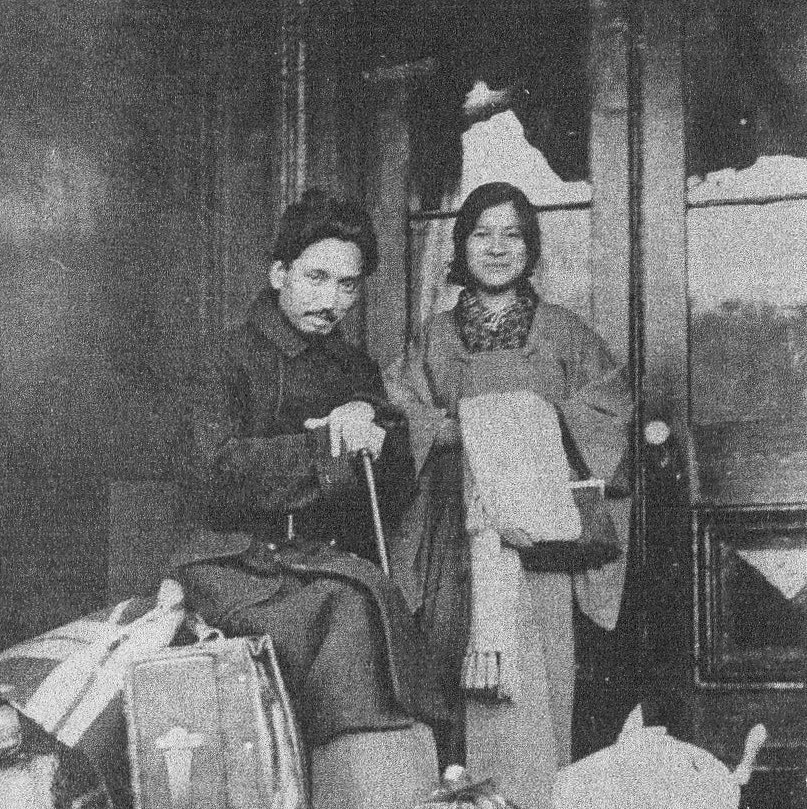
Leading Japanese radicals and partners Ōsugi Sakae and Itō Noe were murdered in the Kantō Massacre outside of Tokyo of thousands of Koreans and Chinese workers, Japanese radicals and trade unionists by rightists in the aftermath of the 1923 Kantō earthquake.
‘The Murder of Comrade Sakay (Ōsugi Sakae)’ by G. Vojtinsky from International Press Correspondence. Vol. 3 No. 69. November 1, 1923.
A brief telegram from Japan, dated September 3, informs us that comrade Sakay, who was released from prison after the earthquake in company with other comrades arrested in June, and who was again arrested on the following day, was murdered by a soldier on the way back to the prison. The provocatory methods pursued by the hangmen of the working class are alike in all countries
The government which has caused the murder of this most popular of the leaders of the Japanese labor movement substantiates its bloody deed with the time-worn phrase of: “attempt at escape and resistance”. Everyone who knows the part played by comrade Sakay in the political life of Japan, realize the declaration made by the government to be an impudent lie, for this celebrated political economist, who was well known throughout the country, and enjoyed the respect of all sections of the population, naturally could not have contrived to conceal himself and live illegally. Even when comrade Sakay was first arrested in June, the arrest was carried out in such a manner that comrade Sakay knew beforehand when this would take place. but still did not think of hiding himself or seeking flight.
The murder of comrade Sakay is of great political significance for Japan. The fact that the Japanese government committed this bloody deed immediately after the earthquake, proves that it is determined to suppress with an iron hand any attempt at a rising on the part of the starving and shelterless working millions, and that it will continue its policy of ruthless annihilation of any labor movement.
The Japanese labor movement during the past year has had to pass through a period of the most bitter offensive on the part of the government and the capitalists. The number of trade union members decreased considerably during this time. But now that the labor organizations have withstood this attack on the part of the state power and of the separate capitalists, they have emerged from the struggle with increased strength and greater political experience. At the time when the economic and financial crisis in Japan began to abate, that is, at the beginning of this year, a fresh fighting spirit pervaded the labor movement, which spread to the most important industrial centres such as, Tokio, Osaka, Kobe, Kioto, to the mining districts and to the islands of Hokaido and Kiu-Siu.
The revival in the Japanese labor movement expressed itself in a strike movement and in a general revolutionary movement. The Communist movement has acquired fresh strength from the trade union and political labor organizations alike. In the Spring of this year a number of trade union congresses were held, and these passed many resolutions concerning the new forms under which the working masses are to be gathered together to fight for their economic and political rights. At the same time an energetic campaign was started in Japan for the united front within the working class itself, and between the working class and the agricultural proletariat and small tenant farmers. This campaign had remarkable results. The Association of Tenant Farmers, on the occasion of its congress on February 20, resolved to enter into communication with the trade union organizations of the industrial proletariat, and to enter protests against the draft of the Anti-Communist Law and against the limitation of the right of combination and of holding meetings. The workers for their part resolved, at the congress held by the General Labor Federation, to support the tenant farmers in their struggles with the landowners.
The Japanese government, which is opposed by a fairly powerful middle and petty bourgeois opposition, opened a fierce attack upon the working class, the development of whose movement alarmed even the oppositional elements of the bourgeois class. The government, recognizing that the most important tendencies in the labor movement were aiming at concentrating and centralizing the trade unions, at immediately associating with the revolutionary movement headed by old socialists of the type of comrade Sakay, and at the setting up of a common united front with the tenant farmers struggling to rid themselves of the landowners’ yoke, launched its blow precisely against these points of the labor movement.
The main object of the Japanese government has been to separate the labor movement from the communist movement, and from the tenant farmers’ movement. In order to attain this end, the government arms and incites the Fascist bands composed of the disreputable bourgeoisie, ex-officers, and out of work officials, against the labor organizations and against the organizations of the tenant farmers.
At the same time, the Japanese militarists are preparing for a decisive blow against the communist movement all over the country. In June of this year numerous leaders of the revolutionary and labor movements were arrested and imprisoned. The pretext for this action was the great students’ demonstration made by the University of Vaseda against the militarist attempt to introduce military instruction into the high and middle schools. The murder of comrade Sakay is, in a sense, the finale of the attack made by the ruling clique of Japan against the labor and peasant movement.
After the earthquake catastrophe, the results of which are as disastrous as those of a lost war, the Japanese people are threatened by complete enslavement at the hands of Anglo-American capital. All the existing forces in the nation are to be mobilized for the restoration of the economic powers of the country. The national bourgeoisie will gain an ever-increasing economic importance during the restoration of the country, and will naturally gain a corresponding position of importance in political life. This means that the feudal pillars of Japan will break down. It is only necessary to cast a glance at the budget of the Japanese government in order to observe the striking contradiction between the economic importance and the political impotence of the Japanese bourgeoisie. In Japan, this agricultural country, the whole yield from agriculture to the government amounts to only 75 million yen out of a total revenue of 1600 million yen. Naturally the cost of restoring the districts devastated by the earthquake will have to be covered, not only by foreign loans, but also by an increase in the burden of taxation: and here the bourgeoisie will oppose a desperate resistance to the government of the agrarians. It will endeavor to bring about an enhanced exploitation of the working class on the one hand, and a casting of the load on to the landowners on the other.
The government of the agrarians represents a reactionary force in this respect, and will drive the country towards subjugation by Anglo-American capital, for it is anxious to base its plans for reconstruction mainly on foreign loans, and on a still greater oppression of the colonies With regard to Soviet Russia, this government will probably continue its old policy of threats and extortions, though perhaps with less militarist pressure.
This is inevitably bound to increase the enmity of the industrial bourgeoisie and the broad masses of the workers against the government. But the Japanese bourgeoisie will only be able to successfully combat the power of the agrarians, if it allows free play to the energies of the working masses, if it does not destroy the labor organizations, and discontinues its policy of preventing the concentration of the workers’ forces.
The main forces upon which the restoration of Japan is based, are the Japanese working class and the working peasantry, and these are the sole forces which can save the country from enslavement by international imperialism.
The murder of workers’ leaders by Japanese militarism is a heinous crime against the whole nation, against the whole Japanese people.
International Press Correspondence, widely known as”Inprecor” was published by the Executive Committee of the Communist International (ECCI) regularly in German and English, occasionally in many other languages, beginning in 1921 and lasting in English until 1938. Inprecor’s role was to supply translated articles to the English-speaking press of the International from the Comintern’s different sections, as well as news and statements from the ECCI. Many ‘Daily Worker’ and ‘Communist’ articles originated in Inprecor, and it also published articles by American comrades for use in other countries. It was published at least weekly, and often thrice weekly
PDF of full issue: https://www.marxists.org/history/international/comintern/inprecor/1923/v03n69[45]-nov-01-1923-Inprecor-stan.pdf
 Revolution's Newsstand