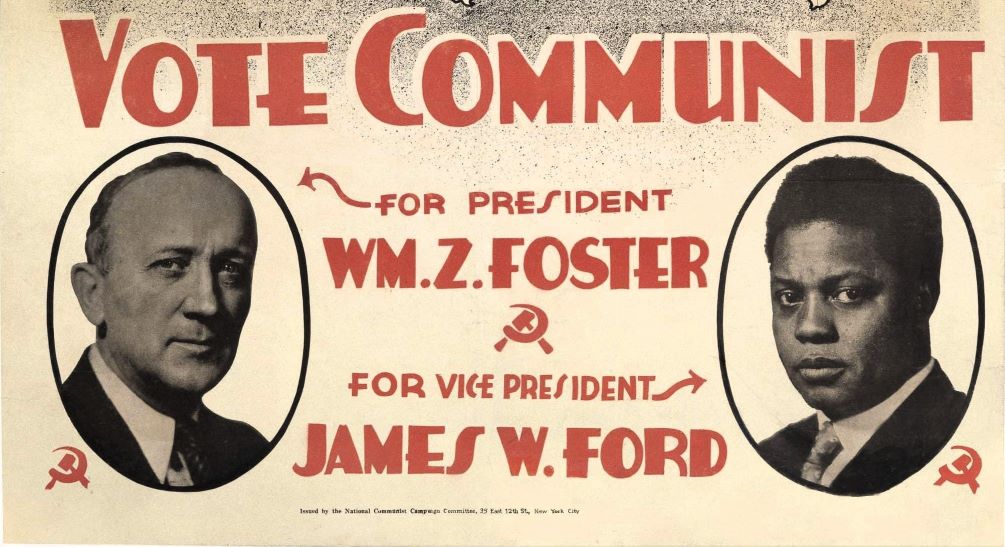
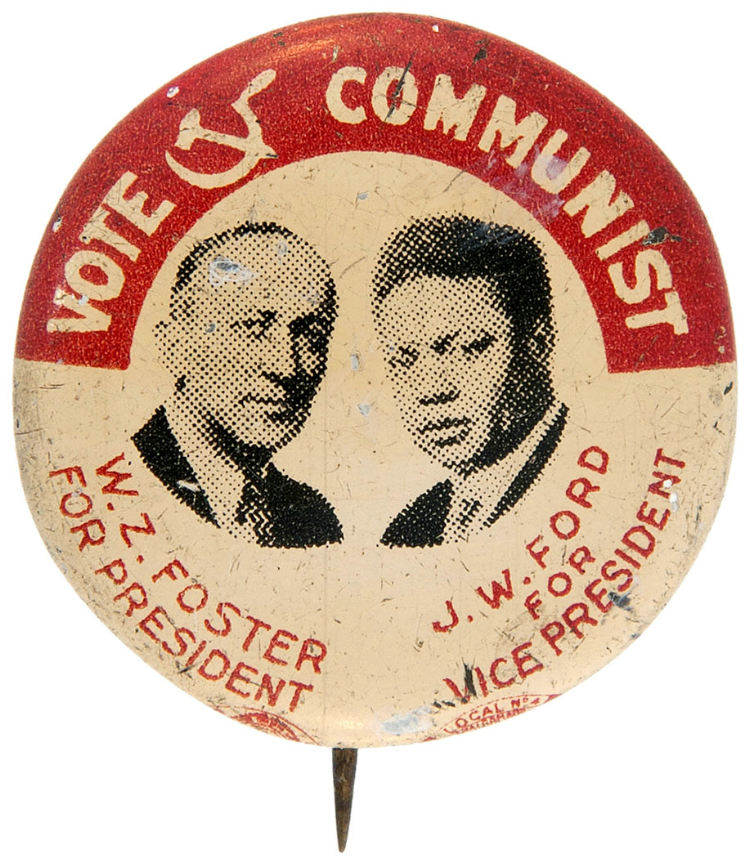
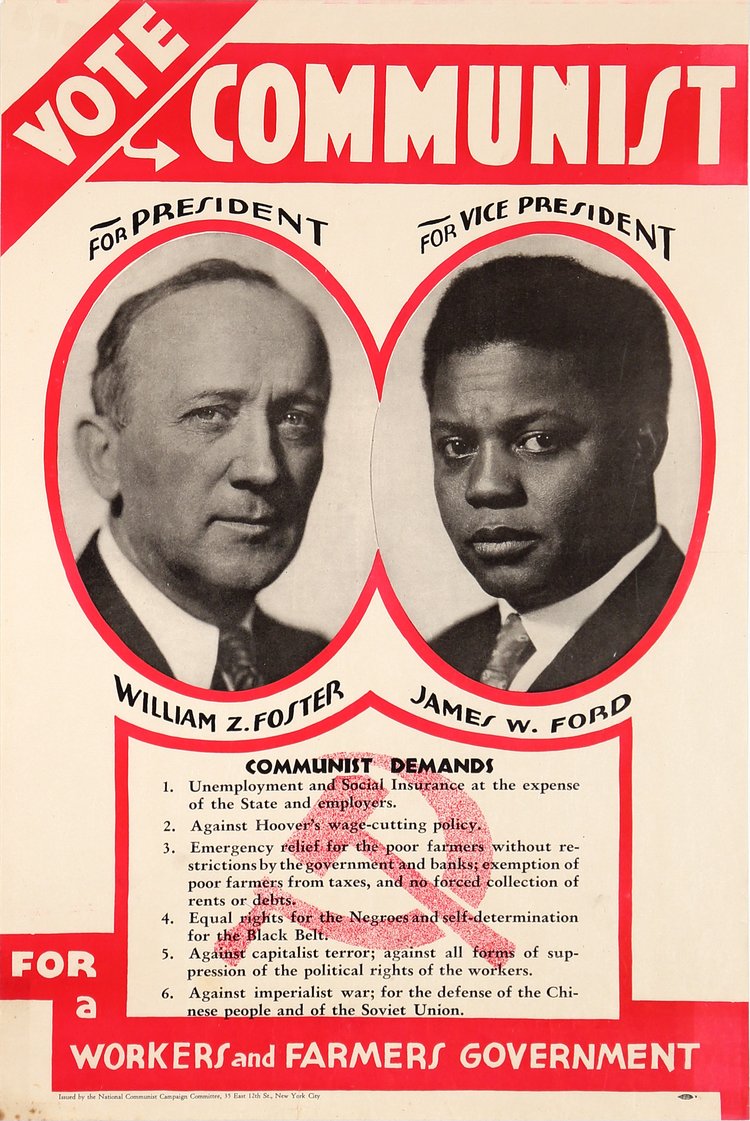
The Communist Party’s 1932 Presidential campaign of William Z. Foster and James W. Ford is of interest historically for many reasons, not least of which that it was the only national election held during the ‘Third Period.’
‘Some Problems of Agit-Prop Work and Our Election Campaign’ by Sam Don from The Communist. Vol. 11 No. 8. August, 1932.
THE essence of the Leninist conception of agitation is concreteness and simplicity—a concreteness and simplicity which does not stand isolated, but rests on a proper understanding of the background of events and their perspectives. Propaganda, therefore, must be closely related to our agitation and in a still broader sense, our agitators must have an understanding of the political line of the Party and the fundamental principles of Marxism-Leninism. What do we mean by concreteness and simplicity? Is it merely a recitation of facts and the use of very simple language? Certainly facts and simple language are very important. The key understanding, however, is that our concreteness must be based on the actual life, conditions, moods and thoughts of the masses—to learn all the facts of the class struggle, not merely through facts by way of statistics and statements, but above all, by establishing “solid personal contacts with the workers” (Fourteenth Plenum Resolution). In connection with our present election campaign it is well to recall and grasp every shading of the following words of Lenin:
“Communists should penetrate into the humblest taverns, should find their way into the unions, social and chance gatherings of the common people and talk with them not learnedly, not so much after a parliamentary fashion.” (Emphasis mine—S. D.)—Left Wing Communism—An Infantile Disorder.
How should we speak, how should we write in this election campaign? Again let us consult Lenin. In the thesis on the Communist Party and Parliamentarism, written by him and adopted at the Second Congress of the Communist International, we read:
“The Communist members must speak in parliament in such a way as to be understood by every working man, peasant, washer-woman, shepherd, so that the Party may publish his speeches and distribute them to the most remote villages of the country.”
Indeed, the standard set here by Comrade Lenin must become the ambition of all of us. In this article we will deal with some of the problems of agitprop work in connection with our election campaign. Our discussion is based primarily on an examination of the various leaflets on the elections.
What strikes one first of all in reading through our leaflets coming from all parts of the country, is their “uniformity” and “similarity.” “They all might have been issued in the national office for national distribution. In a nutshell, they lack local background and color. Of course, we are in the midst of a presidential election campaign where national issues are the decisive ones, but these must be in the closest manner linked up with a discussion of the local conditions. Then again, practically all of the districts have issued one or two election leaflets. ‘There must be a variety of election leaflets, particularly such leaflets which show a quick response and reaction to the local conditions, to various statements of local demagogs and politicians, etc.

The entire Party, from top to bottom, has not yet earnestly taken up what the Fourteenth Plenum suggests in its resolution, namely that:
“Throughout the campaign every statement and every proposal of the enemy parties must be quickly answered and in millions of leaflets.”
The united front from below must be the key approach in our election campaign and of course this should reflect itself in our agitation. The election platform is headed by the following:
“For Working Class Unity in the Election Campaign! Against the Hunger and War Offensive of the Capitalists! For the Workers’ Ticket—Candidates of the Communist Party—Against the Candidates of the Bosses!”
The note struck here is working class unity. The slogan for the Workers’ Ticket does not appear accidentally; it is in line with our united front approach. Yet in all of the leaflets which we have on hand, none mention the above slogans, particularly for the “Workers’ Ticket.” The absence of this united front approach is reflected in the content, form and style of our leaflets. We speak too much as a Party “for the workers,” and not “of the workers” (Fourteenth Plenum Resolution).
The six main demands are printed in most of the leaflets, although not in all of them, but of course this is by no means sufficient. Practically none of our leaflets in the text explain the meaning of our slogan “Unemployment and social insurance at the expense of the state and employers.” We take it for granted that the workers will accept it and agree with it by merely mentioning it. The leaflet which comes nearest to an explanation is one from New Bedford, Mass., which says “The Communist Party takes a part in this election campaign, carrying on a struggle for unemployment and social insurance at the expense of the government and employers.” It insists on the fact that “those who are responsible for wrecking the mills, those responsible for unemployment—the mill owners and their government, shall pay for this crisis. If they will not provide work, they must provide us with unemployment insurance.”
Take for instance the call for the Pennsylvania State Nominating Convention. There we do not even find the slightest mention of our first central demand of unemployment and social insurance at the expense of the government and the employers. It is not mentioned either in the text or at the bottom of the leaflet. The call speaks for “Bread and Jobs.” Of course there is nothing wrong with that, but to substitute it for our first central slogan and to eliminate completely our first central slogan is a very serious opportunist error.
The leaflet issued by the Workers International Relief and the National Miners Union in the Kentucky and Tennessee Districts, also improved on the first central slogan; they “simplified” it a little bit in the following fashion: “Fight for relief at the expense of the operators and their government.”
Our fight against Pinchot in Pennsylvania is important. There is no serious attempt in the Pennsylvania call to expose the various relief measures of Pinchot, and it merely confines itself to the statement “Pinchot talks of unemployment relief and taxing the rich, but this is all he does.”
An opportunist error of omission is the complete silence with which the Pennsylvania call passes over the existence of Father Cox.
What we state of the Pennsylvania call for the Nominating Convention in its attempt to expose Pinchot also holds good for the Reading leaflet. The Reading leaflet also brings out a weakness in relation to our slogan for the defense of the Soviet Union which is true of practically all of the other election leaflets— namely, it says: “at the same time it (imperialism) is desperately driving toward imperialist war, especially against the Soviet Union.” (Our emphasis.) Why, may a worker ask, “especially against the Soviet Union”? And if we would read through the leaflet there would be no answer. No mention of the fact that unemployment has been liquidated in the Soviet Union, not even a slight mention and contrast of the condition in the Soviet Union and that of the United States.
Our leaflets in a general way speak about war. It is not concretized and hardly any leaflet takes up concretely the question of pacifism, both the official pacifism of the government and the various pacifist organizations and the Socialist Party. The most striking omission in connection with the war danger is complete silence in all leaflets regarding the bonus march. We take the opportunity in connection with this point to bring out the very serious underestimation of the political significance of the bonus march by the Party.
A number of our leaflets because of “lack of space” even “economize” on our six main demands. For instance, Kansas City decided only to print our first, fourth and sixth demands. We are certainly more than tempted to ask, why is the second demand, “Against Hoover’s wage-cutting policy” left out, the third demand, “For the farmers” (there of all places!), and the fifth demand, “Against capitalist terror, against all forms of suppression of the political rights of the workers.” It should also be noted that in practically all of the leaflets, while unemployment is spoken of, the question of wage cuts and to an extent the fight against the stagger system is completely left out. In other cities like Chicago and Lawrence, leaflets were issued where only five of the six demands were printed, and the one on the farmers left out. Is the problem of the farmers of no concern to city workers? It is obvious that this is wrong.
Our leaflets once more emphasize the fact that the Party as yet does not fully grasp the national aspect in our struggle for Negro rights. It is very interesting to note that our election leaflets deal with the Negro question primarily in connection with our fifth demand, “Against capitalist terror,” and do not tackle the Negro question in connection with our fourth demand, “Equal rights for the Negroes and self-determination for the Black Belt.” Many leaflets do not even speak about Jim-Crowism, and merely confine themselves to the question of terror against the Negro masses in conjunction with the general terror against the toiling masses. The most serious mistake was committed by our Tennessee Party organization in a long leaflet for its State Nominating Convention. Under a misleading headline “Republicans and Democrats try to buy Negroes,” we read: “The Communist Party is the only Party that fights for unconditional equal rights for Negroes, economic, political and social”—not one word regarding our demand for self-determination for the Black Belt! And this in Tennessee!

The Fourteenth Plenum Resolution states:
“The sharpest struggle against social fascism during the elections is of the greatest importance. Without detracting the attention to the slightest degree from the struggle against the Republicans and Democrats as pointed out above, the chief attention must be directed to unmasking and combatting the Socialists and the Muste group.”
Our leaflets certainly do not indicate that the chief attention is directed in unmasking and combatting the social fascists, and when it is done, it is carried through in a clumsy mechanical manner as, for instance, in a mimeographed leaflet issued by the Lawrence section in District 1. It reads as follows:
“The Republican, Democratic and Socialist Parties are competing with each other and inside their own ranks cannot agree on exactly what kind of pill to feed the workers to keep them from fighting against wage cuts and unemployment.”
Then, of course, there is always the formula-like mention of the fact that the Socialist Party is a third party of capitalism, without any attempt to explain what we mean by it.
The main sinner in this respect is the Reading leaflet. As we know there was a Socialist administration in Reading, with the Socialist Party still holding many offices. The Reading leaflet, however, has nothing to say about the practices and actions of the Reading Socialist administration and Socialist Party which would really prove to the workers that the Socialist Party, as the leaflet says, “is the third party of capitalism.”
The actions of the Socialist Party, particularly in Wisconsin and Reading, their statements, must be continually taken up in order to really be able to convince the workers that the Socialist Party is the third party of capitalism.
A few remarks as to the language in the leaflets. There is quite a bit of general phrase-mongering, even “philosophical” language. For instance, a leaflet issued by the Detroit League of Struggle for Negro Rights has the following expression: “The future is dark and hopeless.” ‘The already mentioned leaflet of the Workers International Relief and National Miners Union has a slogan “Cowards Starve, Men Fight.” This slogan smells very much of a college intellectual journalism.
Just a few gems of “simple” language. A Buffalo leaflet writes: “mass misery, etc., is the fate of the workers in all cities whether dominated by Republican, Democratic or Socialist administration.”
We have a feeling that simpler words could be found for expressing the thought of domination. The same leaflet in pointing out the fact that Negro workers are first fired and white workers may be hired, then again Negro workers may be hired, etc., is put in fine thesis language in the following manner: “this process is repeated.”
A quite lengthy leaflet issued by District 19 (Colorado) states: “The Industrial Workers of the World in its policy of ‘against the strike now,’ objectively serves to extend its aid to the coal operators in their wage-cutting drive.”
First, even before we take up the question of language, the Industrial Workers of the World is not only objectively, but also subjectively against strikes, but what miner in the Colorado fields will know what we mean when we say that the I.W.W. is objectively against the strike? More care should be taken in the use of words and formulation of sentences.
Without going into a detailed discussion, we wish merely to raise the question of our propaganda for the revolutionary way out of the crisis. The capitalist parties, the social fascists, make attempts to give “fundamental” explanations and solutions for the present crisis. The workers are anxious to learn what are the programs that will point a way out of the present crisis. We cannot and we must not neglect our agitation propaganda for the revolutionary way out of the crisis. How shall this be done? The Plenum Resolution gives a clear answer:
“Placing in the center of the mass election work the immediate demands of the workers and toilers in factories, bread lines, unemployed gatherings, in towns, the Party must on this basis present concretely and popularly to the broad working masses its program of the revolutionary way out of the crisis. In exposing the whole policy of the bourgeoisie, the Party must make clear to the workers that only through the revolutionary class struggle, fighting for the program and supporting the candidates of the Communist Party, can workers counteract the attacks of the bourgeoisie and protect and secure their immediate demands and prepare the ground for the further advance of the working class interests.”
Unexpressed and unshaped tendencies and opinions exist to the effect that if we wish to be concrete, we cannot deal with the revolutionary way out of the crisis, and if we wish to deal with the revolutionary way out of the crisis we cannot be concrete. Here too, the Plenum Resolution clearly indicates the method when it Says:
“The revolutionary way out of the crisis must be concretized by showing the masses how a revolutionary workers’ government, a United Soviet States of America, would through the nationalization of the means of production, railways, commerce, etc., by taking them from the hands of the big exploiters and placing them in the hands of the workers’ state, immediately eliminate unemployment by starting the machinery of production at full speed, producing the commodities needed by the masses; how it can at once make available to the starving workers the full stores of foodstuffs, fuel and clothing now withheld from the workers; how it can solve the pressing problems of housing, solve the needs of the toiling farmers, guarantee full equality for the Negroes, carry out a peace policy of the proletarian state, as exampled by the Soviet Union in contrast to all imperialist powers, etc.”
Thus we see that while placing in the center our struggles for immediate demands, we must also raise the question of the revolutionary way out of the crisis, and raise it in such a manner which will show to the workers the revolutionary way out of the crisis as a concrete solution for the present-day evils and grievances growing out of the capitalist system.
We have adopted in this article the method of raising questions of agitation in our election campaign on the basis of the concrete examination of our leaflets. What we have said with regard to various mistakes and shortcomings of the leaflets also holds true generally for all of the phases of agitation and propaganda in our election campaign.
We cannot fight the capitalist system by representing it merely as an “impersonal” evil. The capitalist system should be more “personified.” One cannot fight the capitalist system without fighting the capitalists, the exploiters. More burning indignation in our agitation! Less of. the half-baked intellectual “objectiveness.” The capitalists are responsible for the crisis, the capitalists are responsible for the growing starvation through the land. And our agitation should be permeated with this consciousness.
We spoke above about the need of learning to know the moods and thoughts of the masses. Is it not a fact that entirely too often we dismiss the opinion of the workers with the saying, “Oh, he is backward” and “He is influenced by bourgeois propaganda”? Of course the workers are influenced by bourgeois propaganda, and it is precisely our task to free the workers from the influence of the bourgeois press. The idea that to vote Communist is to waste one’s vote, that the Communists are O.K., but in the elections we will vote for a “good man,” must receive our careful attention and answer in a very detailed and conscientious manner. The degree of our success in the election campaign also depends on how well we will dispel such ideas in the minds of the workers.
We must struggle to convince the workers that we are correct. A mere belief in the righteousness of our cause will not convert the workers to our ideas. The weakness of all of our leaflets s the fact that we take too much for granted. We must over and over again explain our main demands. Special leaflets should be issued giving a thorough explanation of one of our demands and linking it up with our major demands and issues. Above all, more local leaflets dealing with the conditions, struggles and issues in a given locality.
So far we may say that our agitation in the election campaign was mainly confined to leaflets and to the big election meetings with Comrades Foster and Ford. We certainly must widen out our agit-prop activities in this campaign and this must be done on the basis of the Fourteenth Plenum Resolution which states:
“The Communist Party itself should organize thousands of meetings, great city-wide meetings as heretofore, neighborhood meetings and especially small meetings in the workers’? homes where our program should be explained and the workers drawn into active participation in our election campaign. Leaflets of many kinds, posters, dealing with the proposals of the enemy parties, with the conditions of the workers in the various industries, with our demands, etc., should be issued in larger quantities than ever before. Pamphlets to be sold at the lowest prices.”
In conclusion we merely want to raise the very important problem of developing more political clarity on the importance of the election campaign this year, and the question of revolutionary parliamentarism. The election campaign section in the Fourteenth Plenum Resolution must be studied over and over again. This issue of The Communist carries a reprint from Comrade Lenin’s article on “Left Communism—An Infantile Disorder, “Should Communists Participate in Bourgeois Parliaments?” This article should be read and studied. Our Party has not yet overcome completely in practice anti-parliamentarian tendencies.
The success of our election campaign depends on how well the Party will grasp the significance of the following statement in the Fourteenth Plenum Resolution:
“The election campaign this year is of most particular significance and must be utilized for the general extension and intensification of the activity of the Party and for the intensification and widening of class struggles against the capitalist offensive and the war danger, especially against the danger of intervention against the U.S.S.R.”
The above statement from the Plenum Resolution must be always borne in mind in order to develop a real tempo, hard work and devotion for the carrying out of a successful election campaign.
There are a number of journals with this name in the history of the movement. This ‘The Communist’ was the main theoretical journal of the Communist Party from 1927 until 1944. Its origins lie with the folding of The Liberator, Soviet Russia Pictorial, and Labor Herald together into Workers Monthly as the new unified Communist Party’s official cultural and discussion magazine in November, 1924. Workers Monthly became The Communist in March ,1927 and was also published monthly. The Communist contains the most thorough archive of the Communist Party’s positions and thinking during its run. The New Masses became the main cultural vehicle for the CP and the Communist, though it began with with more vibrancy and discussion, became increasingly an organ of Comintern and CP program. Over its run the tagline went from “A Theoretical Magazine for the Discussion of Revolutionary Problems” to “A Magazine of the Theory and Practice of Marxism-Leninism” to “A Marxist Magazine Devoted to Advancement of Democratic Thought and Action.” The aesthetic of the journal also changed dramatically over its years. Editors included Earl Browder, Alex Bittelman, Max Bedacht, and Bertram D. Wolfe.
PDF of full issue: https://www.marxists.org/history/usa/pubs/communist/v11n08-aug-1932-communist.pdf
 Revolution's Newsstand