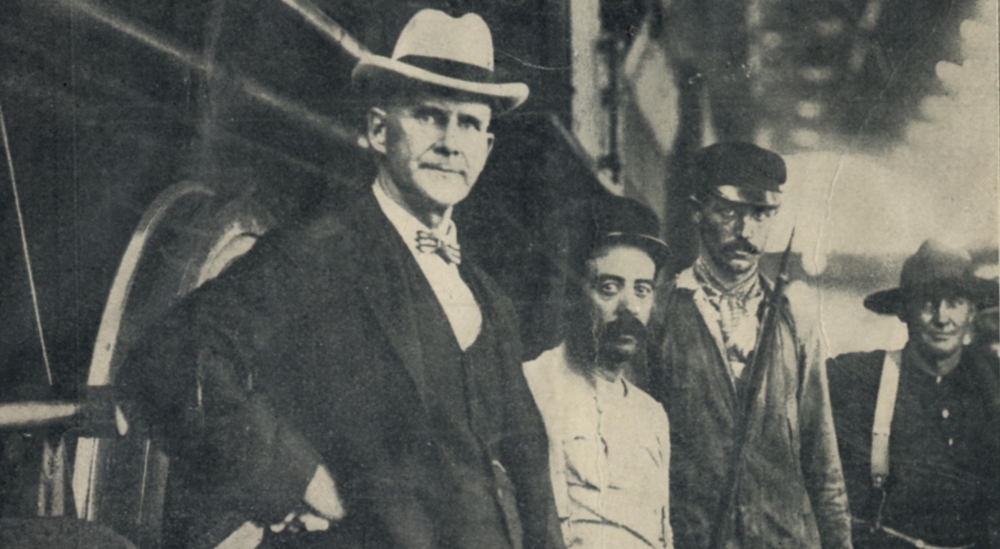
Debs accepts the nomination of the Socialist Party for Presidential candidate in the 1904 elections.
‘Speech of Acceptance’ by Eugene V. Debs from the International Socialist Review. Vol. 14 No. 11. May, 1904.
IN the councils of the Socialist Party the collective will supreme. (Applause.) Personally I could have wished to remain in the ranks, to make my record, humble though it might be, fighting unnamed and unhonored side by side with my comrades. I accept your nomination, not because of any honor it confers—because in the Socialist movement no Comrade can be honored except as he honors himself by his fidelity to the movement. (Applause.) I accept your nomination because of the confidence it implies, because of the duty it imposes. I cannot but wish that I may in a reasonable measure meet your expectations; that I may prove myself fit and worthy to bear aloft in the coming strife the banner of the working class (applause); that by my utterances and by my conduct, not in an individual capacity, but as your representative, I may prove myself worthy to bear the standard of the only party that proposes to emancipate my class from the thralldom of the ages. (Applause.)
It is my honor to stand in the presence of a very historic convention, and I would that Karl Marx might be here to-day (applause); I would that Lassalle and Engels, the men who long before the movement had its present standing wrought and sacrificed to make it possible for me to stand in this magnificent presence— I wish it were possible for them to share in the glories of this occasion. We are on the eve of battle to-day. We are ready for the contest. (Applause.) We are eager for the fray. (Applause.) We depart from here with the endorsement of a convention that shall challenge undisputed the approval of the working class of the world. (Applause.) The platform upon which we stand is the first American utterance upon the subject of international socialism. (Applause.) Hitherto we have repeated, we have reiterated, we have followed. For the first time in the history of the American movement we have realized the American expression of that movement. There is not a line, not a word in that platform which is not revolutionary, which is not clear, which does not state precisely and properly the position of the American movement. We leave this convention standing on this platform, to throw down the gauntlet to the capitalist enemy (applause), to challenge the capitalist oppressor to do battle for the perpetuation of a system that keeps in chains those in whose name we meet to-day. (Applause.)
There is a Republican Party; the dominant capitalist party of this time; the party that has its representative in the white house; the party that dominates both branches of the congress; the party that controls the supreme court; the party that absolutely controls the press; the party that gives inspiration to the subsidized pulpit; the party that controls every force of government; the party that is absolutely in power in every department of our activity. And as a necessary result we find that corruption is rampant; that the congress of the United States dare not respond to the demands of the people to open the sources of corruption from which the lava stream flows down the mountain sides; that they adjourned long before the hour struck for adjournment in order that they might postpone the inevitable. (Applause.)
There is a Democratic party—(A Voice: “Where ?”)—a party that has not stock enough left to proclaim its own bankruptcy (laughter and applause); an expiring party that stands upon the crumbling foundations of a dying class; a party that is torn by dissension; a party that cannot unite; a party that is looking backward and hoping for the resurrection of the men who gave it inspiration a century ago; a party that is appealing to the cemeteries of the past (applause); a party that is trying to vitalize itself by its ghosts, by its corpses, by those who cannot be heard in their own defense. (Applause.) Thomas Jefferson would scorn to enter a modern Democratic convention. He would have as little business there as Abraham Lincoln would have in a modern Republican convention. (Applause.) If they were living to-day they would be delegates to this convention. (Tremendous applause.):
The Socialist Party meets these two parties face to face, without a semblance of apology, without an attempt at explanation, scorning to compromise, it throws down the gage of battle and declares that there is but one solution of what is called the labor question, and that is by the complete overthrow of the capitalist system. (Applause.)
You have honored me in the magnitude of the task that you have imposed upon me, far beyond the power of my weak words to express. I can simply say that obedient to your call I respond. (Applause.) Responsive to your command I am here. I shall serve you to the limit of my capacity. My controlling ambition shall be to bear the standard aloft where the battle waxes thickest. (Applause.) I shall not hesitate as the opportunity comes to me to voice the emancipating gospel of the Socialist movement. I shall be heard in the coming campaign (applause) as often, and as decidedly, and as emphatically, as revolutionarily (applause), as uncompromisingly (applause) as my ability, my strength and my fidelity to the movement will allow. I invoke no aid but that which springs from the misery of my class (applause); no power that does not spring spontaneous from the prostrate body of the workers of the world. Above all other things I realize that for the first time in the history of all the ages there is a working class movement (“Hear, hear,” and applause) — perfectly free from the sentimentality of those who riot in the misery of the class who are in that movement. On this occasion above all others, my comrades, we are appealing to ourselves, we are bestirring ourselves, we are arousing the working class, the class that through all of the ages has been oppressed, crushed, suffered, for the one reason that through all the centuries of the past this class has lacked the consciousness of its overmastering power that shall give it control and make it master of the world. (Applause.) This class is just beginning to awaken from the torpor of the centuries (applause), and the most hopeful sign of the times is that from the dull, the dim eye of the man who is in this class there goes forth for the first time in history the first gleam of intelligence, the first sign of the promise that he is waking up, and that he is becoming conscious of his power; and when he, through the inspiration of the Socialist movement, shall become completely conscious of that power, he will overthrow the capitalist system and bring the emancipation of his class. (Great applause.)
To consecrate myself to my small part of this great work is my supreme ambition. (Applause.) I can hope only to do that part which is expected of me so well that my comrades, when the final verdict is rendered, will say, “He was not a candidate for President; he did not aspire to hold office; he did not try to associate his name with the passing glories, but he did prove himself worthy to be a member of the Socialist Party (applause); he proved his right to a place in the International Socialist Movement of the World.” (Applause.) If when this little work shall have been completed this can be said of me, my acceptance of your nomination will have been so much more completely made than I could hope to frame it in weak words, that I close not with the decided utterance, but with the wish and the hope and the ambition that when the fight has been fought, when the task you have imposed upon me has been performed so far as it lies in the power of an individual to perform that task, that my acceptance of the honor you have conferred upon me will have been made and that your wisdom and your judgment will have been vindicated by the membership of the party throughout the country.
From the depths of my heart I thank you. I thank you and each of you, and through you I thank those you represent. I thank you not from my lips merely. I thank you from the depths of a heart that is responsive to your consideration. We shall meet again. We shall meet often, and when we meet finally we shall meet in much larger numbers to ratify the coming of the Socialist Republic. (Great and prolonged applause.)
The International Socialist Review (ISR) was published monthly in Chicago from 1900 until 1918 by Charles H. Kerr and critically loyal to the Socialist Party of America. It is one of the essential publications in U.S. left history. During the editorship of A.M. Simons it was largely theoretical and moderate. In 1908, Charles H. Kerr took over as editor with strong influence from Mary E Marcy. The magazine became the foremost proponent of the SP’s left wing growing to tens of thousands of subscribers. It remained revolutionary in outlook and anti-militarist during World War One. It liberally used photographs and images, with news, theory, arts and organizing in its pages. It articles, reports and essays are an invaluable record of the U.S. class struggle and the development of Marxism in the decades before the Soviet experience. It was closed down in government repression in 1918.
PDF of full issue: https://www.marxists.org/history/usa/pubs/isr/v04n11-may-1904-ISR-gog-Harv.pdf
 Revolution's Newsstand