
An anti-racist white worker navigates Florida’s racial realities in this glimpse of the state as it was being speculatively transformed into what it is today.
‘Florida As Seen By A Worker’ by H. C. Fillmore from the Daily Worker Saturday Supplement. Vol. 2 No. 41. February 28, 1925.
Much of Florida is flat, uninteresting country, with great tracts of gray sand covered with pine trees. The relatively high lands are all sand, the lower lands black soil shading into pure muck as in the everglades. The big planters (there are 6,000 acres of orange trees in one block owned by one company near Lake Wales) are full of hope for the future. The small growers and back woods planter is not so optimistic and complains bitterly about the state of the market, the cupidity of the buyers, and particularly of the railroads who, he says, charge as much for moving the crop 200 or 300 miles to Jacksonville as do from Jax to New York.
Lake Wales lies in the Ridge District. That is a district where the monotonous level of the wooded plains of Florida is broken by a succession of relatively high ridges and valleys between, many of which contain lakes. The “realtors” are impressing their optimistic psychology on all the cockroach business men of the hundreds of little towns that are springing up, fed by northern money. Some of the town laborers are also infected and are trying to buy town lots and shares in orange groves out of their puny wages. In few other places in America perhaps does this custom more certainly necessitate the laborer’s family doing without proper food, because rents are high (exceptionally so in the winter, due to the tourist influx) and so is food, and wages are low; not far from the absolute minimum required. This is not mere literary license; not Marxian phraseology, but fact gained from observing how the laborers live; moreover, living it out with them.
To those who prate so knowingly about the American standard of living I would suggest they try “making both ends meet” on a wage of from 15c to 30c an hour, while paying $20 a month for a shack to live in and with milk ranging from 17c to 25c a quart. Other food prices being higher than in Chicago except for meat, which is a trifle cheaper. Even without investing anything the white laborers’ children, and himself as well, show a poor physique. The blacks show up better due to living in poorer dwellings, a lesser desire to keep up appearances, and a better knowledge of real food values.
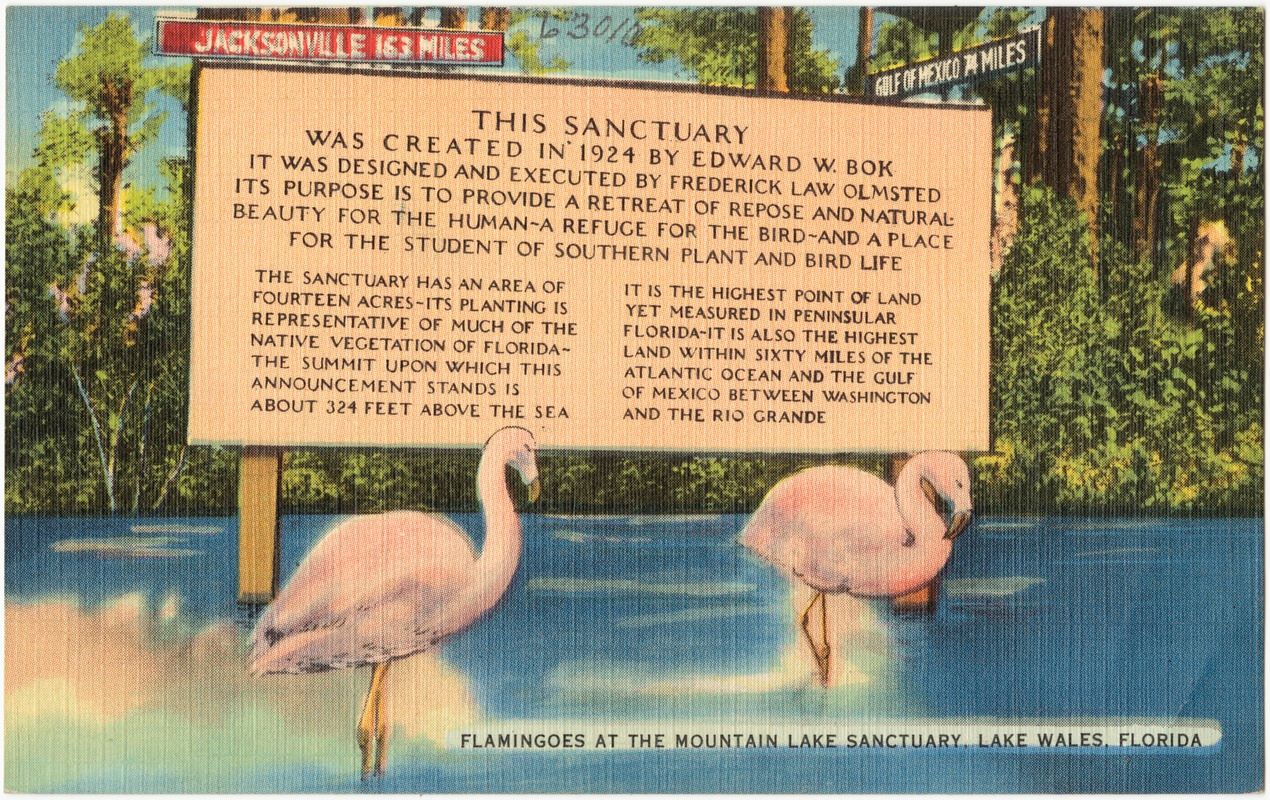
Just a few miles from the little town of Lake Wales lies the home of the Mountain Lake Club, where a pack of wealthy northerners make their winter home. They have lots of room among the wild pine ridges and lakes, and have built a fine golf course, a great clubhouse and each one has his separate bungalow. There we find Edward Bok, the karo syrup king, President Suspender King and Scores of others with prominent money bags and abdomens. Last winter they gave work to many laborers and what do you suppose they are doing? Oh, you would never guess. Bok and some others were building a BIRD SANCTUARY, that is, they put a big crew of men and trucks on and ranged the country for miles round about and dug up all the huckleberry and other kinds of bushes they could find. They hauled them up on top of a ridge and by using lots of manure and water, right here in the woods, where presumably the birds have always lived quite happily, they started a fine, exclusive plantation. of their own for the birds. No doubt they figure that all the nicest birds in the neighborhood will come inside and the fences and guards will keep undesirable persons out and the sweet singing of the birds will help soothe the tired nerves of the poor, weary millionaires.
Both white and black labor is employed apparently impartially all over the place. The southern white laborer who has not been used to working close to Negroes doesn’t know what to make of this. They say, “The n***r is the cause of the low wages, he ought to be segregated somewhere, perhaps in Africa,” and I would come back with inward malice, “Why I think the blacks do very well, indeed. They seem to do as much work as we and do it just as well. I rather like to work and talk with them.”
One hangover from the old is evidenced in two water buckets, one for the whites, another for the blacks. Over I go for a drink and when cautioned against the blacks’ bucket say: “These blacks look good and healthy to me. I was brought up on a farm and we never watered white and black cows separately.”
A truck driven by a black passes and the old line whites tell you of 10w only few years before such a condition would not have been allowed. You restrain your anger and say: “Why he seems to me to drive that truck just as well as anyone, and does his best to get as much money as he can for it, just like a white man.”
Summing up one may say that blacks and whites are coming together down here, are growing slowly to understand one another.
You might think that an organization like this Mountain Lake Club, composed of men who have more money than they know what to do with would pay the laborers pretty well. The truth is they pay just what they have to and no more. 25 cents and 30 cents an hour and this maximum only because living in Lakes Wales is very high. At Plant City where our (?) winter strawberries mostly come from, a farmer offered me $1.50 a day, from sunrise to sunset. Listen to the karo syrup king when the park superintendent told him that to keep his grounds in order during the summer he would have to pay a man $3.00 a day. “Damn it, man, there is not work enough here to keep him busy. A man ought to care for two or three places. These caretakers are half asleep anyway. They don’t know what work is.” And you ought to have seen his indignant red mush, and pot belly shaking as he said it.
The Saturday Supplement, later changed to a Sunday Supplement, of the Daily Worker was a place for longer articles with debate, international focus, literature, and documents presented. The Daily Worker began in 1924 and was published in New York City by the Communist Party US and its predecessor organizations. Among the most long-lasting and important left publications in US history, it had a circulation of 35,000 at its peak. The Daily Worker came from The Ohio Socialist, published by the Left Wing-dominated Socialist Party of Ohio in Cleveland from 1917 to November 1919, when it became became The Toiler, paper of the Communist Labor Party. In December 1921 the above-ground Workers Party of America merged the Toiler with the paper Workers Council to found The Worker, which became The Daily Worker beginning January 13, 1924.
PDF of full issue: https://www.marxists.org/history/usa/pubs/dailyworker/1925/1925-ny/v02b-n041-supplement-feb-28-1925-DW-LOC.pdf
 Revolution's Newsstand