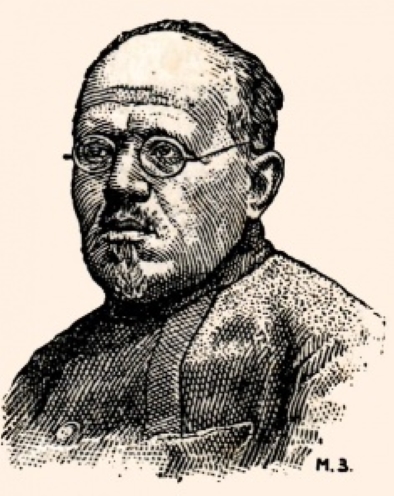
Prolific Marxist writer and historian Mikhail Pavlovitch, in 1913 living in Parisian exile, with the first in his 1913 series on the Panama Canal for New Review. He begins with the diplomatic history in three sections below; The Early History of the Canal, Panama and Russia, and American Control of the Canal.
‘The Panama Canal—Its Diplomatic History’ by Mikhail Pavlovitch from New Review. Vol. 1 Nos. 6 & 7. February 8 & 15, 1913.
I. EARLY HISTORY OF THE CANAL
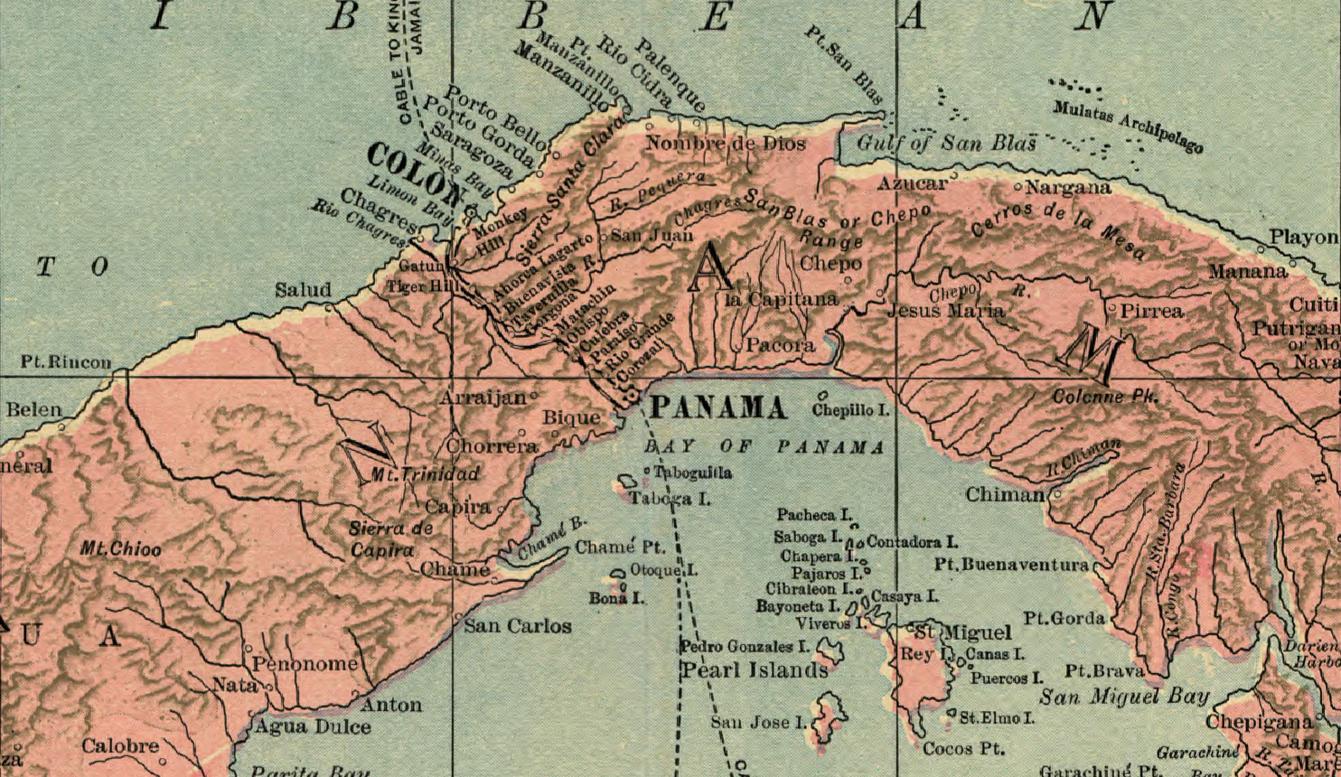
Among Goethe’s brilliant anticipations there is, perhaps, none other so interesting as the prophetic opinion uttered by the immortal German poet regarding the Panama Canal. It is interesting to recall that prediction just now, on the eve of the completion of the colossal undertaking that was begun more than thirty years ago by the great though unfortunate French engineer, Ferdinand de Lesseps.
On Wednesday, February 21, 1827-Johann Eckermann, the poet’s faithful friend, tells us Goethe was talking at table enthusiastically of Alexander von Humboldt, who had just published his book on Cuba and Colombia, wherein he touched upon the possibility of cutting through the Isthmus of Panama.
“Undoubtedly,” Goethe said, “if we could succeed in digging a canal from the Pacific Ocean to the Gulf of Mexico, it would be of immense consequence to all civilized countries. But I should be surprised if the United States permitted any other country to undertake this enterprise. Considering the development of the United States westward, one can foresee that within the next thirty or forty years that young country will occupy and settle the vast territory lying west of the Rocky mountains. At the same time it is clear that on the Pacific coast, where nature has already created safe harbors, there will grow up great commercial cities, which will act as intermediaries in the exchange of commodities between the United States, on the one hand, and China and India on the other. Under these circumstances it would be not only desirable but also necessary that a more rapid communication should be established between the eastern and western shores of North America, both by merchant ships and men-of-war, than has hitherto been possible with the tedious and expensive voyage around Cape Horn. I repeat that it is indispensable for the United States to effect a quick passage from the Gulf of Mexico to the Pacific Ocean and I am certain that it will do it. Would that I might live to see it! But I shall not.”
Is it not wonderful that nearly a hundred years ago Goethe clearly foresaw the future of the United States? Even then he understood the inevitable development of the Pacific coast line with its great commercial port of San Francisco. Even then he foretold what the English, French and Spanish diplomatists did not see until the very last moment–that, despite all obstacles, the United States would seize the canal, which at that time existed only in the mind of the great poet. Even then he had already comprehended in its entirety the great importance, strategic and commercial, of the canal. Is it not strange that this man, who so well comprehended all the enchanting beauty of antique poetry and art and had so deep an insight into the past, should display at the same time such far-sightedness in grasping the economic destinies of the great American republic?

What strikes us most is his prophecy as to who would ultimately control the canal.1 Indeed, as is evident from a careful study of the diplomatic documents dealing with the Panama Canal in 1827, it was exceedingly difficult to foresee how the question of joining the Pacific and Atlantic through Central America would terminate. It was a question that had long agitated many persons interested in the destinies of the New World. Columbus had dreamed of such a canal, and the Spanish king, the morose fanatic Philip II, had attentively read over the report submitted to him by a special commission of investigators who had visited the isthmus and studied the conditions there with reference to the digging of such a canal.
Early in the nineteenth century, after five years of travel in Central and South America (1799-1804), the famous German savant, Alexander von Humboldt, published in the French language a series of masterpieces, setting forth the results of his observations in the regions he had explored. In one of them Humboldt expressed regret as to the lack of information that would make possible the solution of the canal question. With his personal investigations as a basis, Humboldt expressed himself in favor of digging the canal by way of Lake Nicaragua. The great authority that Humboldt’s name carried in the highest circles of Europe caused the Spanish government to drop its customary inertia. The report on the canal that had been submitted to Philip II was taken from the dusty archives of Simancas. Other documents, too, were dug up. In April, 1814, the Cortes passed a resolution on the necessity of building a canal through the Isthmus for vessels of the highest tonnage and addressed an appeal to financiers to proceed with this vast undertaking. Nevertheless this resolution of the Cortes brought no results. Less than ten years after the adoption of this resolution Spain had lost all influence in Central America, where independent republics were proclaimed.
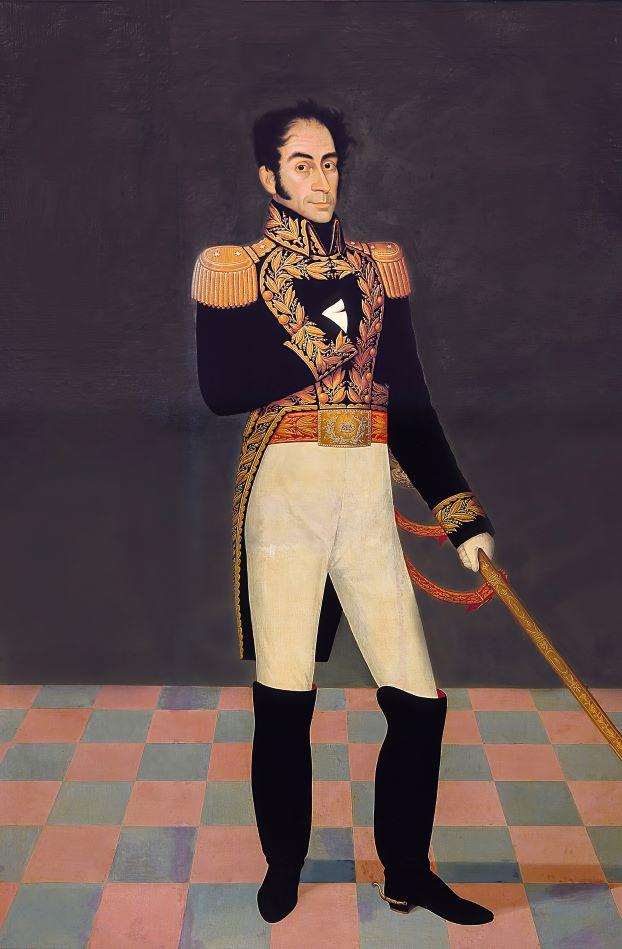
At the Pan-American Congress in Panama, June 22, 1826, the canal question was raised by the famous liberator of the Spanish-American colonies, Simon Bolivar. The hero of the fifteen years’ war against Spain for the liberation of Central and South America now desired to unite those countries which had waged common war in peaceful labor for the realization of this great project. The canal that was to be the result of the joint efforts of all the nations of America was also to be the exclusive property of the states of the New World. It was to serve at the same time as a symbol of the brotherhood of all American peoples, an evidence of their friendly union, and a guarantee of their absolute and undisputed independence from Europe. Such was Bolivar’s grand idea.
It is interesting to note that the government of the United States which now claims the Panama canal as its exclusive property, at that time objected to Bolivar’s point of view. President John Quincy Adams gave Commissioners Anderson and Sargent instructions diametrically opposed to it. “If the work should ever be executed so as to admit of the passage of sea vessels from ocean to ocean, the benefits of it ought not to be exclusively appropriated to any one nation, but should be extended to all parts of the globe upon the payment of a just compensation or reasonable tolls.”2
That was eight months before Goethe predicted that the canal would be built and monopolized by the United States. After the above-mentioned congress of 1826, that is, after the United States government had for the first time given an official statement of its point of view in regard to a canal through the Isthmus of Panama, its policy remained for a long time unchanged in its general features. American statesmen energetically maintained as a principle that the canal should not be built in the interests of any one nation, but should benefit all countries equally and should therefore be placed under the protection of all the powers. In a word, no monopoly in the building or administration of the new world-route should be tolerated, lest in the hands of some one power the canal become a tool to oppose the legitimate interests of the rest of the world. International ownership of the canal instead of a possibly dangerous monopoly by one government–this was the basic principle upheld for a long time in the commercial and diplomatic circles of America.
But this point of view in regard to the Panama question was maintained only so long as the United States was comparatively weak, and had to pursue a cautious policy in its relations with European countries, particularly the great powers of France and England. Both of these had designs on the Isthmus of Panama and stubbornly strove for control there.
The failure of the French expedition into Mexico, which ended in the execution in 1868 of the pretender to the Mexican throne, the archduke Maximilian of Austria, marks a new era in the diplomatic history of the Panama Canal. Until the Civil War the United States kept on the defensive in its foreign relations, as its lack of power dictated. But beginning with the year 1866, it assumes an aggressive attitude toward all those adversaries who are trying to prevent the United States from establishing control of the coast of the Gulf of Mexico, especially in the region of the future canal. Having driven the French out of this territory, the American eagle began to press hard the British lion.
The diplomatic history of the Panama Canal is replete with interest. The history of the greatest undertaking of the times is not only the history of the origin, growth and realization of the most difficult engineering feat in the whole history of the world. It is at the same time the history of the rise, growth and expansion of American imperialism, which is destined to play so prominent a role in international politics in general, and in the economic life of the European and Asiatic nations in particular. It is also the history of the rise and decline on the American continent of the European powers, Spain, France and England, at one time leaders of the world in colonization.
As is well known, the question of the Panama Canal first entered the domain of reality when it was taken up by the famous French engineer, Ferdinand de Lesseps.
On May 28, 1878, he was one of a group of enterprising Frenchmen who obtained from the government of Colombia a concession to build the canal. Subscription for shares of the company that was to build the canal was opened in 1880 and met with instant response in France, where the required funds were duplicated several times over. But in the United States de Lesseps’ undertaking was viewed with great disfavor. This opposition was not, however, sufficiently active or bitter to change his plans.
The attitude of mere cautious reserve which diplomatic circles in the United States displayed toward the French government was due partly to the fact that the American public were skeptical from the very beginning as to the successful outcome of de Lesseps’ project, controlled as it was by a private company and financed by public subscriptions. How de Lesseps’ enterprise ended is well known and many still remember the great scandal that broke out in connection with this affair.
What a blot the Panama affair has been on the reputations of a whole array of republican lights in France, such as Rouvier, Clemenceau, etc. Yet at the time those who most disgraced them- selves were the adversaries of the republic, nationalists, Bonapartists, “patriots” of all kinds. Instead of endeavoring to retain their country’s hold on the great undertaking, already half-finished, and to save it from disaster, the political antagonists of the republican regime secretly schemed to send to ultimate ruin the Panama Canal and the republic of France along with it.

The republic survived, but the great undertaking of which France could have been so proud, was wrested from her control. The seizure of the Suez canal by England and the Panama catastrophe have had a profound influence on the subsequent economic development of France. Since that time her financiers have sedulously avoided all great industrial and engineering enterprises involving risk. They have preferred to make loans to governments, where the investment was secure, even though the rate of interest was small. More terrible and far-reaching a catastrophe even than the defeat of France on the battle-field at Sedan in 1871, was her surrender of those advantages at Suez and Panama which the genius and daring of Frenchmen had almost secured to her. The attempt at realizing the dream of French control of these two world routes, which would have increased the international importance of France both from a political and economic point of view, was completely frustrated. Properly speaking it was this defeat, and not that of Sedan, which marked the beginning of the fall of France from her position of world leadership in politics and finance.
II. PANAMA AND RUSSIA.
The history of the Panama Canal includes one curious episode that is but little known in America. When it was finally understood in France that the Panama enterprise was failing and that French control of the situation might possibly be lost, some of the stockholders in de Lesseps’ undertaking decided to seek the aid of Russia. It was at this time that Russia was beginning to build the great trans-Siberian railroad, and Emperor Alexander III, as head of the greatest world-power, seemed in the eyes of the anxious Frenchmen a sort of a demigod. That titan could save the situation, they thought, and at the same time advance the interests of Russia. It is a fact that the Panama Canal is just such a crowning of the great trans-Siberian road as the Suez Canal is of the North American transcontinental railroads. A glance at the globe shows that the Panama Canal is the connecting link of a world-route that goes by railroad over Asia and Europe in the east, by water through the Atlantic and Pacific in the west; just as the Suez Canal completes the other world-route, by railroad across North America in the west and by water through the Atlantic and Pacific in the east.
As Russia had just completed the first great world route when her railroad was finished, it seemed likely she would be interested in having the control of the second world route in the hands of a nation friendly to her.
Accordingly in 1894, the well known French engineer Phillippe Bunau-Varilla, who had played a prominent part in the history of the Panama Canal, went to St. Petersburg. His mission was to learn of Witte whether in view of the critical situation confronting France, Russia would show her friendliness by giving needed aid.
On March 24, 1894, Bunau-Varilla made a report of his visit to a select audience made up of such prominent Frenchmen as the vice-president of the Senate, Poirier; the ex-ministers, Dupins and Lanaissant; the influential deputies, Crisppi and Mascureau; and others. Witte, he said, had first of all asked him what the attitude of the French government was toward the idea of seeking Russian help. “If France thinks as you do,” said Witte, “I can say personally, without making any promise in the Emperor’s name, that a solution of the question which will conserve all French interests, will be taken into favorable consideration by his Majesty’s government.”
On returning to France Bunau-Varilla sought at once an interview with Casimir-Perier, then President of the Council and Minister of Foreign Affairs. He then went to Arcachon for an interview with Minister of Finance Burdeau.
It was after Bunau-Varilla’s report that Burdeau, returning to Paris, summoned the unofficial diplomat to the Ministry of Finance.
“Casimir-Perier and I have studied the question together,” said Burdeau. “In a few days he will send for you to tell you that the French government is in favor of acting in common with Russia in the Panama enterprise. This is, therefore, a basis for reorganization. I am speaking personally to-day, but the official communication from the minister will reach you soon.”
But before Casimir-Perier gave government sanction to the plan, the ministry fell (May 22, 1894). A month later, following President Carnot’s assassination, Casimir-Perier was elected President of the republic. But his resignation soon followed amid circumstances that deprived him of all future influence in affairs of state. About the same time occurred the death of Emperor Alexander III, while Burdeau and several others deeply interested in Panama lost their prestige and found themselves powerless.

At this day there are in existence no printed documents to indicate what the plans were in the carrying out of which the Russians and French expected to join hands. Nor is there anything to indicate what share Russia would have had in the partnership. According to one oral version, Russia was to declare that she considered the building of the Panama canal a great cultural undertaking, which would not only serve the economic interests of France and Russia, but also in the highest degree advance commerce among all countries and thereby further international peace. The Russian government was also to point out that so great an undertaking could not be successfully carried on by a private company and that reorganization must be done with government aid. So Russia would propose to France that they jointly complete the building of the Panama canal. It was plain that the means required for the quickest carrying out of this plan could be obtained in the same place as the millions for building the Trans-Siberian road, that is, in France, and doubtless the French stockholders, who had refused to give money to Ferdinand de Lesseps, would gladly advance it to the Tsar of Russia.
At present it is hard to say how far this version as to the manner in which Russia and France were to co-operate corresponds with reality. Bunau-Varilla did not deem it advisable to put down in black and white a statement that would have made We shall have to await the plain Russia’s role in the affair. memoirs of Witte, or some other statesman, French or Russian, who had part in it. At all events it is beyond doubt that negotiations were entered into.
III. AMERICAN CONTROL OF PANAMA
European agitation over the way France had handled the Panama situation during the twenty years since de Lesseps’ plans were first formulated, had aroused the interest of the American public. The press of the United States heralded it louder and louder that the canal must be an American one. The old clap-trap about making the canal neutral, international and what not, was forgotten.
On April 27th, 1898, the United States began military operations against Spain in Cuba, the key to the isthmus of Panama. By a strange coincidence, on the same day France was enacting the last act in her control of Panama by trying the case of Quesnay de Beaurepaire, the Procureur of the Republic, in the Court of Cassation. The Cuban war resulted in the expulsion of the Spaniards from Cuba and the passing of the island practically into American control. Porto Rico was also annexed and the Philippines conquered. America’s position on the Gulf of Mexico and the Carribean Sea was strengthened to an extraordinary degree. After that the Panama Canal question became a topic of daily discussion in the American press.
In his message of Dec. 7, 1898, McKinley declared that the construction of the inter-ocean canal had become more necessary than ever to establish rapid communication between the two coasts of America and that the annexation of the Hawaiian Islands and the prospect of increasing American commerce and influence in the Pacific Ocean logically demanded American supremacy over the canal. Such statements were radically opposed to the spirit of the Clayton-Bulwer treaty of 1850, which declared against the control of the canal by any one country. This alarmed the English press and Great Britain asked an explanation of the United States.
The reply was given that the president did not intend to repudiate the Clayton-Bulwer convention and would loyally observe its terms, which bound both Great Britain and the United States to the neutrality of the future canal. Both countries had pledged themselves never to seek exclusive control of the canal, and to prevent any breach of faith they both pledged themselves to erect no fortifications along the canal or in its vicinity; not to occupy nor to subject to their dominion the territories of Nicaragua, Costa Rica, the Mosquito Coast or any part of Central America; to establish no protectorate nor to contract any alliance in violation of this treaty. This was designed to put an end to the attempts of any single power to monopolize the great international water route.

It was, however, already evident that the Clayton-Bulwer convention had outlived its usefulness, that some fine day the United States would monopolize the canal. Not only had the strategic position of the great republic become one of great strength on the isthmus, but the economic might of the United States, its role in the world’s economy, had increased to an extraordinary degree. In 1870 there were in the United States 808 steel foundries and iron-mills, with an annual output amounting to $207,000,000. In 1900 there were but seven hundred of these mills, but the output had increased to $800,000,000, i.e., had quadrupled. In 1900, the United States alone produced twenty per cent of the wheat consumed in the entire world, seventy-five per cent of the corn, eighty-five per cent of the cotton, thirty per cent of the coal, thirty-four per cent of the cast iron, thirty-seven per cent of the steel. In the opinion of American imperialists a country which is at the same time the granary, the iron and coal store, and the cotton warehouse of the world could not and should not remain indifferent to what is going on in the rest of the world. The American nation could no longer shut itself up in the old boundaries. The imperialists were not satisfied with the inclusion of the whole American continent in the Monroe doctrine. Circumstances favored the American imperialists to an extraordinary degree. In 1899 the Boer war broke out. Great Britain saw herself completely isolated at that moment. Relations with Russia and France were far from friendly, and very strained with Germany. The United States availed itself of this favorable opportunity to propose certain modifications of the Clayton-Bulwer treaty. England consented to enter into negotiations. Concessions were made by her which resulted in the signing of the Hay-Pauncefote Treaty, Nov. 18, 1901. This provided that the canal, while remaining nominally neutral, should pass under the exclusive protectorate and complete disposal of the United States. The numerical strength of the English garrisons on the West Indies was to be reduced. In a word, Great Britain acknowledged American supremacy in this zone.
This result gained, the United States began negotiations with the Panama Company and purchased all its rights and claims for $40,000,000. Then it remained but to overcome the opposition on the part of the Republic of Colombia, through whose territory the Panama Canal was to run. The Colombian senate did not recognize the agreement signed by the United States with the Panama Company and on August 12, 1903, rejected the claims. In view of this the United States government determined to foment revolution in Colombia, thereby bringing about the secession of the province of Panama. Beginning in September there began to appear in American newspapers articles to the effect that something was “doing” in Panama, that the whole district was in a ferment. On Nov. 6 a revolution broke out in Panama. It was headed by the French engineer Bunau-Varilla, who decided to offer his services to the United States government after his unsuccessful effort to save the canal with Russia’s aid. The executive committee appointed Bunau-Varilla to act as its plenipotentiary to the United States. Under threat of intervention by the United States, the troops of Colombia were not allowed to resort to arms in suppressing the revolt. On Nov. 18, 1903, the adventurer Bunau-Varilla, in the name of the provisional government of the newly created Republic of Panama, signed a treaty under which the United States assumed full ownership of the canal. This was to include both its outlets, on the Atlantic and Pacific, and a strip of land about ten miles wide, adjoining the canal. Colombia, thus deprived of its property, proposed to its masterful neighbor that the question be submitted to the Hague tribunal for arbitration. Secretary Hay indignantly rejected this proposal. Thus at last was fulfilled the desire of President Grant, the father of American imperialism, “An American canal owned by the American people and situated in American territory.”
The treaty signed by the United States with the new republic of Panama, which fell completely under the ascendancy of its creator, is the last big episode in the diplomatic history of the Panama canal and at the same time marks a new stage in the development of American imperialism. On Feb. 27, 1911, Congress adopted a resolution as to the necessity of fortifying the Panama canal and voted an appropriation of $5,000,000 for the preliminary work of erecting defensive fortifications. Thus the imperialist policy of the United States was brought to a logical conclusion.
In a speech delivered before the Pennsylvania Society of New York on Jan. 21, 1911, the peace-loving President Taft, loath to be outdistanced by Roosevelt, criticized the proposal to neutralize the canal by means of international agreements, and raised the question whether having spent $500,000,000 for defense, the United States ought to renounce half the military value of the canal by conferring advantages upon nations that at any time might become hostile to it. Mr. Taft said he yielded to no one in love of peace. He was ready for treaties that should make peace more likely than it had ever been before, but withal he could not help admitting the possibility of war. The time, he thought, had not yet come when we could count upon settling all international disputes by arbitration. Therefore, the canal must be fortified. President Taft’s energetic agitation in behalf of fortifying the canal was crowned with success. Congress determined that a casual $19,500,000 would be required to make the fortifications. Six forts were to be built, two on the Atlantic coast in the vicinity of the city of Panama, and four on the Pacific coast in the vicinity of Colon. The garrison of the canal zone was to consist of eighteen companies of artillery, fourteen regiments of infantry and a troop of cavalry. Thus at the entrance to the canal the strongest fortifications would arise, equipped with gigantic guns of great range. A whole army was to guard this “neutral” canal, which would thus become a second Gibraltar in Yankee hands. Furthermore, in order to gain a hold on all the routes leading to the Panama canal, the United States government, through a dummy, acquired considerable land concessions in the Galapagos Islands, belonging to the republic of Ecquador and situated in the Pacific Ocean. However, the government of Ecquador refused to surrender by formal act its sovereign rights to the Galapagos islands, or to cede these by a ninety-nine year lease to the United States for $15,000,000. Of course, the government of Ecquador will be made to pay dearly for its stubbornness. Following the traditional method of all powerful states in dealing with their weaker neighbors, the United States will endeavor to make anarchy more acute in Ecquador, will secretly supply money and arms to all malcontents there, will foster sedition in the country and will finally compel Ecquador, exhausted, to yield at every point.
In one way or another, the Panama canal, in contrast to the Suez canal, will become at the same time a great point of strategy and a military base, which like a two-faced Janus looks with the yawning mouths of its great range guns in two opposite directions: upon the Atlantic ocean toward England, Germany and the whole of the European continent; upon the Pacific ocean toward Asia, the multi-millioned market, for which the American bourgeoisie has longed for so many years. It is needless to dilate upon the degree to which the military power of the United States will be increased by this canal that will enable it to hurl its squadrons at any moment from the Atlantic to the Pacific ocean, and vice versa.
However, before long the great merchant vessels of all European countries will when entering the canal solemnly and submissively defile before the open jaws of forty odd American 12-inch guns and mortars and other more insignificant pieces. What an irony after all the peace speeches of Taft, our courts of arbitration and international agreements! When the canal is opened, the first salute will come from the formidable American batteries whose volleys will proclaim to the world the beginning of a new era in the history of international commercial relations.
NOTES
1. In the same conversation with Eckermann, Goethe also expressed the wish that England would possess the Suez canal, which was not built until fifty years later. Ed. N. R.
2. International American Conference, Vol IV, Historical Appendix, p. 144.
The New Review: A Critical Survey of International Socialism was a New York-based, explicitly Marxist, sometimes weekly/sometimes monthly theoretical journal begun in 1913 and was an important vehicle for left discussion in the period before World War One. Bases in New York it declared in its aim the first issue: “The intellectual achievements of Marx and his successors have become the guiding star of the awakened, self-conscious proletariat on the toilsome road that leads to its emancipation. And it will be one of the principal tasks of The NEW REVIEW to make known these achievements,to the Socialists of America, so that we may attain to that fundamental unity of thought without which unity of action is impossible.” In the world of the East Coast Socialist Party, it included Max Eastman, Floyd Dell, Herman Simpson, Louis Boudin, William English Walling, Moses Oppenheimer, Robert Rives La Monte, Walter Lippmann, William Bohn, Frank Bohn, John Spargo, Austin Lewis, WEB DuBois, Arturo Giovannitti, Harry W. Laidler, Austin Lewis, and Isaac Hourwich as editors. Louis Fraina played an increasing role from 1914 and lead the journal in a leftward direction as New Review addressed many of the leading international questions facing Marxists. International writers in New Review included Rosa Luxemburg, James Connolly, Karl Kautsky, Anton Pannekoek, Lajpat Rai, Alexandra Kollontai, Tom Quelch, S.J. Rutgers, Edward Bernstein, and H.M. Hyndman, The journal folded in June, 1916 for financial reasons. Its issues are a formidable and invaluable archive of Marxist and Socialist discussion of the time.
PDF of issue 1: https://www.marxists.org/history/usa/pubs/newreview/1913/v1n06-feb-08-1913.pdf
PDF of issue 2: https://www.marxists.org/history/usa/pubs/newreview/1913/v1n07-feb-15-1913.pdf
 Revolution's Newsstand