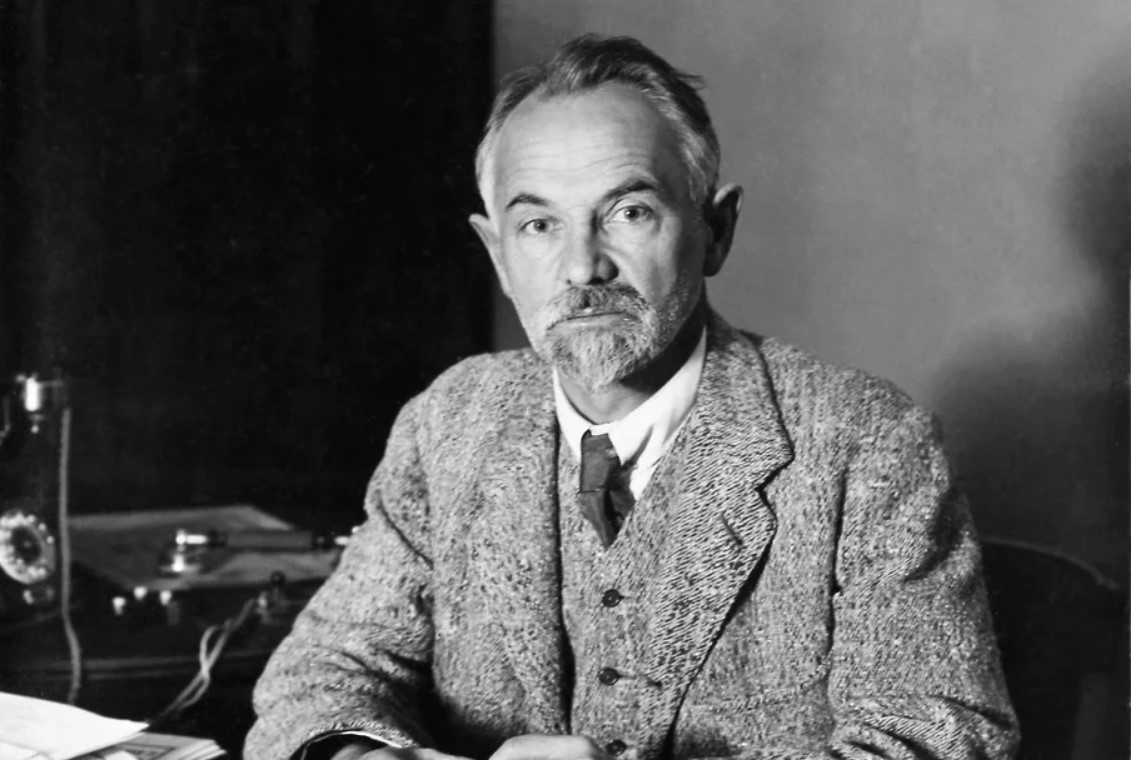
Shortly after this biography was published, Krassin would be made People’s Commissar of Foreign Trade. Krassin died in 1926 while serving as Soviet ambassador to France.
‘Leonid B. Krassin, Commissar for Means of Communication’ from Soviet Russia (New York). Vol. 2 No. 22. May 29, 1920.
Krassin is a native of Siberia and was born in 1870. He entered the Petrograd Technological Institute from which he was expelled three years later for participation in student mutinies.
In 1892 Krassin served in the army, where he was arrested in connection with the case of the social-democrat M.I. Brussenev, who was accused of party propaganda among the workers in the shops of the Moscow-Brest Railway. The hearing of this case lasted until December, 1894, and in the meantime Krassin succeeded in leaving the Tagansk jail, where he was imprisoned. However, shortly after this he was imprisoned in Voronezh for a while. Later on, by the order of Czar Nicholas II, he was expelled from the army and sent to Siberia.
During his stay in Irkutsk Krassin worked as a master mechanic, and later on as mechanical engineer in the construction of the Siberian railroad. In the latter capacity he obtained permission to complete his education; not in Petrograd, however, but in Kharkov. But again, due to his participation in student uprisings, he was expelled from the Kharkov Technical Institute (in 1898). After that he directed the construction of the railroad “Petersburg-Viatka.” In 1899 he participated in the construction of the Trans-Baikal Railway.

In the same year he returned to the Kharkov Technological Institute, from which he was again expelled. He then went to Baku, working there at the construction of the central electric station, and performing the duty of supervisor of the entire enterprise from 1900 to 1904. During this entire period he actively participated in the organization of illegal printing-shops for the publishing of “Iskra,” which printing-shops later became the shops of the Central Committee of the Russian Social Democratic Workers’ Party. These printing shops were in existence during the Revolution of 1905, at which time they were transferred to Petersburg, where they later became part of the printing shop where the Bolshevist newspaper Novaya Zhizn was published.
While in Baku, Krassin received his diploma from the Kharkov Institute (1901) and entered the Central Committee of the Russian, Social Democratic Labor Party.
In 1904 he left Baku for Orekhon-Zuev, where he took up the position of superintendent of the Central Electric Station of the Nikolsk Works. But in 1905 the Central Committee of the party were arrested at the home of the writer Andrieyev. Krassin and two other members of the committee fled to Geneva, Switzerland, where Krassin participated in the party convention, and worked under the names of Nikitich, Winter, and Zimin. Later on he returned to Russia, where, when circumstances permitted, he returned to his engineering profession and became the superintendent of the cable system in Petrograd. At that time he devoted his leisure to the organization (financially and technically) of the Bolshevist party.
Revolutionary activity compelled him again to leave Russia. He settled down in Berlin, having at first obtained a position as engineer in the works of Simens, Schukert & Co., and later on he was engaged as director of the Moscow department of the same firm and received special permission to enter Russia from the Czarist authorities.
In January, 1914, Krassin was transferred to the same position in Petrograd. When the war broke out and the German staff of this firm left Petrograd, Krassin was appointed chief manager of all establishments of Simens, Schukert & Co. in Russia. He occupied this position until August, 1918, at which time he was elected to an official post with the Soviet Government.
His connections with the Soviet Government began in 1917, at which time he participated in the Brest-Litovsk peace negotiations with Germany, having received a request to do so from the Soviet Government.

He also participated in the drawing of the commercial treaty in the capacity of financial and economic expert.
Upon his return to Moscow he was elected President of the Supreme Council of National Economy and of the Extraordinary Commission for supplying the Red Army with necessities. He became Peoples Commissar of Commerce and Industry in November, 1918. On March 20 he became, in accordance with the resolution of the Central Executive Committee of Soviets, People’s Commissar for Means of Communication.
Soviet Russia began in the summer of 1919, published by the Bureau of Information of Soviet Russia and replaced The Weekly Bulletin of the Bureau of Information of Soviet Russia. In lieu of an Embassy the Russian Soviet Government Bureau was the official voice of the Soviets in the US. Soviet Russia was published as the official organ of the RSGB until February 1922 when Soviet Russia became to the official organ of The Friends of Soviet Russia, becoming Soviet Russia Pictorial in 1923. There is no better US-published source for information on the Soviet state at this time, and includes official statements, articles by prominent Bolsheviks, data on the Soviet economy, weekly reports on the wars for survival the Soviets were engaged in, as well as efforts to in the US to lift the blockade and begin trade with the emerging Soviet Union.
PDF of full issue: https://www.marxists.org/history/usa/pubs/srp/v1v2-soviet-russia-Jan-June-1920.pdf
 Revolution's Newsstand