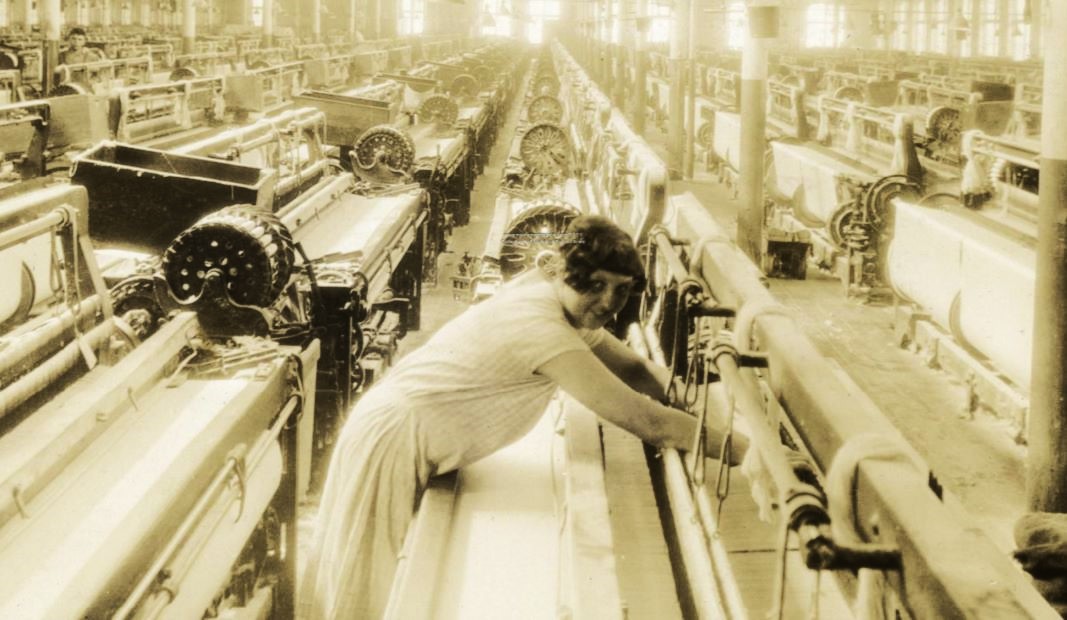
While the textile workers’ Uprising of ’34 most dramatically took place in the South, it was a national rebellion. Carl Reeve reports from Maine, not usually seen as the center of class struggle, and the fight of ‘French-Canadian’ mill workers in Waterville.
‘Sharp Clash Occurs as Police Attack Pickets at Maine Mill’ by Carl Reeve from the Daily Worker. Vol. 11 No. 227. September 21, 1934.
LEWISTON, Me., Sept. 20. Here in the last outpost of the textile employers, the textile strike is beginning to break through the terrific terrorism and pickets are beginning to form.
The eight large mills are surrounded by hundreds of National Guardsmen and hired thugs. Your correspondent was stopped and subjected to a severe cross-examination as he was trying to get near the mills.
The press here, and this is typical of the entire New England press, is trying to split the strikers by poisoning the New England workers against the Southern workers, hinting that the Southern workers are going back to work, deserting the Northern strikers.
The Lewiston Journal carries big headlines announcing that the Southern workers are “Going Back on the Job.” This vicious lying is intended to break the spirits of the workers here. Waterville, the nearby center, is rapidly closing down.
PORTLAND, Me., Sept. 20. The strike is effective in Maine according to a survey of the Saco-Biddeford and Portland and Lewiston areas.
In Waterville, Me., police attacked the pickets with tear gas last night. A sharp clash took place, in which a number of workers were arrested, and the picket line was broken up only after the reinforcement of troops were called out.
I was in Saco-Biddeford this morning, around the Pepperell Mill, which covers a large area and employs 4,000 textile workers. There is a large group of National Guardsmen around this mill, which is completely shut down.
The York mill, employing over a thousand workers, tried to resume operating the mill this morning. There were more troops and private detectives around it than at the Pepperell Mill. But less than 100 workers out of a thousand went into the plant.
The following statements were made by workers upon being interviewed:
“…Since the N.R.A. it is much worse.”
“They work us too hard…”
“…In one department we have 45 looms.”
When asked, “What are you striking for,” some of the replies were: “Shorter hours.”
“They work us too long. We have to work forty hours a week. want to work thirty hours.”
Others said:
“They drive us too hard.” Everybody said:
“The wages are too low.”
One worker said:
“We only get $13 a week since the N.R.A. (which is the minimum set by the N.R.A.). We want $18 a week.”
When asked how long the strike will last, they answered:
“We are going to keep the mill shut down until we get a good settlement.”
Others said: “They don’t know.” And others: “We are fighting for these demands and we are going to fight as long as we can.”
1,000 Sign With U.T.W.
In most of these mills the workers have been completely unorganized, and now about one thousand have signed application cards for the U.T.W. Maine has been the least organized of the textile areas, and the spread of the strike into these Maine mills shows the far-reaching power of the strike.
From the time I got off the bus in Saco-Biddeford, until O’Flaherty and I left for Portland, we were followed by plainclothes detectives. Finally, a uniformed policeman came up and questioned us as to what we were doing in town. We told him we were on our way to Portland. These towns in Maine are all being run by the plain-clothesmen, as well as troops and uniformed cops. They are observing everybody coming into town.
People are French-Canadian.
The population of the Maine area is largely composed of French-Canadians. Up to this time the French-Canadians, especially in Maine, have not been in the forefront of the previous struggles. This is the first time that the Maine mills have been shut down.
The following are quotes from the Portland Press, regarding these French-American workers:
“A peace-loving, law-abiding class of citizens, never have been mixed up with disorders of any kind. Never agitators. They have absolutely nothing in common with Communists.
“The only reason the mills came out is because they are being intimidated from the outside.”
Press Aids Owners
The Portland Press in an editorial says the following: “From the first, Mayor Robert Wiseman of Lewiston has taken a firm stand to protect the workers who refused to be stampeded by out-of-state union organizers. In his effort he has been given invaluable aid by the leading Catholic priest in the city, who has counselled his flock against striking.”
The French-Canadians here are largely Catholics. This shows how they are trying to break the strike. In Maine there is a very severe wave of arrests and heavy sentences of pickets. An example is the arrest in Waterville of at least ten strikers, who were sentenced yesterday to four, five and six months in jail for activity on the picket line.
Today the National Guard is undergoing an extensive shifting process. They are shifting between towns all over the State in order to see to it that no National Guardsman on duty is in his own locality.
The Daily Worker began in 1924 and was published in New York City by the Communist Party US and its predecessor organizations. Among the most long-lasting and important left publications in US history, it had a circulation of 35,000 at its peak. The Daily Worker came from The Ohio Socialist, published by the Left Wing-dominated Socialist Party of Ohio in Cleveland from 1917 to November 1919, when it became became The Toiler, paper of the Communist Labor Party. In December 1921 the above-ground Workers Party of America merged the Toiler with the paper Workers Council to found The Worker, which became The Daily Worker beginning January 13, 1924. National and City (New York and environs) editions exist.
PDF of full issue: https://www.marxists.org/history/usa/pubs/dailyworker/1934/v11-n227-sep-21-1934-DW-LOC.pdf
 Revolution's Newsstand