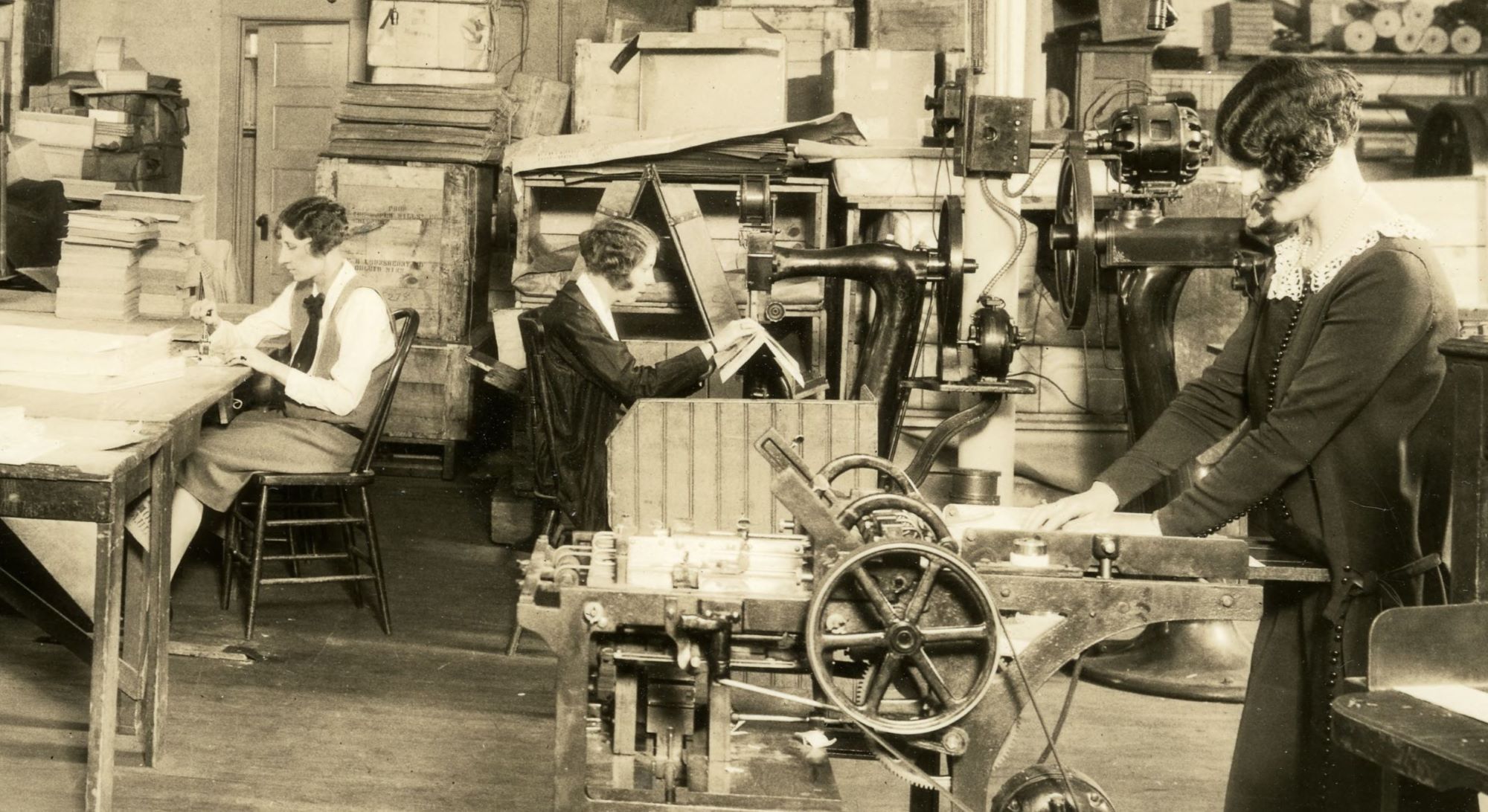
Women demand ‘equal pay for equal work’ in the International Brotherhood of Bookbinders.
‘Exploitation of the Bindery Girl in the Printing Industry’ by Marian Nagrom from The Toiler. No. 147. November 27, 1920.
One of the industries that helps to support the present capitalist system is the printing industry. This by turning printing from its real mission of education and enlightenment to capitalistic purposes and the general spreading of illusions and lies.
Among the many trades that comprise the printing industry one of the most important is bookbinding. The Bindery is the department in which the finishing touches are put to Books, Magazines, Catalogues etc., and where the greatest amount of skill is really necessary.
The work in the bindery falls into two classes. First, the work done by men. Here we find the paper cutters, folding and ruling machine operators and binders, the binding requiring much skill in administering the last touches for which high wages are commanded. Then there is the woman’s department in glaring contradiction to the old adage that “woman’s place is in the home”. Here we find women and girls from the ages of eighteen to forty-five. Some of them are married and have children, but work because they find their husbands earning inadequate for the household.
The new machine.
The women’s part of the bindery work consists of hand folding, inserting and gathering. Wire stitching is an important feature of the work, but with the installation of machines that automatically stitch and insert as well, the girls who do this work, skillful, only after years of experience, find themselves gradually displaced. This new machine requires one girl for each section of a pamphlet and one for the cover. Because of the speed with which the finished booklets come out of the machine, two girls are needed to take them out of the packer, count stack them on a truck for the shipping room. With the help of no more than six or eight girls, this machine does the same amount of work in ten days that the girls alone would do in five or six weeks.
“Hurry, Hurry:”
Then there are the folding machines with the automatic feeder. This does away with hand folding, which is the pride of every experienced bindery girl, and feeding which requires much skill and steady nerves. In the modern bindery “more production” is the watchword and “Hurry, Hurry” the slogan.
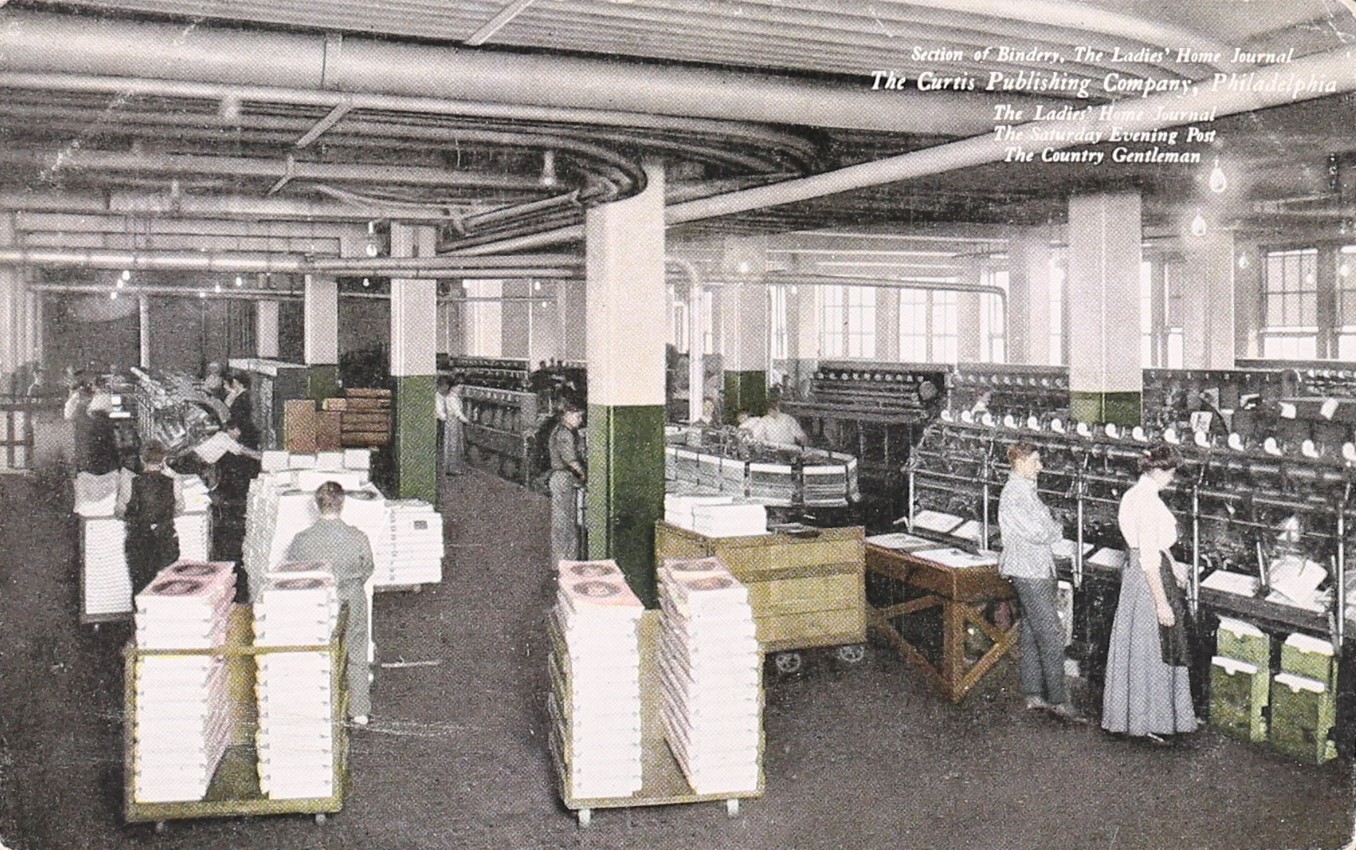
The wage of the bindery girl, as of all other workers is her greatest grievance. Most of them feel the humiliation of walking up to the pay window to receive half the pay of the men for the expenditure of the same amount of energy and effort.
Equal Rights.
The girls are fairly well organized in the International brotherhood of Bookbinders. At the recent convention held in Baltimore the following resolution was presented:
“Whereas, under this new era of reconstruction the status of Women has been placed on a scale equal with that of men, politically, professionally, and in many cases industrially and old prejudices of sex have been swept away one by one, thus giving to women in various fields, equal opportunity and equal compensation with men of like qualifications, therefore be it resolved, that the women Bindery Workers shall be placed upon the same equality with men bookbinders and receive equal pay for equal work. That equal work shall be interpreted to mean not only the same identical processes performed by men bookbinders, but shall include all the activities, either manual requisite for the proper construction of a book, or mechanical, performed by women which are other printed or blank work done in bindery or printing office by women. These activities require as much training and skill and carry as much responsibility as duties performed by men binders”.
“KICK THEM OUT”
Needless to say, our very careful and diplomatic president of the pure A. F. of L. type, took precautions to sidetrack any efforts on the part of our committee, and our aspirations were in vain. Very shortly the whole labor movement will no longer be encumbered by such weaklings, which time will be readily exploited by we women workers for the realization of our industrial rights. You see, we are just as much hampered by misleaders as the men. High time to get rid of them!
The Toiler was a significant regional, later national, newspaper of the early Communist movement published weekly between 1919 and 1921. It grew out of the Socialist Party’s ‘The Ohio Socialist’, leading paper of the Party’s left wing and northern Ohio’s militant IWW base and became the national voice of the forces that would become The Communist Labor Party. The Toiler was first published in Cleveland, Ohio, its volume number continuing on from The Ohio Socialist, in the fall of 1919 as the paper of the Communist Labor Party of Ohio. The Toiler moved to New York City in early 1920 and with its union focus served as the labor paper of the CLP and the legal Workers Party of America. Editors included Elmer Allison and James P Cannon. The original English language and/or US publication of key texts of the international revolutionary movement are prominent features of the Toiler. In January 1922, The Toiler merged with The Workers Council to form The Worker, becoming the Communist Party’s main paper continuing as The Daily Worker in January, 1924.
PDF of full issue: https://www.marxists.org/history/usa/pubs/thetoiler/n147-nov-27-1920-Toil-nyplmf.pdf
 Revolution's Newsstand