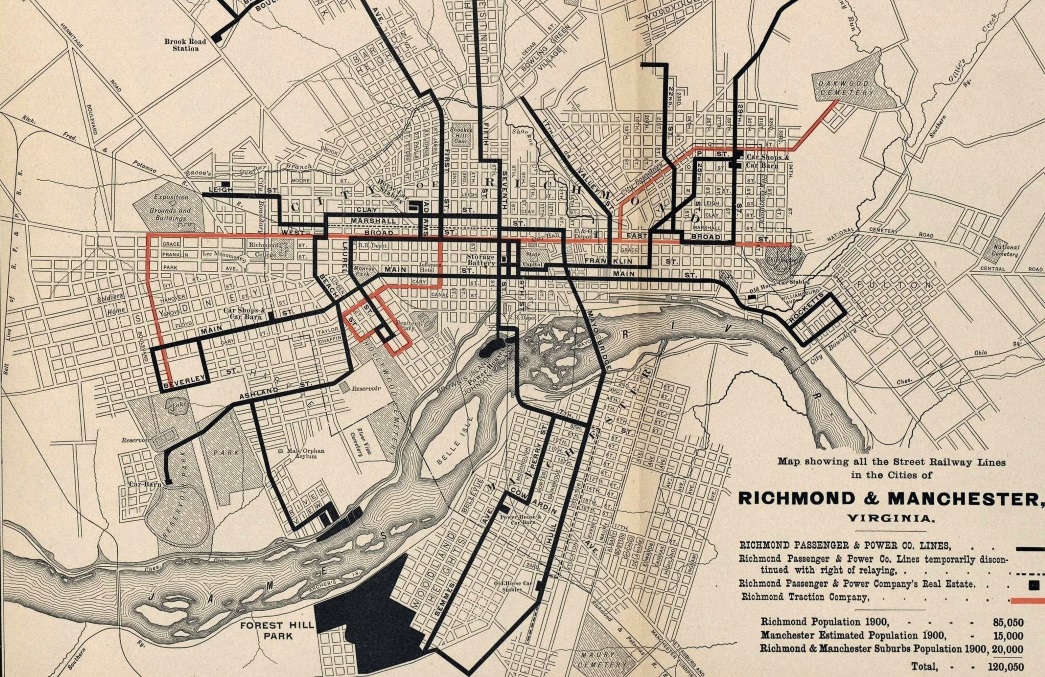
Richmond, Virginia already had a rich labor history in 1903 when an active Socialist Party local helped the Amalgamated Association of Street Railway Employees Local No. 152 in their militant strike against the city’s street car companies.
‘The Streetcar Strike in Richmond’ by John Catrell from The Worker (New York). Vol. 13 No. 18. August 2, 1903.
Militarism Displayed in Its Worst Form.–Ruffian Scabs and Ruffians in Uniform Terrorize the City at Command of Gould’s Trolley Company–Abuse of Public Authority in Service of Capitalism Rouses Interest in Socialism.
Comrade John Catrell reports further to the national headquarters upon the street-car strike at Richmond, Va., under date of July 1.
The strike situation is unchanged; the men are still firm. The laws are stilt violated by the company, for while the cars in operation, are few in number, the deficiency is made up by excessive speed. Previous to the strike the union men were heavily fined for excessive speed, and if not suitably attired were laid off, on complaint of police force, for seven or ten days. Now the scabs are running cars with hardly enough clothes to cover their nakedness. They are the toughest specimens I have ever seen, two of them attired in balbriggan underwear, no coat, no shirt, and no socks, smoking cigarettes, flooding the car with vile tobacco spit with “quids” of tobacco strewing the floor. All this in plain violation of the ordinances.
Last week, I saw one of the cars, running at excessive speed, ran into a little girl, who was picked up by the fender. The motorman applied the hand brakes, without shutting off the power, and the car filled to stop. A young man ran up, caught the front end of the car and rescued the girl, who was taken to the doctor. The motorman proceeded unmolested.
Manufacturing “Riotous Conduct.”
Last week the company planned a scheme to “murder” two strike-breakers as they were going through a lonely part of Fulton street at midnight. The car was timed to pass this spot just as the strikers were returning from their union meeting on their way home. Fulton street is in the East End of Richmond and has a tough reputation. The company had two or three squads of soldiers stationed near the place, where they claimed to have had information that the strikers would wreck the cars and murder the scabs. Everything worked beautifully. Just as the five strikers (De Forest, a member of the Executive Committee, being among them) entered upon this lonely path, the street car came bouncing down. Some one had spiked the rails, the car came to a sudden stop, the scabs cursed and swore, two shots were fired from an alley, and the scabs replied in the same manner.

The strikers, who were unarmed and were surprised by the fusillade, ran for shelter towards an alley. The soldiers
jumped from their hiding place, charged bayonets, and captured the strikers, who are now in jail, charged with attempted assassination.
The press is ringing the charges on this incident. A realistic picture has been drawn of the affair, the soldiers stealthily creeping to the appointed place, the mysterious flashing of lights in the neighborhood, the charge in the dark–all in the nature of a “Diamond Dick” novel, for the purpose of alienating public sympathy from the strikers.
Let the Cat Out of the Bag.
All would have gone lovely for the company, if a simpleminded captain had held his tongue in court. The strikers’ lawyers asked him how many men he had arrested. Seven, he replied. What did he do with them? Turned them over to his superior officer. Could be identify the men with the guns? Yes. The five strikers were brought before them, and he was asked if he recognized among these men the ones who had the guns. No, he answered. Now, said the lawyers, if there were seven men arrested, and there are only five here, where are the men with the guns?
The soldiers were dumfounded. Finally one of the officers volunteered the startling information that the two who were missing were the ones who had betrayed the murder plans and were permitted to escape because, according to military rules, these men must be shielded and allowed to go scot free. And yet, military law has not been declared!
No Redress for Militia Crimes.
Regarding Mr. Taylor, the man who, as I reported, was killed by the soldiers in Manchester, the jury, after many days’ investigation, brought in a verdict that he met his death by a gunshot wound inflicted by one or two soldiers, but could not say whether the shooting was justifiable or not. The soldiers positively refused to give evidence as to who fired first, their officers having declared it was against the rules to speak. The incident is closed” and a widow and five children are left to light for themselves.
Some thirty bricklayers have been sued for $10,000 damages by Sitterding, Corneal & Davis, charged with boycotting their material. Sitterding Is Frank Gould’s president of the street car company. The case comes up Monday. The unions are in a high state of excitement. The Police Board also meets to-morrow to try a number of policemen, suspected of sympathy with the strikers. The press is demanding summary punishment, charging “cowardice with dealing with the violent murderous mob as directly responsible for the lawlessness which has tarnished the fair name of our beautiful city.”
Ruffians In Uniform.
Four soldiers lately held up a man in a buggy within a half-mile of the City Hall, beat him into insensibility, robbed him, threw his body to the bottom of the buggy, and threatened to run their bayonets through the man’s little boy if he did not drive off and stop his screaming. Nothing is said by the press. No action by the authorities. Within one mile of the City Hall a soldier jumped into a buggy and tried to sit by the lady who occupied it. She drove him off with her hat pln. Women and men are grossly insulted by the soldiers, and there is no redress. Protest, and they put the bayonet to you and march you to the armory. Resist, and they murder you. The soldiers refuse to talk, eyewitnesses are not permitted to inspect the soldiers to find the guilty. The press is silent upon this phase of the situation, and militarism in the city would make the Tsar turn green with envy.
The Democratic party (the “white man’s party”) has certainly shown its colors, and as a final proof of Its love for the working class, the court has given Sitterding. Huff, and Bucannan, the president, manager, and general superintendent of the street car company, commissions as notaries public. But good will come out of it all. Thousands are reading our papers and arguing for and against Socialism. Along with the strike, this is the most talked of subject in town. The members of the local are doing good work among the strikers. I am speaking continually before the union meetings. The party has donated $22.55 to the strikers and of course we don’t hesitate to draw “odious comparisons.” We also bought and distributed three hundred copies of Lee’s “Labor Politics and Socialist Politics” and they are being read. We have received many leaflets and bundles of papers and we wish to express our gratitude for the assistance given us. This strike has been a blessing in disguise.
The Worker, and its predecessor The People, emerged from the 1899 split in the Socialist Labor Party of America led by Henry Slobodin and Morris Hillquit, who published their own edition of the SLP’s paper in Springfield, Massachusetts. Their ‘The People’ had the same banner, format, and numbering as their rival De Leon’s. The new group emerged as the Social Democratic Party and with a Chicago group of the same name these two Social Democratic Parties would become the Socialist Party of America at a 1901 conference. That same year the paper’s name was changed from The People to The Worker with publishing moved to New York City. The Worker continued as a weekly until December 1908 when it was folded into the socialist daily, The New York Call.
PDF of full issue: https://www.marxists.org/history/usa/pubs/the-people-the-worker/030802-worker-v13n18.pdf
 Revolution's Newsstand