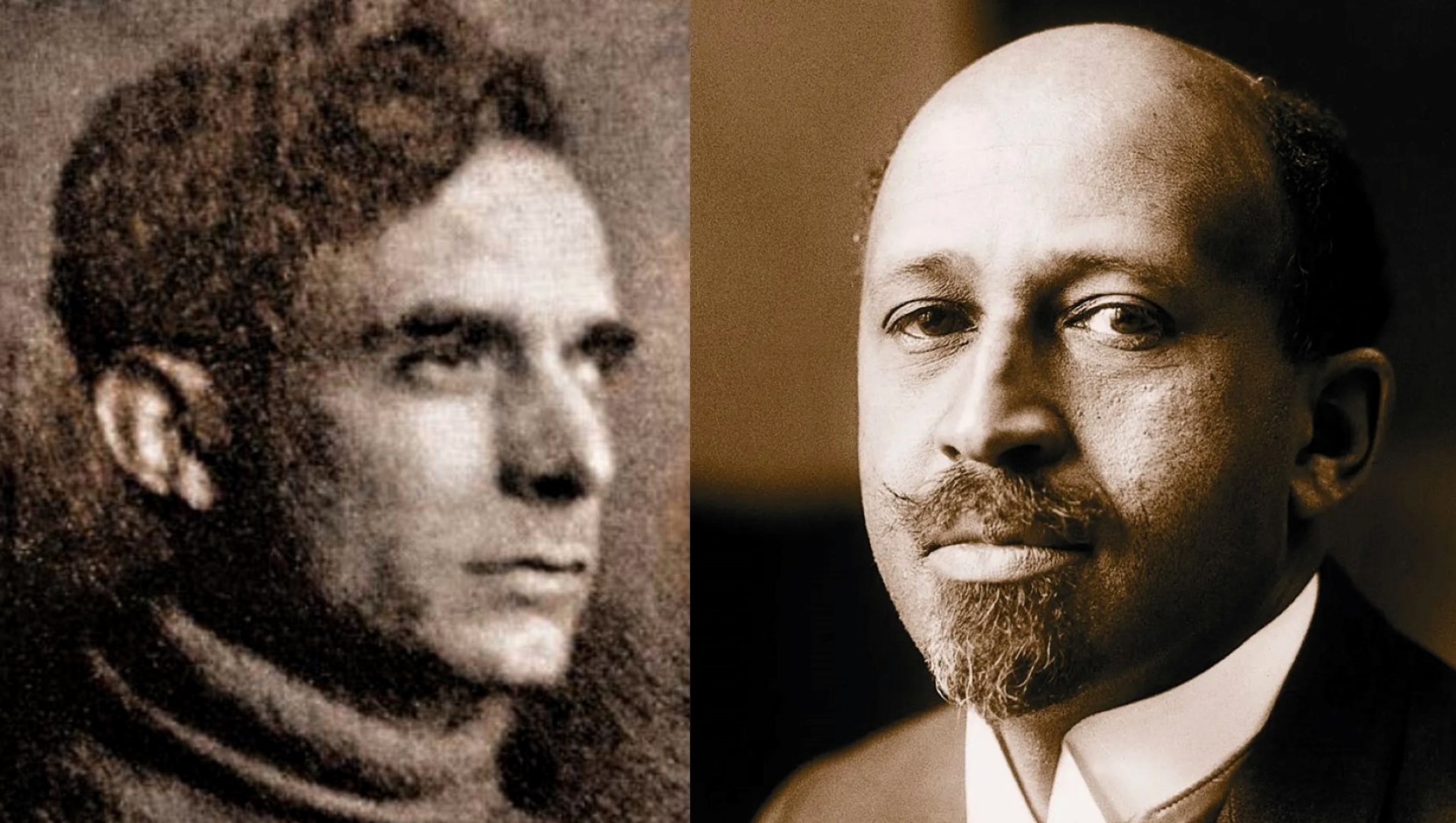
In this fantastic essay on Marxism and psychology Louis C. Fraina begins with a March, 1915 Socialist Press Club discussion of race and racism had by Jacques Loeb, Franz Boas, Louis B. Boudin, Robert H. Lowie and W.E.B. Du Bois with remarks on the lack of an additional psychological appreciation of the problem. Indicative of a larger problem in the left, he back goes to Marx and urges socialists to not neglect the central importance of psychology, combined though it many be with a multitude of others forces, in class relations and the class struggle.
‘Socialism and Psychology’ by Louis C. Fraina from New Review. Vol. 3 No. 5. May 1, 1915.
THE study of psychology is revolutionizing modern thought, transforming the relative importance of the various sciences. It is particularly pervasive in sociology, and is becoming indispensable for the adequate analysis of social problems. Jacques Loeb, Franz Boas, Louis B. Boudin, Robert H. Lowie and W.E.B. Du Bois recently discussed race antagonism at a dinner of the Socialist Press Club. It was a comprehensive discussion: biological, anthropological, economic and social. But I missed the psychologist’s interpretation, and my dominant impression of the discussion was the vital necessity of a psychological analysis of race antagonism.
Biologically, races do not differ materially; race prejudice is an acquired tendency and not an inherited trait; anthropology offers no basis for the division of races into “superior” and “inferior”; racial differences are rooted in different stages of social development; and fundamentally race antagonisms are an ideological expression of economic antagonisms. The conclusion is obvious: since adverse social conditions produce race antagonism, change the social conditions. To change these conditions, however, is a matter of men; the process through which the social factor acts upon the human factor is psychological; and of pressing importance becomes the problem of the human reaction to the conditions that produce race antagonism and to race antagonism itself. In our efforts to change social conditions we must get the support of men imbued with the spirit of race prejudice; and this presents a psychological problem of great intricacy and importance.
The average Socialist’s attitude toward the workers is very simple and very naive: the worker is a wage-slave; his commodity labor-power is bought and sold in the labor-market; exploited and oppressed, his emancipation lies through Socialism, in the class revolt against Capitalism. All of which is very sound, a magnificent formula; but still only a formula, in spite of its social validity. It is largely an expression of the historical imagination, and alone lacks the inspiration and driving power necessary to social action.
Socialist theory postulates that a certain stage of social development has produced a Proletariat in bondage to a Capitalist Class, and that proletarian revolt is historically potential. But the vital thing to us as men of action, as seers of a new vision of life, is to analyze and interpret the psychological reaction of the workers to their conditions of existence; the emotional temper produced by modern industry; the new type of mind, of men, of outlook upon life being developed by changing social conditions. These are the important things. They are necessary to our task of organizing the workers. They constitute the only medium through which we can articulate a new expression of life, a new and revolutionary culture.
The literature of Socialism abounds with phrases concerning “proletarian psychology” and “proletarian modes of thought.” But these terms are simply convenient phrases with no concrete meaning.
This literature deals thoroughly and magnificently with the material existence determining the consciousness of men; but scarcely an effort is being made to analyze that consciousness itself, particularly the changes wrought therein by the changing social existence.

The philosophic system of Marx recognizes the immense power of psychological factors in history. Marx stressed the importance of human effort and the human factor. In his Poverty of Philosophy Marx scored Proudhon for not understanding that “social relations are as much produced by men as are the cloth, linen, etc. The same men who establish social relations in conformity with their material productivity, produce also the principles, the ideals, the categories, conformably with their social relations.” In the Eighteenth Brumaire of Louis Bonaparte: “Man makes his own history;” In one of his fragmentary notes on Feuerbach, Marx indicates the dynamic role of the individual in the revolution: “The materialistic doctrine that men are the products of conditions and education, different men, therefore, the products of other conditions and changed education, forgets that circumstances may be altered by men and that the educator has himself to be educated.” The importance Marx attached to the human factor emphasizes itself in Capital. Capitalist production being the subject dealt with, Marx might be expected to under-estimate the human factor; on the contrary, some of Capital’s most brilliant and deeply philosophical passages attest Marx’s emphasis of this particular factor. I shall cite only one passage, a very pertinent one: “By thus acting on the external world and changing it he [man] at the same time changes his own nature. He develops his slumbering powers, and compels them to act in obedience to his sway.” (Chapter VII, Section 1.) Man changes his own nature. Are not these changes in the nature of man as important as, perhaps more important than, the social conditions producing the changes? This is an aspect of sociology neglected by Socialists; and it is an aspect of dynamic value to the revolutionary movement.
In spite of Marx’s appreciation of the importance of the individual, Socialist propaganda has developed a rigid determinism which minimizes and often totally suppresses the psychological factor. The doctrinaire Socialists act on the belief that the movement has to deal chiefly if not solely with social forces, the individual being of only slight importance. They assume that for all practical purposes it is sufficient to know that the social milieu conditions psychology. But that is not sufficient. While socially conditioned, individual psychology and the psychology of the mass become an independent factor in the social process as a whole, possessing laws and motives of their own: laws and motives which men dealing with human forces must comprehend if they desire success.
The great task of Marx was the analysis of the fundamental social forces which determine the consciousness of men. He developed the negative aspect of psychology. At a time when the science of psychology was the slave of biology, Marx’s social concept marks a tremendous revolution. Strangely enough, the full significance of this revolution was never understood in the Socialist movement; and it is the bourgeois scientist who to-day is transforming psychology by means of the Marxian concept. These scientists are developing a purposive social psychology by an intensive analysis of the psychology of the individual. Dr. Felix Krueger, professor of philosophy and psychology at the University of Halle-Wittenberg, and a few years ago Kaiser Wilhelm professor at Columbia University, excellently summarized, in a lecture at the time, the spirit of the new psychology:
“The new psychologist knows that the psychological problem has its social and genetic side; it must be judged as a result of past conditions as well as by present characteristics; it cannot be valued by experiment alone. Emotion and thought are more conditioned by the social milieu and the past history than by sensation. The proper aim of psychology is not metaphysical but purely empirical, but its actual experimental discoveries must be complemented by historic and social investigation. Psychology lies, indeed, on the borderland of the natural and humanistic sciences-both. We cannot study a psychological phenomenon without delving into history and sociology.”
The reversal of these propositions provides a statement of the concepts which should be emphasized in Socialist theory:
Socialism knows that the social problem has its human and psychological side; it must be judged as the result of emotion and thought as well as economic and social conditions; it cannot be solved by economics alone. The social milieus conditioned psychologically as well as economically. The proper aim of Socialism is not metaphysical, but purely empirical, but its actual activity and volitional expression must be complemented by psychological investigation. We cannot study a social phenomenon without delving into the psychology of human reactions.
But this attitude would still largely remain a negative one. Socialists must not alone recognize the psychological aspects of their philosophy-all genuine Marxists have done that; we must use psychology positively, purposively; we must make a fundamental study of psychology, as fundamental as our study of economics.
The value of psychology is greater than the simple analysis of social problems. As social conditions are transformed, men are transformed ; and the supreme utility of psychology lies in the analysis of transformations in the nature of man.
Out of this analysis emerges the potential culture of the new society in which the chief concern of man is man himself.
Culturally, Socialists are notoriously conservative. Their culture is generally the culture of the progressive bourgeois, and often the decadent bourgeois. Our radicals seek their cultural inspiration in Pagan Greece and the Renaissance, striving to vitalize anew the ideals of a splendid past. But these ideals of Athens and the Renaissance must be transfused with a new meaning. This meaning can be interpreted and developed only through a psychological study of the new individual being produced by social transformations. The aspirations, the mental modes, the temperament of this new individual must largely determine the new education, the new ethics, the culture of the Social Revolution.
Economics has given us a vision of the new society; psychology will give us a vision of the new humanity.
The New Review: A Critical Survey of International Socialism was a New York-based, explicitly Marxist, sometimes weekly/sometimes monthly theoretical journal begun in 1913 and was an important vehicle for left discussion in the period before World War One. Bases in New York it declared in its aim the first issue: “The intellectual achievements of Marx and his successors have become the guiding star of the awakened, self-conscious proletariat on the toilsome road that leads to its emancipation. And it will be one of the principal tasks of The NEW REVIEW to make known these achievements,to the Socialists of America, so that we may attain to that fundamental unity of thought without which unity of action is impossible.” In the world of the East Coast Socialist Party, it included Max Eastman, Floyd Dell, Herman Simpson, Louis Boudin, William English Walling, Moses Oppenheimer, Robert Rives La Monte, Walter Lippmann, William Bohn, Frank Bohn, John Spargo, Austin Lewis, WEB DuBois, Arturo Giovannitti, Harry W. Laidler, Austin Lewis, and Isaac Hourwich as editors. Louis Fraina played an increasing role from 1914 and lead the journal in a leftward direction as New Review addressed many of the leading international questions facing Marxists. International writers in New Review included Rosa Luxemburg, James Connolly, Karl Kautsky, Anton Pannekoek, Lajpat Rai, Alexandra Kollontai, Tom Quelch, S.J. Rutgers, Edward Bernstein, and H.M. Hyndman, The journal folded in June, 1916 for financial reasons. Its issues are a formidable and invaluable archive of Marxist and Socialist discussion of the time.
PDF of full issue: https://www.marxists.org/history/usa/pubs/newreview/1915/v3n05-may-01-1915.pdf
 Revolution's Newsstand