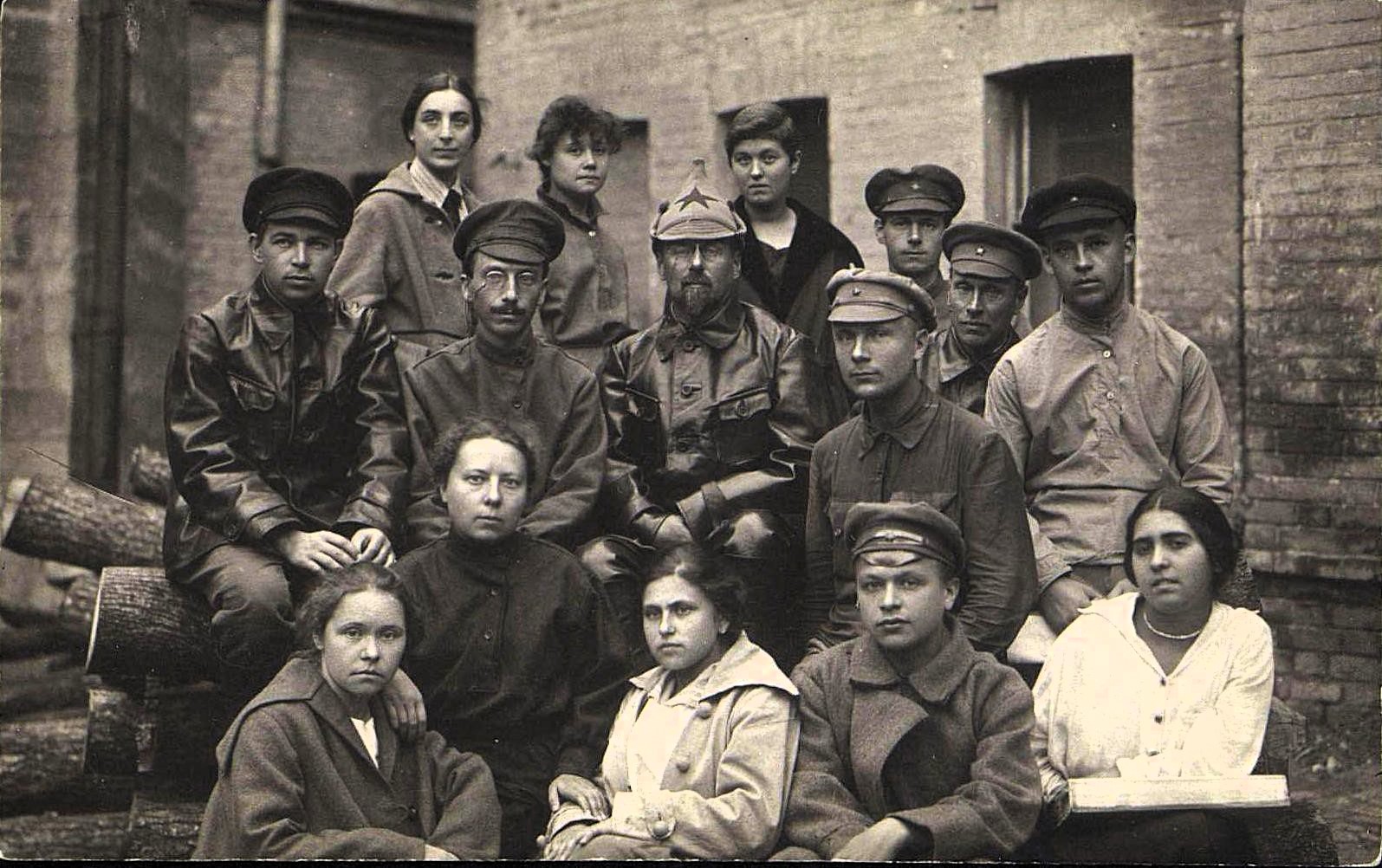
Olgin, who was in Russia during that brutal, transforming Civil War vividly describes the total demands placed on Communists in the enormous effort and and human expense in defending the Revolution.
‘The Duties of a Communist in Russia’ by Moissaye J. Olgin from The Toiler. No. 176. June 18, 1921.
A communist in Russia is a man who must face reality and act. Upon him depends everything. He is responsible for everything. He must consider everything. He must set a good example. He must lead.
A Communist is a man who takes upon himself the task of carrying through the revolution to its very end, and of establishing socialism. He must never say no. He must always forge ahead. He must live up to the decisions of the Soviets, live up to the demands of the Communist Party. He must fear nothing. He must never stop because of difficulties in the way. He has undertaken the task and he must not complain.
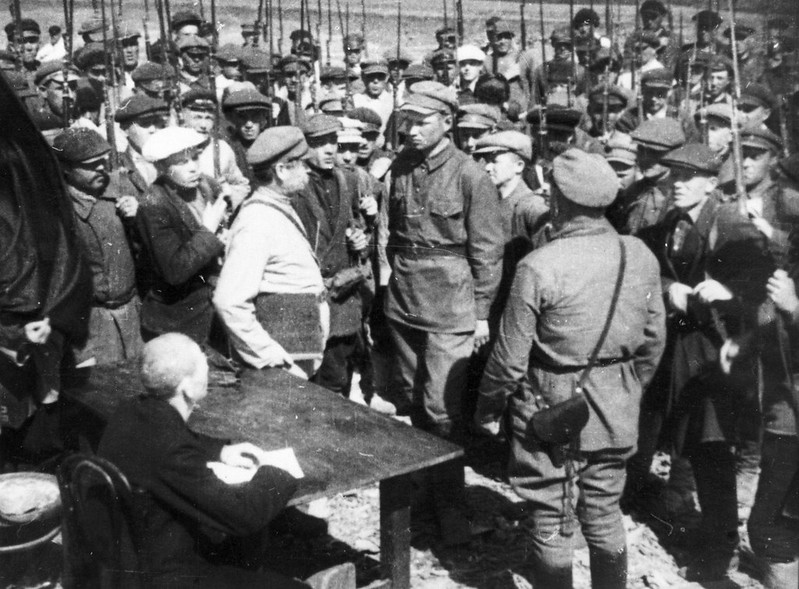
A Communist is a fighter. All the Communists of a city are united in one military organization, called “a division with a special end in view.” All the members of this organization must know how to use a rifle and machine gun. If they do not know they take lessons several times a week. I knew Communists who on three mornings a week had to rise at six o’clock and go for military training, to learn to march and shoot. I saw Communists who were tired, exhausted, hungry, but they attended for military training. What is it all for? So that they may be able to defend the city in time of an insurrection. Every Communist of every city is connected with headquarters which serve as a mobilizing point. If he receives a call by telephone or courier, he must immediately report to headquarters with his gun. Thus all the Communists of the City of Moscow can be mobilized within an hour. It would only take half an hour to mobilize the Communists of a smaller city. In the event of a counter-revolutionary movement in a city, the Communists will be the first to fight and the first to die. This is not an empty phrase with them.
Communists to the Front.
I happened to be in the city of Nizni Novograd at a time when there was a feeling of restlessness among the military units there. It did not come to anything serious, but there was the fear that there might be an uprising. The Communists were called out. Several hundred of them assembled in the building of the Executive Committee of the Communists and remained there for three days and three nights with their guns in hand. Sentries were posted. Patrols were organized. No one undressed in all this time. They ate and slept on the floor above. Were it necessary they would throw themselves to the defense of the revolution with their life and blood. Just what chance their number would have against a far superior force they did not ask. Perhaps they figured that only a part of the enemy would be against them, while another part would join them. However that might have been, they were ready. They came to fight and to die. Thus it was all over Russia. This is not merely a part of the programme, it is a terrible reality.
When the Poles took Minsk what was the first thing they did? They slaughtered the Communists. When Denikin or Petlura have taken a city in Ukraina, who were the first victims? The Communists. When the “whites” had possession of Baku, whom did they shoot as one shoots mad dogs? The Communists. In Vladimir a commissar told me how, escaping from Baku, he passed through Charkow to Soviet Russia. It was like a story from the Arabian Nights. I could not believe that a human being would be able to go through all that. and remain alive. Of one thing he was positive: if they learned that he was a Communist they would shoot him. on the spot.
I met with many Communists and spoke to them not as a newspaper man but as a good acquaintance of theirs. I spent many weeks in the houses of active Communists. And do you know what I heard in the most sacred moments, when hearts open and secret thoughts are uttered? “We will always be hung,” I heard more than once. If the revolution should fail, if a change should come about, the Communists will be the first ones to be shot and hung. They know that. They don’t deceive themselves. And they stick right to it. They lose no courage. They keep active.

A Communist must be ready to sacrifice his life. You should have been in Russia in September, October and November, when the Russian army retreated before the Poles and Wrangel kept moving north, ever nearer. Russia was at that time as if under a heavy cloud. Fear and disappointment prevailed everywhere. A middle-aged woman, a mother of three sons, of whom one was in the Red Army and the other two members of the Young Communist League, said one evening in a quiet, deep and slow voice, “If this be the end of the revolution, I don’t want to live anymore.” Thus felt millions all over the wide and dreamy prairies of Russia. Even the Mensheviks issued a call to their members to join the Red Army. But who really went? Who occupied the most dangerous positions? Who bared his breast to the enemy in the front lines? The Communists. “We, Communists of the committee of the Russian Communist Party of the Don region, have decided in order to support the Red Army, to mobilize five member of the committee on the Don, one member from each of the region committees, 400 members of the Rostow Nachachiwer organization, and 10 per cent Communists of the Don district.” “We, younger Communists of Zarizin, have decided, all of us, to go to the western front.” “We form a separata volunteer division of cavalry and join the Red Army.” “We, the committee of the Communist Party of the government of Tombsk, have decided to send 500 Communists to the Red Army.”
Communists Assume Life Risks.
So in every city, in every locality. People went voluntarily because Communist honor demanded. They were obliged to go because the Central Committee ordered it. “Communists, save Russia!”, the Central Committee wrote to the communists. And it was figured out how many communists each state had to supply. I read the figures: 270 Communists were to be sent to the front in May from Jekaterinburg, but 295 went instead. In June they were to supply 500, and 510 were sent. In August they had to send 90 against Wrangel, 95 were sent. And in September they mobilized again 400. In every city the Communists got together and said, “Friends. we must go to the front to save the revolution.” And they went. Nobody wants to die. They all hate war. Bat if one is a Communist, one must go. The situation demands it. It would be shameful if friends should know they did not go. It is not nice to be a coward. Therefore they must go. Even such Communists went who, at times, took a bigger ration for themselves than was coming to them, who seldom forgot their own little interests in favor of the interests of the Republic, They went, they fought, were wounded and died, because they were Communists and a part of a strong political machine.
And when they arrived at the front they must be in the front lines, lead the others, strengthen the weak, encourage the despondent. And all the time they know that once in the hands of the enemy their lives are lost. A captured Communist is a dead man, no matter whether he be in the hands of Wrangel, the Poles, Petlura or the Ukranian bands. You may ask, how is it learned that one is a communist. The answer is, there are spies everywhere. Sometimes the other captives. betray. But the chief way of finding this out is to order the captives to join the army of their captors. A Communist, therefore has every chance of being shot.
Are “Jimmie Higginses”
A Communist must not refuse physical work. About the Communist Saturdays. All Communists take part in that, with the exception of those who are sick and those who happen to have an important meeting at the time. There is plenty of work for a Communist at other times as well. Whenever there is a crisis in a city, the Communists are the first ones to offer to help.
When I was in Russia, mainly in the months of November and December, the condition of the Red Army was rather deplorable. Then everybody busied themselves to improve whatever could be improved. To start with, people prepared clothes for the soldiers. The women communists put patches on the soldiers’ shirts, darned their socks, put sleeves into their heavy overcoats and washed their underwear.
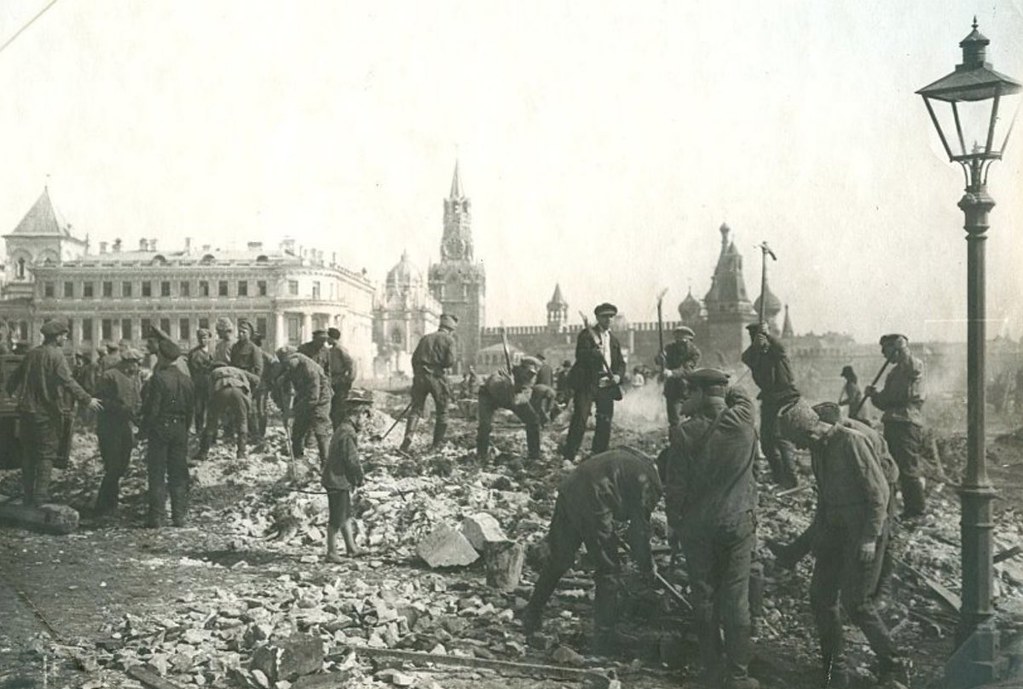
If there is a fuel crisis in a city all the Communists are called out, including the Young Communist League, and out to the woods they go, to chop and carry wood. A communist must help. Nay, a communist does the work with a will. He does not complain. He does not sit and brood over his lot that he, one of the intelligentsia, should have to carry wood or dig with a spade. Nobody forces him to do that. If he does not wish to do so he can quietly leave the party and shake off all these heavy responsibilities.
What Communist Discipline Is.
A Communist must obey. He is under a discipline more severe than is the soldier in time of war. What the committee thinks ought to be done is done. The command of the Central Committee is law. I spent several weeks going around in different villages with a Communist, a peasant, who used to be an under-officer in the Red Army in Turkestan. We spoke together for many hours. With a peculiar pride he repeated the words of one of his commanders. “A Communist,” he quoted, “is nothing but an instrument in the hand of the social revolution. A Communist is material for the future. The revolution will dry up your flesh, drink your blood, suck the marrow out of your bones, and then will throw you away as an old rag. And you will have nothing to complain about, because you but do what is your duty. You are a communist.” My peasant friend repeated this teaching whenever and wherever there was an opportunity, and believed in it wholeheartedly. Maybe some other leader, Lenin, for instance, has a much finer conception of the role of the individual Communist, but that is the general idea.
A Communist must obey. Today he is in Baku. He has established himself, got acquainted with local conditions and the people of the district and has made many friends. He feels quite at home. His work is satisfactory, he is honored and appreciated. At last he has found his place. But just because he is known as an able man he receives a letter from the Central Committee requesting him to go to Penza, where the party work is going on rather slowly. And he goes. without question. He has no one to complain to. He may have to break the most cherished threads that bind him to other people; he may have to break up his family. He goes, for he is as an officer of the army in time of war. The work he has to do stands above everything.
Hundreds and thousands of Communists are being shifted every year from city to city, from village to village, from one end of the country to the other. What is more, it is not proper that a Communist should begin to feel too comfortable in one place, should be well established and begin to feel himself one of the elite of the city. This weakens his courage, cools his revolutionary fire, and develops in him, as they say in Russia, a petty bourgeois psychology. This is the reason for the party’s general rule continually to shift Communists from place to place. The eighth Congress of the Communist Party decided that all responsible, active Communists, those who used to be workers, or belonged to the intelligentsia, should from time to time go to the factories and remain there, working for several weeks as ordinary workers. This, it is said, would be an excellent remedy against breaking away from the people. This decision was not often applied, because the country was continually at war and the active Communists could not be spared. They are, nevertheless, not given an opportunity to become well established in any place. Now that war is over they will be shifted from place to place more frequently.
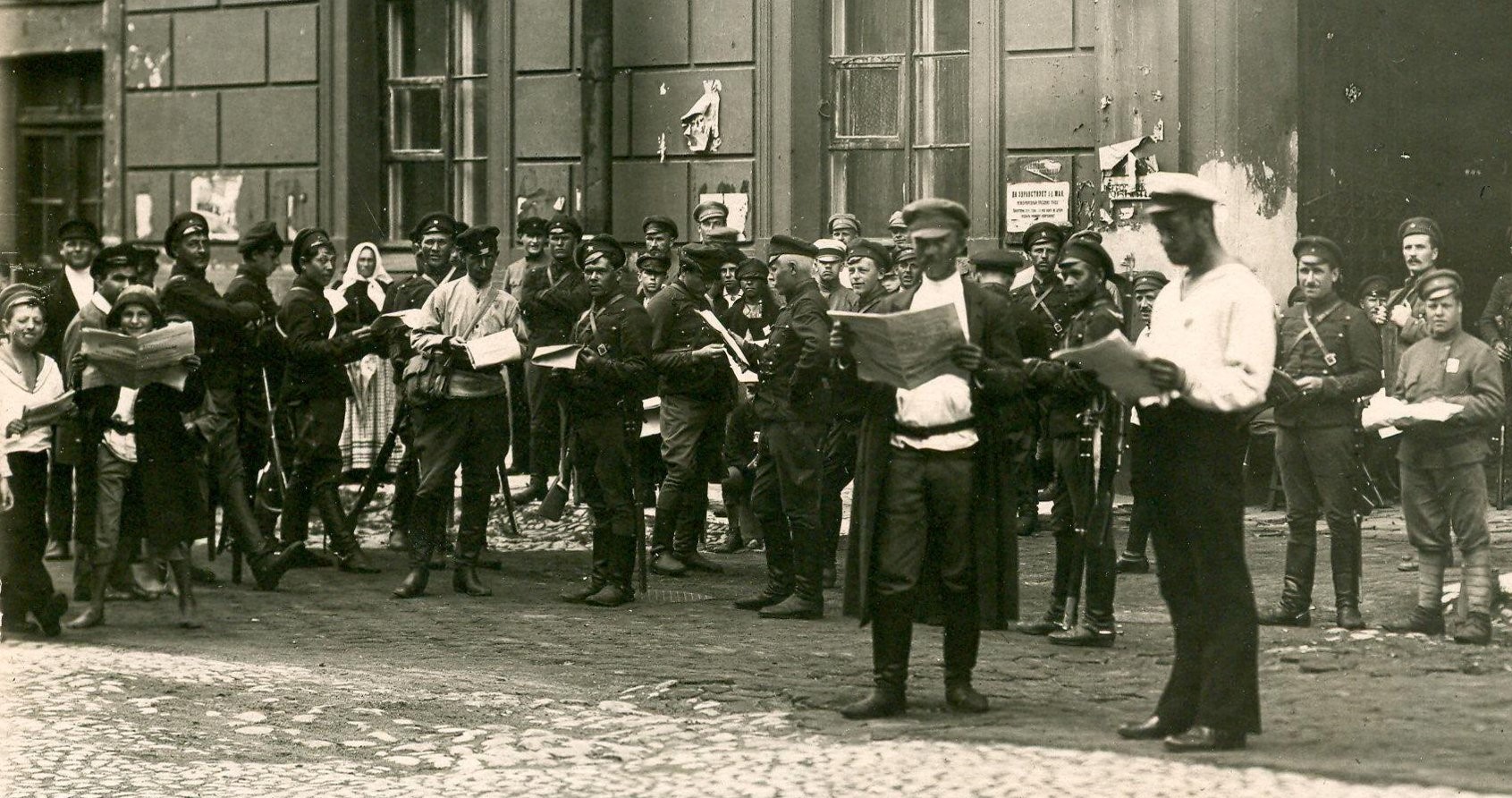
A Communist must obey. Every capable Communist must register in the agitation division of the local Communist committee, and not less than once a week he must speak at a public meeting. No use offering an excuse; it is not accepted. One wakes up in the morning and receives a message which reads, “Comrade So-and-So is going to speak at a meeting on such an such a subject. An automobile (or horse and buggy) will be sent for him in time.” And one goes–sometimes fifty versts from the city, because party discipline demands it. “In the name of party discipline” the committee may demand from the members everything. Here is a notice from the “Pravda”: “As the party and the Soviet schools of the Republic are very much in need of simple Communist text-books, the Central Committee has decided to authorize several responsible writers in the party to compile such text-books. They are therefore completely, or partly relieved from all other work and duties. Instructions for such comrades follow:
1. Bubnoff. “History of the Communist Party.” Time, one month. He is being freed from all work in the Central Committee, but must continue his work at the headquarters of the textile industry.
2. Steklow. “History of the Labor Movement in the West” and “The History of the Internationals.” Time, two months. He is at the same time to attend to his regular work at the “Izvestia”.
3. Bukharin. (a) “Historic Materialism.” (b) “Political Parties in Time of a Proletarian Revolution”. Time for the first book, a month and a half. He is freed from party work but must attend to his duties at the office of the “Pravda”. In the same manner eleven books were ordered written.
In Russia even literature is being created “in the name of party discipline”.
A Communist must know. He must be thoroughly familiar with the external and internal situation of Russia, must be familiar with facts and figures about agriculture, industry, transportation and military institutions. He must be able to give a clear answer on all questions.
It is not a pleasure to be a Communist. To be a Communist means to have grave duties. From this it will be understood why people do not flock to the Communist Party, although that party is in power. From this it will also be clear why some Communists think of themselves as the elite and figure that they deserve more than other citizens. But some time we shall discuss such depraved Communists.
The Toiler was a significant regional, later national, newspaper of the early Communist movement published weekly between 1919 and 1921. It grew out of the Socialist Party’s ‘The Ohio Socialist’, leading paper of the Party’s left wing and northern Ohio’s militant IWW base and became the national voice of the forces that would become The Communist Labor Party. The Toiler was first published in Cleveland, Ohio, its volume number continuing on from The Ohio Socialist, in the fall of 1919 as the paper of the Communist Labor Party of Ohio. The Toiler moved to New York City in early 1920 and with its union focus served as the labor paper of the CLP and the legal Workers Party of America. Editors included Elmer Allison and James P Cannon. The original English language and/or US publication of key texts of the international revolutionary movement are prominent features of the Toiler. In January 1922, The Toiler merged with The Workers Council to form The Worker, becoming the Communist Party’s main paper continuing as The Daily Worker in January, 1924.
PDF of full issue: https://www.marxists.org/history/usa/pubs/thetoiler/n176-jun-18-1921-Toil-nyplmf.pdf
 Revolution's Newsstand