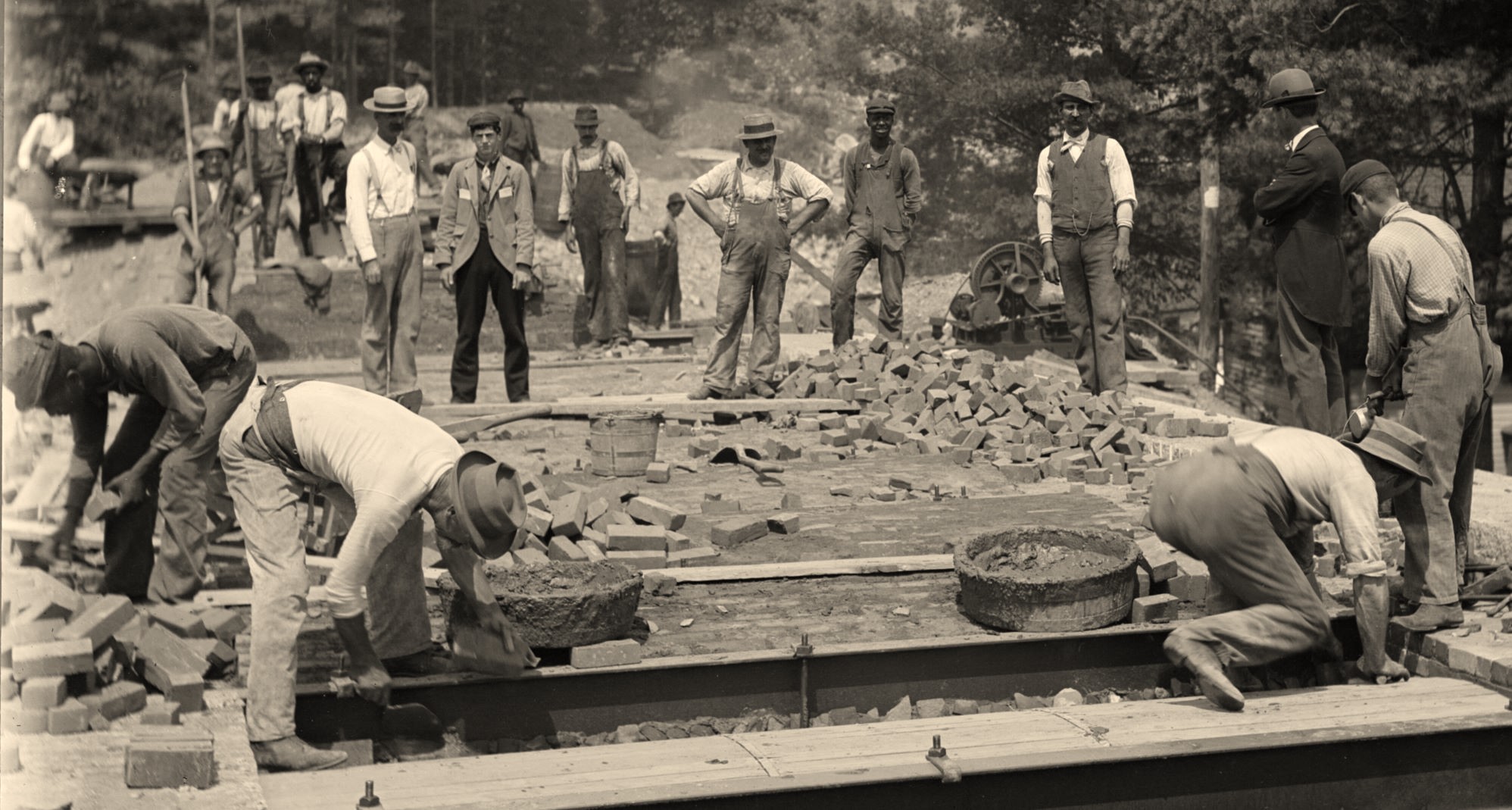
A rank-and-file rebellion among New York’s bricklayers challenges a corrupt union regime with a strike in 1919.
‘What’s the Matter with the Bricklayers?’ by Mike from Voice of Labor (New York). Vol. 1 No. 4. October 1, 1919.
SOME of you workers talk about the Closed Shop. Well, we Bricklayers have got the Closed Shop–have had it for years. We’ve got one of the strongest Unions in existence; there are practically no scabs in the United States or Canada. Up to the present time, so far as I can remember and I’ve been a bricklayer for eight years–we’ve never had a strike.
Eight hours? We’ve had the Eight-hour Day for the last 17 years. Forty-four Hour Week? Go on, we’ve had the Forty-four Hour Week since 1904. In 1904 we got $5.60 for an Eight-hour Day; in 1914, it went up to $6; in the last half year, it has been $7 a day.
Pretty soft, you think?
No. The bricklayers are the most exploited trade in this country.
In spite of this seemingly high pay, the average annual wages for bricklayers in 1918 were $14-$15 per week. This is because a bricklayer averages only five months’ work every year,
How the Bricklayers Are Exploited
A bricklayer on the job is an absolute slave. If he leaves his work to get a drink of water, he is immediately fired. If the boss doesn’t like his face, or doesn’t think he’s working hard enough, or gets any grumbling or back-talk, he turns the worker out.
The Boss has absolute power to fire the worker at will, with or without a reason. This is a Union rule.
When bricklayers start a job, they stretch a line at the place where the bricks shall be laid to. Then they start in. Each bricklayer must reach the line at the same time as the others. If he does not, he is laid off,
A couple of fast workers are put in the gang, and every man must work as fast as the fastest worker. The boss stands behind jingling money in his pocket. The fast worker sets a terrific speed–if he doesn’t, he’s laid off; the other workers have got to keep up with him. When one of them falls behind, he is immediately paid off and fired. For hours at a time, without relief, the workers race each other for the line.
This makes the bricklayers enemies of each other. Each thinks the other is speeding, and each resents the fact. Men are forced to compete with each other, and the loser is fired. But there is another and more serious result. Rushing the job for their very existence, the bricklayers don’t care whether the bricks lie well or not. They slam bricks into dry places, any old way; and some day, when a heavy strain comes on that part of a wall, a terrible accident happens. It is a rule of the Bricklayers’ Union that the boss can fire any worker he wants to. Moreover, many bosses carry cards in the Bricklayers’ Union–this being one of the few organizations in which employers of labor have a voice in the management of the Union.
The Ten Dollar Movement
The same pressure of economic conditions which has forced the rank and file of other trades to ask for more wages, also forced the bricklayers to act.
In New York there are five Locals of the Bricklayers–Nos. 1, 9, 34, 37 and 41. During the Spring and early Summer these Locals held independent meetings and decided to ask the bosses for $10 a day, beginning August 1; and if the bosses did not give in, to strike.
The New York Executive Committee of the Bricklayers, composed mostly of Union officials, awoke with a start. This demand on the part of the rank and file threatened a revolt of the membership. Perhaps they might lose their pie-cards…For years the Bricklayers’ officials had done nothing to justify their salaries
It should be noticed that the bricklayers didn’t ask for anything but just a bare living. They didn’t ask to alter any conditions of the trade; they didn’t demand any let-up in the slave-driving to which they were subjected. Ten Dollars–that was all.
The Executive Committee held a hurried, secret consultation with the bosses, who rejected the $10 demand, but proposed to pay bricklayers $8 a day on August 19th.
The Executive Committee Calls a Meeting The strike was set for Friday, August 1st. To head this off, the New York Executive Committee called a mass-meeting for Sunday, August 3d, to take a strike vote. When the workers came to the meeting, they were informed that they must vote’ secret ballot on one of two propositions:
1. To accept the bosses’ offer of $8 a day.
2. To demand $10 a day beginning August 15th.
The Executive Committee was in favor of proposition No. 1, but it didn’t dare to go against the overwhelming sentiment of the rank and file. In order to break up the movement, however, it set the date two weeks later.
All Locals turned out in full force for the meeting, and by a vote of 1075 to 152, endorsed the $10 demand. These who voted for Number 1 were bosses, foremen, and foreign-speaking workers who didn’t understand the question.
When the vote was announced, workers all over the hall shouted to the Executive Committee members, “We wanted to start the 1st; you put it off until the 15th. Now tell us what to do? Shall we go to work tomorrow or not? Why don’t you give some publicity to this demand?” Not a single Executive member answered. They told the hall-keeper to put out the lights and close up…
The Spontaneous Rank and File Strike
Although the strike had been voted on, still not a word was given out to the papers. The Executive Committee kept silent. There was no public meeting with the Bosses.
On Monday, August 4th, some members of the rank and file in Brooklyn got several automobiles and went around from job to job, calling the men out. Almost 100 per cent left the jobs.
The next day the independent contractors hurried to Union headquarters and signed agreements for the $10 scale. The Associated Contractors, the big firms, like Eidlitz and Ross, Fuller, Terry & Tench, etc., did not sign.
On the 15th the New York bricklayers walked out-also independently of the Union officials, without a strike committee or any other organization.
The Brooklyn men have been on strike on the Associated Contractors’ jobs for two months; the New York men, for a month and a half.
No strike benefits are being paid. The Union officials take no active part in helping the strike–although they do not dare openly to oppose it. Fortunately there is such an immense amount of work on hand, that most of the brick- layers are now employed by the Independent companies at the new $10 scale.
The Bricklayers in Danger
But the bricklayers cannot maintain this scale very long, in their present situation. Slack times are coming, and then it will be an easy matter to restore the lower wages.
As long as the Boss can fire men at will, so long will he be able to discharge the most active and strongest men, and then force the rest to accept the former scale.
In order to maintain their present victory, the bricklayers must demand different conditions in the trade, and be able to exercise some control on the firing of their members. They should organize job-committees to enforce good treatment on the job, the abolition of speeding-up, the reinstatement of men arbitrarily fired.
Bosses should be fired out of the Unions.
As for the organization of their Unions, in which five complete sets of officials are maintained, and placed in a position to sell them out, this should be fundamentally changed. The officials should be subject to control by the rank and file.
All over the City of New York the Building Trades are becoming disgusted with the short-sighted policy of their Unions, and the inefficiency of their form of organization.
Only One Big Union of the Building Trades in this City, based on the control of the job by the men working can solve the problem of the Bricklayers.
The Voice of Labor was started by John Reed and Ben Gitlow after the left Louis Fraina’s Revolutionary Age in the Summer of 1919 over disagreements over when to found, and the clandestine nature of, the new Communist Party. Reed and Gitlow formed the Labor Committee of the National Left Wing to intervene in the Socialist Party’s convention, eventually forming the Communist Labor Party, while Fraina became the first Chair of the Communist Party of America. The Voice of Labor’s intent was to intervene in the debate within the Socialist Party begun in the war and accelerated by the Bolshevik Revolution. The Voice of Labor became, for a time, the paper of the CLP. The VOL ran for about a year until July, 1920.
PDF of full issue: https://archive.org/download/VoiceOfLaborV1n4Oct011919OcrOpt/voice%20of%20labor-v1n4-oct-01-1919-ocr-opt.pdf
 Revolution's Newsstand