
Giovanitti’s poems are a marvelous window into, and reflection of, the effervescence of U.S. radicalism in he first decades of the last century.
‘’Arrows in the Gale’—Giovannitti’s Poems’ by Leonard D. Abbott from Mother Earth. Vol. 9 No. 2. April, 1914.
EVERYONE knows of Arturo Giovannitti as the syndicalist and strike leader. Very few as yet know of him as a poet. At the time of his imprisonment in connection with the Lawrence strike he published “The Walker”—a prison poem. A few months later, when he and Ettor were brought into court in Salem, he wrote “The Cage.” These poems, together with a score of others and a moving “Introduction” by Helen Keller, have been lately put into artistic book form by Frederick C. Bursch, of the Hillacre Press, Riverside, Connecticut.
In this book Giovannitti establishes himself as one of the great poets of revolution. He is of the lineage of Byron, and he vibrates with the libertarian passion that Swinburne felt. He has been compared with Whitman, but the only American poet that he recalls for me is Voltairine de Cleyre. Like her, he shoots his “arrows in the gale.” Like her, he glories in the combat which he hopes will result in the utter overthrow of present-day society. There is in his book a lovely pagan fantasy. Personal love is precious to him. But the one theme that has his undivided allegiance is revolution. He sounds the keynote of his book in the opening lines of his ““Proem”:
These are but songs—they’re not a creed.
They are not meant to lift or save.
They won’t appeal or intercede for any fool or any knave;
They hold no covenant or pledge
For him who dares no foe assail:
They are the blows of my own sledge
Against the walls of my own jail.
He even quarrels with the Spring because it means for him “an atonement, not a rebellion,’ “a returning childhood, not a reconquered virility”; and he exclaims:
No storms, no tempests, no hurricanes,
No spasms of long-nursed follies,
No violences of coveted passions,
No brazen display of warm desires and unclad sins,
No exaltation of fecund motherhood,
Nothing but the recurrence of an old fashion, the rewearing of the discarded, ignoble dress of green, a new mat of perfumed rouge over the wrinkles of the same old yellow face of the world.
I have hated thee, O Spring.
Love may be sweet, but in the spirit of this poem it becomes as a temptress that lures men away from the revolution:
Shall I sing of love now, I who could only sing to the tune of the clarions of war?
And shall I forget for a woman my black frothing horse that neighs after the twanging arrows in the wind?
And shall I not lose my strength when her arms shall encircle me where thou hast girt me with the sword, O Gea, my mother immortal?
Revolution sounds in half a dozen poems devoted to poverty. Giovannitti knows the underworld because he has dwelt in it. One poem he addresses to a bench in Mulberry Park on which, in the days of his direst distress, he slept. Another poem is entitled “The Last Nickel.” Stanzas on “The Bum” reverberate with a coarse, irregular rhythm. The poet incites the poor and the outcast to fling their scorn and hate in the face of’ “this Christian world of sainted thieves and fat apostles of virtue, this world of brutes and prostitutes.” He hopes for a day—
When flesh and sinews shall revolt
And she, the mob, the fiend, the beast,
Unchained, awake, shall turn and break
The bloody tables of their feast.
Revolution sounds, equally, through these poems in which Giovannitti attacks present-day religion and strives to include the sterner ethics on which the future society is to be built. He preaches a gospel not of meekness and love, but of heroic struggle and self-assertion. He translates the Beatitudes of Jesus thus:
Blessed are the strong in freedom’s spirit: for theirs is the kingdom of the earth,
Blessed are they that mourn their martyred dead: for they shall avenge them upon their murderers and be comforted.
Blessed are the rebels: for they shall reconquer the earth.
Blessed are they which do hunger and thirst after equality: for they shall eat the fruit of their labor.
Blessed are the strong: for they shall not taste the bitterness of pity.
Blessed are the sincere in heart: for they shall see truth.
Blessed are they that do battle against wrong: for they shall be called the children of Liberty.
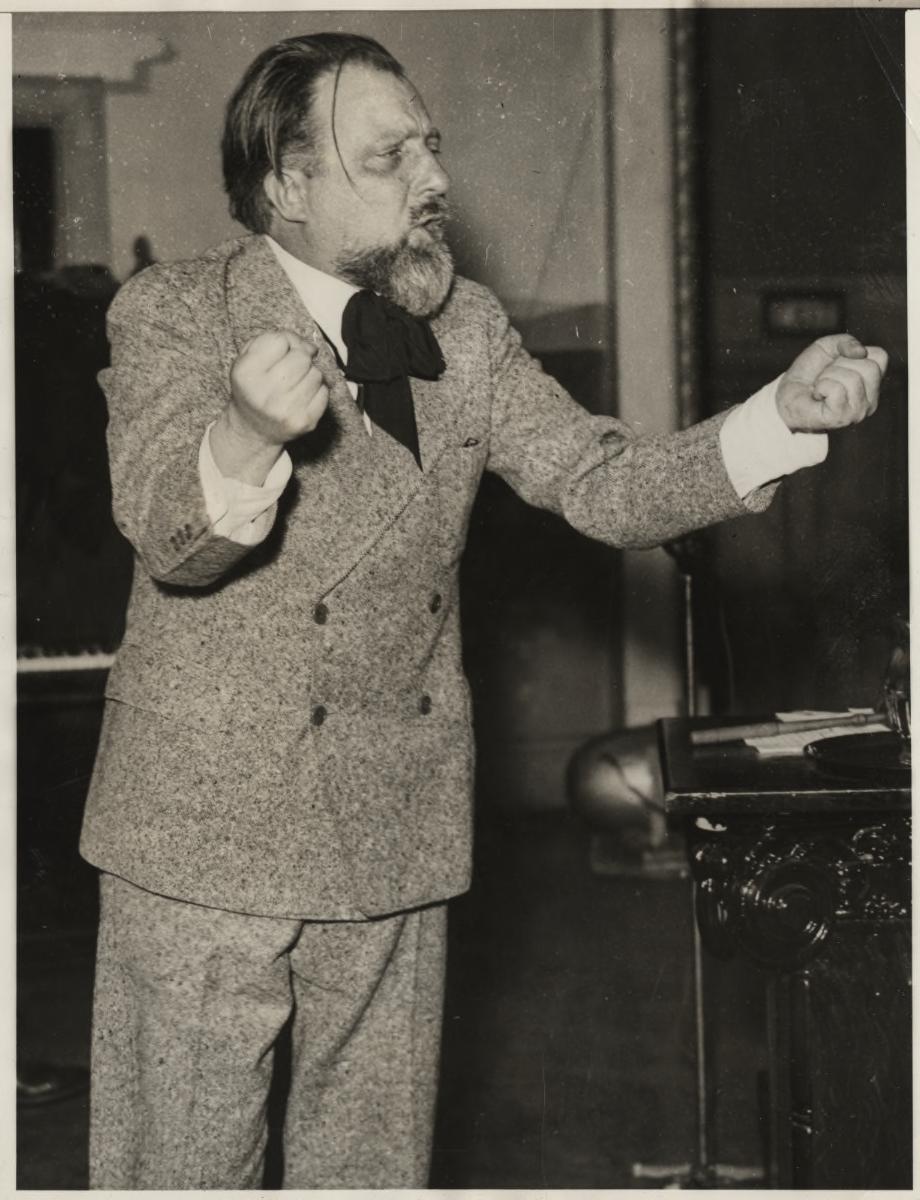
If Giovannitti’s prison poem, “The Walker,” with its unforgettable picture of the captive who tramps to and fro, may be said to symbolize humanity pent up and confined, “The Cage” opens a way of deliverance. As we look on the old order embodied in the judge and his minions, and on the new order which lives in the souls of the three prisoners in their cage, we understand the deepest meaning of what Giovannitti has to tell us. The cage is passing, but the dream of the three men in it is just beginning to be realized. The cage is to go back to the smithy fires and to be reshaped into the sword of man’s justice, the tripod of his worship and the sickle for his grain. But the dream is to go forward. In the throbbing lines of “The Cage” we can hear the tramp of a vast, onrushing host. “It is the highside of the revolution,” as Helen Keller says. “Onward it sweeps through the rent temples of the past, flooding the tombs of dethroned state, thundering through the market-place where men buy and sell the lives and souls of their fellow men. Face the wreckage you who can, and behold upon the tumultuous waves a new ship of state. Fast through the night of our ignorance and our fear it speeds on to the calm, sunlit shores of the desired land.”
Mother Earth was an anarchist magazine begin in 1906 and first edited by Emma Goldman in New York City. Alexander Berkman, became editor in 1907 after his release from prison until 1915.The journal has a history in the Free Society publication which had moved from San Francisco to New York City. Goldman was again editor in 1915 as the magazine was opposed to US entry into World War One and was closed down as a violator of the Espionage Act in 1917 with Goldman and Berkman, who had begun editing The Blast, being deported in 1919.
PDF of full issue: https://archive.org/download/mother-earth/Mother%20Earth%20v09n02%20%281914-04%29%20%28c2c%20Harvard%20DSR%29.pdf
 Revolution's Newsstand