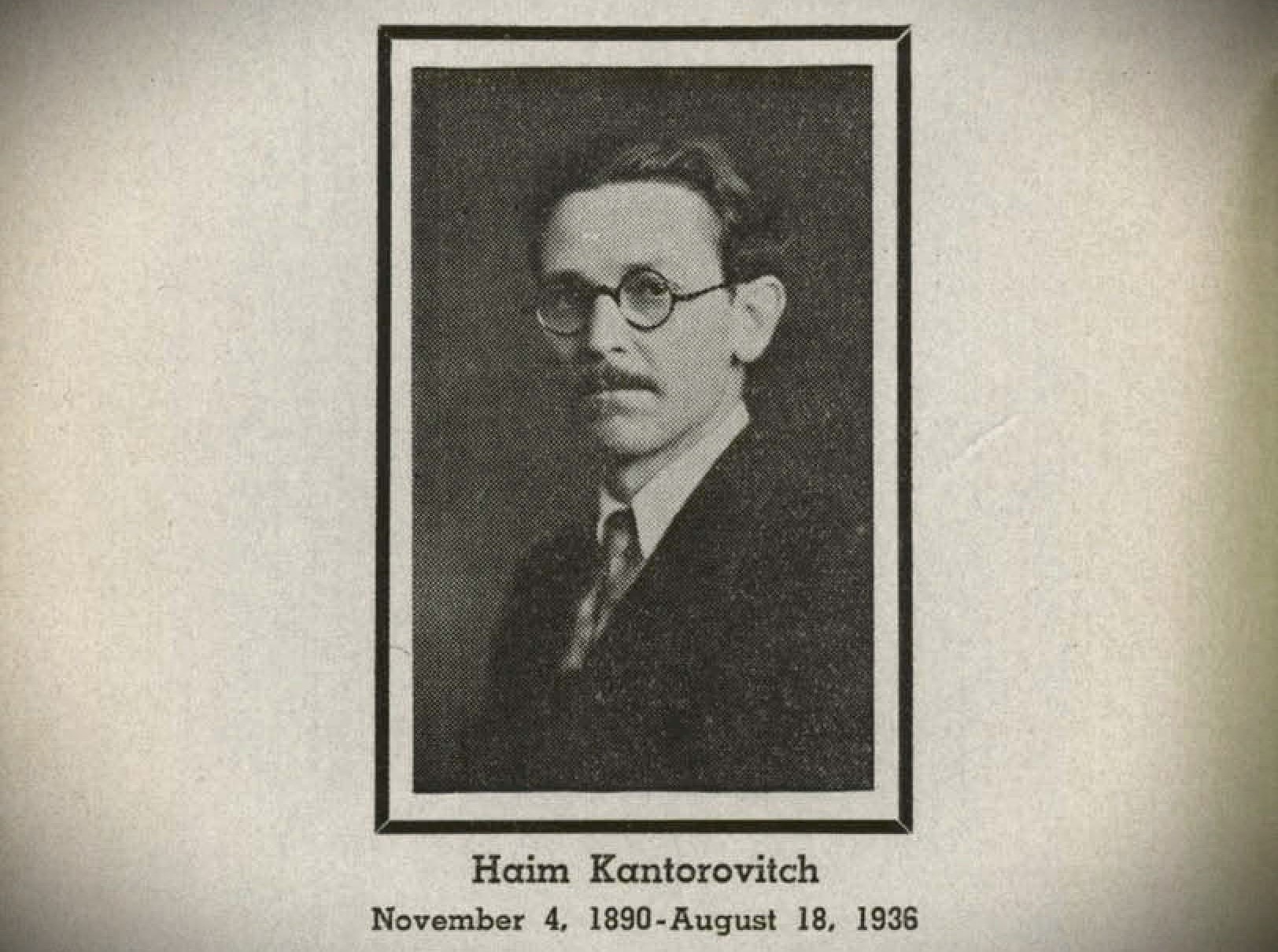
A major figure who contributed greatly to our movement, now largely forgotten, Haim Kantrovitch is worthy of remembering and of study.
‘Haim Kantorovitch: A Tribute’ by David P. Berenberg from American Socialist Monthly. Vol. 5 No. 8. December, 1936.
ΑFTER the death of the “Class Struggle” an interim of ten years followed during which the Socialist Party had no English publication other than the daily and weekly propaganda papers. Few, apparently, felt the need for something more substantial; for a paper or a magazine in which the problems posed to the socialist movement by the rapidly changing face of the world could be adequately discussed. For some years the writer cast about among his friends in the party in the hope of finding those few whose enthusiasm could be concretized into action. Then he found Anna Bercowitz, and through her Haim Kantorovitch, who had been making the same search independently.
The three at once clicked. We began seriously to plan the paper in September, 1931. By December the first issue was off the press. A paper born as was the American Socialist Quarterly, in a time of ferment inside and outside the movement, can have no placid existence. A paper that, like the ASQ, was published neither for gain, nor for enhancement of reputations, but solely to mold opinion in the direction of Socialism, is of necessity the reflection of the lives and thoughts of its sponsors. The numbers of the ASQ were not planned; they were lived. They created themselves out of the changing situations in the party and in the world, out of the give and take of discussion among the editors. In these discussions Haim Kantorovitch, more often than not, was the guiding spirit. His keen analysis of events current and yet to come, his understanding of human character, his insight into the strategy of his opponents contributed more than any other factor to the success of the ASQ.
For the last five years the ASQ, and in the last year the ASM, were Haim Kantorovitch’s life. He gave to it the greater part of his time. He took its problems with him to the sanatorium. In the long hours of his loneliness in Los Angeles and at Liberty he pondered its future course. In his last days he summoned up the remnants of his strength to write for it an article of pungent warning to that party for which he was giving up his life.
It was the joy of his life to be able to create. Haim Kantorovitch was not only a philosopher. He was more than the strategist and the theoretician of the movement. He was an artist. He was a poet who had lost faith in what is usually called poetry. He thought that these times had no use, no ear, no time and no heart for poetry. The days to come would not even know poetry, as we know it today. Whether he was right in this, or wrong (and in this matter I did not agree with him) he had to find an outlet for the frustrated poetic gifts with which nature had endowed him. He found this avenue in the ASQ.
If you read his articles carefully you will find in them not only the expression of a sound Socialism. You will find the creative artist with the poet’s sense for the right word. You will find the exactness of expression that comes of the poet’s sense of form, sound and color. He was slow in writing; exasperatingly slow from the point of view of the editorial office. But he was slow because he was a poet. He would not hurry. The printer could wait. The important thing was the right tone, the right atmosphere.
When I became more closely acquainted with him I was amused, and at the same time impressed by his creative methods. He would greet me with a casual phrase. “Abraham Cahan,” he might say, “is a socialist. But his is the Socialism of the hopeless.” A few days later he would expand this theme in a casual speech full of satiric and cutting humor. At last it would blossom–blossom is the right word–into an article. It became a typical Kantorovitch article whose pertinence, power and wit were the joy of his friends and the despair of his enemies, but whose poetry few recognized.
He is gone now. Other theoreticians will arise. Other writers full of cogency and wit will fill his place. He knew he was not indispensable to the movement. But few among those who follow will have that combination of broad knowledge, deep human understanding, poetic vividness and human kindness that made up Haim Kantorovitch. He was no angel. He had a tendency to emphasize and subtly caricature the failings of his opponents. He was often cynical and bitter. He was sometimes unjust. But these flaws in him merely prove his humanity. We who have lost him would not have had him otherwise than as he was.
Socialist Review began as American Socialist Quarterly in 1934. The name changed to Socialist Review in September 1937. The journal reflected Norman Thomas’ supporters “Militant” tendency of the ‘center’ leadership. Beginning in 1936, there were also Fourth Internationalists lead by James P. Cannon as well as the right-wing tendency around the New Leader magazine also contributing. The articles reflect these ideological divisions, and for a time, the journal hosted important debates. The magazine continued as the SP official organ through the 1940s.
For a PDF of the full issue: https://www.marxists.org/history/usa/pubs/socialist-review/v05-n08-dec-1936-soc-rev.pdf
 Revolution's Newsstand