
Another chapter in Tom Barker serial ‘The Story of the Sea’ for the inaugural issue of Industrial Pioneer. Barker was a self-educated, working-class Marxist, a leading figure in the New Zealand and Australian I.W.W., deported to Latin America for his anti-war and union activities, where he worked the Buenos Aires docks and became a leader of the international marine workers organizing and delegate to the Red International of Labor Unions.
‘The Toilers of the Sea’ by Tom Barker from Industrial Pioneer. Vol. 1 No. 1. February, 1921.
After discussing the “lords of hoarded gold” we will take a brief look at the obscure men who work on ships, the men who take their lives in their hands, work hard and die early. Old merchant seamen are almost as scarce as ice water in hell. Marine workers are the most cosmopolitan body of men in the world. They are the hardest worked, the worst paid. and the oftenest sold. I have traced some of the effects of new processes and machinery upon the lives of these men, and it is safe to say that great changes are taking place today in the mentality of all the grades of men about ships under all flags.
The Seaman-Tradesman.
The old-time sailorman was a rough-hewn chunk of humanity, who feared little on this earth. He was hard and rough, with calloused hands from long hours of work in the rigging. He read little or nothing, but had a retentive memory for stories dealing with his calling. These stories were one of his relaxations in the long voyages, when it was his turn below. He usually went to sea when he was young, and in the majority of cases he stayed at sea until fate called him to his watery grave. For there was many a floating coffin went to sea in those days, whose loss sent a flinty smile across the owner’s face. The seaman was a tradesman and he knew his business. His trade required nerve, coolness and calculation, for there is no room aboard a windjammer for weaklings. There was a time when Great Britain used to produce these sea-tradesmen, but that day is past; they have yielded the palm to Scandinavia and the Eastern Baltic. A few come from Chile, but nine-tenths of them, even on the English sailors, are the blond-haired boys from the fjords.
But while the seaman was quite at home aboard ship, he lived a very rough life. The foc’s’le was usually a grimy blackened hole, with a number of wooden bunks nailed along the sides, and a greasy table stuck in the middle. A varied collection of bugs and fleas generally shared the bunks with the humans, and seemed to thrive upon the atmosphere of salt junk and oilskins. There was seldom room for more than two of the men on the floor at once, the remainder having to wait out on deck or stay in their bunks until it was their turn to get out. On long voyages epidemics of yellow fever and scurvy were common, and the British government in the greatness of its solicitude for the men who built up their merchant marine, prescribed occasional doses of lime juice to counteract the effects of too much salthorse. To this day British ships are known as “lime juicers.” There have been many mutinies on board ships, usually due to some injustice perpetrated upon the men. Captains had power of life and death in their hands, and they used it liberally. For standing on his feet like a man, many a good man and true has finished his last voyage with a rope around his neck. Others seized their ships, put up the “Jolly Roger” at the peak, and, armed to the teeth, engaged in the business of piracy.
A Few Words About Food.
The food issued in many cases was, and is, indescribable muck. The pork was rotten or diseased, the biscuits mouldy and weevily, and the peas as replete with rottenness as a politician. I remember a Danish barque in Buenos Aires having such a stench from her brine tubs that I asked the captain if he had a cargo of dead Chinamen aboard. He was annoyed, and afterwords, when, at the request of the crew, we were discussing this junk with him, he hit the saloon table a bang and roared, “I’m going to be captain of my own ship!” I replied, “If you leave that stuff on board a little longer, it will not only drive the crew ashore, but you too. So if you are going to continue to be skipper, you had better get a gas mask.” I do not know what the skipper did with the sticking muck, but I do know that he didn’t take it to sea with the ship. If he had, he would have had to bend his own sails and take the wheel as well.
Spiritual Food Cheaper than Material.
The food issued today on English ships is disgraceful, and infinitely worse than the food issued on Norwegian and Danish ships. The best ships for food, on the average, are American and Australian ships. The “blue-nose” ships that sail out of Nova Scotia are notoriously skimpy. The English scale was compiled by a collection of pot-paunched British politicians, and they laid it down as a minimum. The poverty-stricken British ship-owners saw to it that the minimum was also the maximum. However, with their typical kindness, they compensated the seamen for the lack of food by a liberal supply of spiritual consolation thru the agency of the Sailor’s Homes and Missions to Seamen in different ports in the world. These missions usually have a weekly concert to which YOU, the sea-faring men, are cordially invited. Everything is quite democratic: the “officials” sit in front, the men with jobs in the middle, and in the rear come the boys who, for the time being, have not the honor of keeping a boss living in luxury. After playing the “Land of Soap and Glory” as an overture, a couple of young ladies sing a soul-stirring duet, which is vigorously applauded by the admiring apprentices in the fourth row. The missioner then sings “Sons of the Sea,” the while he “keeps his eye peeled” to see whether you, the unemployed, are doing your share of the applauding. Then there is a goody-goody recitation or two, a word of warning from the pastor anent the booze, the “lady nicotine,” and the scarlet women, followed by a tame cup of tea and an effort at cake-making, after which everyone stands on his hind legs and bawls “God Save the King.” At Christmas there are free pipes, a tract, and another cup of tea. Roast duck is not plentiful, as it is surmised that it interferes with the proper functioning of stomachs which have been well disciplined to dry-hash and stockfish. Sorry to say, there is a type of man whom this spiritual hog-wash satisfies. In militant inventory we class him as a door-mat.
I have seen dry-hash that had to be held down by the full mess. I have sniffed stockfish that would wake the dead. I have seen salthorse scare the captain on the bridge and drive him into the chart-room. I have seen mean stewards who earned buckshee suits of clothes from the skipper by saving the stores and stinting the crew. I have seen margarine that would make you wilt when you looked at it. But not in the for’ard saloon, bless you! Any kind of god-damned rubbish is good enough for Jack the Sailor, while the ship-owners poodle has to be fed on dainty cuts and cream. But there’s a time coming when the ship-owner will have to eat his poodle, or go hungry.
“Sailors’ Homes.”
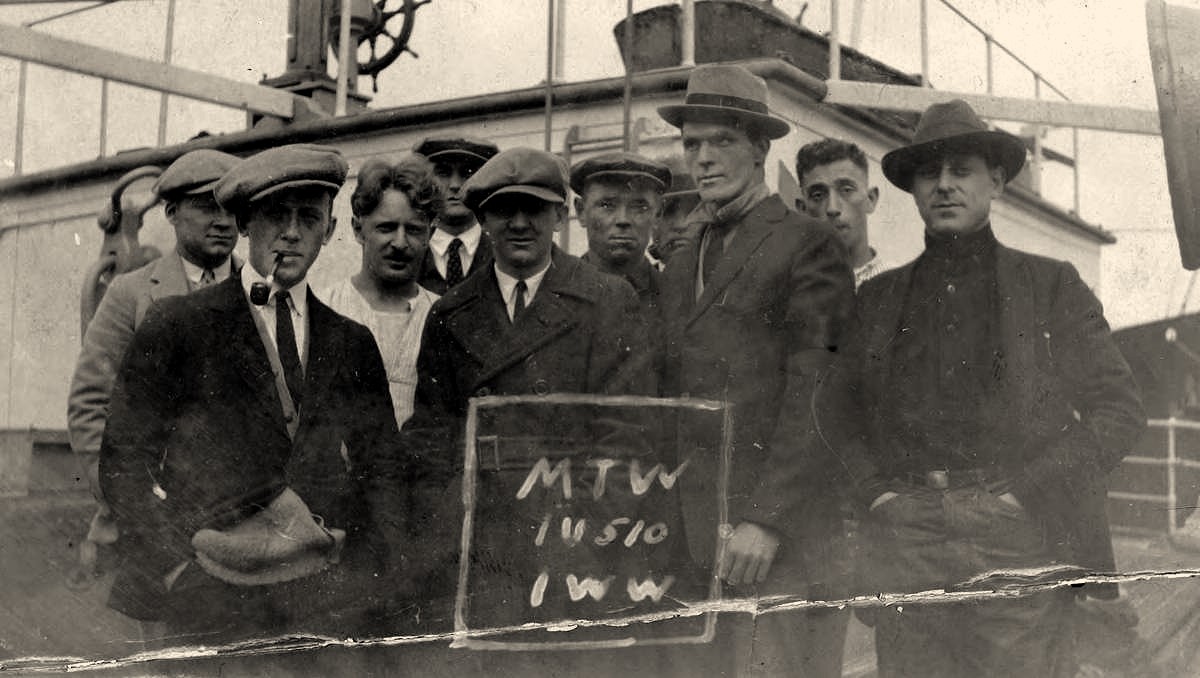
Talking about Seamen’s Homes, here is a brief description of the “hotel” at Rosaria, Argentina, taken from a copy of the “Marine Worker” of Buenos Aires, and written by Julius Muhlberg, late secretary of the Marine Transport Workers’ Union of that city.
“When I went up to take charge I thought it would be a good idea to see how matters stood in the Sailors’ Home and to see how they stood towards the M.T.W. in that institution. So I went up there to spend the night. The room that I was shown into was small, dirty and strewn with scraps of paper. The wall was well illustrated with cobwebs, and the floor seemed as if it had not been washed for six months. There were no sheets, and the pillows were coverless. Under the spring mattress there were pieces of scrap iron to prevent the occupants from going thru on to the floor.
“I was handed one blanket from the store. No more than one. On the other stretcher, on my return, I saw a naked negro sleeping…In a little while the candle flickered out, and I was left in darkness to spend a sleepless night. Next morning I was up at dawn. After a long wait I was given breakfast at 7:30. I found that I had eight companions, four white and four colored. The coffee was only half sweetened and the milk in it was sour. The bread was hard, dry and unpalatable.”
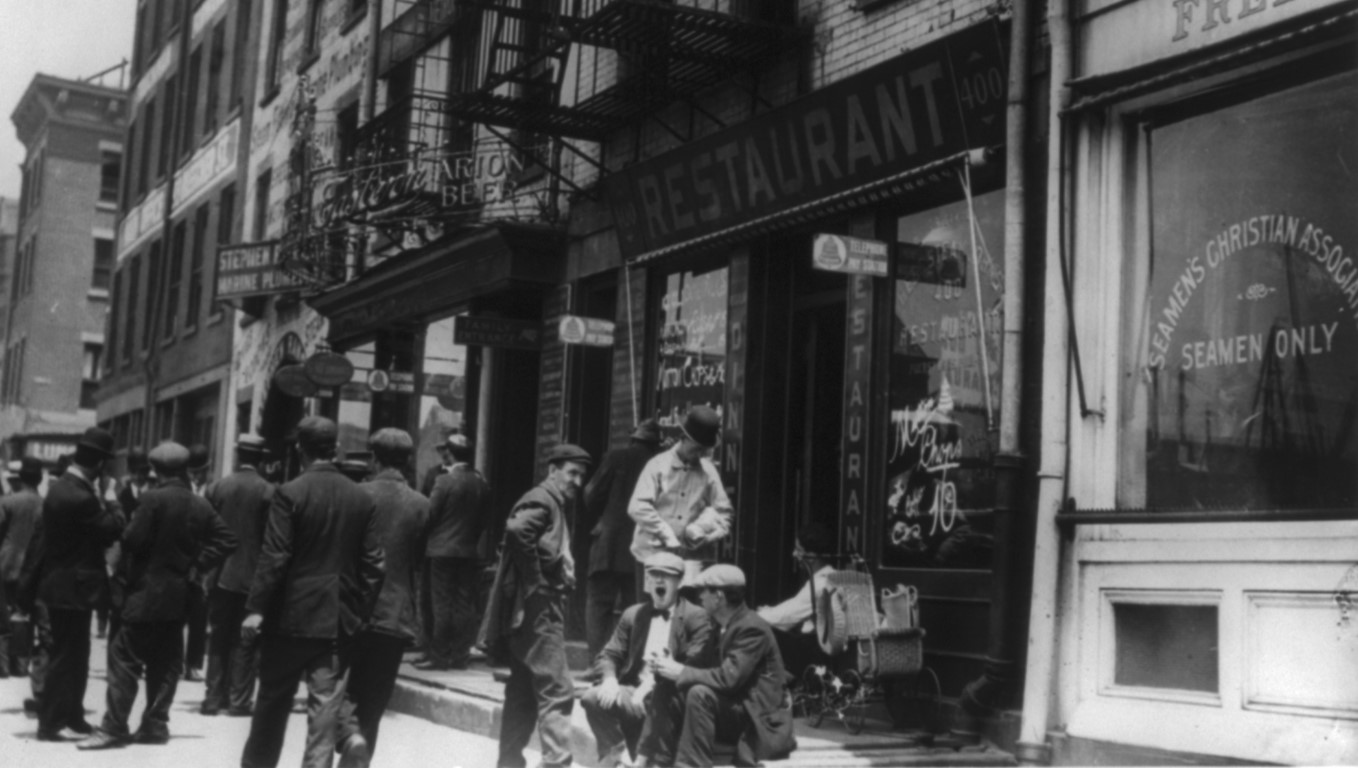
In most of these institutions over-seas, the men are rooted out of bed early in the morning and the bed rooms locked until night time. The boarder must be in early, or be locked out for the night. They are conducted like jails, and are about as popular among seamen as the latter place. I have met large numbers of marine workers who would sooner spend their night in box-cars, railway-wagons, or on a park seat than in these dumps, supplied by the God-fearing ship-owners for their jobless and homeless slaves. Even the message of the Lord Jesus Christ fails to gild the pill. The food is shoddy and scanty, the cooking execrable, and the atmosphere depressing.
The Glorious Liberty of the Seaman.
Personal liberty among marine workers is almost non-existent. Scandinavian ships are the best in that regard towards their crews, and will usually pay off their men anywhere, altho not always. The Scandinavian consuls do not generally place obstacles in the way. American seamen are supposed to wallow in freedom and luxuriate in liberty since the passing by Congress of the famous “Seamen’s Bill,” which was pioneered by Andrew Furuseth and Senator La Follette. It may confer a considerable measure of freedom on the seaman in his home ports, but when he gets to other parts of the world he has less freedom than a Greek. Whether this fact is due to the U.S. authorities, I cannot say. I have seen American skippers anxious to pay off some of their men, and the men anxious to leave, but the consul would invariably refuse their applications, altho there were plenty men ready to fill their places. The seaman is still a chattel, and all the bills in all the parliaments will not affect his position until he has POWER on his side.
The Seaman and the Consul.
The British seamen, and the seamen on British ships, God help ’em, are even worse off. Under the exigencies of hunger they are compelled to sign articles sometimes running into years. They cannot leave a ship until their articles expire, without forfeiting their wages, and risking a long term of imprisonment. The British shipping interests have seen to it that colonial and foreign authorities will seize their deserters and jail them. The ordinary liberty that the average shore worker enjoys of leaving his job when he likes and getting paid up to the last cent does not apply to the seaman. For the least infringement of innumerable petty-fogging rules he can be penalized by the captain. His word counts for nothing before a court, or a consul. The marine worker sailing in the most powerful merchant navy in the world cannot claim the inviolability of his wages, like the worker ashore. The hand of the world and of authority is against him. Advantage is taken of his ignorance of languages in foreign ports, and he is arrested upon the flimsiest excuses. Isolated by his calling from the mass of his fellows, brutalized by rough work, he has never had an opportunity of thoroly organizing himself in order to win respect and justice.
With regard to consuls, I find from an extensive experience that they do not care a damn about their fellow countrymen who earn a living on ships. Judged from the seamen’s standpoint, they are, in the mass, a collection of insufferable, supercilious nincompoops. A decent consul is as rare as an honest politician. To their narrow, middle class vision, it is the right thing to cringe before their economic superiors and to browbeat their supposed inferiors. And it is significant that the bigger and more powerful the country, the more contempt has the official for the workers whose misfortunes take them into his office. I have seen them in Buenos Aires deliberately keep a seaman on the beach by refusing to give him a passport, without which he could not get a ship. If you venture into their offices they bawl, “Take off yer hat,” and from thence on you are doomed. They hate unions, and conspire against officials of the unions in foreign ports, and are not above making false accusations and complaints in order to cover their own malpractices. There are exceptions, it is true, but they are confined to the smaller nations.
Hindoos, Chinese and other colored workers are maltreated even worse than their white fellow workers. Vile cases have been hushed up by consular officials, One thing is undeniable, and that is that consular offices exist for the benefit of the commercial interest of the ruling classes of different countries, and NOT in order to see justice done to the working classes of those countries. And I know whereof I write.
In Over-seas Ports.
In a foreign port the marine worker has no friends. Thieving sharks lay in wait for him, his drinks are drugged, he is fair game for the local police, and is at the mercy of everyone else. The immigration officer takes a dislike to the shape of his head or the color of his hair, and he is refused a permit to go ashore. There was a time–before the war–when the merchant seaman, by the nature of his calling, could travel the world over without either passport or identification paper. Today, however, he is examined at every port, and even his dunnage is overhauled and searched by the zealous authorities. He is shipped on boats that carry wheat and no shifting boards, boats which turn turtle at sea, simply because the owners are too mean to pay the cost of the boards.
All these abuses are eloquent examples of what the seamen’s unions have Not done, and of what the International Transport Workers Federation has NOT accomplished, nor made an attempt to accomplish. But before going into the various forms of the existing disorganization which prevails in each country, I will devote a chapter to the gentle art of “shanghaiing,” which I am able to discuss with some authority.
The Industrial Pioneer was published monthly in Chicago by the Industrial Workers of the World from 1921 to 1926. The precursor of the Industrial Pioneer was the One Big Union Monthly. Heavily illustrated, the journal included arts, prose, and poetry along with historical articles and analysis. Editors included John A. Gahan, Vern Smith, H. Van Dorn, and Justus Ebert.
Full issue PDF: https://www.marxists.org/history/usa/pubs/industrial-pioneer/Industrial%20Pioneer%20(February%201921).pdf
 Revolution's Newsstand