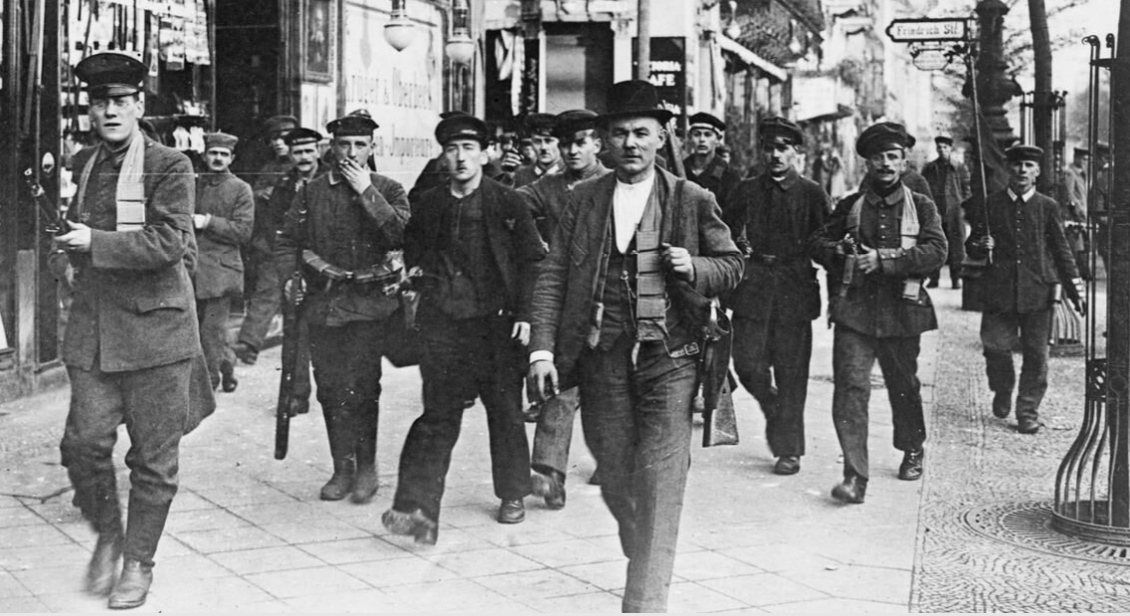
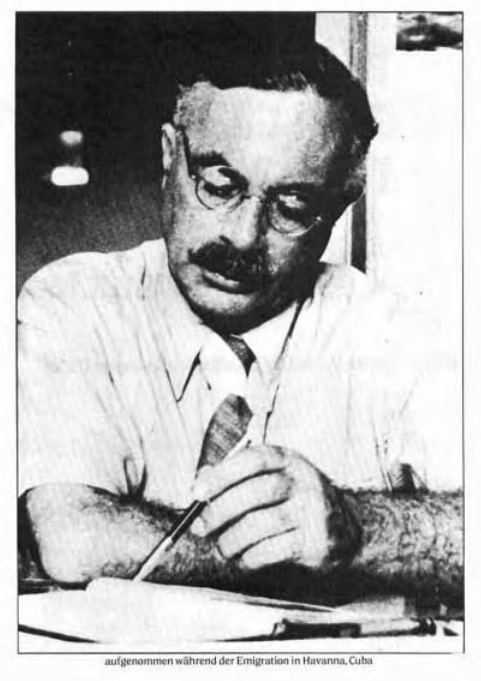
The veteran German Marxist looks back on the two revolutions a decade later.
‘The Russian Revolution of February 1917 and the German Revolution of November 1918’ by August Thalheimer from International Press Correspondence. Vol. 7 No. 18. March 10, 1927.
The tenth anniversary of the Russian revolution of February 1917 very naturally suggests a comparison with the German revolution in the November of the following year. How was it that the former could lead in eight months to the defeat of the bourgeoisie by the working class, and by the peasantry which was allied with it and under its leadership, and to the establishment of the Soviet Government, while the latter after no more than two months (in January 1919) already began to regress and finally ended in the bourgeois Republic and the maintenance of the capitalist Order? This question very naturally arises in the mind of the German worker and especially of the German Communist, all the more so at a time when the bourgeois Republic represents the domination of the big capitalist monopolies, the predominance of the steel trust, the chemical trust, the big banks, etc.
We propose here to go briefly into this question from the standpoint of the experiences and tasks of the German working class. It is quite obvious that in November 1918 the German working class had no less power in their hands than the Russian workers had in February 1917; indeed, they had more. For not only were they numerically far stronger; they were also far better organised. When, on November 9th, the army made common cause with the working class, the German bourgeoisie was absolutely powerless and defenceless. If, instead of gaining the victory, the German proletariat was defeated, the reason must in the first place lie in the proletariat itself. The German proletariat itself abandoned the power it held; it itself assisted in restoring the bourgeoisie to power.
These are facts. But how was such a thing possible at all? The instrument for the restoration of the bourgeois rule was, as is known, the Social Democratic and trade union leadership. That, too, is an indubitable fact. These leaders, however, could never have succeeded, if they had not been believed and trusted by a great portion of the workers when they asserted that the victory of the working class lay in the direction they indicated and could far more easily be gained in that way than in the way indicated by the Communists. That this belief was false has been proved by facts. It is, however, of the very greatest importance for the German working class to realise fully in the greatest detail, by what mirages they were led astray, when, instead of gaining the promised land of socialism, they found themselves back in the deserts of most concentrated form of capitalism ever known in any country.
The first illusion was the belief that only a bourgeois Republic could ensure peace, whereas a Soviet Republic would lead to renewed warfare, to war with the Western Powers and to civil war in the country. Now, it is certainly just as probable that the capitalist States would have tried by all possible means to persecute a German Soviet Republic by one intervention after another, as they actually did in the case of Soviet Russia. Nor is it less probable being quite certain, indeed that the defeated German bourgeoisie would have followed the example of the Russian bourgeoisie in combining with the French, British, and other capitalists against the workers of Germany, that they would have moved heaven and earth to gain their ends, and would have continued the outer and inner warfare to the utmost limit of their strength.
Undoubtedly therefore, a German Soviet Republic would have had (and will have) no easy time of it in the first few years of its existence. But what actual results have the German workers gained by allowing themselves to be persuaded to shirking this life-and-death struggle for their own emancipation? A world at peace? The laying of the war spectre forever? Precisely the contrary. The armaments of the capitalist States are incomparably greater at present than they were either at the beginning or at the close of the world war. The competitive struggle between the capitalists of the individual countries has been aggravated rather than modified. No seriously thinking person can fail to recognise today, that the capitalist world is again steering towards an imperialist world slaughter, which means that untold millions of proletarians are again to be sacrificed for capitalist interests in a war which would entail many times more victims than those of any civil or revolutionary war.
This is one result of the fact that the German workers permitted themselves in 1918 to be scared into abandoning a “fight to the finish” for their emancipation. That which they wished to prevent by avoiding civil and external war, now threatens them on a far larger scale in the form of another capitalist war.
The second great illusion was the expectation that the Entente would relieve and succor the starving and exhausted people, whereas a Soviet Republic would allegedly mean further hunger and devastation. Certainly, however willing the working population of Soviet Russia was to extend brotherly assistance to the German workers, a proletarian revolution would necessarily have entailed certain sacrifices and caused some hunger and devastation. But how is it now, if the German working class stop to consider their condition? Have they not suffered hunger, misery, and devastation throughout these eight years, are there not two millions of unemployed in the streets, have not the capitalists forged the workers’ fetters more firmly than ever?
A German Soviet Republic would today undoubtedly be in the midst of a vigorous evolution, while by means of its highly developed technic it could have accelerated the rise of Soviet Russia as well.
The third great illusion was the hope that Socialism might be reached step by step in a peaceful and democratic way. “Socialism is on the Advance”, men like Ebert and Scheidemann announced on countless posters when they were engaged in perpetrating the fraud of the Socialisation Commission and at the same time let loose Noske and the Whites on those workers who refused to be deceived by this swindle and who knew that there cannot be any question of socialism until the capitalists are struck down, their political power completely destroyed and the revolutionary power of the working classes established as the leader and ally of all working elements.
The smooth, peaceful, democratic path recommended by Ebert and Scheidemann did not serve for the advance of Socialism but for the progress of concentrated capitalism. And most of the small concessions made by the capitalists in 1918 and 1919 in factory and social legislation, to prevent the workers from a general assault, have in the meantime been taken back.
By these three illusions the German workers of 1918 and 1919 allowed themselves to be deceived, and thus it was that the German revolution in November 1918 took such a completely different course from that of the Russian revolution of February 1917. But experience exists for us to learn by, especially when it is an experience we have to suffer to our own cost.
The Russians, too, have learnt by experience. Prior to 1917 there was 1905, the year of the first Russian revolution, which also ended with a defeat of the workers. The more the German workers profit by the lesson taught them in the 1918/19 period, the sooner we shall see the day, when they advance beyond the bourgeois to the proletarian revolution, the day which makes their victory lasting and complete.
International Press Correspondence, widely known as”Inprecor” was published by the Executive Committee of the Communist International (ECCI) regularly in German and English, occasionally in many other languages, beginning in 1921 and lasting in English until 1938. Inprecor’s role was to supply translated articles to the English-speaking press of the International from the Comintern’s different sections, as well as news and statements from the ECCI. Many ‘Daily Worker’ and ‘Communist’ articles originated in Inprecor, and it also published articles by American comrades for use in other countries. It was published at least weekly, and often thrice weekly.
PDF of full issue: https://www.marxists.org/history/international/comintern/inprecor/1927/v07n18-mar-10-1927-inprecor-op.pdf
 Revolution's Newsstand