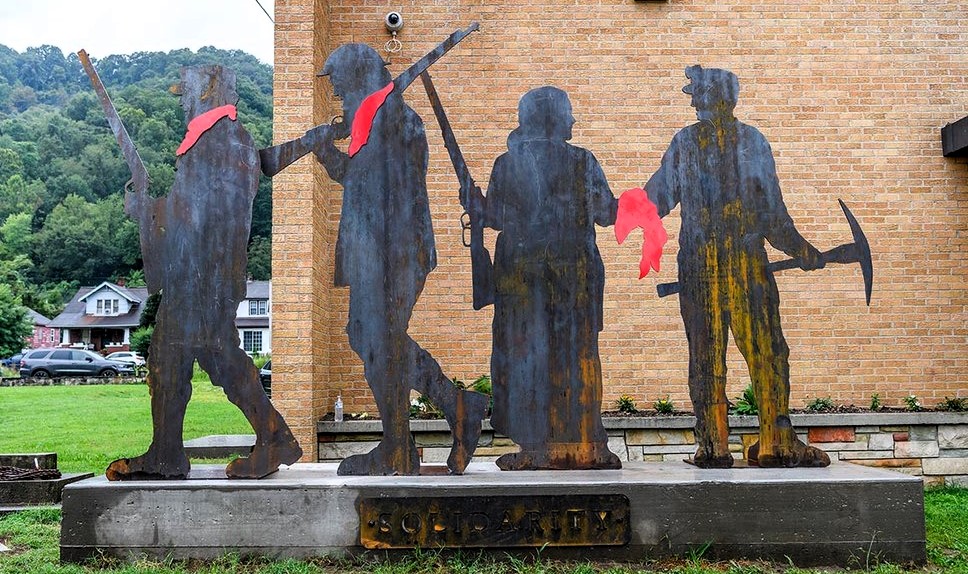
Art Shields reports from what is now known as the Battle of Blair Mountain, gathering evidence of the air attacks against striking mining communities. While the U.S. Air Force was present during the fight, it was planes flown by the coal operators that machine-gunned miners and dropped gas and bombs on their villages.
‘Thug Government Uses Gas and Bombs’ by Art Shields from Truth (Duluth). Vol. 4 No. 37. September 16, 1921.
(Federated Press Correspondent) Clifton, Boone County, W. Va. The newspapers of Guyan and Kanawha valleys have a becoming modesty about their communities. They lack that blatant small town self-assertion–that exaggerated civic pride–which is always shouting to the world what the town is doing or rather what its leading citizens are doing. One and all these newspapers are soft-pedaling the interesting and characteristic exploits of their great and noble.
Take, for instance, their sublime silence about these airplane raids on women and children that continued for three days–this bombing and gassing of mining villages behind the lines. A brilliant achievement for the lords of Guyan, and yet unhonored unsung by their minstrels.
If one did not understand the newspapers’ keen appreciation of the modesty of Don Chafin and the great financial interests behind him, one would think the newspapers world was coming to an end when the same papers that played up in seven column headlines the kaiser’s bombing of non-combatants in distant Europe have nothing to say when the same thing is pulled off right at our back door in the little Coal River valley.
But so it is, and that is why, when labor wishes to indulge its unhallowed curiosity about what is: going on in the warfare against itself it has to turn to its own newspapers.

Now, to get back to the air raids: I spent the morning and afternoon listening to dozens of men and women who saw the bombs dropping on the town in the little Coal River valley, or were under fire from the aviators’ machine guns. The testimony of these people cannot be drowned by the chorus of denials that will issue from the Logan county authorities when and investigation starts, any more than the bombs now in possession of the United Mine Workers and the United States soldiers can be dissolved into nothingness. Miners and their wives, physician, preacher, justice of the peace and merchants, all saw the mechanical hawks swooping over the mountainside that walls off Chafin’s land, and were witnesses of the loosing of the infernal apparatus and of the machine gun fire on the village.
I talked to housewife of Jeffrey, Mrs. Dula Chambers, wife of the village blacksmith. Her head was splitting with sharp pains and her nose bled intermittently from a gas bomb attack Saturday on the Red Cross automobile in which she was hastening to the school house used as a field hospital several miles up Hewitt Creek from Jeffrey.
“But did the aviator know it was a hospital wagon?” I asked.
“He couldn’t help knowing,” said Mrs. Chambers; “it was covered with brilliant Red Cross markings on sides and top that shone in the sunshine for a mile.”
Mrs. Chambers’ story was corroborated by another nurse and by a half dozen miners and by a physician who treated her and who will testify at any investigation that may be called. She was proceeding along Hewitt Creek with Mrs. Bertie Currans, a trained nurse, who had come as a volunteer) from Russel, Ky., to aid the wounded. Suddenly, said Mrs. Chambers, there was a whirring afar in the heavens, and a little later a crash as a glass bottle struck the ground. Greenish, sickening fumes rose about them and Mrs. Chambers reeled dizzily. Her experienced companion got a cloth over her own nose and that of her fellow nurse, and the chauffeur, holding his breath, raced out of the poisoned atmosphere. Later on the fragments of the bottle and the chlorine-soaked stopper were picked up. Two of these stoppers are in the possession of the miners and have been analyzed and evidence of deadly chlorine was discovered. Several other persons were affected by other gas bombs, but none seriously.
Both gas and explosive bombs were used at this part of the front, where the hospital was located. One struck the ground near the old Ferrall home, which had been made into a dressing room, near the hospital. It failed to explode. Another tore a hole thirty feet wide in the earth a mile away. But nearly all of the bombs were hurled from one-quarter of a mile to three miles behind the lines.

Mrs. Myrtle Hainor, a pretty young woman of Jeffrey, was one of many who described the severest raid, the one made Friday, September 2. She was standing just outside the Eagle Hall, where two hundred miners back from the front lines for a rest, were eating. She was in the act of hustling out roasting ears for the men when the airplane shot into view from the other side of the mountain that runs down close to the village.
“There it goes!” someone shouted as the bomb was loosed almost directly over the mess hall, as it seemed. But the devil-cylinder missed its mark and buried itself in the hillside, 200 yards away across Hewitt Creek, without exploding. Another fell with just as little result an additional evidence of the bad marksmanship of Chafin’s aviators and the lack of technical skill of the bomb makers. Before the aviator left he sent down a volley of machine gun bullets that hit no one.
It was all over so quickly, said Mrs. Hainor, that the food hadn’t time to get cold on the mess tables. Mrs. Hainor was one of the women. in charge of the Jeffrey mess arrangements, and was full of justifiable pride of the good food served to the boys.
“And those Logan county folks saying we were just feeding them bread and beans,” she protested, describing the variety and abundance of food that they served.
Only small detachments were fed there, however, most of the meals going hot to the front. The food came in by the ton from all parts of the countryside of several countless, in large automobile trucks. Nearly all of it was donated by the plain country people of West Virginia, who are heart and soul with the miners, as well they may be, for nearly all of them, farmers included, do their stint in the mines at some time of the year, and they regard this fight as their fight.
As Mrs. Hainor was talking my eye wandered over the numerous religious prints and “God Bless Our Home,” etc., which covered her walls. I found the same devotional atmosphere in some other houses that I visited, and in the whole village of several hundred folks there is not a single dance hall, nor are moving pictures ever exhibited. An old-fashioned religious faith radiates out over the town and the Methodist church on the high hill to the right, overlooking the village, is as representative as it is prominent. I have heard some refugees from Logan county speak bitterly of a preacher who, they claimed, worked hand in hand with Don Chafin, but here in Jeffrey the church is almost “working-class conscious.” Rev. Shorden, the pastor, is thoroughly in sympathy with the union views of his flock and he used to be a union man himself.
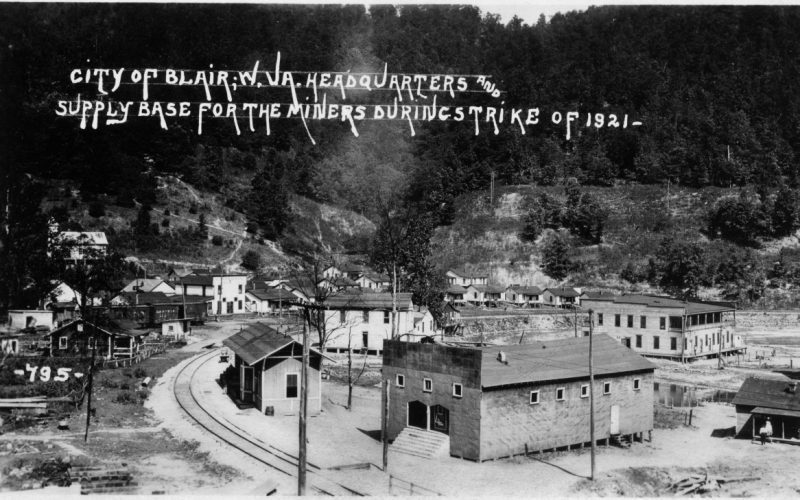
I had also heard much about a Logan county justice of the peace named Mitchell who was captured by the miners near a machine gun nest in the mountain. But In Jeffrey there is a different kind of a Judge. Moses Atkins, justice of the peace of Washington District, Boone county, was emphatic in his expressions against the air raids which he had witnessed, and said that an investigation will be forced. “This is the greatest outrage ever perpetrated against a law-abiding people,” he declared. “The people of this community are the best behaved people in the United States. If they have finally joined their fellow miners and taken up arms against this thug system it was because they insist on the American rights guaranteed by law.”
The soldiers near whom a bomb fell Saturday morning have reported the matter to their superiors and are demanding action. Their one regret, say the rank and file of the soldiers to the villagers, is that they did not bag the bomb thrower.
Dozens of persons told me their stories, and most of them gave full permission to use their names as much as was useful, but others told me frankly that they did not want their names in the papers unless there was no other way to give authentication to certain necessary details.
“It isn’t that we are afraid,” said an old man, “we’ll face those thugs any time man to man as we have been doing all last week, but we don’t relish the idea of being shot in the back. Some of us have to go to Logan county to pay our taxes.”
Such a remark astonishes no one who has been in this West Virginia atmosphere for a few days. There are too many well verified stories of the cold-blooded murders committed by Don Chafin’s crew without interference from the state government.
For from opposing Chafin, Governor Morgan is abetting him. State troopers fought side by side with the Baldwin-Feltz thugs and now Governor Morgan, in a fulminating statement, threatens murder prosecutions against miners from the front. At the same time he apparently regards the atrocious air raids on non-combatants as mere incidents of warfare.
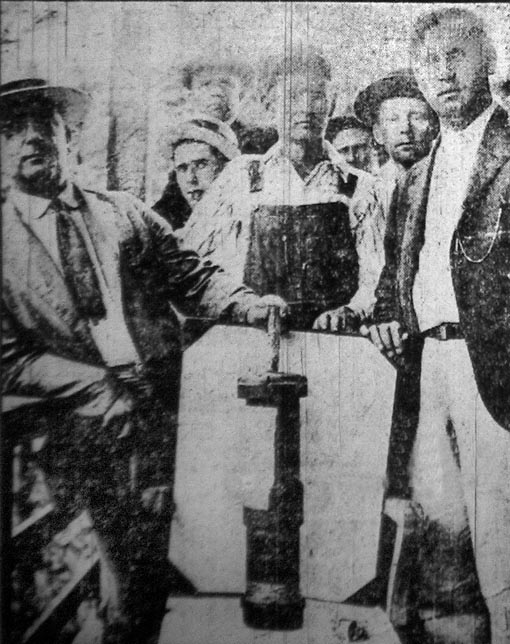
William Marry, international vice-president of the United Mine Workers, and William Petry, vice-president and acting chief of District 17, are unconcerned by the governor’s threats. They say that the United Mine Workers can prove that it co-operated to the fullest extent with the United States troops and that their organization is unalterably opposed to crime, especially such as is represented by the murderous Baldwin-Feltz men.
The attitude of the rank and file of the miners toward Morgan was typified by the utterance of a coal digger in the headquarters of District 17 in Charleston:
“Don’t blame Morgan!” said this man. “He’s loyal to his own people.”
Then, tilting up the end of the airplane bomb on exhibition there, he said:
“This is what a lot of folks voted for. This represents the government of West Virginia–bombs!”
Truth emerged from the The Duluth Labor Leader, a weekly English language publication of the Scandinavian local of the Socialist Party in Duluth, Minnesota and began on May Day, 1917 as a Left Wing alternative to the Duluth Labor World. The paper was aligned to both the SP and the I.W.W. leading to the paper being closed down in the first big anti-I.W.W. raids in September, 1917. The paper was reborn as Truth, with the Duluth Scandinavian Socialists joining the Communist Labor Party of America in 1919. Shortly after the editor, Jack Carney, was arrested and convicted of espionage in 1920. Truth continued to publish with a new editor J.O. Bentall until 1923 as an unofficial paper of the C.P.
Access to full paper: https://www.mnhs.org/newspapers/lccn/sn89081142/1921-09-16/ed-1/seq-2
 Revolution's Newsstand