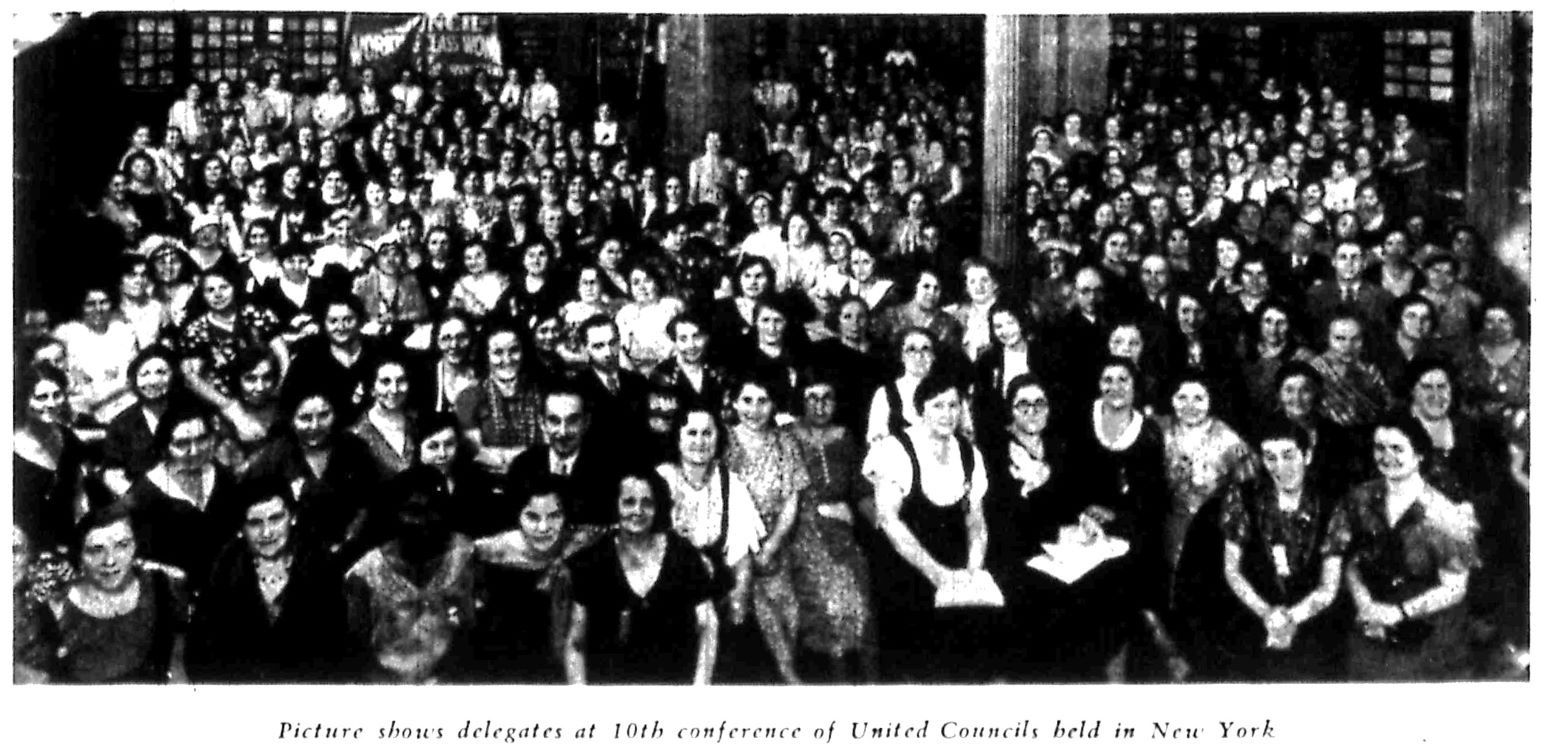
The U.S. Communist movement in its first decades had very few women-specific ‘mass organizations.’ The most successful project was the United Councils of Working Class Women (renamed Progressive Women’s Councils with the Popular Front in 1935) founded in 1923 under the leadership of Kate Gitlow. Reborn in 1929 with the leadership of Clara Lemlich and Rose Nelson, the councils grew significantly in the early years of the Great Depression. Here is a report on its tenth conference in 1933.
‘Conference of the United Councils of Working-Class Women Plans Struggle’ by Clara Bodian from Working Woman. Vol. 4 No. 4. June, 1933.
On Sunday, May 14, the tenth annual conference of the United Councils of Working-Class Women was held in New York City. Secretary Clara Bodian gave the report for the Central for the Central Executive Committee on the activities of the sixty-one Councils in the past year, the achievements, shortcomings, and a plan for future activity.
The conference was attended by 159 delegates representing 59 Women’s Councils. The Workers’ School, Bakers’ Union, Morning Freiheit and the Working Woman also sent fraternal delegates. Comrade Anna Damon greeted the conference in the name of the Communist Party, District No. 2, and for the Working Woman.
The conference was full of fine spirit and lasted all day. In the evening there was a banquet which was attended by over 600 people. An interesting program was presented and a number of speeches made. One of the outstanding speakers was Mother Bloor who made splendid and inspiring speech to the younger generation.
This year the conference had many new elements, young American women and Negro delegates representing the new Councils recently organized. There were also among the delegates representatives from Councils in Jersey and Connecticut.
The report showed that the various Councils have been doing splendid work, particularly in the field of unemployed struggles, working hand in hand with the Unemployed Councils and Block Committees. They had They had participated and militantly fought for increases in welfare at the home relief bureau; in many sections led rent strikes, and mobilized the women in the neighborhood for active participation on the picket line which resulted in the lowering of rents. During the year 1932 numerous struggles against the high cost of living (the cost of bread and meat) were led by the Councils.
It was further reported that the Councils had taken part in numerous strikes that have taken place in various sections of the city. Particularly active were they in mobilizing the women for participation on picket lines for shoe workers, cigar workers, furniture and laundry workers, etc. They also collected food to help feed the strikers and their families, held many open air meetings, in support of the strikes, and so on.
In the campaigns that were carried on for the defense of the Scottsboro boys, the Councils have done good work in making known to the women in their neighborhoods the nature of the case and arousing the women to fight against the Jim-Crow lynch system of the United States.
It was brought out that the financial support given by the Councils to the struggles carried on by the workers in the past year amounted to $11,000. In addition over $1600 was raised for the Daily Worker; $1900 for the Freiheit, $961 for the International Labor Defense, and over $1200 for the Workers International Relief.
The discussion which followed the report was very interesting and brought out the need of furthering the organization, especially in the poorer sections, among the Negro and American workers. The problem of increasing the sale and distribution of the Working Woman was discussed at length. Many good recommendations were brought forward, especially that of using the magazine as a way of approaching English speaking working-class women.
Some of the delegates pointed out that it is difficult to bring Negro women into the Councils. Comrades Perkins and Jordan, representing Councils that have Negro women in them, took the floor and pointed out that’ the method of approach which the present Councils used towards the Negro women must be changed. We must be more patient and persistent in organizing Negro workers for they have been fooled so many times that they are now suspicious until we prove our sincerity to them, but that once we convince them they make the most militant fighters for the cause of the working class.
After the discussion resolutions were proposed and adopted dealing with the struggle against fascism in Germany, against military training, enforced labor camps, for the defense of the Soviet Union, demanding the immediate release of Edith Berkman, Tom Mooney, the Scottsboro boys. A special resolution was passed pledging to help raise funds, get subscriptions and send in correspondence to the Working Woman.
Twenty-five delegates were elected to the Central Executive Committee for the coming years and were charged with the responsibility of putting into action the program adopted at the conference. The delegates were full of determination to carry on the fight against the Roosevelt program of hunger and war.
The Working Woman, ‘A Paper for Working Women, Farm Women, and Working-Class Housewives,’ was first published monthly by the Communist Party USA Central Committee Women’s Department from 1929 to 1935, continuing until 1937. It was the first official English-language paper of a Socialist or Communist Party specifically for women (there had been many independent such papers). At first a newspaper and very much an exponent of ‘Third Period’ politics, it played particular attention to Black women, long invisible in the left press. In addition, the magazine covered home-life, women’s health and women’s history, trade union and unemployment struggles, Party activities, as well poems and short stories. The newspaper became a magazine in 1933, and in late 1935 it was folded into The Woman Today which sought to compete with bourgeois women’s magazines in the Popular Front era. The Woman today published until 1937. During its run editors included Isobel Walker Soule, Elinor Curtis, and Margaret Cowl among others.
PDF of full issue: https://www.marxists.org/history/usa/pubs/wt/v4n04-jun-1933-WW-R7524-R2-col-cov.pdf
 Revolution's Newsstand