Instead of freeing humanity, capital places each new technological advance in the hand of its enemy.
‘Flying Machines Good for Murder’ from The New York Call. Vol. 2 No. 98. April 24, 1909.
Federal Government Will Experiment with Aerial War Craft–Dr. Bell Enthusiastic
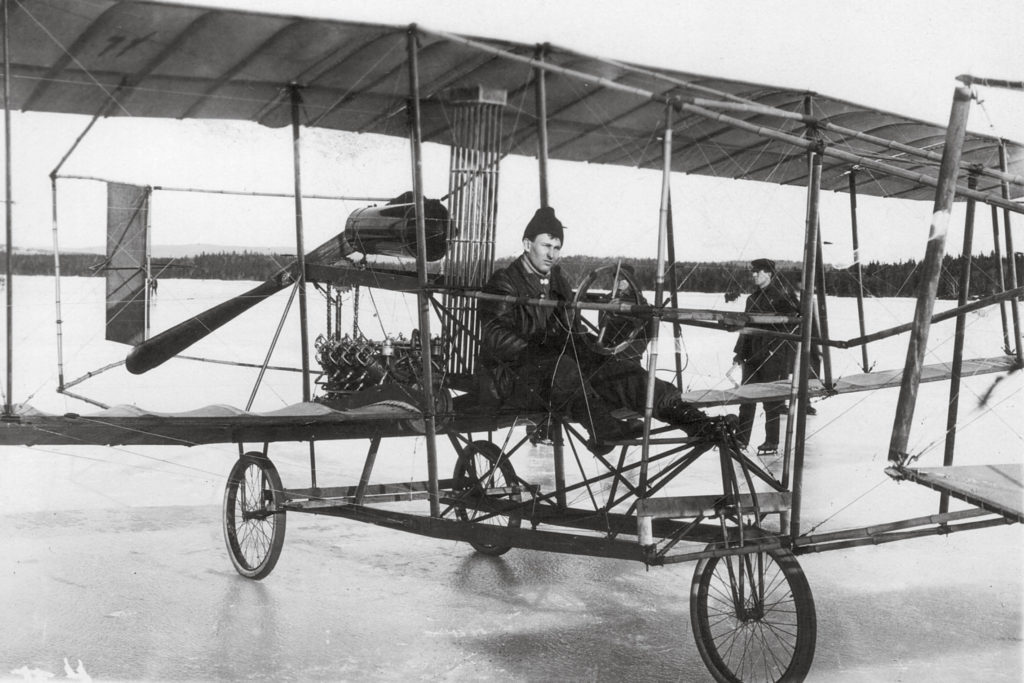
(National Socialist Press Bureau.) WASHINGTON, April 21. Dr. Alexander Graham Bell, the distinguished aeronaut, has just come to this city from Baddeck, Nova Scotia, where he has spent six months in experimenting with heavier-than-air flying machines, in connection with the other members of the Aerial Experiment Association, which has recently been dissolved. He talks most enthusiastically concerning the results attained; though he is not inclined to consider the aerodrome, as he calls what is popularly known as the aeroplane, as the last word in machines in the type mentioned, when from a standpoint of practicability.
War Utility First Consideration.
“The principal of the aerodrome of the type we are now familiar with,” said Dr. Bell, in an interview, “will be as an aid to warfare: It is not generally known, I believe, that when you increase their size you increase their weight at a far greater ratio. As the lifting power increases in proportion only to the increase in size, it can readily be seen that a point would shortly be reached where the machine could not raise itself from the ground. This would seem to be a barrier to a successful use of the aerodrome, as we know it now for the practical purposes of transportation, both of passengers and freight.”
Dr. Bell is still enthusiastic regarding his tetrahedral kite system and announced that he proposed to devote his time to its development. In this system the increase in size. weight and lifting power are equal.
“I see nothing which would prevent the construction of gigantic tetrahedral kites capable of carrying 100 or more men.” said he, “when once I overcome the problem of control and propulsion on which I am working. I was too busy with the association experiments in connection with the flights of the Silver Dart during the past winter to take the time for my kite experiments, but I will resume the experiments this summer. That will be my work from now on.”.
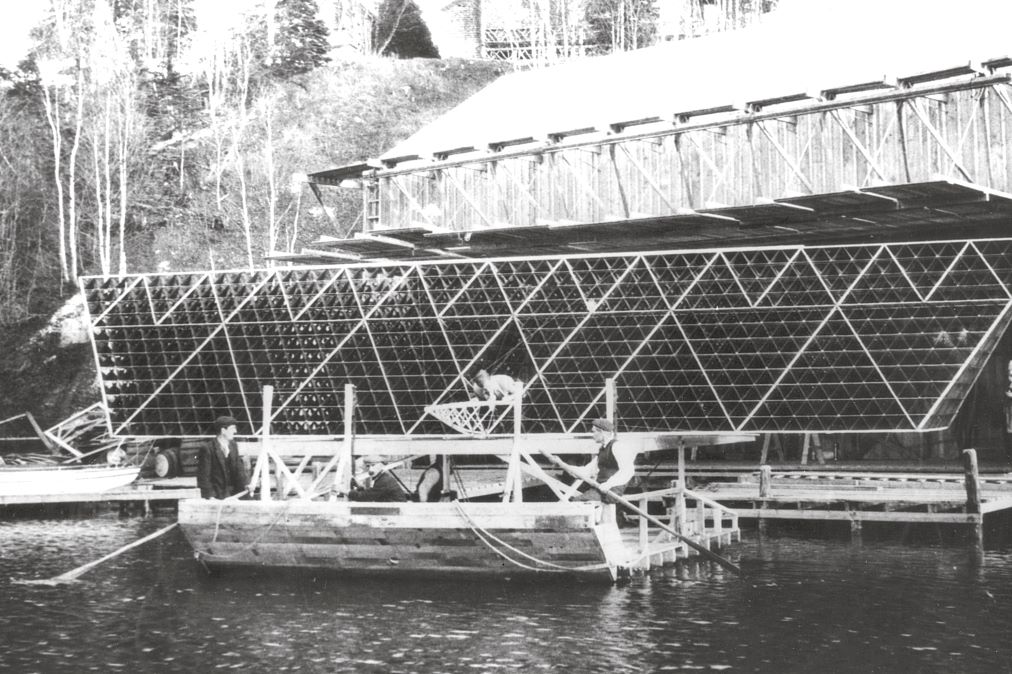
Dr. Bell claims for his tetrahedral kite system that it would seem to insure stability and to render possible the maintenance of a low rate of speed while in the air, which is impossible at the present type of aerodrome or aeroplane.
In discussing the experiments at Baddeck with the Silver Dart, Dr. Bell explained that a mistaken impression had gone abroad concerning the lengths of the flights made by J.A.D. McCurdy. He said that Mr. McCurdy had not made a straightaway flight of twenty miles, as reported. but that he had made two flights of nine and one half miles each, roughly estimated. Four miles of the course followed was straightaway. This has never been approached by the Wright brothers, who, while they have flown for more than seventy miles, have flown at all times within comparatively small circle.
Comparing the Wright machine with the Silver Dart, Dr. Bell said:
Wrights Not Only Ones.
“The Wrights excel as aviators, that Is all. No one can approach them as heavier-than-air machines. I consider the Silver Dart an improvement on their aerodrome for several reasons, The wing surface of their machines are distorted to control the equilibrium. This is a disadvantage. In the Silver Dart the equilibrium is maintained by means of lateral rudders, the operation of which is partly instinctive and partly voluntary, for the ropes controlling them are fastened to the body of the operator, and as he moves his body to readjust the center of gravity they operate the rudders. We think, too. that the Silver Dart is a much more rigid and stronger machine than the Wright machine, and that the operation is much simpler.”
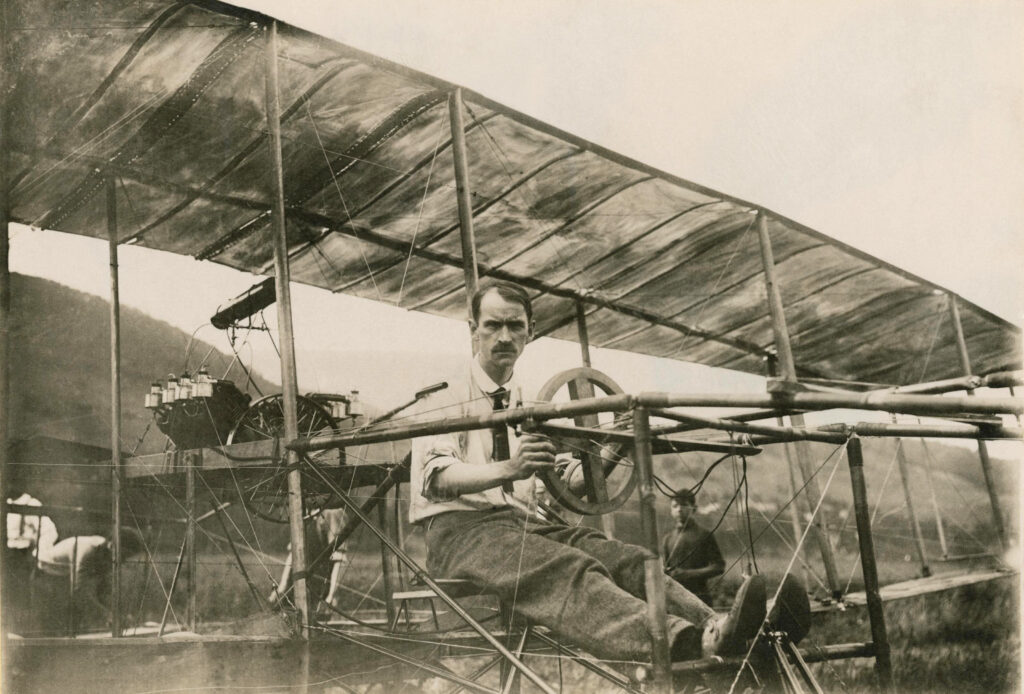
Dr. Bell said that Glenn H. Curtis. one of the five members of the association, proposed to manufacture Aerodromes at Hammondsport. He said that so far as his knowledge went there had been no arrangement entered into between Mr. Curtis and A. M. Herring. whereby the latter was to enter the Silver Dart in tests at Fort Meyer.
“I would have to be consulted about that.” said Dr. Bell, “for I own the Silver Dart. Mr. Herring is interested in a company which has bought out Mr. Curtis’ motor plant. That is all I know about it.”
To Build New Machine.
F.W. Baldwin and J.A.D. McCurdy, who with Dr. Bell and Mr. Curtis comprise the membership of the association, are to remain in Canada, where they will construct a new aerodrome. They will offer this to the Canadian government. If it Is not purchased by that government they will offer it to Great Britain. “The association was dissolved,” said Dr. Bell, “because the purpose for which it was organized was accomplished. Mechanical flight is not now a theory, it is an accomplished fact. It is probable that the invention of a Washington man will be tried for the first time at the tests at Fort Meyer this month. F.L. Rice, who built the Ludlow aeroplane last summer working with F.L. Young, both of this city, has constructed an improved form of propeller for dirigible and heavier-than-air machines. Mr. Rice was at the signal corps offices in the War Department this week making arrangements for the signal corps to use his propeller on the big dirigible.
The Rice-Young propeller is only five feet long, and at both ends instead of the usual finished twist of the ordinary propeller, there are disks set almost at right angles to the blade of the shaft.
It is claimed that this arrangement will give the thrust of the propeller in enormous purchase power on the air and greatly multiply the speed and stability of a dirigible or an aeroplane. It is stated at the War Department that there are to be experiments in runs and projectiles designed to destroy aerial craft at Sandy Hook roving grounds this summer. General Crozier, chief of the ordnance bureau, is having experimental guns made, and has completed the designs for a gun carriage that will enable he cannoneers to fire with safety into the clouds.
The New York Call was the first English-language Socialist daily paper in New York City and the second in the US after the Chicago Daily Socialist. The paper was the center of the Socialist Party and under the influence of Morris Hillquit, Charles Ervin, Julius Gerber, and William Butscher. The paper was opposed to World War One, and, unsurprising given the era’s fluidity, ambivalent on the Russian Revolution even after the expulsion of the SP’s Left Wing. The paper is an invaluable resource for information on the city’s workers movement and history and one of the most important papers in the history of US socialism. The paper ran from 1908 until 1923.
PDF of full issue: https://www.marxists.org/history/usa/pubs/the-new-york-call/1909/090424-newyorkcall-v02n098.pdf
 Revolution's Newsstand