
‘Young Workers and the Passaic Strike’ by Irving Freeman from The Daily Worker. Vol. 3 No. 60. March 23, 1926.
THE strike of the textile workers in Passaic and vicinity has already lasted seven weeks. Fifteen thousand workers, men, women and children, are striking for a living wage, better working conditions and for recognition of the United Front Textile Union.
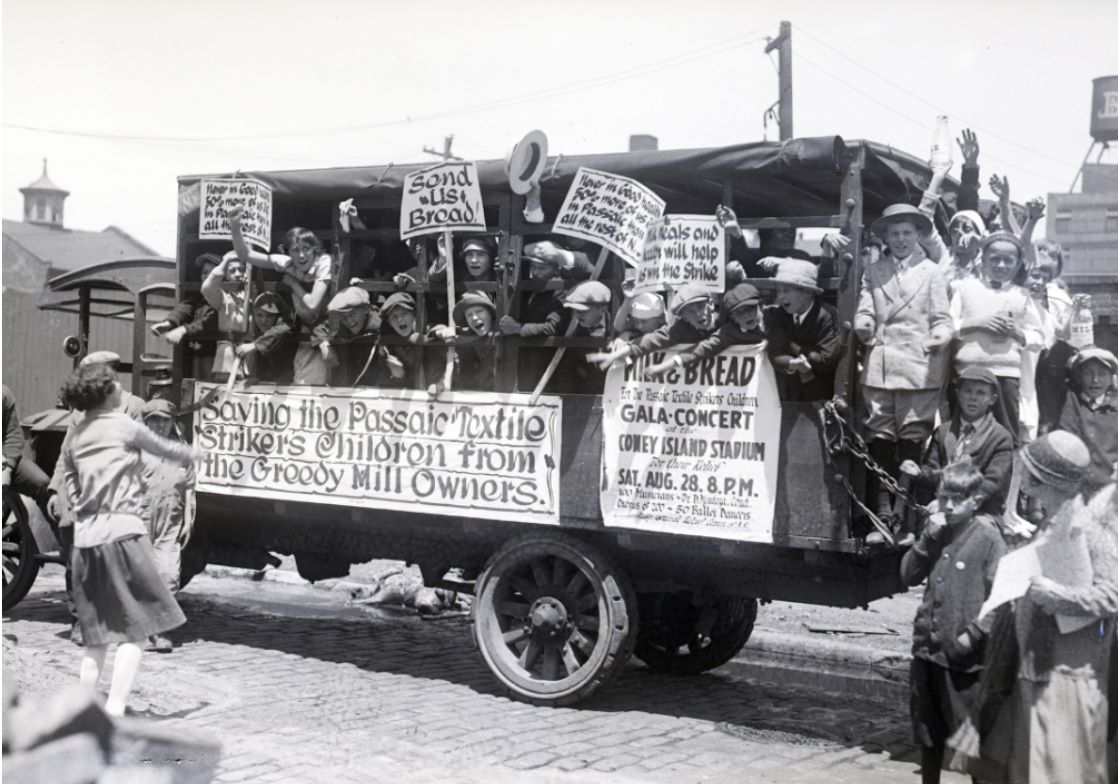
In reviewing the strike there are many features that are noteworthy; mass picketing, absence of violence, singing of the strikers and the presence of large masses of young workers and children. Nobody can help but note the presence of the youth and the predominating part that the young workers are playing in Passaic.
Wherever one goes along the battle-line of the strike, whether it is in the relief office, the stores, the mass meeting or on the picket lines, these young workers who never conducted relief work before, who never dreamed of leading the picket lines and never knew they had the courage and the power to resist every onslaught of the bosses, are always present. It is the young men and women who are the driving force, the power and the spirit that maintains the splendid morals of the strike. The youth in Passaic are the ones leading the picket lines, the ones that are thrown in jail; they are singing and they are beaten up by the police. They are undergoing all the hardships that a strike throws upon the workers. They have no time for recreation–no dance halls, no playhouses, no movies, etc.
War is on between the workers and the bosses. The youth knows it. The strikers want more wages-the bosses more profits. Who will win? If all signs are correct, the strikers will win! They have learned during the past seven weeks that organization is the weapon that will carry them thru to victory. They also know that their children and wives are fighting side by side with them. The strikers know that youth are sacrificing all to win. They are learning who their friends are and who their enemies are.
As a result a splendid solidarity has been created amongst the rank and file of the strikers. Let me emphasize that this solidarity will not be broken by policemen’s clubs, nor by the jails of the cities.

The young workers are on guard. They are present everywhere. They are the life and motive force behind the strike and consequently the strike will be won. Organization, education and solidarity are the lessons the strikers have learned. Thru these roads they will obtain their victory.
“The future belongs to the youth,” is a saying. For further proof visit the war zone in Passaic.
Passaic Strikers March on Lodi Mills Told by Young Textile Striker.
PASSAIC, N.J. March 9th was the day set for the march on the Lodi mills. At the strike meeting it was announced that today we would test our strength. If everyone goes on the picket line we will be successful in pulling out the workers of the United Piece Dye Works of Lodi.
C. Miller, the speaker at one of the meetings, asked if everyone was willing to go on the picket line and march in Lodi. Belmont Hall, where the meeting was being held, just shook with the cries: “Yes.”
All the meetings that day adjourned at 3 o’clock and the strikers formed in columns of two in front of the hall and the march on Lodi was started. The pickets, 6,000 strong, were enthusiastically singing “Solidarity Forever–Hold the Fort” and other workers’ songs. Cheering, they proceeded slowly to the city of Lodi.
The Lodi chief of police met the pickets at the city line and advised the pickets to remove their helmets, as his force is not armed with their “night sticks,” so no violence will occur.
The 6,000 pickets circled the United Piece Dye works a few times and each time around more workers joined the strikers’ ranks.
Having succeeded in pulling out 600 workers, the pickets proceeded on their homeward march enthusiastically singing and cheering, feeling proud that their ranks was made stronger by 600 workers. The next day the task of pulling out the rest of the workers of this dye plant would be undertaken, which would add 4,000 workers to the strikers’ ranks.
The Daily Worker began in 1924 and was published in New York City by the Communist Party US and its predecessor organizations. Among the most long-lasting and important left publications in US history, it had a circulation of 35,000 at its peak. The Daily Worker came from The Ohio Socialist, published by the Left Wing-dominated Socialist Party of Ohio in Cleveland from 1917 to November 1919, when it became became The Toiler, paper of the Communist Labor Party. In December 1921 the above-ground Workers Party of America merged the Toiler with the paper Workers Council to found The Worker, which became The Daily Worker beginning January 13, 1924.
PDF of full issue: https://www.marxists.org/history/usa/pubs/dailyworker/1926/1926-ny/v03-n060-NY-mar-23-1926-DW-LOC.pdf
 Revolution's Newsstand