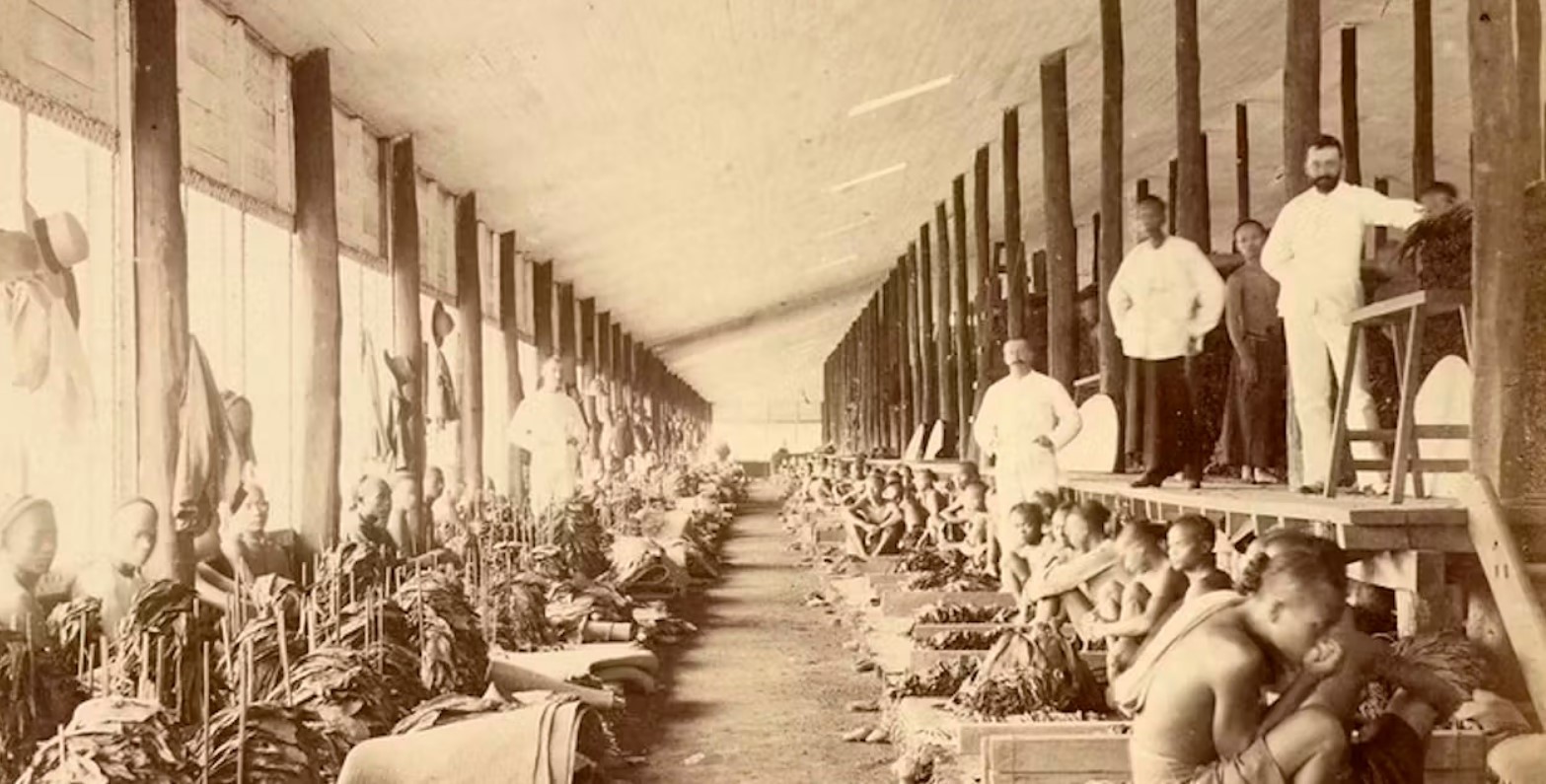
Veteran militant Gerard Vanter on the treatment of political prisoners and on the famine underway in Dutch imperialism’s Indonesian colonies.
‘Dutch Civilization in Indonesia’ by Gerard Vanter from Pan-Pacific Monthly. No. 33. February, 1930.
THE Dutch bourgeois press is regularly publishing the short official reports, that again a new transport of deportees has been conveyed to the concentration camp of Digul in New Guinea. Indonesians who are suspected of Communism are being banished to Digul by the Dutch government. Only once has a bourgeois journalist succeeded in inspecting this camp. He called it a hell, in which the deportees are perishing of malaria, black fever and mental isolation.
But only those who are suspected of Communism are being tortured to death in this way. Very little has been published by the press regarding the sufferings of these thousands of deportees. Recently the “Nieuwe soerabayasche Courant” published a report concerning the prison in Pamekasan, on the isle of Madura, where four European warders have been wounded by a prisoner who had become insane. In this prison there are only Communists; the mood of the prisoners, who are being slowly tortured to death is such that the director of the prison gave instructions that the prison doors be opened only in the presence of two guards with drawn swords. There are 610 prisoners in this prison, 405 of whom have been waging a constant fight ever since they were delivered into prison. They refused to do any work and were cruelly mishandled, of which the Dutch press reported only when it considered it necessary.
The rich islands of Indonesia offer hardly any possibility of livelihood for the native population. The news regarding the famine in the islands of Flores and Madura is appalling. Wolff, a catholic missionary, reports on conditions in Flores. He describes how the population is leaving the villages and going into the jungle in quest of food. But the jungles offer only insufficient food, and, as the population finds only impure water, numerous cases of dysentery are to be observed.
The missionary reports appalling details of the deaths of women and children; he complains that he had not sufficient time to baptize all the dying children. Of the five hundred children whom he baptized, fifty have died already. The official government reports laconically state that in these famine districts “there can be seen everywhere horrifying figures of starving, exhausted and emaciated people,” who died in dozens in the months of September and October.
But the government of the pious Dutch exploiters had not granted a pennyworth of aid. Already in May the facts of the famine were known, but it is only now that rice for seed purposes has been sent into the districts most seriously affected.
At the same time, the Indonesian government granted an additional credit of 350,000 florins for the extension of the police force on the western coast of Sumatra, i.e., for the protection of the Dutch planters living there.
The poverty of the native population of Madura is so great that they live exclusively on wild fruits and the leaves of the Nangka tree. The cattle are dying and the natives are compelled to pawn what little property. they possess. In addition, there are the appalling sanitary conditions. Epidemic diseases are spreading as a result of the permanent malnutrition of the population and claiming a tremendously high percentage of victims. The press of the Dutch exploiters is now paying attention to the bubonic plague, because it threatens to affect also the Dutch. The population of Bandung and Semarang showed great indifference towards this pest; they regard death as a happy release.
Meanwhile, the terror against the Communists and Nationalists is being increased. The cynical murder regime in Indonesia is splendidly illustrated by the following quotation from a big Indonesia daily, the “Nieuws van den Dag voor Nederlandsch Indie.” On the occasion of mutinies of political prisoners the paper wrote:
“MORE AND BETTER SHOOTINGS”
“The prisoners are striking! They conspire, they make attempts to murder the prison guards! The prisoners put forward their demands. We are having a fine time with these riff-raff who are costing the treasury millions every year! If at the time of the revolt more and better shooting had taken place, then we think, the government would now have less difficulties with these good-for-nothings!”
The economic crisis in Indonesia is becoming more acute. The Chairman of the Union of Importers in Batavia reported on a decline of business in the whole of Indonesia. Exports have greatly declined the last year or so, especially the export of tea.
It is obvious that a new revolutionary situation, like that of the year 1926, is approaching. The terror in Indonesia is not a sign of strength on the part of the bloody Dutch rule. The Indonesian revolutionary movement can only temporarily be dammed back by violent measures. Dutch social democracy, which furnishes the best hangmen for Indonesia, declares that the Dutch regime in Indonesia has many good sides and the independence and the right of self-determination of Indonesia is an impossibility.
The approaching revolt of the Indonesian masses will prove that Indonesia is not only ripe to take her fate into her own hands, but is prepared to fight and to win. In the meantime, the Dutch revolutionary workers will do their duty and make it clear to the Dutch workers that the Indonesian revolution will also deal a blow to the rule of the Dutch capitalists over their white slaves in Holland.
The Pan-Pacific Monthly was the official organ of the Pan-Pacific Trade Union Secretariat (PPTUS), a subdivision of the Red International of Labor Unions, or Profitern. Established first in China in May 1927, the PPTUS had to move its offices, and the production of the Monthly to San Francisco after the fall of the Shanghai Commune in 1927. Earl Browder was an early Secretary of tge PPTUS, having been in China during its establishment. Harrison George was the editor of the Monthly. Constituents of the PPTUC included the Australian Council of Trade Unions, the All-China Federation of Trade Unions, the Indonesian Labor Federation, the Japanese Trade Union Council, the National Minority Movement (UK Colonies), the Confédération Générale du Travail Unitaire (French Colonies), the Korean Workers and Peasants Federation, the Philippine Labor Congress, the National Confederation of Farm Laborers and Tenants of the Philippines, the All-Union Central Council of Trade Unions of the Soviet Union, and the Trade Union Educational League of the U.S. With only two international conferences, the second in 1929, the PPTUS never took off as a force capable of coordinating trade union activity in the Pacific Basis, as was its charge. However, despite its short run, the Monthly is an invaluable English-language resource on a crucial period in the Communist movement in the Pacific, the beginnings of the ‘Third Period.’
PDF of full issue: http://fau.digital.flvc.org/islandora/object/fau%3A32146/datastream/OBJ/download/The_Pan-Pacific_Monthly_No__34.pdf
 Revolution's Newsstand