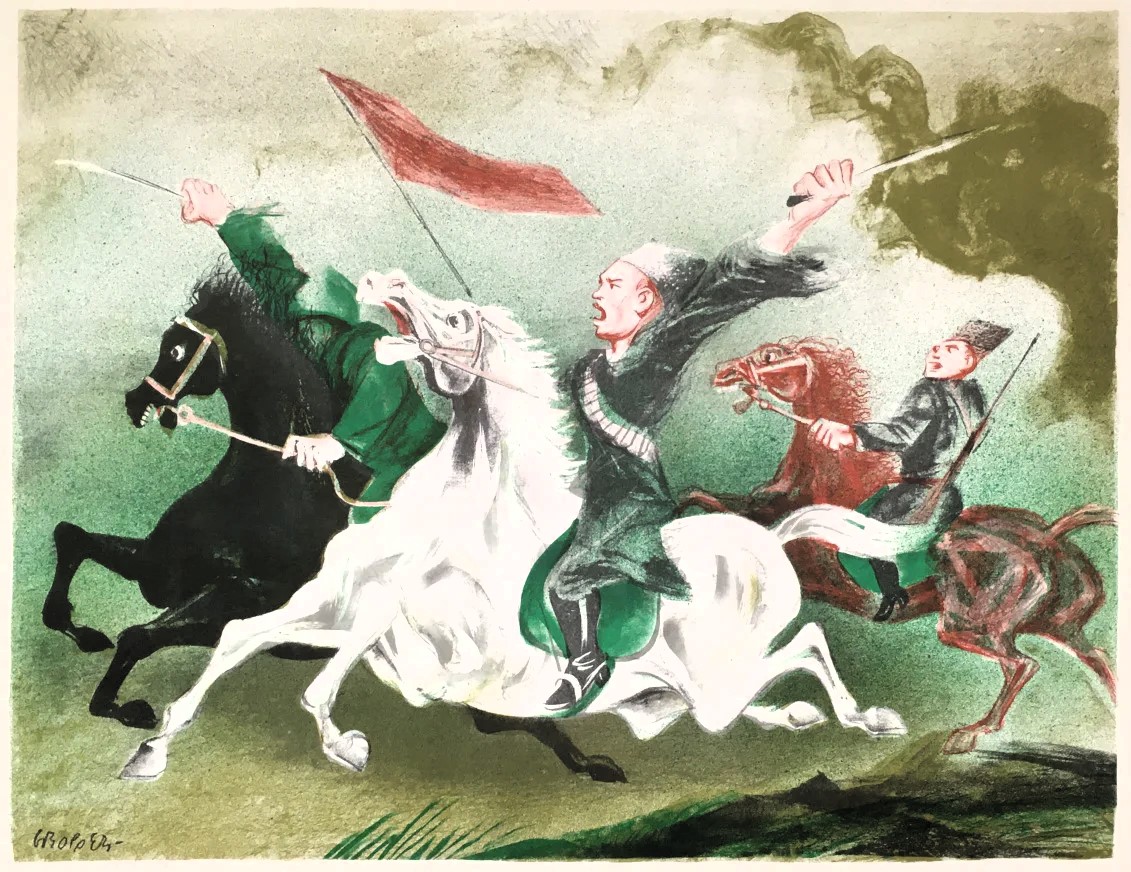
Isaac Babel accompanied the Red Cavalry during the Polish War as a war correspondent, later writing an international popular and acclaimed collected of stories, ‘Red Cavalry.’ ‘The Letter’ taken from this collection has the illiterate cavalry soldier Semyon dictate a letter to Lyutov for his mother on the fortunes of his father and brothers during the Civil War. Babel, among the most celebrated authors of the revolutionary generation, was a victim of the Purges. Arrested in 1938 he was executed on January 27, 1940.
‘The Letter: A Story of the Red Cavalry’ by Isaac Babel from Labor Defender. Vol. 3 No. 11. November 1928.
HERE is a letter home dictated to me by a boy in our division, Kurdiukov by name. It is worth saving from oblivion. I have copied it out without in any way touching it up, and I give it word for word, just as it is.
***
Dear Mama Yevkodia Federovna. In the first lines of my letter I hasten to assure you that, God be thanked, I am alive and well, and I hope to hear the same from you. And also, most humbly I greet you, bowing to earth, and also… (here follows a list of relatives, god-parents, kinsmen, etc. Let us omit this and go on to the next paragraph).
Dear Mama Yevkodia Federovna Kurdiukova. I hasten to write to you that I am in Comrade Budenny’s Red Cavalry, and there’s also your kinsman here, Nikon Vasilyitch, who is a Red Hero now. He took me along with him in the Politdept Division, and we go around the lines handing out literature and newspapers-the Moscow Izvestia, CEC, the Moscow Pravda, and our own hard-boiled paper, the Red Cavalryman, which every front line fighter wants to read, and then he’ll go out and hack down the rotten aristocrats like a hero, and it’s a great life here with Nikon Vasilyitch.
Dear Mama Yevkodia Federovna. Do try hard and send everything you can. I beg you to slaughter the spotted pig and make me a parcel and send it to the Politdept of Comrade Budenny, recipient Vasily Kurdiukov. Every night I lie down to sleep and I haven’t had anything to eat and there’s no cover on me at all, when it’s terribly cold, too. Write me a letter about Styepa, is he alive or isn’t he, I beg of you, see to him, and write me about him–does he rear up when they try to harness him still, or has he stopped it, and also, because of that scab on his forelegs, did they shoe him or didn’t they? I beg of you, dear Mama Yevkodia Federovna, do please wash his forelegs with the soap I left back of the ikon, and if papa has used up all the soap buy some in Krasnodar, and God will not forsake you. I can also write you that the country round here is poor as could be, the mujiks hide in the woods with their horses from our Red Eagles, there is hardly any wheat to be seen and it’s terribly small, we laugh at it. They sow rye here and old oats. The hops here grow on stricks so they come up very regular; they make moonshine out of them.
In the second part of my letter I hasten to write to you about papa, how he killed brother Fedor Timofeyitch Kurdiukov a year’s time ago. Our Red brigade under Comrade Pavlichenko was advancing on the city of Rostov when there was treachery in our ranks. And at that time papa was with Denikin, commander of a company. Some men who saw him told us he wore medals all over him just like in the old days under the old regime. And by reason of this treachery we were all taken prisoner and brother Fedor Timofeyitch knocked right into papa. And papa began to slash at Fedya saying, God damn your hide, son of a bitch, and other things, and he kept on slashing him till it grew dark for brother Fedya Timofeyitch and he died. I wrote you a letter then how your Fedya lies without a cross. But papa Fedya caught me with the letter and said: Your mother’s child, are you, her spawn, the thrull, my life is ruined and I’ll do for this God damned family of mine, and other things as well. He made me suffer as our saviour Jesus Christ suffered. Only as quick as I could I broke away from papa and didn’t stop till I landed in our own division, Comrade Pavlichenko’s. And our brigade got orders to go to the city of Voronezh to get reinforcements, and also horses and knapsacks and revolvers and everything that was coming to us. About Voronezh I can write you, dear Mama Yevkodia Federovna, that it’s a great place, bigger than Krasnodar it must be, the people in it are very nice and the river’s fine for bathing. They gave us bread, two pounds, meat, half pound, and enough sugar so as when we’d get up we’d have sweet tea to drink, and the same way at supper, too. And we forgot about hunger. And after dinner I’d go to brother Semyen Timofeyitch for pancakes and goose and after that I’d lie down and take it easy.
And around this time, seeing he was such a dare devil fighter, the whole regiment wanted Semyen Timofeyitch for commander, and an order for that came from Comrade Budenny, and he got two horses and a fine uniform and a wagon for his equipment and the Order of the Red Flag. And they all knew I was his brother. So now when any of the neighbors starts to insult you, Semyen Timofeyitch can knock hell out of them. Then we began to chase General Denikin, we cut down his men by the thousands and drove them into the Black Sea, only papa wasn’t anywhere to be seen, and Semyen Timofeyitch kept searching for him all through the lines because he was very lonesome for brother Fedya. But, dear Mama, you know papa and his stubborn character and this is what he did–shamelessly he dyed his beard from red to black and went into the town of Maikop in civilian clothes, so that none of the people there would know he was the same one who was bailiff in those parts under the old regime. But the truth comes out–your kinsman Nikon Vasilyitch saw him by chance in some villager’s hut and he wrote a letter to Semyen Timofeyitch. We jumped on our horses and galloped two hundred versts with them, I and brother Syenka and some fellows from the Cossack settlement who volunteered to go along.
And what did we see in the town of Maikop? We saw that the rear doesn’t give a damn about the front and there’s treachery everywhere. And in the town of Maikop Semyen Timofeyitch had a good scrap, they wouldn’t let papa go but put him in the jail under lock and key, saying–Comrade Trotsky sent an order that prisoners were not to be killed, we’ll try him ourselves, don’t get so angry, we’ll see that he gets his all right. But Semyen Timofeyitch took what was his by right, and let them know that he was commander of a regiment and had all the orders of the Red Flag from Comrade Budenny and threatened to kill the whole gang of them if they didn’t stop fighting over papa, and he chased away the Cossack lads from the settlement who were hanging around too. So Seymen Timofeytich got papa to himself. And he drew up all the fighting men in the courtyard in regular battle order. And then Syenka dashed water over papa Timofey Rodionitch, on his beard, and down his beard ran the dye. And Syenka asked Timofey Rodionitch:
“Is it good, papa, being in my hands?” “No,” said papa, “evil.”
“And Fedya, when you butchered him, was it good for him in your hands?”
“No,” said papa, “for Fedya it was evil.” “And did you think, papa, that for you too an evil day was coming?”
“No,” said papa, “I did not think that an evil day was coming.”
Then Syenka turned about to the others and said:
“And I believe that if I fell into your hands there would be no mercy for me. And now, father, we will put an end to you…”
And Timofey Rodionitch fell to cursing Syenka shamelessly, cursing him as the son of his mother, and cursing him by the Virgin Mary, and he struck Syenka in the face and Semyen Timofeyitch sent me out of the courtyard, so I can’t write to you, dear Mama Yevdokia Federovna about it, how they put an end to papa, because they sent me out of the courtyard.
After that we were stationed in the city of Novorossisk. The thing there is to tell about this city is that beyond it there isn’t any dry land any more at all, but only water, the Black Sea, and we stayed there right up till May when we advanced on the Polish front and now we are thrashing the aristocrats right and left…
I remain your loving son Vasily Timofeyitch Kurdiukov. Mama dear, do see after Styepa and God will not forsake you.
***
Here is Kurdiukov’s letter without a single word altered. When I had finished it he took the written sheets and stowed them away in his bosom next to the bare skin.
“Kurdiukov,” I asked the boy, “was your father bad?”
“My father was a hound,” he answered gruffly.
“And your mother’s better?”
“Oh, mother’s all right. If you’d like…Here’s our family…”
He held out a worn photograph to me. On it was pictured Timofey Rodionitch, a broad-shouldered bailiff in a uniform cap, beard carefully combed, stolid face with prominent cheekbones, glaring before him with lack-lustre brutish eyes. Seated next to him in a bamboo armchair glimmered a diminutive peasant woman in a loose blouse, with a fair timid withered face. And behind them against the pitiful village photographer background with its doves and flowers, towered two young lads–huge, blunt-featured, broad-faced, staring-eyed, rigid as at military drill–the two brothers Kurdiukov, Fedor and Semyen.
Translated by Amy Schechter.
Labor Defender was published monthly from 1926 until 1937 by the International Labor Defense (ILD), a Workers Party of America, and later Communist Party-led, non-partisan defense organization founded by James Cannon and William Haywood while in Moscow, 1925 to support prisoners of the class war, victims of racism and imperialism, and the struggle against fascism. It included, poetry, letters from prisoners, and was heavily illustrated with photos, images, and cartoons. Labor Defender was the central organ of the Scottsboro and Sacco and Vanzetti defense campaigns. Editors included T. J. O’ Flaherty, Max Shactman, Karl Reeve, J. Louis Engdahl, William L. Patterson, Sasha Small, and Sender Garlin.
PDF of full issue: https://www.marxists.org/history/usa/pubs/labordefender/1928/v03n11-nov-1928-LD-ORIG.pdf
 Revolution's Newsstand