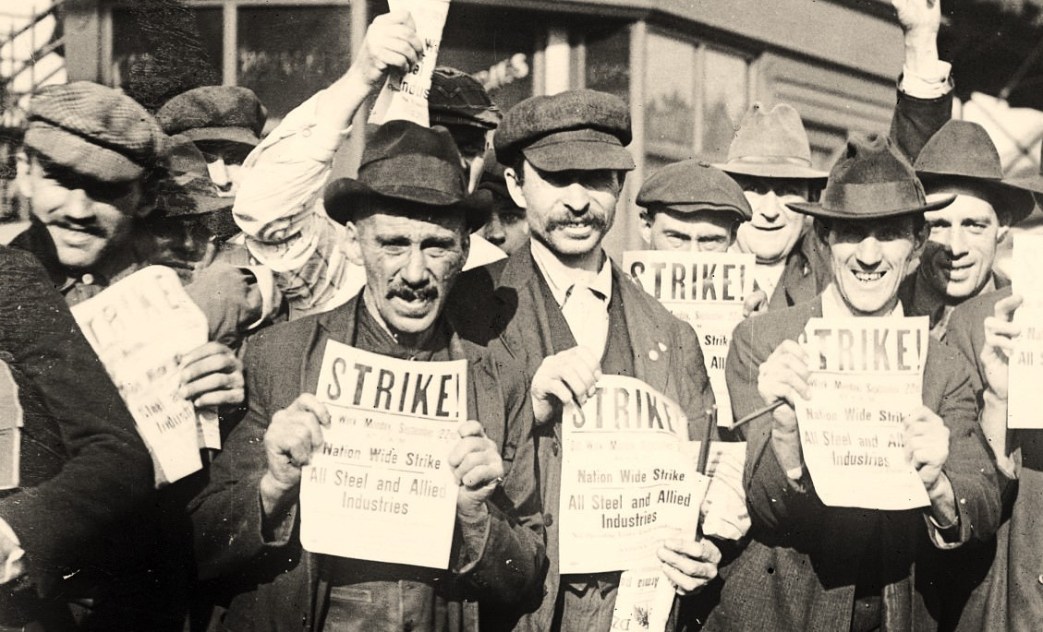
Emerging from the founding congress of the Red International of Labor Unions in 1921, which saw a sharp debate between I.W.W. supporters and militants active in A.F.L. unions, this is an important document for the history of the U.S. workers’ movement. These theses served as the original perspective and tasks document for the Trade Union Educational League, with an overview of U.S. labor history and an inventory of its current divisions, while not dismissive of the I.W.W., was adamant in its orientation to existing labor organizations.
‘Theses on the American Labor Movement and the Red International’ from The Toiler. No. 129. October 29, 1921.
Shortly after the Civil War of 1861-65, when the slave-owning, agricultural, ruling class was superseded in power by the industrial capitalist class in the United States, the labor union movement began its existence on a mass scale. movement in its infancy developed two types of unions, the craft union, each confined to a skilled trade, and the general union, admitting workers of all trades, both skilled and unskilled–the forerunner of the modern industrial union.
The first large, general union, the Knights of Labor, founded in 1869, grew harmoniously side by side with the craft unions until 1886. Then the efforts of the Knights of Labor to extend their organization in some of the skilled crafts resulted in the beginning of bitter competition with the craft unions. From that time until to-day the American Labor Movement has been divided into two hostile camps.
In 1886 the principal craft unions formed a close alliance in opposition to the Knights of Labor, under the name of the “American Federation of Labor.” This federation was a centralization of the former very loose federation formed in 1881 with a membership of about 300,000. Although the Knights of Labor was at that time more than twice as large as the American Federation of Labor, it rapidly declined and disappeared, leaving a small industrial union movement in its wake. The craft unions, then growing in size, became more and more conservative, while the industrial unions merged and founded the Industrial Workers of the World (I.W.W.), which has since been the predominant industrial union with declared revolutionary aims. The One Big Union and various other labor organizations of small membership with programs of revolutionary industrial unionism have sprung up during the life of the I.W.W. A fraction separating from the I.W.W., taking the name of the Workers’ International Industrial Union, has a program attempting to accomplish revolution through the ballot and otherwise in conformity with the capitalist system.
The natural increase in numbers of organized workers during the ripening of American capitalism has been absorbed, not by the revolutionary industrial unions, but by the reactionary American Federation of Labor and the railroad brotherhoods, the right wing of the American labor movement, which now include more than 85 per cent of the organized workers. The revolutionary industrial unions are small in membership, all of them together having in their ranks less than two per cent of the organized workers. In short, the masses of the organized workers are in the unions controlled by the reactionary bureaucracy.
The American Federation of Labor and the Railroad Brotherhoods are composed chiefly of a multitude of craft subdivisions declaring themselves to be devoted to narrow craft interests. With the spirit of “labor aristocracy,” some of the higher skilled trades put severe restrictions upon apprenticeship, demand very high initiation fees, and require American citizenship of foreign born workers. Some races are excluded from membership. Wage contracts are made to expire at different dates, so that if the workers go on strike at the expiration of contract, other workers of another plant or of another craft in the same industry are induced to continue working in observance of their own unexpired contract. The leaders make every effort to hold the workers back from the class struggle. Many union officials privately or even publicly engage in breaking strikes. It is the habit of the labor bureaucracy openly to guarantee the capitalist class and government complete security against any radical developments in the labor movement. During the World War and the subsequent industrial crisis, this went so far that the government used police and military power to compel the workers to obey what are called their lawful” union officials in the railroad and coal mining districts. At the same time, the leaders of the I.W.W. and thousands of its members were imprisoned, some of the leaders being condemned to prison terms as high as twenty years.
But the labor bureaucracy has not completely succeeded in emasculating the trade unions under its rule, especially not in the case of the large mass unions. The International Association of Machinists metal workers), 273,000 strong, more or less mildly advocates a change of leadership in the American Federation of Labor and a change to the industrial union form. At the close of the World War, large and spontaneous “outlaw” strikes of railroad workers and coal miners were directed against union officials as well as employers.
The physical nature of the coal mining industry has necessitated the mine workers’ organization taking the industrial union form, even under the worst type of reactionary bureaucracy. The United Mine Workers have engaged in strikes of terrific violence throughout their history. In West Virginia the mine workers of this union have since 1912 been engaged having had thousand of workers under arms at one time. Yet in intermittent warfare against their employers and the state, this union forms a solid block of half a million men–one-eighth part of the American Federation of Labor, and ten times the size of the largest of the revolutionary industrial unions outside of the American Federation of Labor. In several districts, it is, and has been for two years, in a state of rebellion against its corrupt leaders. In many instances the spontaneous rebellions against the union bureaucracy have collapsed through the inability to find capable new leaders and executives. In other instances able and honest leaders have developed out of the coal pits and have led a few sections of the United Mine workers into advanced positions.
The revolutionary labor unionists are not by any means all in the small revolutionary industrial unions. On the contrary, many thousands of revolutionary and semi-revolutionary workers have developed consciousness inside of the reactionary trade unions. Also a great many workers after getting a revolutionary training in the I.W.W. have drifted back into the trade unions and have obtained an influence over the backward membership. Since the foundation of the Communist parties, now united into one, the Communist Party of America, Communist nuclei have been in rapid process of formation and have already obtained strength in many unions, in some local unions even the power of control.
In notable instances, large or small sections of the conservative wing of the American labor movement have grown restless and have overridden the will of the bureaucrats. In 1914, the majority fraction of the United Garment Workers, in rebellion against the bureaucracy, was refused recognition by independent union, the Amalgamated Clothing Workers, with the American Federation, and thereupon founded the large, and is the largest of all the independent unions. a semi-revolutionary program. It now has 175,000 members. In several other cases, sections of unions have been expelled and have formed small unions with programs and ideology more or less like those of the I.W.W.
It is now an established custom of the Federation to expel from the general mass of organized workers any portion of it that becomes infected with revolutionary thought.
At the same time it has become the custom of revolutionary workers to accept their expulsion almost as a matter of course, found new unions with a revolutionary program, and to call or even voluntarily to secede from the reactionary unions, to upon their fellow workers of the industry to join them. This works in strange accord with the wish of the reactionaries to get the revolutionary workers out of the mass unions. Of course, the workers who join the new organizations are those inclined to radicalism. The masses are left behind more hopelessly than ever in the hands of the reactionary bureaucracy of the American Federation of Labor and the Railroad Brotherhoods, while the rebels find themselves in small unions with little economic power, segregated for easy capitalist suppression.
The policy of the Red International of Labor Unions is to keep the revolutionary workers inside the mass organizations of backward workers, such as are affiliated with the American Federation of Labor and the Railroad Brotherhoods. Dual unionism must be done away with. The R.I.L.U. adheres to the principle that wherever possible there should exist but one union in each field. Adherence to this policy means that attempts of the labor bureaucracy to expel revolutionary individuals or sections will be resisted with every possible means. The custom of revolutionaries seceding from the mass unions to form smaller unions on the ground of the reactionary character of the mass union, must be brought to an end. The policy of the R.I.L.U. is that of consolidation, not division. The slogan shall be “No splits in the labor movement!” The Executive Council of the Red International of Labor Unions advance the following application of its policy to the American labor movement:
American Office of Red International
The Executive Council of the Red International of Labor Unions will appoint and maintain in the United States of America a special representative who shall be a practical revolutionary unionist. This representative shall have the special task of directing the application to the labor union work of such methods as have in practice been shown to be effective in bringing trade unions into revolutionary structure and control, for example, organized minority committees, committees of action, shop stewards movements, educational leagues, publication of journals specializing in labor union questions, and publication of pamphlets, leaflets, etc. pertaining to labor union questions as such. The activities of the special representative shall be confined strictly to labor union work. He must understand that his work is not general Communist propaganda, but the special work of inaugurating and directing the developments of the American section of the Red International of Labor Unions. His activities must in no way conflict with or encroach upon the general work and propaganda of an existing revolutionary working class political party, but on the contrary, all of his activities must be in full co-operation with the work of any genuine revolutionary force and the directing body of that force.
Revolutionary Unions Must Aid
The Red International of Labor Unions will call most naturally upon the existing revolutionary industrial unions to co-operate in a concerted and thoroughly modernized plan to revolutionize the four or five million organized workers in the reactionary unions of the United States, to reach whom all methods heretofore used have failed. Workers of the revolutionary industrial unions are expected to respond immediately to the call to join in the work of (1) changing the structure of the reactionary mass unions into the industrial union form, and (2) ejecting from control of those unions the reactionary leaders. The R.I.L.U. constructed as it is out of the combined experience of the revolutionary unions of all countries, is the instrument for bringing the tactics of each country into adjustment with the scientific knowledge of revolution gained in the experience of all, especially with the knowledge gained in the after-war and revolutionary period. All affiliating revolutionary industrial unions will carefully re-examine and adjust their tactics to the scientific knowledge gained in the experience of the last three years, using for the purpose their connection with all other revolutionary unions of the world through the Red International of Labor Unions.
Abandon Dual Unionism
In industries dominated by the trade unions, and where the revolutionary industrial unions are either non-existent or a minor factor, the revolutionary industrial unionists shall be induced to abandon their dual unionism, and to concentrate their activities in the trade unions. Such industries are, principally: Coal mining, building trades, printing trades, metal trades, clothing trades, railroads, general transport, theatrical trades, meat slaughtering industry, and electrical supply trades. In all these industries the trades unions are strong, containing in each instance the overwhelming majority of the workers that are organized. The revolutionary industrial unions either have no organization there at all, or are negligible in strength and influence. Nor is there a prospect of the situation being changed by the tactics heretofore used. For the revolutionary industrial unions to continue their program of maintaining a dual organization in these industries, and to insist upon the support of all revolutionists on that basis, would be to block the performance of real work. The revolutionary industrial unions must be induced definitely to stop maintaining, or attempting to form, arbitrary dual unions in such industries. What few members they now have in such industries shall enter the old unions and organize themselves therein as minority groups. The direction and control of the revolutionary trade union work in these branches of industry shall devolve upon the Red International of Labor Unions.
Support the Strongest Unions
In certain industries the trade unions are weak and the revolutionary industrial unions have developed some degree of constructive organization. These industries are principally metal mining, textile, lumber, boot and shoe manufacturing, baking and candy making, automobile manufacturing, hotels and restaurants, and agriculture. Where one of the revolutionary industrial unions has attained in such an industry a membership superior to, or approximately equal to, the membership of the reactionary trade unions the Red International of Labor Unions will vigorously support such revolutionary industrial union with a view to its absorbing the entire industry. Where several revolutionary industrial unions have a foothold, the aggregate of their membership being greater than, or approximately equal to, that of the reactionary trade unions, the policy will be as follows: the representative of the R.I.L.U. will call conferences of the revolutionary industrial unions fractions involved, so that a united course of action may be decided upon. Failing agreement, the R.I.L.U. will support the union showing the greatest hold upon the industry.
Organize Sympathizing Groups
The representative of the R.I.L.U. under instructions given him by the Executive of the R.I.L.U. will formulate programs for individuals and fractions that may be expelled from unions by the reactionary bureaucracy finding solutions wherever possible entirely free from the old mistake of dual unionism.
Within all trade and industrial unions the American representative of the R.I.L.U. will widely organize and promote and extensively cultivate the revolutionary groups, and will help to crystallize around such groups larger blocks of sympathetic workers growing in understanding. The American representative will supply the revolutionary groups with literature, information, instruction as to methods, and also with the means of communication between the unions, so as to co-ordinate the entire left-wing of the American labor movement on a national scale without removing it from the old mass trade unions.
Support Industrial Amalgamation
The trade union minorities working under the direction of the R.I.L.U. will vigorously support all of the present tendencies toward breaking down of craft aloofness and getting closer to the industrial form. The movement of the International Association of Machinists for introducing industrial union forms into the American Federation of Labor, as well as the movement for closer federation and subsequent amalgamation of the various crafts of the railroad brotherhoods, will be supported without giving support to the reactionary leaders who have been drawn into a half-hearted identification with these movements. The object shall be, not to destroy the craft unions, but to accelerate in a vigorous manner the natural process of federation and amalgamation by which they evolve to a practical industrial union form.
Don’t Smash or Split the Unions
The work of the revolutionary groups within the trade unions shall not be directed to smashing these unions, nor of splitting them, but of keeping the mass as nearly as possible intact as to membership, while throwing off from each union its bureaucratic superstructure. The subject matter of the agitation of the revolutionary groups in the reactionary unions shall be the questions of every-day struggle, with revolutionary principles applied to their solution in a practical manner–never in an impractical or abstract manner. The revolutionists must be more practical than their opponents, more efficient and hardworking in handling the daily routine of the union. At the same time they must work as rapidly as possible to bring their union into line with the more advanced unions for the proletarian revolution.
Resist Expulsion; Stand for Unity
The revolutionists must continue their revolutionary propaganda at any cost. But wherever humanly possible they must avoid paying the cost of being expelled as individuals or groups from the unions. They must remember that their doing any propaganda at all is dependent upon their remaining in contact with the masses in the unions. In cases of expulsion of fragments from unions, these fragments must be led to refuse to recognize their expulsion, and to make a continuous fight as part of the union, or contend for their claim to be themselves the original union. In cases of expulsion of entire unions from the American Federation of Labor, such expulsion will be resisted as long as possible, for the purpose of exposing the motives of the bureaucracy. The same rule shall apply to the railroad brotherhoods and the independent unions generally.
The Toiler was a significant regional, later national, newspaper of the early Communist movement published weekly between 1919 and 1921. It grew out of the Socialist Party’s ‘The Ohio Socialist’, leading paper of the Party’s left wing and northern Ohio’s militant IWW base and became the national voice of the forces that would become The Communist Labor Party. The Toiler was first published in Cleveland, Ohio, its volume number continuing on from The Ohio Socialist, in the fall of 1919 as the paper of the Communist Labor Party of Ohio. The Toiler moved to New York City in early 1920 and with its union focus served as the labor paper of the CLP and the legal Workers Party of America. Editors included Elmer Allison and James P Cannon. The original English language and/or US publication of key texts of the international revolutionary movement are prominent features of the Toiler. In January 1922, The Toiler merged with The Workers Council to form The Worker, becoming the Communist Party’s main paper continuing as The Daily Worker in January, 1924.
PDF of full issue: https://www.marxists.org/history/usa/pubs/thetoiler/n194-oct-29-1921-Toil-nyplmf.pdf
 Revolution's Newsstand