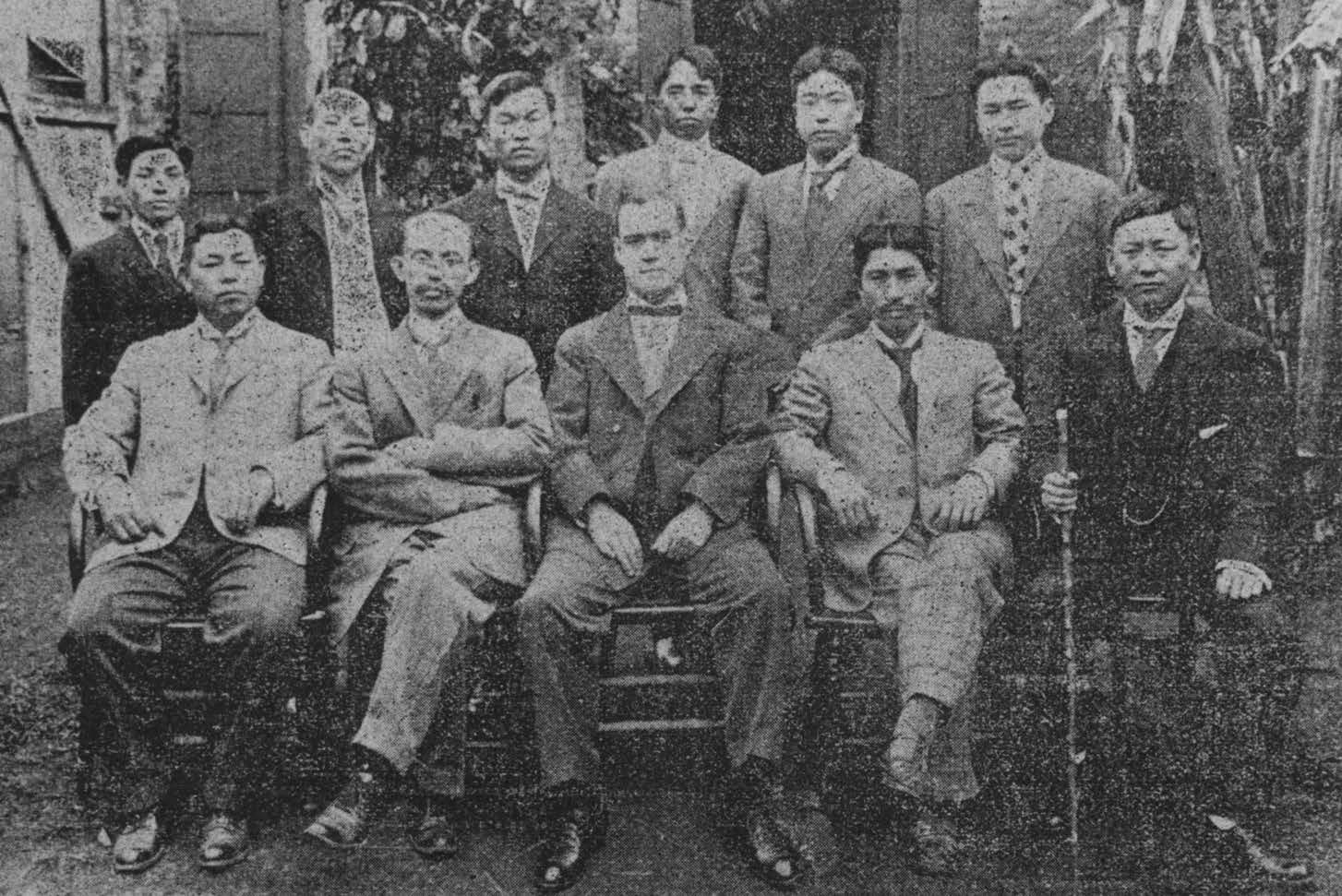
Yasutaro Soga, Kinzaburo Makino, Motoyuki Negoro, Yokiichi Tasaka; back, Yasuyuki
Imai, Tsurumatsu Okumura, Katsuichi Kawamoto, Hidekichi Takemura, Keitaro Kawamura,
Shuichi Ihara. 1909.
The 1909 strike of Japanese sugar plantation workers in Hawaii made a profound impression on the I.W.W. in this U.S.
‘Example of Japanese Workers’ from Industrial Union Bulletin. Vol. 1 No. 24. August 26, 1909.
The best credentials for an agitator for revolutionary union of the workers are the opinions of the enemy. The study of human nature is one of the branches of learning, to which the employers of all lands pay great attention. They have found, by long and luxurious experience, that it is better to know than to work, However much we may regret the slow minds of some of the working people, and however deeply we may deplore the ease with which many of our fellow workers are deceived by the skillful tricks of the masters and their agents, the employing class’ estimate of men who are active in the labor movement is generally correct. Whatever scheme a “labor leader” may advocate: his real intentions and the result of his teachings do not escape the keen eye of the vultures of modern industrial struggles. The universal persecution of the revolutionary workers is one of the strongest proofs that the wage system is in general, everywhere the same. The class struggle is world-wide; and like an enormous battlefield, all countries of the earth are experiencing the ever-growing power of the employing class, and a feeling that organization of the workers must be on a line with organization of the employers, in order that the workers may win the world for themselves alone. ·
Recent events in Hawaii are instructive. The Japanese workers in the sugar plantations, and the agricultural laborers generally, in the islands have formed a union called the “Higher Wage Association.” They have been conducting a strike, many features of which show the discipline and fighting spirit of our Japanese fellow workers.
The patriotism of the employers did not prevent them hiring thousands of “foreigners,” who have made profits of millions of dollars for the sugar kings. Gold, at least, knows no flag. The attempt has been made, though with little success so far, to spread the idea that the strike of the Japanese in Hawaii was a move on the part of the Japanese government to get national control of the islands. The fact that the officials of the Japanese government have vied with the American employers in persecuting the strikers goes to show that the struggle is on class lines between the workers and the employers without regard to nation or race.
On August 18, four of the Japanese who were active in the strike, were convicted by a jury as being guilty of “conspiracy.” The jury did not waste any time in debate, for they were out only six hours. Makino, the president of the union, Soga, the editor of the labor paper “Juji,” and the two associate editors, Negroro and Tashaka, were all convicted of criminal conspiracy to “Incite riot, violence and injury to the property of the plantations affected by the strike.” The newspaper office was raided on June 14, and the whole proceedings are typical of American liberty, and show that the American colonies partake of the blessings of Christian civilization. Freedom of the press and freedom of speech are smothered under the ample folds of “Old Glory.” But aside from the actions of the enemy which are typical and usual, the stimulating feature of the strike has been the solidarity of the Japanese workers. That the Japanese workers, as a rule, are intelligent and class conscious in a high degree, cannot be denied. It has often been said in the United States, and especially in the West, that the solidarity of the Japanese workers was not of real working class spirit, but that the Japanese unite, “merely as against the American workers.” The persecutions and insults heaped upon our Japanese fellow workers by other workers who are ignorant of their real Interest, has indeed been deplorable. The American Federation of Labor, true to its sacred principles of dividing the working people either on craft lines or those of race and religion, has been unable to demonstrate that the Japanese are even as prone to the vice of scabbery as the white workers. The sudden and complete strike of the Japanese workers in many places in America–notably in California–has been an example worthy of imitation by the “57 varieties” of craft scabbery. The Japanese readily learn the difference between the I.W.W. and the A.F. of L., and more and more of them are joining the only labor union worthy of the name. The Japanese are not members of the scab “international” union of lumber workers, for instance, which latter aggregation is even now scabbing on the I.W.W. at various places where strikes have been declared and enforced by the Industrial Workers of the World. The average Japanese simply will not scab. He knows too much, and is too much of a man. He leaves deliberate “organized” scabbery to such lights of American unionism as Fairgrieve, Hughes & Co.
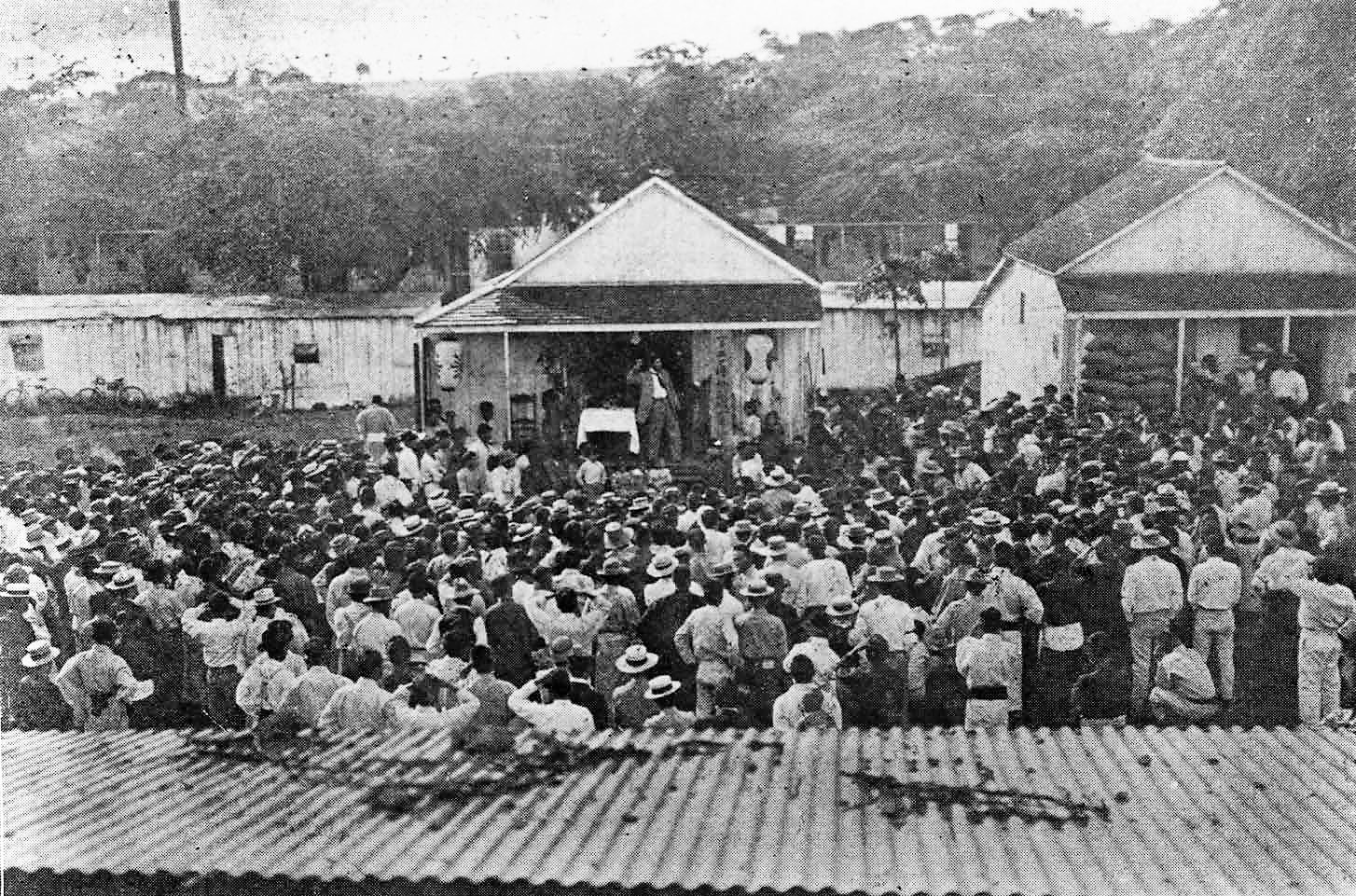
‘Aiea, O‘ahu, Hawai‘i. 1909.
The personal cleanliness, of the Japanese workers is one of the highest and surest marks of their inborn intelligence and their natural refinement of disposition. Compare the bunk house of a gang of “stiffs” on the average railroad with that of the next Japanese extra gang. The difference can easily be detected a half mile off—especially of the wind is in the right direction. Comparisons are offensive, and we are not praising the Japanese workers to flatter them, but merely stating a few facts to counteract, if possible, the effect of some of the lies told about them by the common enemy of all working people the employing class.
The arrest and conviction of the agitators in Hawaii shows, like the recent events in Sweden and in Spain, that the spirit of social unrest is rising with every turn of the earth, and knowing that the class war cannot be ended in one place or country alone, and that the class struggle is irrepressible. It is encouraging to learn of the stand of the Japanese workers in Hawaii and though the foremost fighters may suffer imprisonment, such persecution will only be one more shake to rouse the sleeping giant of Labor.
The Industrial Union Bulletin, and the Industrial Worker were newspapers published by the Industrial Workers of the World (IWW) from 1907 until 1913. First printed in Joliet, Illinois, IUB incorporated The Voice of Labor, the newspaper of the American Labor Union which had joined the IWW, and another IWW affiliate, International Metal Worker.The Trautmann-DeLeon faction issued its weekly from March 1907. Soon after, De Leon would be expelled and Trautmann would continue IUB until March 1909. It was edited by A. S. Edwards. 1909, production moved to Spokane, Washington and became The Industrial Worker, “the voice of revolutionary industrial unionism.”
PDF of full issue: https://www.marxists.org/history/usa/pubs/industrialworker/iw/v1n24-aug-26-1909-IW.pdf
 Revolution's Newsstand