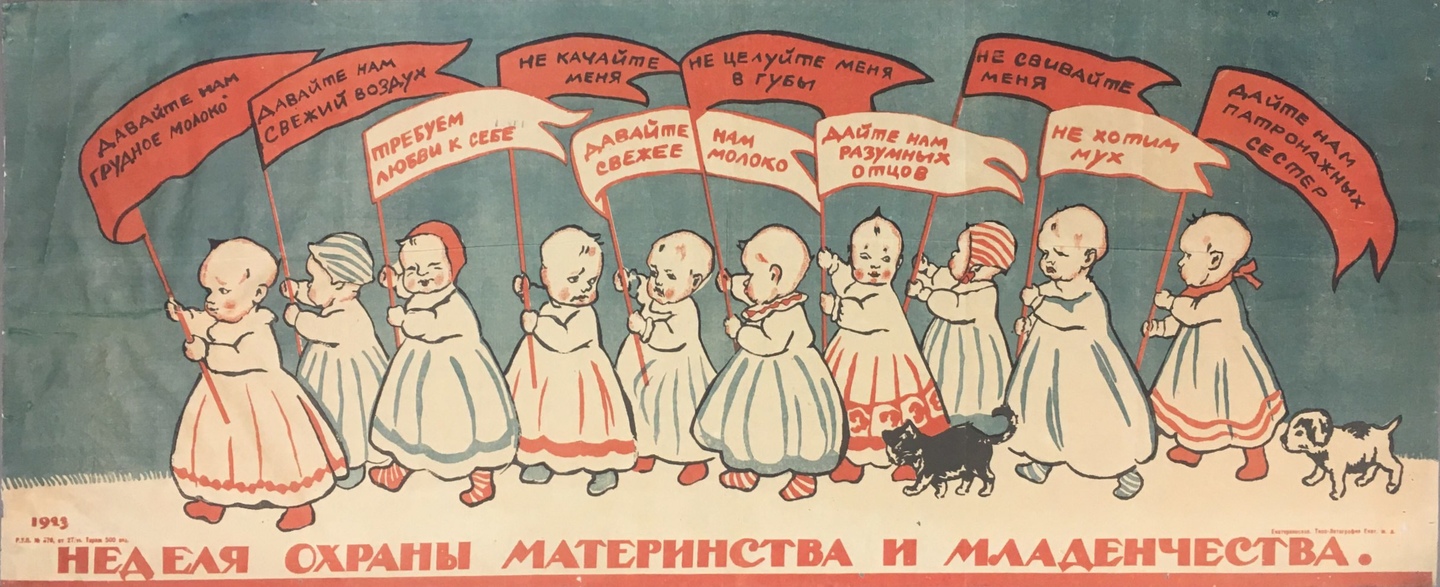
A thorough report from an American Friends Service Committee relief worker on early efforts to improve the care of children after the Revolution.
‘The Care of Children in Soviet Russia’ by Arthur J. Watts from Soviet Russia (New York). Vol. 4 Nos. 10 & 11. March 5 & 12, 1921.
(The following survey of the work of the Russian Socialist Federal Soviet Republic in the care of children is published by permission of the American Friends Service Committee. Mr. Waits forwarded this report from Moscow, where he has been for several months distributing relief supplies for the English and American Friends. Information regarding the relief work of the Friends in Soviet Russia may be obtained from the American Friends Service Committee, 20 South Twelfth Street, Philadelphia, Pa.)
THIS report does not pretend to be a complete account of all that is being done by the Socialist State for the care and education of children. It is simply a general outline drawn from personal observation during a period of four months’ work in connection with the distribution of children’s clothing and food donated by the Friends Emergency and War Victims Relief Committee (England). There may be gaps, as I can only write of what I have observed or learned in the course of my work.
The People’s Commissariat for Social Maintenance.
This Commissariat is responsible for the maintenance of the children of soldiers and sailors and of the disabled (by work or war). This is done by pensions to their mothers or in cooperation with other Commissariats.
The Peoples Commissariat for Supplies.
This Commissariat is responsible for the feeding and clothing of every child. This Commissariat supplies food and clothes to all the institutions of other Commissariats. It has special children’s kitchens of its own and supplies food to children on the family ration cards.
Departments and institutions obtain their supplies of food and clothing from the Commissariat for Supplies and are not allowed to purchase their own. By this means competition in buying between departments is avoided.
Departments and institutions may receive gifts. These donated supplies often reach large amounts, as, for example, when the Red Armies captured large stores of condensed milk from Kolchak and in Archangel they gave them to the Commissariat for Health for use in children’s houses and hospitals. The Navy recently sent several car-loads from Odessa to the Commissariat for Public Instruction. Institutions may also receive supplies from abroad and have received gifts from time to time from the Danish Red Cross, the Norwegian Famine Committee, and the English Society of Friends.
In addition some departments and institutions have established farms and workshops of their own to augment the supplies received from the People’s Commissariat for Supplies.
Department for Protection of Motherhood and Infants.
This is a department of the Commissariat for Public Health and is responsible for the health of mothers and infants to the age of three years.
Maternity Exhibitions.
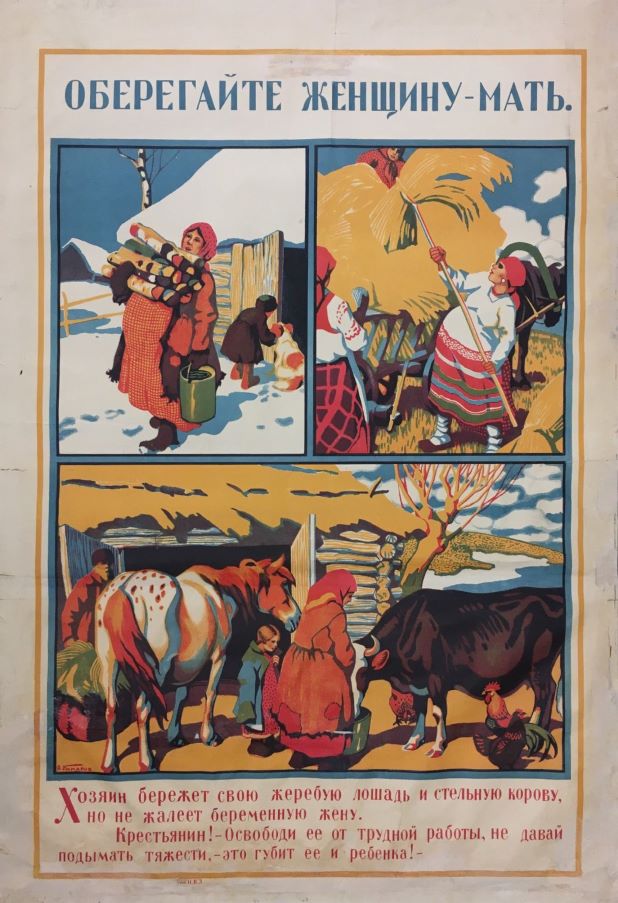
Very excellent exhibitions on motherhood and the care of infants have been arranged by this department in Moscow and Petrograd and smaller ones in the provinces. These exhibitions are divided into two sections, viz., pre-birth and after-birth. By means of charts, pictures, diagrams and models which the simplest peasant woman can understand, valuable instruction is given on all points connected with the care of the mother and child. Pictures illustrating the results of hereditary disease and of the need of greater care before birth form a prominent part of these exhibitions. Models showing the amount and strength of milk to be given at various ages and very descriptive pictures and diagrams indicate the advantages which a breast child has over one fed artificially. The proper clothing of infants is also very well illustrated by a series of models and I am told that this has had a very beneficial effect in causing mothers to abandon the Russian practice of wrapping their babies so tight that they could scarcely move.
Rest Homes for Mothers.
Every mother who performs manual work is entitled to eight weeks rest on pay before the birth of her child and a similar period following. In the case of sedentary workers the period of rest is for six weeks before and after the birth of the child. Special rest homes have therefore been established for expectant mothers, and for mothers with their children, where extra food is given and every care is taken of the mothers and infants.
Maternity Hospitals.
Unfortunately, owing to the lack of suitable buildings and equipment, there are not sufficient Maternity Hospitals in Moscow, and mothers have to leave them from six to nine days after the birth of their child; but a new combined Rest Home and Hospital is now being prepared which will enable mothers to remain for a longer period in the same home.

Special assistance is also given to mothers who remain at their own homes, and they are entitled to draw extra rations either from the ordinary kitchens or from the special kitchens attached to some of the Consultation Depots.
There is now a proposal under consideration for considerably extending the period of rest, for increasing the mothers’ food ration still more, and allowing her fuel for an extra room in her own home with a view to encouraging her to have a room for herself and child separate from the rest of the family,
Consultation Depots.
Before the revolution there was one Consultation Depot in Petrograd and another in Moscow; these have now been increased to 25 and 17 respectively.
Mothers attend these depots for advice every 14 days unless there is some special reason for more frequent visits. In all these depots there are pictures, models and charts similar to the most important ones in the Maternity Exhibitions.
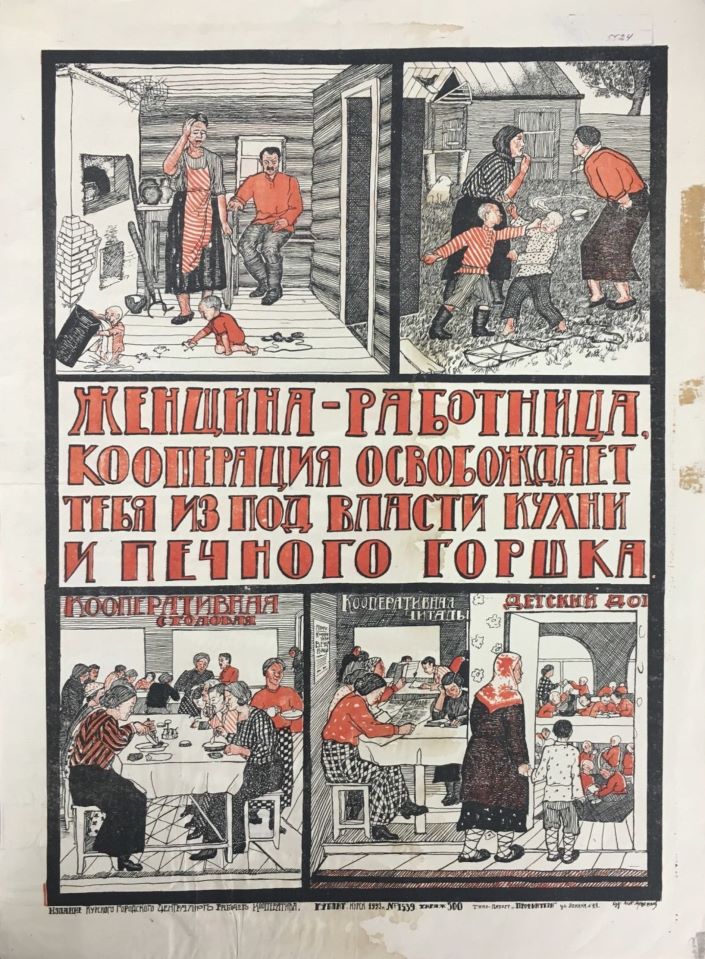
Attached to many of the Consultation Depots are milk distributing depots and in some instances kitchens, where special warm meals are served to mothers,
Every mother attending a consultation receives clothes for her child and such other material help as may be required, such as feeding bottles, nipples, etc. At some of these depots lectures are given to mothers and special training courses are arranged for nurses.
Milk Depots.
Special Milk Depots have been established or extended for the supply of milk to infants, who receive prescriptions from doctors at Consultation Depots where no milk distribution is made. Here the milk is sterilized, diluted or merely added, according to prescription, and put up in bottles with a slip attached indicating the number of feeds in each bottle.
Infants’ Homes.
These are divided into two classes, one for infants up to the age of one year and the other for infants between the ages of one and three. There are also special wards attached to some of the Mothers’ Rest Homes where motherless babies are cared for up to the age of two months. The infants are very well cared for in these homes. The standard (or model) homes are well-equipped and have very efficient staffs. These standard homes are also used as training centers for girls who are preparing to become nurses in similar homes or in day nurseries and creches,
Careful records are kept of the weight and development of each child together with the amount and kind of food it receives. A new home is now being opened for 15 infants who will be cared for according to a scheme drawn up by a Russian doctor as the result of a study of the books of leading American and European experts.
Creches and Day Nurseries.
There has been a very large development of these since the revolution and many factories employing women have their own creches. The demand at the moment is greater than can be met, with the pen personnel and equipment. The Maternity Department takes the view that to open a poor creche is worse than to have no creche at all.
The People’s Commissariat for Public Instruction. The responsibility for the care and education of normal healthy children after they attain the age of three rests with the Commissariat for Public Instruction, though education is not compulsory before the age of eight.
Children’s Gardens.
There has been a great development of children’s gardens since the revolution and there are now over a quarter of a million children registered in these gardens all over Russia. A children’s garden is a delightful picture on a warm summer day with little boys and girls at play dressed in single tunics of varied colors, as full of life as one could wish. In winter, when the little ones have to be kept indoors because there are not sufficient boots or clothes, the picture is not so gay.
The children spend the whole day here returning at night to their homes, Dinner and supper are provided for all the children in these gardens, but unfortunately the food shortage does not allow the full norm to be supplied.
Children’s Houses (or Communes).
These are similar to boarding schools in England, though a greater number of scholars spend their whole days in these houses than is the case in England. This is due to several reasons. First, children go at a much younger age and then, as there are no orphanages as distinct from commune houses, there are a large number of boarders who have no homes to go to in vacation.

Usually speaking there are separate houses for children between the ages of three and eight. From 8 to 17 the commune house is also a school, or the children attend a school in the locality.
The principle of coeducation exists throughout and the children are taught on the principle of learning some handicraft at the same time as they learn from books and lectures. The children have their own committees for arranging entertainments amongst themselves. Here, of course, the children receive all their meals and here again the food shortage is manifest particularly in the scarcity of fats. Clothes and boots are also lacking for the winter months.
Children’s Colonies.
Children’s colonies are of two kinds: children’s houses where children live all the year round, and summer colonies in the country for the children of the town to live in during the warm months. The largest settlement of children is at Dyetskoye Selo (Children’s Village) about 40 miles from Petrograd. This used to be the “Tsar’s Village” (Tsarskoye Selo), where the late Tsar had two palaces. The houses of many of the courtiers have now been turned into children’s colonies, a group of three or four houses forming a colony. There are usually 25 boys and girls in each house, with a manager in charge. One house in each group is used as a center for meals and household administration. The colonies are all run on coeducational lines, grouped according to pre-school age (three to eight) and school age (8 to 16).
The communal spirit is very great in these colonies, both among the children and between the staffs and the children.
The children perform a large part of the household duties and in the colonies for older children have their own committees for electing orderlies and so forth. As far as one can judge from visiting about a dozen of these colonies the results of coeducation are good, boys and girls seem to be growing up in a natural and healthy companionship with a very great sense of equality and communal responsibility.
In Moscow the colonies are more scattered than is the case at “Dyetskoye Selo”, where there are over 2,000 children in 32 colonies, with a special colony run on George Junior Republic lines for defective boys and girls, a sanatorium and a children’s hospital. The Children’s Village was occupied by Yudenich at the time of his attempt on Petrograd and several of the houses were destroyed, but now the colonies have resumed their normal life again. As is the case in Children’s Houses, the parents are allowed to visit their children very frequently. Day Schools.
First and second grade schools are run on the coeducational principle for children between the ages of 8 and 16. Manual training both for boys and girls fills a very important place in their program and many schools have very excellent carpentry, bookbinding, and engineering shops and needlework and other handicraft workrooms. There are also special schools for art and music, some of which are children’s houses (boarding schools).
The teachers are greatly handicapped by the shortage of books and writing materials and as a consequence most of the exercises and tests have to be done orally.
Discipline is maintained without punishment in the ordinary sense of the word, but natural consequences follow from a breach of rules, e.g., a child does not receive any dinner till its hands are clean but it is not punished otherwise. For anti-social acts a child may be isolated for a period. Corporal punishment is quite forbidden.
Every scholar and student is entitled to an extra food ration and the education authorities endeavor to give every scholar a warm luncheon consisting of
Bread…100g, Meal…20g, Fats…13g, Sugars…17g, Meat or Fish…27g, 4/5 of an egg.
Unfortunately the food supplies are not sufficient to allow of this ration being supplied at all adequately.
Trade Schools.
There are special Trade Schools for boys and girls, apart from the Technical Schools and Universities for older students.
Children’s Theaters.
There are special theatrical performances and concerts arranged for school children, in many of which the children take part. The theme of orchestral music is explained before the performance and everything possible is done to develop their appreciation of the artistic.

Special performances are also arranged in Moscow for the children who are found loitering in streets and markets, but it is hoped that before long all these children will be in the schools, as is the case in Petrograd.
The Health of School Children.
The People’s Commissariat for Public Health is responsible for the medical and dental inspection of various school children and has its doctors and dentists attached to the various children’s colonies and schools.
This Commissariat is also responsible for the physical culture of the children and cooperates with the Commissariat for Public Instruction in the organization of games and gymnastics and has established one or two special schools for physical culture in which boys and girls live and are specially trained to develop their athletic ability or to correct some physical defect.
Homes and Schools for Tubercular Children.
The Commissariats for Health and Public Instruction cooperate in the maintenance of special homes and schools for children suffering from tuberculosis, but who are able to receive lessons. These homes are all on the outskirts of the town or in the country. Fresh air treatment and sun baths are very thoroughly applied. The children are as brown as berries all over and in warm weather lie in the sun for six hours every day. Lessons are given out of doors and by graduated treatment the children become hardened to the cold.
The cases of bone tuberculosis look very healthy apart from the affected limb and many very remarkable cures have been effected. Very great care is taken of these little ones and special food is allotted to them, but unfortunately there is not enough to meet the need, and dried vegetables for the winter are also lacking.
Forest Schools.
Here again the two Commissariats unite in the establishment of forest schools where children recovering from fever and sickness are sent to recuperate, or children threatened with consumption are given a chance of regaining their strength.
Open sir lessons, meals, and sleeping are the rule, with the sun bath and bathing pool, all in the middle of a huge wood.
The open air life develops a love of nature and the children have collected and arranged excellent Natural History Exhibitions. The school I visited had once been inhabited by two wealthy ladies with 60 servants, and now about 50 children enjoy a three months’ period of recuperation here under ideal conditions.
As is the case in summer colonies and many other institutions, they wear a single garment during the summer days, with a loose overall to slip on in the cool of the evening.
Schools for Deaf and Dumb.
There has been some development of these schools since the Revolution, and the two Commissariats cooperate in the management of such institutions. Those which were at one time limited to wealthy children are now open to all.
Schools for the Blind.
Petrograd is rather ahead of Moscow in this respect. Moscow has a very large institution for blind children, which was established many years ago, and though it is doing good work, it is old-fashioned both in its method and atmosphere. There is not the same spirit of comradeship between teachers and children as one finds in all the new institutions.
I understand, however, that all the blind are being registered with a view to something more being done.
The Children’s Commission.
According to a decree, no child is to be tried by the ordinary tribunals, but is to be brought under the consideration of the Children’s Commission. In Petrograd this decree seems to be efficiently complied with. In the provinces, however, and to some extent in Moscow, children are still tried and condemned by the tribunals, owing to the lack of sufficient people with the proper qualification to serve on Children’s Commissions. In most cases, however, children are removed from the prisons by the action of the Children’s Commissioners, though some delay often occurs.
The Children’s Commission is also interested in the welfare of mentally defective children in all degrees of deficiency.
In Petrograd there is a very efficient reception home for children arrested for crime or sent by school teachers as being incorrigible or unable to benefit by ordinary school training. These children are not regarded as criminals but are well cared for, and during their stay of 28 days they are made as comfortable as possible. The staff consists of doctors, psychologists and teachers who carefully observe the children and decide what kind of treatment will best meet the individual case.
Some cases can of course be diagnosed at once, but all children remain 28 days in order to make sure that they are free from infectious diseases before being sent on to a home or colony.
In Moscow a similar reception house has just been established, but is inefficient through lack of a qualified staff and material equipment.
The Mentally Defective.
On Kamenney Ostrov (“Stony Island”) in Petrograd there is a special home for mentally defective children. Here Professor Griboyedov with a staff of five doctors and eight teachers carefully examines the children, and either keeps them in his colony or sends them to some other home. There is a very excellent laboratory and library of books dealing with the subject, on which he seems to be an expert. The same friendly spirit exists between staff and children as in other colonies and the children seem to enjoy life there very much. There is no hesitation about being examined; in fact the children are eager to be allowed to visit the laboratory.
Careful records are kept by the teachers and doctors alike, and when a child is discharged or sent to some other colony for mental cases, instructions are given as to the kind of training or treatment that is required.
Cases of paralysis are also treated by a system of electric therapeutics, though they are badly handicapped through lack of equipment. Six hundred children have passed through this home and 80 doctors and 220 teachers have received training there since it was established about two years ago.
Schools for Neurasthenics.
Special schools are arranged by the People’s Commissariats for Education and Health for nervous and neurasthenic children, where special treatment is given and lessons arranged in accordance with the child’s temperament. A very large extension of a Children’s House of this type is now being arranged in Moscow.
Auxiliary Schools.
Special schools are arranged for children who at the age of twelve are behind in their schooling, but are capable of learning if given more individual help. They attend these classes in addition to their ordinary school course.
Schools for Backward Children.
For children who are unable to respond to the ordinary school training special schools have been arranged. These come under the care of the Health and Public Instruction authorities jointly.
There are 10 such schools in Petrograd and several in Moscow.
Special Trade Schools.
Special Trade Schools have been arranged for boys and girls who do not respond to ordinary mental training but are capable of developing some skill in manual occupations.
Care of Epileptics and Lunatics.
Special colonies are maintained by the Commissariats for Health and Public Instruction, for the care and training of epileptic, idiotic, and lunatic children. These are mostly in the country under the charge of competent doctors and much valuable research is being carried on with a view to improving the treatment of such cases. As a general rule children up to the age of 12 are in separate homes from the others.
Moral Defectives.
I have already mentioned in the paragraph on the Children’s Commissions that children who are arrested for crime are carefully observed for a period before being sent to institutions.
Where the crime is found to be the result of a mental defect the child is treated accordingly without any distinction being made between it and any other child in the same institution.
Where the crime is due to evil surroundings the child is sent to an ordinary home or colony, but where some definite moral defect or social backwardness is manifested the child is sent to a home for Moral Defectives.
There is such a home in a house which used to belong to the tailor of the late Tsar. Here, under ideal surroundings, Professor Belski has charge of 34 boys and girls. He has on his staff a doctor and teachers as well as manual instructors. The principle on which they work is that the aim to be accomplished is to educate the socially backward in social responsibility and to re-direct misdirected energies into right forms of expression. Their method is to give a general education with special emphasis on manual work for those whose energies are misdirected, and special attention is given to the development of collective responsibility. Discipline is maintained without punishment, but a system of natural consequence (no food till hands are clean, etc.), and isolation for anti-social acts. The period for which a child is detained is not determined by the nature of the crime it has committed, but by the way in which it responds to the training.
Parents are allowed to visit their children and after three months children may go home for occasional week-ends. Such week-end visits to their homes form a valuable test and the child is observed on return to see if there is any tendency to relapse into former habits after contact with its old associations.
On discharge every endeavor is made to get the children sent to the country away from the temptations of town life.
There are also several colonies for morally defective boys and girls, run on the lines of the George Junior Republic.
From a visit paid to several of these institutions in Petrograd it is my impression that the results are good, and out of the cases which have gone through such homes and colonies during the past two years only four per cent have returned for a second offense.
In Moscow, unfortunately, there has not been so great an improvement as in Petrograd, nevertheless what was once a children’s prison with cells and iron bars has now been turned into a reformatory school. The iron bars and military guards have been done away with, but unfortunately some of the old instructors and staff do not seem to be inspired with any great enthusiasm for adopting new ideas. Another institution has been transformed into a “Children’s Home” for moral defectives (boys only), but they do not seem to have reached the efficiency of the Petrograd colonies and the spirit of the place is too institutional and not homelike enough. There are also a number of boys between the ages of 14 and 18 in one of the Moscow prisons. Several were condemned by the tribunals to death or life imprisonment for murder and robbery with violence, but the Children’s Commission has obtained commutations for them and it is hoped that before long they will be able to establish colonies and homes to which they can be transferred.
The Care of the Sick.
The People’s Commissariat for Public Health has established special dispensaries, hospitals, and sanatoria for sick children. These are in addition to the schools and colonies which it manages in cooperation with the Commissariat for Public Instruction for weak children who are able to study.
Unfortunately the supply of medicines and appliances handicaps a great deal of this work.
The Feeding of Children.
The People’s Commissariat for Supplies is responsible for the feeding of the whole population. This Commissariat supplies food to schools, colonies, and children’s homes. It has also established special children’s kitchens of its own where children receive one warm meal per day.
Children are also fed in the ordinary communal kitchens or their parents can obtain food for them by means of ration cards.
Special Kitchens for Undernourished Children.
The Commissariat for Supplies and the Commissariat for Health have both established special kitchens where weak and undernourished children receive an extra ration. There are already four such kitchens in Moscow and two more are being prepared.
Mr. Watts’ Comments.
The foregoing is an attempt to give a general impression of what is actually being done for the care of children in Soviet Russia.
In the carrying out of the full program there are many difficulties and some failures. Many of the institutions are quite new types to Russia and there is not a sufficiency of trained personnel. Some homes are unsatisfactory because of inefficient staff, lack of suitable accommodation or equipment, and a few have had to be closed down. Every month, however, sees a distinct move forward towards the realization of the full program. Workers are being trained by special courses and the inefficient are learning by experience. Homes are being remodeled and renovated ready for new homes or colonies. Generally speaking the organization in Petrograd is superior to Moscow and the personnel better trained. Petrograd is also more fortunate in having a large number of buildings suitable for homes, etc.
The People’s Commissariat for Public Instruction and the People’s Commissariat for Protection of Health are uniting for a “Children’s Week” which it is hoped will result in a greater development of child welfare work.
Schools, like all other institutions, have suffered through lack of proper personnel. Many of the old teachers are incapable of teaching according to the new methods, and the new teachers have only had a very short training; but 1921 will see the introduction into the schools of the first batch of teachers who have received a full course of training under the new regime.
I have often heard the criticism that there are a few very good institutions of each type for show purposes, but that the majority are really very poor. This is a half truth. It is the aim of the authorities in each department to maintain Standard Institutions of each type which shall be as perfect as possible. In these Standard Institutions doctors, nurses, and teachers are trained with a view to their being sent to other institutions or to open new ones. The advantage of having Standard Institutions as training centers is obvious. They also form a standard which other institutions are urged to emulate.
Another common criticism is that the Russian Government is interfering with home life by putting children into institutions. So far I have not come across any instance of compulsion being used to put children into institutions other than in cases of crime. It is true, however, that the greater certainty of the children’s receiving food and clothing in Soviet institutions results in a desire on the part of some parents to place their children in commune houses or colonies. A great amount of freedom is allowed to parents to visit their children and the atmosphere of the homes and colonies is not at all institutional, but very homelike.
Homes and colonies run by private organizations such as “The League to Save the Children,” “Society of True Freedom”, (“Tolstoyans”), or Trade Unions, receive from the Soviet authorities the same ration of supplies as are given to Soviet institutions.
No religion is taught in the schools or colonies except that the significance of certain religious holidays is explained. (Parents may visit their children on Sundays and give them instruction in religion if they so desire. Children and teachers are allowed to hang ikons on their beds but no ikons are set up by the authorities.
Coeducation has been much criticized, but I am convinced that as a general rule the results are undoubtedly good. I have been much impressed by the natural comradeship which exists between boys and girls. In a few cases where coeducation has been suddenly adopted with older boys and girls unsatisfactory results may have occurred, but on the whole the change seems to be good and especially so as coeducation commences at the age of three and continues as the natural consequence throughout school life.
There is a great shortage of food and clothing, particularly in the provinces where the opening of schools, colonies, homes, and food kitchens is held up simply through lack of supplies.
It is my impression that in general the machinery for child-welfare already exists and that if Russia only had the supplies her children would be thoroughly well cared for and that in a very short time her institutions would be examples for the rest of the world to follow.
Soviet Russia began in the summer of 1919, published by the Bureau of Information of Soviet Russia and replaced The Weekly Bulletin of the Bureau of Information of Soviet Russia. In lieu of an Embassy the Russian Soviet Government Bureau was the official voice of the Soviets in the US. Soviet Russia was published as the official organ of the RSGB until February 1922 when Soviet Russia became to the official organ of The Friends of Soviet Russia, becoming Soviet Russia Pictorial in 1923. There is no better US-published source for information on the Soviet state at this time, and includes official statements, articles by prominent Bolsheviks, data on the Soviet economy, weekly reports on the wars for survival the Soviets were engaged in, as well as efforts to in the US to lift the blockade and begin trade with the emerging Soviet Union.
PDF of full issue: (large file): https://archive.org/download/SovietRussiaVol4And5/21-SovietRussia_text.pdf
 Revolution's Newsstand