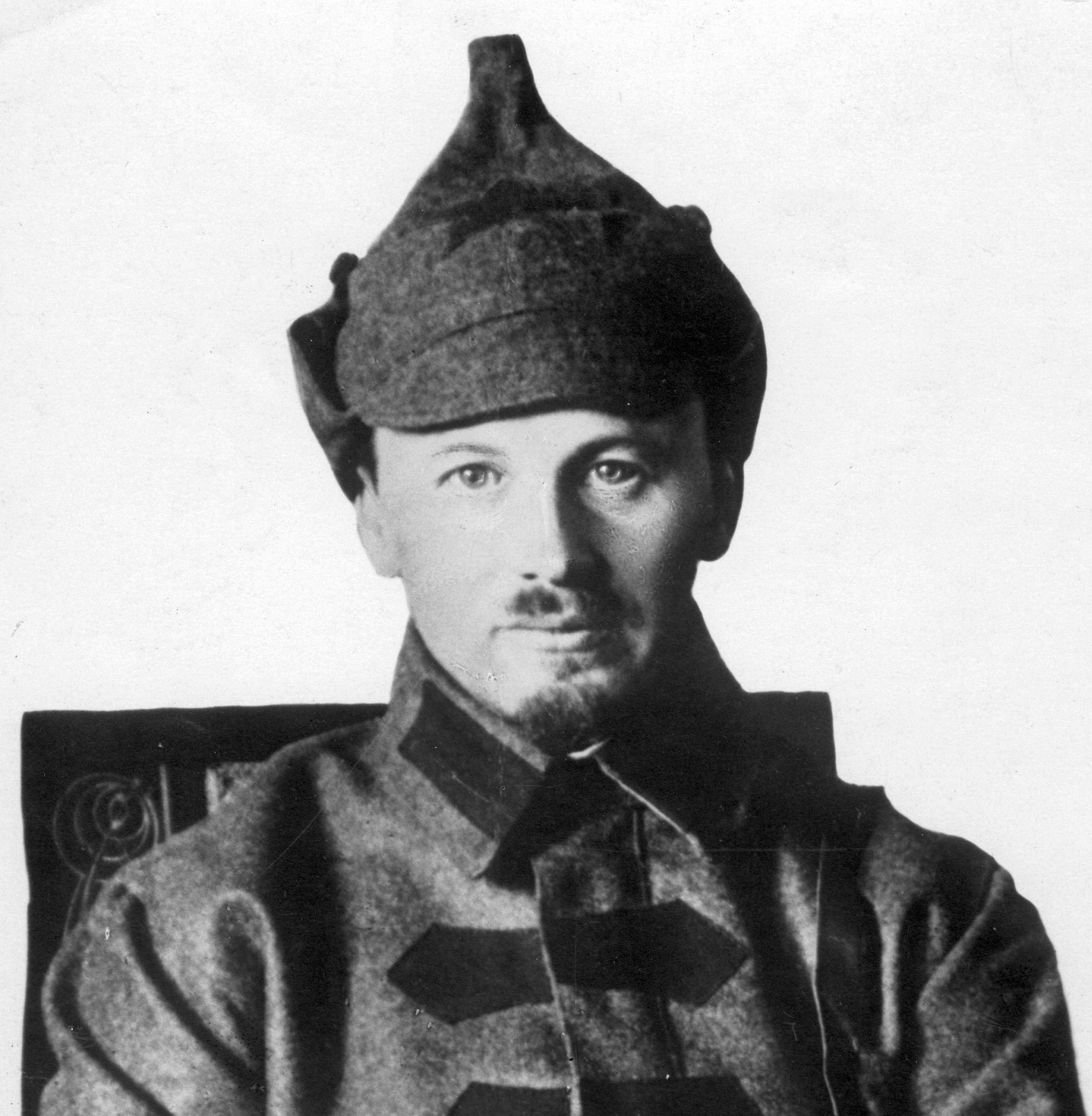
Less than a year after the defeat and expulsion of the United Opposition in November 1927, the alliance between Stalin and Bukharin broke down. In late 1928 Bukharin spoke against the collectivization plans and pace of industrialization that Stalin’s wing had proposed. Losing the debate in the Party over the winter, Bukharin–long-time editor of Pravda–was relieved of his senior posts in April, 1929. That August Bukharin, who had taken over the Chair of the Comintern from Zinoviev, was removed from by the E.C.C.I. of his leading positions, with many of his international supporters expelled, ending the role of one the most prominent leaders of the Communist movement in its first decade. Below is the editorial from Pravda giving the official reasons for the break. Bukharin would be at the center of the Trial of the 21 during the Purges and executed on March 15, 1938.
‘Fight Against the Right Danger: On the Deviations and Mistakes of Comrade Bukharin’ from The Daily Worker. Vol. 6 No. 169. September 21, 1929.
(From the “Pravda” of August 24, 1929.)
The decisions of the E.C.C.I. and of the C.C. of the C.P. of Germany published in the last number of “Pravda,” the opportunist mistakes of Comrade Bukharin, who up to the April Plenum of the C.C. of the C.P.S.U. was the responsible editor of “Pravda” and one of the leaders of the Comintern, deserve the most serious attention.
The role which Comrade Bukharin has played in the leading work of our Party and of the whole Comintern is sufficiently known. This fact alone compels us to deal in detail with the grave opportunist mistakes which Comrade Bukharin has committed in the course of the last period, in order to make this perfectly clear to the broad masses of the Communist Party of the Soviet Union as well as of the whole Comintern.
Already before the last July Plenum of the C.C. Comrade Bukharin perceptibly deviated from the line of the Fifteenth Party Congress. This was the case in fundamental questions of Party policy, such as the relation of the working class to the peasantry, as well as the tempo and the direction of work in the socialist reconstruction of agriculture. Already at that time we had to face the organized sabotage of the kulak portion of the village in the carrying out of the grain procuring, together with vacillations of various middle peasant sections towards the kulak. Whilst our Party made certain concessions to the middle peasantry (increase of grain prices) it considered it necessary, unswervingly to continue the measures for the reconstruction of the village in the sense of the decisions of the Fifteenth Party Congress (collective undertakings and Soviet farms), on the basis of a determined attack upon the kulak and of the alliance of the poor and middle peasants with the Party. Comrade Bukharin at that time was inclined to renounce the offensive against the kulak, to relegate into the background the measures for the socialist reconstruction of the village, to reduce the state regulation of trade and to grant the kulak a whole number of fundamental concessions in the direction of a development of capitalist relations in the village.
The Party, on the other hand, sought a way out of the grain difficulties by means of cooperation and collectivization of agriculture (with a simultaneous consolidation of the alliance with the middle peasants).
Comrade Bukharin sought this way out by means of a consolidation of the capitalist upper strata of the village, by means of promoting the production of their undertakings for the market. As a result, for more than a year there existed profound fundamental differences of opinion between the line of our Party and Comrade Bukharin’s line. And if these differences of opinion did not come to light already at that time, it was only due to the fact that Comrade Bukharin at that time did not venture to defend consistently and determinedly his mistakes which led to the break with the line of the Party.
At the Sixth Congress of the Comintern also, Comrade Bukharin made a number of erroneous statements both in his report and in his concluding speech of the first item of the agenda of the Congress (“The International Situation and the Tasks of the Comintern”). When Comrade Bukharin spoke of post-war capitalism entering the third period of the technical reconstruction of capitalism, as the period of the strengthening of the inner organization of capitalism, and in fact as a consolidation of capitalist stabilization. This standpoint was expressed by a whole number of delegates at the Congress (Ewert, Lovestone, Pepper), from which Comrade Bukharin did not consider it necessary to dissociate himself. Further, in analyzing the contradictions of capitalist stabliziation Comrade Bukharin stated that the outer contradictions of the capitalist countries are beginning to play the decisive role and not the inner contradictions between capital and proletariat (within the individual countries and on an international scale). Only one conclusion can be drawn from this: A revolutionary situation is only brought about by war and not by an accentuation of the class struggle within the capitalist system along with the growth of the war danger. Such an inference lulled to sleep the revolutionary activity of the Communist Parties and provided the occasion for a demagogic agitation of social democracy, which declared that the Comintern, which desires to win the broad masses of the working class, is taking everything upon the card of war.
At the Sixth Congress of the Comintern it was clearly seen that Comrade Bukharin did not wish to conduct any fight against those comrades (especially of the German Party) who adopted a conciliatory attitude towards the Rights. On the other hand, Comrade Bukharin did not show at the Sixth Congress sufficient determination and consistency in defending to the last his erroneous statements and tendencies. The resolutions of the Sixth Congress (among them being the resolution on the report of Comrade Bukharin on the international situation and the tasks of the Comintern), after they had been discussed in the Plenum and in the commissions of the Congress and also by the individual delegations, gave a decidedly Bolshevist answer to all the fundamental questions of the international Communist movement.
But when it was a question of converting these resolutions into action, when immediately after the Congress the Right and conciliatory elements in the C.P. of Germany organized a genuine revolt against the C.C. and against the line of the Sixth Congress, we did not see Comrade Bukharin in the first ranks of the fighters for this line. Comrade Bukharin preferred to stand diplomatically aside, without uttering or writing a single word in defense of the line of the Sixth World Congress which everybody expected of him in view of his position in the Comintern. Nay more. Comrade Bukharin did not by a single word protest against the speculation with his name; that the German conciliators claimed to have his solidarity, those conciliators who had formed a regular bloc with the Rights against the C.C. of the German C.P. and even against the Comintern. Not a single participant in the German inner-Party struggles could doubt after this that Comrade Bukharin is really at one with the German conciliators who are fighting against the line of the Comintern.
Comrade Bukharin found time and opportunity in the Autumn of 1928 to come forward openly against the general line of the C.P.S.U. in his article: “Remarks of an Economist,” which has acquired unenviable fame. Comrade Bukharin’s attacks were chiefly directed against the tempo of our industrialization, as provided for in the Five-Year Plan according to the decisions of the Fifteenth Party Congress. Comrade Bukharin’s criticism, which is formally directed against the specialists of the State Planned Economic Commission, is in fact directed against the C.C. of our Party. Through the whole article there runs like a red thread the tendency of slowing down the tempo of our industrialization, of adaption to the “weak points.” The very ambiguous remarks in this article by Comrade Bukharin regarding the degradation of agriculture caused the reader to assume that in our country there is really taking place a degradation of agriculture as a result of the erroneous policy of the Party, as the bourgeois professors have been maintaining for a long time. Here again Comrade Bukharin had not sufficient consistency to defend to the very end the standpoint which he had laid down in his article “Remarks of an Economist.”
Not quite a year has passed since the publication of this article. The tempo which at that time was provided for our industry by the State Planned Economic Commission has been far surpassed by the Five-Year Plan which has been adopted by the Sixteenth Party Conference and the Fifth Soviet Congress. A number of concrete corrections are already being made in this Five-Year Plan in the direction of a further increase of the tempo. Life has shattered the sinister pre- dictions of the author of “Remarks of an Economist,” which remarks were prompted by the disbelief in the forces of the working class and the overestimation of the difficulties of socialist construction, and nothing has remained of the whole capitulation theory of this article.
Although the Party has from the beginning decidedly and unanimously rejected such an attitude, although Comrade Bukharin was not yet determined in Autumn, 1928, to defend this view to the last consequences and it seemed that he would overcome his vacillations, Comrade Bukharin has nevertheless not abandoned his struggle against the general line of the Party.
At the beginning of 1929, on the anniversary of Lenin’s death, Comrade Bukharin published in the “Pravda” an article in which he, in a disguised form, resumed his attack on the Central Committee. The article was full of sallies against our leadership, which, allegedly, did not come up to the requirements of the latest science and technique. The reasons for these shortcomings Comrade Bukharin could only see in the “incorrect” policy; in the refusal to slow down the pace of industrialization–contrary to all the scientific interpretations of Comrade Bukharin–that we were not inclined to make concessions to the kulak; that we were not inclined to stake our card on the capitalist development of the village. Bourgeois “culture,” science, in the person of Kondratjevs and his like, long ago pointed out to our country and to the Soviet Power this means of overcoming the difficulties.
Comrade Bukharin adopted a still more direct and clear position in his speech at the Moscow Plenum of the Party and Soviet organizations under the heading: “The Political Legacy of Lenin.” His political line (which is now sufficiently clear) of capitulation and concessions to the kulak elements of the country, Comrade Bukharin recommended to the Party as “Lenin’s legacy.” When on this occasion some comrades referred to Eduard Bernstein, who subjected Marx to a revision under the flag of Marxism, this was not at all a polemical exaggeration. Comrade Bukharin has deserved this comparison. How could one react differently to the attempt of cloaking opportunism and capitulatory tendencies with the banner of Lenin! If one were to judge according to Comrade Bukharin’s report, then it would appear that Lenin never taught anything else but “caution” towards the peasantry; that he never mentioned anything of the kulak in his last article (why, therefore, does the Party again and again undertake its attacks on the kulak); that Lenin considered the building up of Communism in the village (Soviet farms and collective undertakings) as an untimely idea and was in favor of carrying out industrialization by means of thriftiness and the simplification of the state apparatus, but by no means by an “overburdening” of the peasantry.
Thus Comrade Bukharin gradually developed a whole system of opportunist views and a whole tactical line fundamentally different from that of the Party. In international questions Comrade Bukharin actually defends the thesis of the increasing strength of capitalist stabilization. There inevitably follows from it the rejection of the whole conception of the Sixth Congress regarding the new revolutionary upsurge; there follows the glossing over of the growing contradictions between the working class and capitalism; there follows the support (for the time being only diplomatically) of the Right and conciliatory tendencies in the Comintern.
With regard to the inner-Russian questions: the slowing down of the pace of industrialization, using as a pretext the weak spots; abandonment of the line of the Fifteenth Party Congress, of the policy of the broad and intensive socialist reconstruction of agriculture; the idea of raising the level of the whole village (on the basis of the individual peasant undertakings) that is to say, the unchaining of the capitalist elements in the village; the theory of peaceful co-existence with the kulak; the peaceful growing of the kulak into socialism; the abandonment of the consistent and determined struggle against bureaucratism in the state apparatus by means of self-criticism, which in practice would mean a conciliatory attitude towards the distortion of the class line in the work of this apparatus and open conciliatory tendencies towards that portion of the bourgeois specialists in the town who are not prepared to settle down to the idea of the Soviet Power. All this together represents capitulation in face of the capitalist elements on all fronts of our socialist construction.
The Right opposition which has arisen in our Party thus found in Comrade Bukharin its theoretician and leader. This opposition has become the center and point of attraction for all Right, conciliatory elements who have separated from Communism or are about to separate from it in the international Communist movement.
After the April Plenum and the Sixteenth Party Conference, which criticized in detail the views of Comrade Bukharin and of his followers in all the fundamental questions of Party policy one could expect that the representatives of the Right Opposition in our Party, although they may perhaps not openly recognize their mistakes, would at least refrain from a further struggle against the Party line, which has been splendidly confirmed by all the experiences of our socialist construction in the course of the last months since the conference. But this was not the case.
This was not the case, before all with regard to Comrade Bukharin. Comrade Bukharin published before the Tenth Plenum of the E.C.C.I. an article on “Organized Mismanagement” in which he repeated, developed and deepened his mistakes which were ascertained at the Sixth Plenum and which already at that time brought him very near to the Rights and conciliators. Comrade Bukharin now speaks still more openly than at the Sixth Congress of the growth of the capitalist elements, of the organized state of the capitalist system, of overcoming the anarchist tendency in production and trade, of the mitigation of the inner contradictions. Comrade Bukharin has thereby made a decided step from the Marxist-Leninist estimation of the system of monopolist capitalism to the views of the social democratic decadents of Marxism from the Hilferding school. Needless to say this step encountered unanimous and determined resistance on the part of the representatives of all the sections at the Tenth Plenum. And precisely as an answer to this conception the Tenth Plenum has relieved Comrade Bukharin of his function as member of the Presidium of the E.C.C.I. and adopted that recently published political resolution on the mistakes of Comrade Bukharin.
The Party is fully conscious of the great merits of Comrade Bukharin who for many years has fought in our ranks side by side with Lenin. The Party highly appreciates the great work which Comrade Bukharin performed in the last years in the leadership of our Party, already after Lenin’s death, in the struggle against Trotskyism. But it is impossible for the Party to consider Comrade Bukharin as the infallible guardian of “Lenin’s legacy.” The Party has not forgotten the great mistakes which Comrade Bukharin committed in the past, his long struggle against Lenin. Comrade Bukharin still conducted this struggle in the years of the imperialist world war, when he vacillated between the semi-anarchist views on the state and the program of the Party on the one hand, and the conciliatory tendencies towards the open centrist elements of the kind of Trotsky and their opportunist conceptions.
For a number of years, during and after the war, Comrade Bukharin defended anti-Leninist Luxemburg opinions regarding the national question, which is of enormous importance in the epoch of imperialism. In the year 1918 Comrade Bukharin stood at the head of the fraction of the Left Communists, who almost brought about a split, and who whilst they themselves were sitting up to their ears in the petty bourgeois bog, accused the Party and Lenin of degeneration. In the year 1919, at the Eighth Party Congress, Comrade Bukharin was the first to criticize the Leninist draft of the Party Program. In the year 1920 he wrote the brochure, “The Economy of the Transition Period,” which called forth a number of very energetic criticisms from Lenin (this brochure contained various germs of Bukharin’s present ideas regarding “organized capitalism.”) In the year 1921 Comrade Bukharin entered the ranks of the Trotskyist Opposition to the Leninist C.C. and made a number of quite impermissible concessions to the semi-anarchist-syndicalist ideology of the labor opposition. Finally, at the time of the Third Congress of the Comintern, also in the year 1921, Comrade Bukharin fought against Lenin in the fundamental questions of the tactics of the Comintern.
After Lenin’s withdrawal from work, Comrade Bukharin came forward, after the Twelfth Party Congress, in defense of the deviation of the Georgian comrades, who later went over to Trotsky, and in their overwhelming majority have been expelled from the Party together with the whole Trotskyist Opposition. In the year 1925, at the beginning of the struggle against the so-called new Opposition, Comrade Bukharin, who joined the Party in this struggle, committed a number of great opportunist mistakes (the slogan “Enrich yourselves”; the declaration regarding the kulak cooperatives, which, allegedly, along with the concession undertakings, are growing into our socialist system; the observations that it is possible for us to advance to socialism at a “snail’s pace”) although at that time he admitted some of these mistakes.
However great the services of Comrade Bukharin in the past may be he has not therefore the right to come before the Party in the role of the infallible and only authentic interpreter of Lenin’s legacy and as the only guardian of this legacy.
That Comrade Bukharin has become, in the twelfth year of the Soviet Power, the leader of the Right Opposition in our Party; that his present mistakes surpass all the limits of his former mistakes, proves the extent of the danger which threatens our Party from the Right deviation, without the exposure and overcoming of which the successful socialist construction in our country and the further consolidation of the Party is unthinkable. The experience with the former oppositions shows us where the struggle against the Party leads. This experience must serve as a serious warning for Comrade Bukharin.
Whatever position Comrade Bukharin may adopt at present–whether he will have sufficient courage to admit his mistakes, or whether he will develop and deepen them further–our Party possesses sufficient proletarian firmness and determination in order to continue the struggle against the Right deviation, which is disintegrating its ranks and to conduct this struggle to the final victory.
The Daily Worker began in 1924 and was published in New York City by the Communist Party US and its predecessor organizations. Among the most long-lasting and important left publications in US history, it had a circulation of 35,000 at its peak. The Daily Worker came from The Ohio Socialist, published by the Left Wing-dominated Socialist Party of Ohio in Cleveland from 1917 to November 1919, when it became became The Toiler, paper of the Communist Labor Party. In December 1921 the above-ground Workers Party of America merged the Toiler with the paper Workers Council to found The Worker, which became The Daily Worker beginning January 13, 1924. National and City (New York and environs) editions exist.
PDF of full issue: https://www.marxists.org/history/usa/pubs/dailyworker/1929/1929-ny/v06-n169-NY-sep-21-1929-DW-LOC.pdf
 Revolution's Newsstand