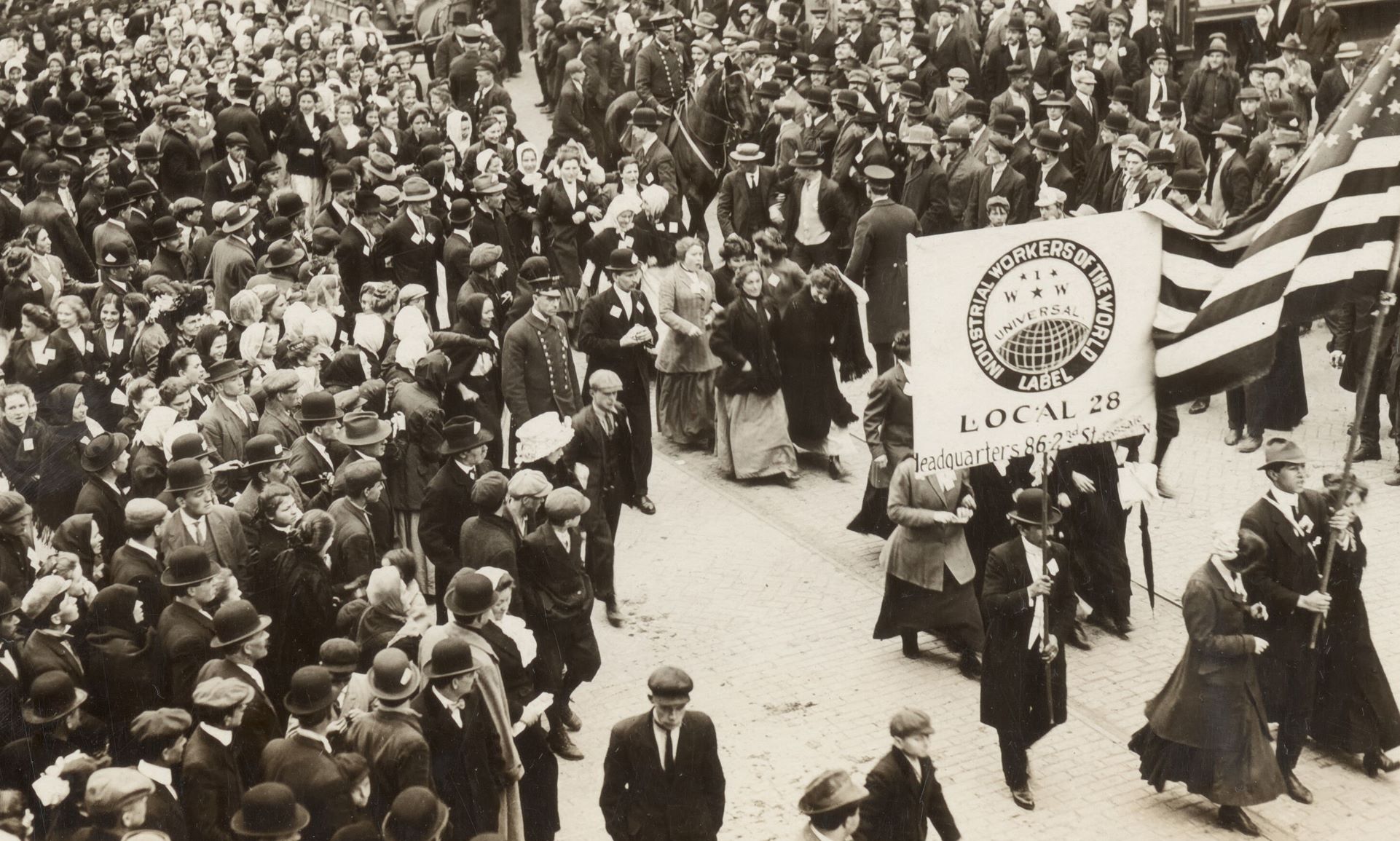
Phillips Russel on writes on how the emergence of industrial unionism was transforming the strike and its methods.
‘Strike Tactics’ by Phillips Russel from New Review. 1 No. 13. March 29, 1913.
There are more ways of killing a cat than choking it with butter; and there are more ways of conducting a strike than by merely stationing a few pickets here and there, and then drawing up a set of demands to be forwarded to the employers.
Changing conditions demand changing methods. New developments demand new tactics, and the successful strike organizer of to-day must not only be a man of action but also a thinker. He must use his head as well as his hands. He must be not only an inspirer but also a strategist.
In the old days—and they are not so far back, at that–the strike organizer was usually an official of a union. His scheme was to negotiate first and fight afterward. The old unionism held that a strike was a deplorable thing for all concerned and to be avoided as far as possible. When a group of workers had been driven by oppression into a state of desperation that could no longer be ignored, it was customary for the old style union to send an official to the scene of trouble. His usual procedure was to ascertain the grievances and then tell the workers to be patient while he “took the matter up” with the boss. His plan was to approach the employer in a friendly spirit, as if apologizing for the annoyance, and enter into a “conference” over a good cigar. These conferences might last days or even weeks, after which it would be announced either that “an adjustment” had been arrived at or that a strike could no longer be avoided.
If a strike was necessary, the old-style organizer pulled out as many of a certain trade or craft as he could, threw out a few stationary pickets, then bombarded the boss with settlement committees to obtain the best terms possible. If the employer remained obstinate, the strike became a sort of passive siege, strike benefits were ordered paid, and the workers stayed in their homes or hung about the street corners, till after a period of weeks or months, the strike was declared either lost or won.
But these methods are now becoming old-fashioned and futile. A new and revolutionary unionism has arisen which has introduced us to tactics and fighting methods that doubtless seem outlandish, bizarre, and undignifiedly spectacular to the old-line unionist, but which are undoubtedly effective, according to circumstances. Due credit for showing us many new ideas in the way of strike tactics must be given to that young and vigorous organization, the Industrial Workers of the World. Whatever may be said of the I.W.W., there is no denying the fact that it is infusing a new spirit into the labor movement of America.
A few months ago there was a strike of construction workers against contractors who were building track for the Canadian Pacific Railway in the Northwest. It was ferocious from the first and no quarter was given on either side. Before long the strikers discovered that one of their biggest enemies was the saloon. Too many men were finding it more comfortable to loaf around the warm stove in the backroom than to freeze out on the picket line. Besides, it was found that the saloons were being used as stalking-traps by the detectives and hired thugs of the bosses, and strikers were being repeatedly drawn into useless brawls in which it was easy to blackjack or shoot men who were otherwise active workers in the strike. It was suspected, too, that the saloon-keepers were standing in with the contractors and furnishing them valuable information. So a boycott was ordered against the saloons and all strikers were instructed to stay away from them. But these instructions were not obeyed by a number of strikers whose spirit was willing enough but whose flesh was weak. These men were appealed to, but in vain. The strike committee was equal to the emergency. It adopted drastic measures. Its next step was to picket the saloons as well as the contractors camps. The next striker who was seen approaching a saloon was warned to stay out and all strikers who were seen sneaking out by the backway were reported to the committee and disciplined. A striker could drink out of a private bottle, if he wished. but he must not enter a saloon. There were some who protested against this summary action, of course, but the committee was backed up by the sentiment of the strikers as a whole, and when it became evident that the tone an! temper of the men were improving because of the absence of liquor and saloon fights, the kickers soon subsided.
The Lawrence strike showed us many new methods. The mass or moving-chain style of picketing adopted there has since been used in the garment workers’ strike in New York. The situation of the mills in Lawrence made this method peculiarly effective Some of the largest of them lie in a long line, only one block from the principal business thoroughfare, and though the militia barred the strikers from the street that ran beside the mills, it could not prevent them from using Essex Street as much as they pleased, as long as they kept moving.
In Little Falls the moving chain of pickets, forming a continuous circle, presented a novel and beautiful picture. Most of the strikers were women and girls. They were fond of bright colors, especially red sweaters, and the sight of this brightly colored line circling round and round the mills invariably aroused the wonder and admiration of train passengers, the railway station being close by one of the principal mills.
Later, however, the police succeeded in breaking up and pre- venting the formation of this picket line by brute force, so new tactics were made necessary. It was found that a large part of the strike-breaking force was coming from Utica over the interurban car line, and since the strikers could no longer picket the terminal in Little Falls, they went to Utica and picketed the terminal there and succeeded in persuading many prospective strike-breakers not to board the cars at all.
In great mass strikes the participants sometimes become restless in their enforced idleness, and “grouchiness” and depression are apt to result. The only way to prevent this is to give each striker something to do–to make each individual feel that it is upon his participation that the success of the strike depends. That is why mass picketing, mass parades and mass demonstrations are so essential. The strikers draw courage from one another, feel their common interests, and realize the necessity of solidarity.
At Little Falls the strike lasted twelve weeks and at one time all forms of activity were suppressed. No picketing, no parading, no open-air meetings were allowed and it was dangerous for even a small group of strikers to gather at any one spot on the streets. Nothing was left them save their nightly hall meetings.
They soon tired of continuous oratory, consequently it became necessary to vary the program. And every night for three months there was practically a continuous vaudeville. Speeches were kept as brief as possible and every visitor who appeared was invited to make a few remarks. Those who couldn’t speak were made to sing. Every striker who was jailed was put on the stage after his release and made to relate his experiences. These were almost always given with a comic touch that never failed to make the audience roar with laughter. As fast as possible speakers were developed from the ranks of the strikers themselves, men and women alike, and several of them became effective orators. One evening the “home talent” varied all the way from little John Kokis, six years old, who told about his wonderful trip to Schenectady in a charming treble, to old Jan Barchefsky, sixty-six years old and former Prussian soldier, who spoke his opinion of the police in no uncertain terms. In this way the spirits of the strikers were kept from flagging and many of them remarked that they had a better time during the strike than ever before while at work.
Just after the later Lawrence strike that was called as a protest against the imprisonment of Ettor and Giovannitti, the merchants and business men whose establishments lined Essex Street organized the parade to demonstrate against the I.W.W. These gentry afterward had reason to regret their rashness, for the word went out that no mill worker was to buy any more goods on Essex Street, but to do his trading elsewhere. Several merchants afterward announced in effect, that they would “be good” hereafter if only that boycott were called off.
Organized publicity can be made a tremendous factor in a strike. The list of labor and Socialist papers in the United States and Canada now runs into the thousands and most of them will gladly print strike news if properly prepared. Capitalist newspapers will also print helpful news sometimes. In former times reporters, from whatever paper, were usually treated with rank discourtesy by labor leaders and sometimes were refused any information whatsoever. This is a great mistake. Reporters are very human and are likely to give just what they receive. Some of them will prove to be traitors and spies, but the majority are perfectly willing to be fair in their stories if received courteously and given the proper information.
In cases where the capitalist press is grossly unfair there are other ways of disseminating information. At Little Falls the one newspaper was a sheet of slime and finally it refused altogether to print news from the strikers. In consequence they printed their own bulletins in newspaper form, and when the police arrested the newsboys and confiscated the copies they were selling on the streets, a directory was secured and a copy was mailed to every person in town. One bulletin mailed to prominent citizens contained “Christmas greetings” and expressed regret that the strikers were unable to join in the cheer that the more prosperous residents of the town would enjoy, and then the reasons why were enumerated. It may have been only a coincidence, but a day or two after the mailing of this bulletin a committee of prominent citizens was formed for the purpose of forcing the mill barons to settle.
Whatever the difficulty, love for the cause will find a way if brains are set to thinking. If forced to retreat from one point, the army of labor can generally find another through which to break. In the past, strikes have always been regarded as if they were unusual occurrences that were not likely to happen again, and proper provision was never made for handling them or putting them on an organized basis. But the labor general of to-day is learning that the way to win battles is to be prepared for them. He must have his lieutenants and aids ready and waiting, and as soon as he arrives on the field he must organize his councils of war, his sappers and miners, his sharpshooters and scouts, his captains of commissariat and war chest. If the cost of living continues to rise at the present rate, there will be more strikes in the next ten years than ever before in the history of this country, and they will be on a larger scale. The class war is on and it must be fought on the principles of regular warfare.
The New Review: A Critical Survey of International Socialism was a New York-based, explicitly Marxist, sometimes weekly/sometimes monthly theoretical journal begun in 1913 and was an important vehicle for left discussion in the period before World War One. Bases in New York it declared in its aim the first issue: “The intellectual achievements of Marx and his successors have become the guiding star of the awakened, self-conscious proletariat on the toilsome road that leads to its emancipation. And it will be one of the principal tasks of The NEW REVIEW to make known these achievements,to the Socialists of America, so that we may attain to that fundamental unity of thought without which unity of action is impossible.” In the world of the East Coast Socialist Party, it included Max Eastman, Floyd Dell, Herman Simpson, Louis Boudin, William English Walling, Moses Oppenheimer, Robert Rives La Monte, Walter Lippmann, William Bohn, Frank Bohn, John Spargo, Austin Lewis, WEB DuBois, Arturo Giovannitti, Harry W. Laidler, Austin Lewis, and Isaac Hourwich as editors. Louis Fraina played an increasing role from 1914 and lead the journal in a leftward direction as New Review addressed many of the leading international questions facing Marxists. International writers in New Review included Rosa Luxemburg, James Connolly, Karl Kautsky, Anton Pannekoek, Lajpat Rai, Alexandra Kollontai, Tom Quelch, S.J. Rutgers, Edward Bernstein, and H.M. Hyndman, The journal folded in June, 1916 for financial reasons. Its issues are a formidable and invaluable archive of Marxist and Socialist discussion of the time.
PDF of full issue: https://www.marxists.org/history/usa/pubs/newreview/1913/v1n13-mar-29-1913.pdf
 Revolution's Newsstand